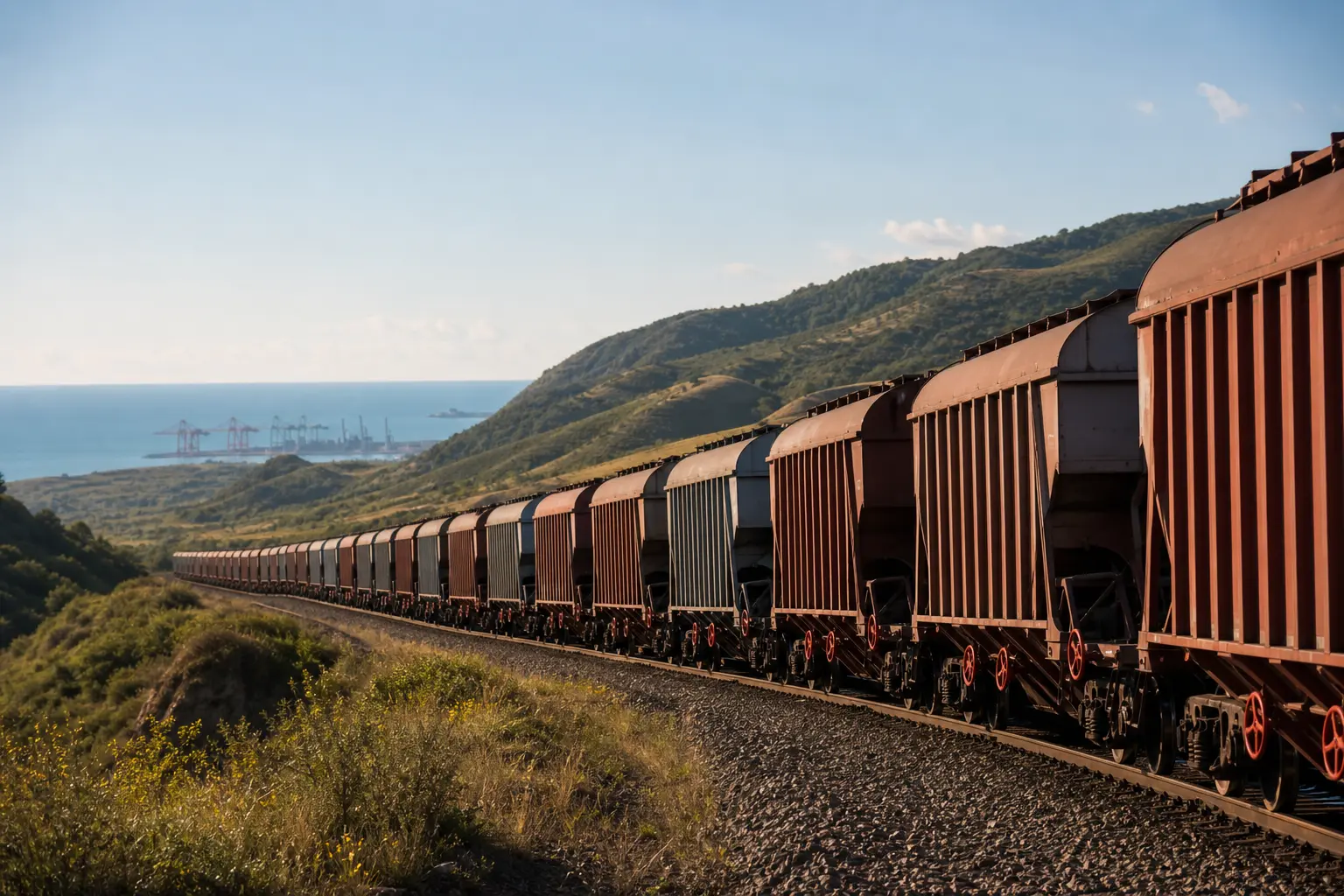
TBC Bank financed Zet Trans Group’s purchase of 100 new freight railcars for nearly $7 million, the largest private investment yet in Georgia’s rail freight sector. The wagons rolled into service in April and are already hauling carbamide fertilizer between Azerbaijan and Georgia’s Black Sea coast.
That is a fraction of the money behind Georgia’s port and rail megaprojects. But it targets the exact shortage analysts say is choking the whole corridor: a lack of wagons and locomotives.
TBC Backs Zet Trans’s 100-Car Freight Fleet
The hundred railcars sit at the center of a nearly $7 million investment, fully financed by TBC Bank, one of Georgia’s two largest lenders. Zet Trans Group put the fleet to work on the Azerbaijan-Georgia route in April, moving carbamide, a granular nitrogen fertilizer, toward Batumi Port on the Black Sea.
- The fleet entered commercial service in April 2026 on the Azerbaijan-Georgia line.
- Railcars complete an average of three to four rotations every month.
- Roughly 40,000 tonnes of cargo have already moved toward Batumi Port.
- TBC and Zet Trans Group have worked together for more than ten years.
“The new, modern railcar fleet has significantly enhanced our capabilities, which is crucial for increasing the competitiveness of the Middle Corridor,” said Alexi Nikolaishvili, founder of Zet Trans Group. He said the investment had already lifted cargo turnover and sharpened the efficiency of the company’s logistics operations, with optimizing transit time, safe transport, and quality standards as the company’s stated priorities.
Why Does Logistics Matter So Much to TBC?
Logistics makes up roughly 6% of Georgia’s GDP, and TBC treats transport and warehousing as a strategic lending priority. The bank’s loan book in the sector has grown 74% over three years to GEL 436 million, about $160 million, mirroring Georgia’s broader push to build out the Middle Corridor between Europe and Asia.
TBC Bank Group reported gross loans of GEL 30.47 billion in the first quarter of 2026, up 11.4% year over year, with total assets of GEL 44.58 billion. Group-wide, the bank’s loan book expanded 14% in 2025 on a constant-currency basis, part of a wider push into corporate and infrastructure lending.
“Logistics accounts for approximately 6% of GDP, and due to the sector’s scale and strategic importance, transport and warehousing remain key priorities for TBC,” said David Kontsee, vice president of corporate banking business management at TBC. He said TBC and Zet Trans Group have partnered for more than a decade, financing projects across production and service sectors, and that the railcar deal shows how bank and business cooperation can create value for a company and for the wider economy.
Freight Volumes Blow Past Old Forecasts
Georgia’s transit numbers explain the urgency behind deals like this one. Container traffic shipped from China through Georgia along the Middle Corridor jumped 173% in the first half of 2025 compared with the same period a year earlier, rising to 9,849 TEU (twenty-foot equivalent units) from 3,608 TEU, according to Georgia’s Ministry of Economy and Sustainable Development. Poti and Batumi, Georgia’s two main Black Sea ports, together handled 7 million tons of cargo in that window, a 5.9% increase, with container throughput up 19.5% to 375,654 TEU.
The Trans-Caspian International Transport Route’s own operating body counted 57,000 containers moving through the corridor in 2024, nearly triple the 20,500 recorded in 2023. The Baku-Tbilisi-Kars railway, the rail link tying Azerbaijan and Georgia to Turkey, added to that momentum on June 2, when its modernized Georgian section pushed annual freight capacity from about 1 million tonnes to 5 million tonnes.
Wagons and Locomotives Run Short Across the Corridor
None of that growth solves the corridor’s core problem. Georgia sits at its most exposed point: every rail shipment moving from Baku toward European markets has to cross Georgian territory, and the Port of Poti alone handles roughly 80% of the country’s container traffic despite draft restrictions that keep out larger ships.
Current constraints on the route stem mainly from a shortage of rolling stock and operational inefficiencies at rail-to-port handoff points, rather than from the rail lines or ports themselves, according to a recent assessment from the Jamestown Foundation, a Washington research group focused on Eurasian security. The wider math is stark too: the whole Middle Corridor is currently estimated to handle only about 5% of the capacity of the Russian-controlled Northern Corridor, held back chiefly by a shortage of Caspian Sea vessels and of locomotives and wagons in Azerbaijan and Georgia specifically.
Carnegie Endowment for International Peace analysts have gone further, warning that “the Middle Corridor has hard bottlenecks and likely a limited shelf life,” pointing to Georgia’s paralysis over Anaklia and regional volatility among the reasons why.
| Project | Investment or Capacity Change | Status |
|---|---|---|
| Zet Trans Group railcar fleet | Nearly $7 million, 100 railcars | In service since April 2026 |
| TBC logistics loan portfolio | GEL 436 million, up 74% in three years | Ongoing |
| Baku-Tbilisi-Kars railway | Capacity up from 1 million to 5 million tonnes a year | Full operations since June 2, 2026 |
| Anaklia Deep Sea Port | 2026 budget cut from 150 million lari to 50 million lari | Active construction since April 2026 |
| World Bank TC-GATE project | $372 million of a $750 million total | Approved June 2, 2026 |
Set side by side, the numbers show where the money is concentrated, and where it isn’t. Georgia’s marquee port project is running on a smaller budget than planned, even as private capital and multilateral lenders quietly fund the wagons, locomotives, and rail links keeping cargo moving right now.
Anaklia’s Port Waits on a Shrunken Budget
Anaklia is the flip side of the railcar story. Georgia’s government moved the Black Sea port into active construction in April, with Deputy Economy Minister Tamar Ioseliani confirming the start of breakwater work and channel dredging. At the same time, the 2026 budget submitted to parliament cut port funding from 150 million lari ($56 million) to 50 million lari ($18 million), with officials saying the reduction reflects money already committed in earlier years. A separate 45 million lari ($17 million) for an 18-kilometer access road stayed untouched.
Belgian contractor Jan De Nul is expanding cargo capacity by 600,000 containers through the port’s breakwater and dredged approach channels. A large dredging vessel is due in Anaklia’s waters this month to begin deepening the port basin, with the water infrastructure expected to wrap up by May 2027.
What We Know:
- Construction is active. Georgia’s economy ministry confirmed marine works began in April, with breakwater construction and channel dredging underway.
- The budget was cut. The 2026 allocation for port infrastructure fell from 150 million lari to 50 million lari, even as the access-road budget held steady.
- A bigger vessel is coming. A large dredger is scheduled to arrive this month to deepen the approach channel and turning basin.
What’s Unconfirmed:
- The concession deal. Georgia selected a Chinese-Singaporean consortium for a 49% stake in 2024, but officials had not finalized the agreement as of early 2026.
- The reason for the cut. Officials say the smaller figure reflects prior-year carryover; independent analysts have floated softer demand and geopolitical pressure as alternative explanations.
- The main berth. Construction of the berth itself needs a separate procurement process that has not yet been scheduled.
Georgia’s prime minister has said costs on the deepening and breakwater agreement, once quoted near $203.9 million, have since come down after a review of contractor terms, part of what officials call state expenditure optimization.
Zet Trans Group Plans a Bigger Fleet for Anaklia
Zet Trans Group is wagering that Anaklia eventually gets built, and wants more capacity ready when it does.
We are ready to support this large-scale initiative with an upgraded and modern fleet, which can be further expanded if required.
Nikolaishvili said the company’s experience, international partnerships, and technical capabilities give it confidence it can contribute meaningfully to the port’s development, strengthening the transit potential of the Middle Corridor and of Georgia as a whole.
The World Bank Group’s board approved a $750 million rail and road upgrade package in June, financing $372 million of it directly to replace Georgia’s aging locomotive fleet with energy-efficient electric units and to modernize road links, a project expected to directly benefit more than 900,000 people. Zet Trans Group’s 100 railcars got there first, one shipment of fertilizer at a time.
Frequently Asked Questions
What Is TBC Bank’s Position in Georgia’s Financial System?
TBC Bank and Bank of Georgia together hold about 76% of the banking sector’s assets and 75% of its loan portfolio, based on a review of 2025 data. Georgia’s total banking assets reached 108 billion lari, equal to 102.5% of the country’s GDP, by the end of 2025.
How Does the Middle Corridor’s Transit Time Compare With Sea Freight?
Cargo moving along the Middle Corridor takes around 15 days, compared with roughly 45 to 55 days on the traditional sea route most shippers use between Asia and Europe. That speed advantage is why shippers keep testing the corridor despite its limits, even though congestion has stretched some transit times to 40 days or more during peak demand.
Why Do the US and EU Watch the Anaklia Port Deal Closely?
Washington and Brussels have flagged concerns over the Chinese-Singaporean consortium holding a 49% stake in Anaklia’s construction, since the lead contractor, China Communications Construction Company, is under US sanctions. Both governments have invested in Middle Corridor connectivity as an alternative to Russian-controlled trade routes, which makes the port’s ownership structure a point of diplomatic friction.
What Is Carbamide, and Why Ship It by Rail?
Carbamide is the technical name for urea, a nitrogen-rich fertilizer widely used in agriculture across the Caucasus and beyond. It travels efficiently in bulk hopper cars, which is why fertilizer shippers rely on dedicated railcars rather than standard shipping containers on cross-border routes like Azerbaijan to Georgia.