Mestia municipality, the high-mountain seat of Georgia’s Upper Svaneti, burned through 133 million kilowatt-hours (the standard unit for billing electricity) in 2025. Comparable mountain districts rarely cross 10 million. On June 1, Vice Prime Minister Mamuka Mdinaradze, who also coordinates the country’s law enforcement agencies, named the gap for what officials say it is: illegal cryptocurrency mining in Svaneti, fed by power the state hands out for free.
The fix is a meter. Across the villages and settlements of Svaneti, the government will install metering at the household level, keep electricity free up to a cap, and bill anything above it. The irony sits in the wiring. The subsidy built to keep these villages alive is the same subsidy that turned them into a mining hub.
Counting Every Kilowatt in Mestia
Mdinaradze laid out the plan at a June 1 briefing, framing the metering rollout as both a grid-quality measure and a law enforcement operation. Network and transmission lines in the region are congested, he said, and the resulting outages hit residents and the tourism trade that Svaneti leans on. Meters will go in across villages and settlements to pinpoint where the load is coming from.
The damage estimate is the part that turned heads. By the government’s count, the excess consumption costs the system at least 20 to 25 million Georgian lari (GEL, roughly 7 to 9 million US dollars) a year. Residents keep their free power within an established limit; cross the threshold and the bill arrives at the standard tariff.
Strip out the politics and the figures sit on their own:
- 133 million kilowatt-hours consumed in Mestia in 2025, the number the whole operation is built around.
- GEL 20 to 25 million in estimated yearly damage to the national system.
- Under 10 million kilowatt-hours used by mountain municipalities of similar size.
How a Survival Subsidy Became a Mining Magnet
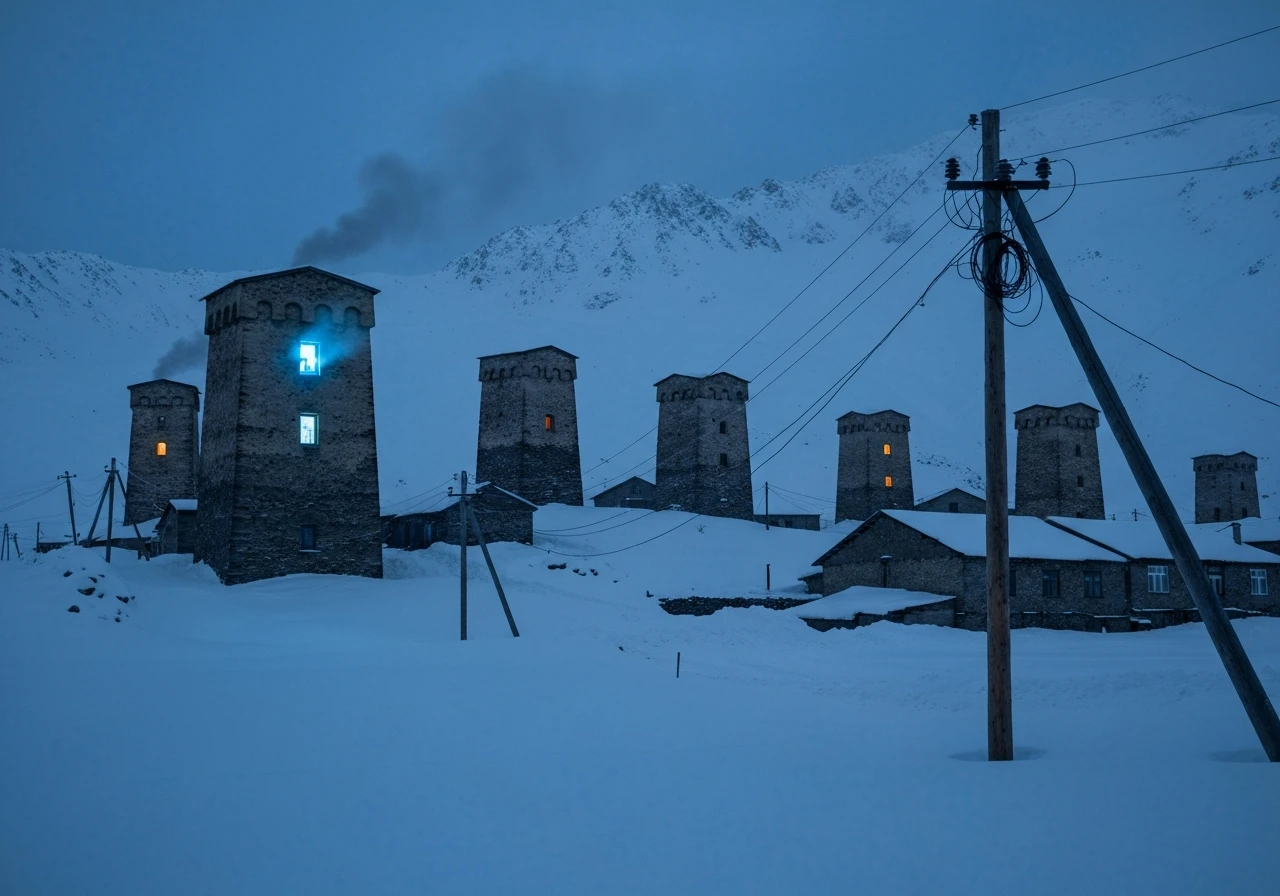
Svaneti does not pay for electricity. Upper Svaneti households get power free of charge, a policy meant to slow depopulation in one of Georgia’s most remote corners and give its tourism economy room to grow. Other high-mountain regions get a softer version of the same deal, with the state covering half the tariff.
That works as social policy right up to the moment someone realizes free electricity is the single largest input cost in cryptocurrency mining. A mining rig is a machine that converts cheap power into digital coins. Make the power free and the math becomes irresistible, especially in a place where a stone tower can hide a rack of humming hardware through a long winter.
So the load climbed. Mestia now draws more than 13 times the electricity of a comparable district, a gap no amount of household heating or hot water can explain. The government and the local utility both attribute the surplus to mining hardware running around the clock.
The result is a policy eating itself. The cheap power meant to keep families on the mountain is now the reason those families lose power when demand spikes. Mdinaradze’s parliamentary career has been built on hard-edged enforcement messaging, and this rollout fits the pattern; readers following his political profile saw it in a recent committee clash involving the vice prime minister.
Svaneti Has Lived This Blackout Winter Before
This is not the first winter the lights have gone out over crypto. The current crackdown is the latest round in a fight the distribution company and the region have been having for years, and the earlier rounds set the template for what metering is up against.
- December 2021: A major outage left parts of Svaneti dark, with crews needing a helicopter to reach and repair a high-voltage line in the snow.
- New Year’s Eve 2021: Local residents publicly pledged to halt mining operations to ease the strain on the grid.
- January 2022: Mikheil Botsvadze, chair of the board at distribution utility Energo-Pro Georgia, warned that Mestia was pulling 27 megawatts against an authorized 7, and said “no network” could carry that.
- 2025: Annual consumption reached the headline figure, well past anything the local infrastructure was designed to serve.
- June 2026: The government ordered large-scale metering and put law enforcement behind it.
The pledges did not hold. The hardware came back each cold season, which is why the state is now reaching for meters and statutes rather than promises. Energo-Pro Georgia, which serves more than 1.2 million customers nationwide, has called the situation unsustainable in its own grid operations and customer disclosures.
The Surcharge Every Georgian Subscriber Pays
The overlooked party in this story is not in Svaneti at all. It is the ordinary subscriber in Tbilisi or Kutaisi who never mined a coin and still helps cover the gap. Mdinaradze estimated that the problem adds about GEL 1.5 to each subscriber’s costs, a small line item that spreads a mountain village’s mining bill across the whole country.
The scale becomes clearer set side by side.
| Measure | Mestia | Similar mountain district |
|---|---|---|
| 2025 electricity use | 133 million kWh | Under 10 million kWh |
| Relative scale | About 13 times higher | Baseline |
| Household power subsidy | Free (Upper Svaneti) | 50% of tariff (other highlands) |
Zoom out and the national picture explains why the government cares. Mining is no longer a Svaneti curiosity; the activity has spread across cheap-power pockets nationwide, and Georgia’s electricity consumption ranks high relative to its size in the way cross-country Bitcoin energy comparisons tend to capture. A village subsidy has turned into a line item on every bill in the country.
Free Within a Limit, Billed Above It
The design tries to thread a needle. Keep the social promise to people who genuinely live in Svaneti, while pricing the machines that hide among them. Meters at the household and settlement level give the state granular data on who is drawing what, so a family heating a home reads very differently from a basement full of rigs.
Enforcement is the harder half. Mdinaradze said law enforcement agencies have been instructed to support the rollout and respond to cases of illegal use, language that signals this is not a soft audit.
We call on everyone to respect this process. Any obstruction and violation of the law will be followed by strict legal action.
That was Mdinaradze at the June briefing. The pressure is showing up across Georgian institutions this season; the same day, the Interior Ministry stood up a new speech-monitoring division, part of a broader enforcement push detailed in Georgia’s expanding policing apparatus. The mayor of Mestia, for his part, backed the meters, arguing that the winters when locals and tourists lost power were doing more harm to Svaneti than any tariff would.
Why a Meter May Just Move the Problem
A meter solves a measurement problem, not an incentive problem. As long as Georgian power stays cheap and parts of it stay free or half-priced, the rigs have a reason to exist somewhere; mining nationally drew an estimated 752 million kilowatt-hours in 2025, around 5 percent of the country’s consumption, and Georgia still registers on the global hash rate map tracked by the Cambridge Bitcoin electricity index alongside the broader energy footprint logged by independent monitors like the Bitcoin energy consumption index.
If the metering holds through next winter, Svaneti’s residents get the reliable power the subsidy always promised them, and the mining quietly drifts to the next cheap-power corner. If enforcement lapses the way the 2021 pledges did, the towers will hum again by January, and the GEL 1.5 every subscriber pays will still be sitting on the bill.