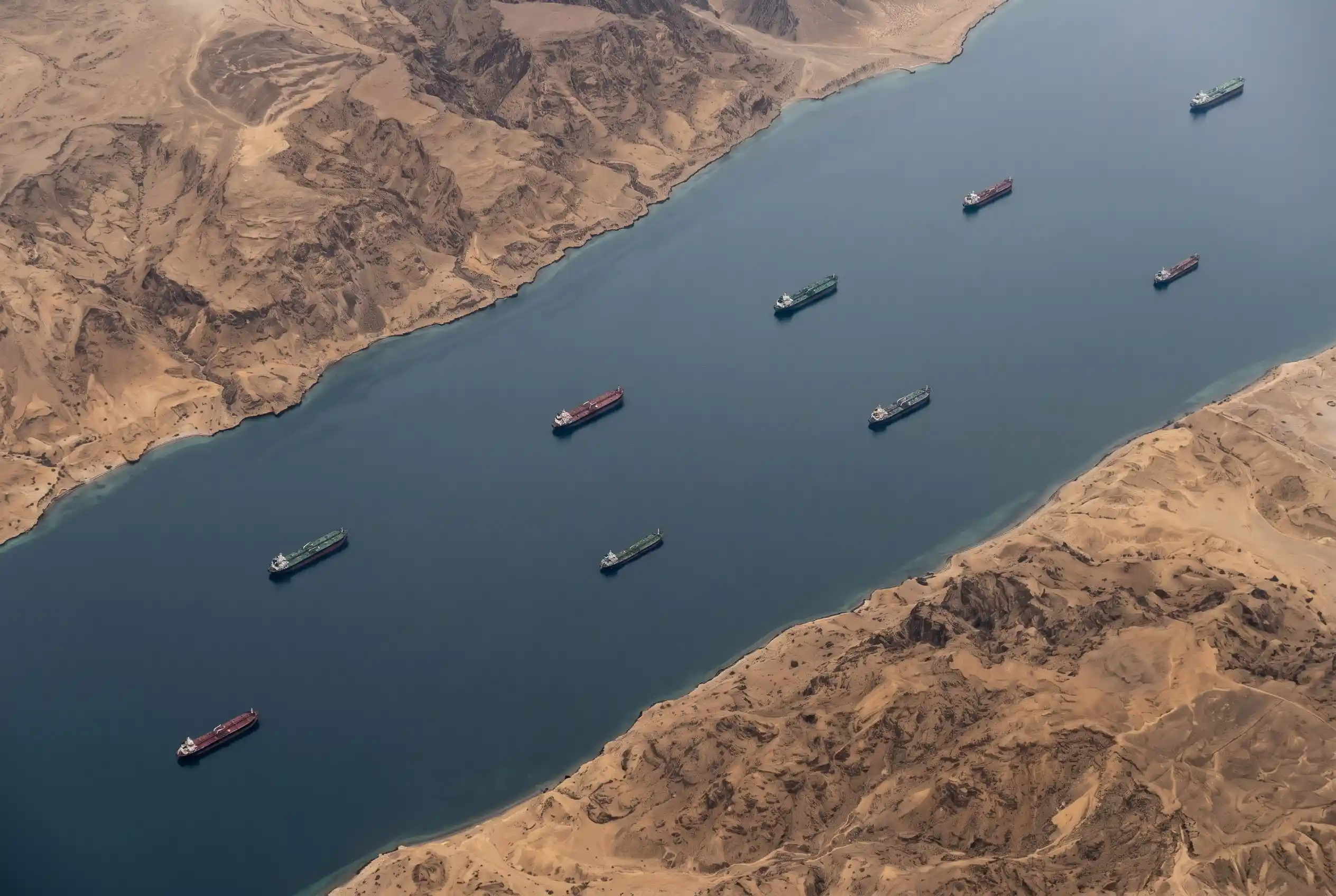
Ship transits through the Strait of Hormuz collapsed from roughly 130 a day in February 2026 to just 6 in March, a 95% drop that the International Energy Agency (IEA) described as “the greatest global energy security challenge in history.” The waterway, just 21 miles wide at its narrowest and running between Iran and Oman, carries around a quarter of the world’s seaborne oil trade and a fifth of its liquefied natural gas. For the first time in its commercial history, it is functionally closed, triggering a global energy shock with no clean precedent for resolution.
People reaching for historical reassurance turn immediately to the 1980s Tanker War, when Iran last mined these waters and the US last sent warships in. That comparison is instructive, mostly for what it reveals about why this crisis is harder to end.
When Iran Last Mined the Strait
Both Iran and Iraq attacked merchant shipping from 1981 to 1988 as part of their wider war. The Islamic Revolutionary Guard Corps (IRGC), the paramilitary force that controls current Hormuz operations, laid mines and deployed fast attack boats in patterns now familiar from current news footage. Iraq struck Iranian oil terminals from the air. By 1987, US Navy records show Iraq had conducted 283 attacks on shipping, Iran 168. But the strait never fully closed. Even at peak hostility, commercial traffic continued, because Iran had financial incentive to keep oil revenues flowing and the US role was defensive: convoy escort duty, not war.
The decisive moment came in April 1988, when an Iranian mine nearly split the USS Samuel B. Roberts in two during Operation Earnest Will, the Navy’s tanker escort mission. The US launched Operation Praying Mantis four days later, destroying Iranian oil platforms and sinking or crippling most of Iran’s surface naval fleet in a single engagement. Combined with eight years of attrition against Iraq, that pressure helped push Iranian leadership to accept a UN ceasefire that summer. The Iran-Iraq War ended August 20, 1988.
Three conditions made that resolution achievable. Iran was exhausted by a two-front conflict it couldn’t win. The strait had never actually closed, so Tehran retained financial incentive to preserve access. And the US was an external party protecting neutral shipping, not the originator of the conflict.
| Factor | Tanker War (1984-88) | 2026 Crisis |
|---|---|---|
| US role | Convoy escort, defensive | Combatant and blockade enforcer |
| Strait traffic impact | Disrupted but never halted | 95% collapse (130 ships/day to 6) |
| Oil price effect | Minimal sustained increase | $70 to $119/barrel peak |
| Iran’s situation | Two-front war, military attrition | Weakened but nuclear-capable, on defensive |
| Resolution path | UN ceasefire via combined pressure | Nuclear agreement required; none agreed |
None of those three conditions apply now. On February 28, 2026, US and Israeli air strikes killed Supreme Leader Ali Khamenei and targeted nuclear and missile infrastructure. Iran’s IRGC declared the strait closed within days. Ali Khamenei’s son, Mojtaba Khamenei, was named supreme leader on March 8, reportedly wounded in the same strikes, adding a leadership uncertainty that has complicated every negotiating session since. The nuclear question, which the 1988 conflict never had to confront, is the single issue that broke up the most significant talks of the current crisis.
A Blockade Inside a Blockade
Nothing in the waterway’s modern history looks quite like the dual mechanism now operating. The IRGC transmitted VHF radio warnings that no ship was allowed to pass, backed those warnings with sea mines and fast attack gunboats, and physically boarded and fired on vessels that tested the restriction. On March 4, the IRGC officially confirmed the strait was closed to “unfriendly nations.” Major container lines, including Maersk, CMA CGM, and Hapag-Lloyd, suspended transits almost immediately, as tanker traffic through the strait froze within the first days of the conflict. By early March, war risk insurance coverage was removed for the region entirely, making the economics prohibitive regardless of any legal arguments about navigational rights.
Washington’s counter-blockade, activated April 13 after JD Vance left Islamabad with no deal, targeted Iranian ports rather than the strait itself. US Central Command (CENTCOM) specified the measure would not block vessels transiting to non-Iranian destinations. In practice, with IRGC gunboats enforcing Iranian rules and US destroyers enforcing American ones, shipping firms found the passage commercially unworkable. The Greek-owned cargo ship Epaminondas was attacked by an Iranian gunboat with gunfire and rocket-propelled grenades on April 22, despite having received prior clearance to cross.
One physical detail complicates every diplomatic timeline that follows. Iran reportedly lost track of some of the mines it planted in the strait, meaning it cannot fully clear the passage even if it agrees to. The US Navy, which decommissioned four dedicated minesweepers stationed in the Gulf before the war began, has limited mine-clearing capacity in the area. A corridor requiring individual US Navy accompaniment for each vessel is not, by any commercial definition, an open strait. Shipping operators need insurable, unescorted access, and no party currently can offer it.
The US blockade on Iranian ports ended May 29, following progress in negotiations. The mine threat has not.
The Price of 21 Miles
According to the World Bank’s April 2026 Commodity Markets Outlook, conflict-related disruption in the strait triggered “the largest oil market shock in history,” with Brent crude rising roughly 65% by the end of March to record its highest monthly increase on record.
- $103/barrel: average Brent crude in March 2026, up from roughly $70 before the war
- $119/barrel: the peak reached during active US-Israeli-Iranian fighting in March and early April
- 6.6%: projected year-on-year fall in global oil output in Q2 2026, the steepest quarterly decline since the COVID-19 pandemic, per the World Bank
- 95%: the drop in daily strait transits from roughly 130 to 6 in March, per UN Trade and Development (UNCTAD) rapid assessment of the Hormuz disruptions
The damage extends well beyond oil. Around 30% of globally traded fertilizers transit the strait, along with roughly 12-14% of Europe’s liquefied natural gas (LNG) supply from Qatar. QatarEnergy warned that missile damage to its largest LNG facility could take up to five years to repair. An estimated 84% of crude oil through the strait went to Asian buyers, with China, India, Japan, and South Korea collectively absorbing nearly 70% of that volume. Jet fuel costs in North America spiked 95% since the war began. UNCTAD projected global merchandise trade growth decelerating from 4.7% in 2025 to between 1.5% and 2.5% in 2026, and forecast global growth slowing from 2.9% to 2.6% even without further escalation.
21 Hours in Islamabad
The highest-level direct engagement between the US and Iran since the 1979 Iranian Revolution ran from April 11 to April 12, 2026, across three rounds of talks at the Serena Hotel in Islamabad’s Red Zone. It lasted 21 hours and produced nothing signed.
The Gap No Weekend Could Bridge
The American team numbered 300, led by Vice President JD Vance alongside special envoys Steve Witkoff and Jared Kushner. Iran sent 70 officials, led by parliamentary speaker Mohammad Bagher Ghalibaf and foreign minister Abbas Araghchi. Pakistan’s prime minister Shehbaz Sharif mediated with more than 10,000 security personnel deployed across the capital.
They came close enough that Araghchi said a memorandum of understanding was “just inches away” and accused the US side of moving the goalposts. The structural obstacle wasn’t negotiating skill. Iran signed the 2015 Joint Comprehensive Plan of Action (JCPOA, the nuclear accord brokered by Iran, the US, and five other powers), watched the US exit it in 2018, and was now being asked to hand over enriched uranium permanently in exchange for commitments any future administration could reverse. Former US special envoy Rob Malley, who participated in the 2015 talks, told NPR: “Once they give up their stockpile, they can’t recapture it the next day.” That asymmetry sat at the center of every session.
What Each Side Put on the Table
The gap at Islamabad wasn’t a gap between two prices. It was a gap between two entirely different conceptions of what the negotiation was supposed to resolve.
Most points were agreed to, but the only point that really mattered, nuclear, was not.
Trump said that in the immediate aftermath, calling Iran “unyielding.” The US proposal reportedly demanded a 20-year moratorium on uranium enrichment, suspension of Iran’s ballistic missile program, full reopening of the strait, recognition of Israel’s right to exist, and an end to Iranian support for Hezbollah, the Houthis, and Hamas. Iran’s counter-demands included war reparations, security guarantees against future US-Israeli military action, an end to Israeli operations in Lebanon, and formal international recognition of Iranian sovereignty over the strait, along with the release of frozen assets including $6 billion.
| US Core Demands at Islamabad | Iran’s Counter-Demands |
|---|---|
| 20-year moratorium on uranium enrichment | War reparations from the US and Israel |
| Ballistic missile program suspension | Security guarantees against future military strikes |
| Full reopening of the Strait of Hormuz | End to Israeli operations against Hezbollah in Lebanon |
| Recognition of Israel’s right to exist | International recognition of Iranian strait sovereignty |
| End of support for regional proxy forces | Release of frozen Iranian assets including $6 billion |
Vance boarded Air Force Two on April 12 without a deal. That afternoon, according to the UK House of Commons Library briefing on reopening the Strait of Hormuz, Trump declared a US naval blockade on ships heading to or from Iranian ports. The counter-blockade began at 10 a.m. ET on April 13 under the command of Admiral Brad Cooper at CENTCOM.
Negotiations Stall as Iran Pulls Back
The geometry of the standoff shifted considerably through May. The US blockade ended May 29, following progress in back-channel discussions between Witkoff, Kushner, and Iranian officials on a 14-point memorandum of understanding. The framework, reported by Axios, would declare an end to the war, open a 60-day negotiating window on nuclear terms, and see both sides gradually lift shipping restrictions in parallel. The terms would be contingent on reaching a final agreement, explicitly preserving the risk of renewed war if talks collapsed.
Then June arrived. On June 1, Iran’s state-affiliated Tasnim news agency reported that Tehran had resolved to stop all back-channel exchanges with Washington and would move toward a complete Hormuz closure, citing ongoing Israeli military operations against Hezbollah in Lebanon as ceasefire violations. Trump told CNBC the same day that the negotiating process “started to get very boring.” On June 2, Reuters reported Iran was preparing to decline the latest US proposal outright.
The picture since has been one of mixed signals. On June 4, Ahmad Khomeini, a son of the new supreme leader, told reporters that Iran “has never shied away from dialogue” and had not rejected ongoing negotiations, while warning Tehran was ready for another round of military action if needed. On June 5, IAEA Director General Rafael Grossi said both parties appear “pretty close” to agreeing on an organizational structure for future talks.
Pre-war, around 3,000 vessels used the strait each month. That number now stands at roughly 5% of that level, with the IRGC deciding which ships receive permission to transit. Iran has reportedly lost track of some of the mines it planted in the strait, meaning no diplomatic statement gives shipping insurers what they need to send crews back through.