Skoda pulled the wraps off the production version of the Epiq electric SUV on May 19 in Zurich, with a UK starting price of £24,950 (about $33,500) that lands it at parity with the petrol-powered Kamiq and makes it the cheapest electric vehicle the Czech carmaker has ever sold. The compact crossover, 4,171 mm long, gets two battery options and is the first model out of Volkswagen Group’s new MEB+ architecture, the platform that will also underpin the ID. Polo, ID. Cross and Cupra Raval.
Production starts in mid-2026 at the Volkswagen Navarra plant in Pamplona, Spain. UK order books open in July, with customer deliveries scheduled for the start of 2027.
What Skoda Unveiled in Zurich
Tuesday’s reveal at Skoda’s Zurich event confirmed dimensions and trim levels that had leaked through teaser images over the past three weeks. The Epiq measures 4,171 mm long, 1,798 mm wide and 1,581 mm tall, sitting below both the Elroq and Enyaq in Skoda’s electric line-up. A 475-litre boot plus a 25-litre frunk under the bonnet for charging cables push the practicality argument the brand has built on for two decades with the Fabia and Kamiq.
Skoda’s Modern Solid design language gets its second full production showing here, after the Elroq. A closed-off glossy black Tech-Deck Face replaces the conventional grille, slim T-shaped LED daytime running lights frame the bumper, and the body sides carry the chunky surfacing the brand has adopted across its larger EVs. A drag coefficient of 0.275 is competitive for the segment, helped by active cooling shutters, aero wheel trims and a tuned rear spoiler.
Inside, the dashboard layout keeps physical buttons and haptic rotary controls for climate and audio, an editorial choice that puts Skoda on the opposite side of the cabin-design argument from Tesla, BYD and most of the Chinese brands now pushing into Europe. A 13-inch infotainment touchscreen sits in the centre, with a 5-inch digital driver display in front of the wheel. Wireless smartphone mirroring, wireless charging with cooling, dual-zone climate, heated seats and the MySkoda connected-car app are standard or optional across the range. Skoda says more than 34 kg of recycled materials make it into each car, alongside animal-free upholstery on every trim.
The familiar Simply Clever touches survive: an umbrella holder in the door, a soft bag for charging cables in the boot, hooks for shopping bags and smart cupholders that grip a bottle one-handed.
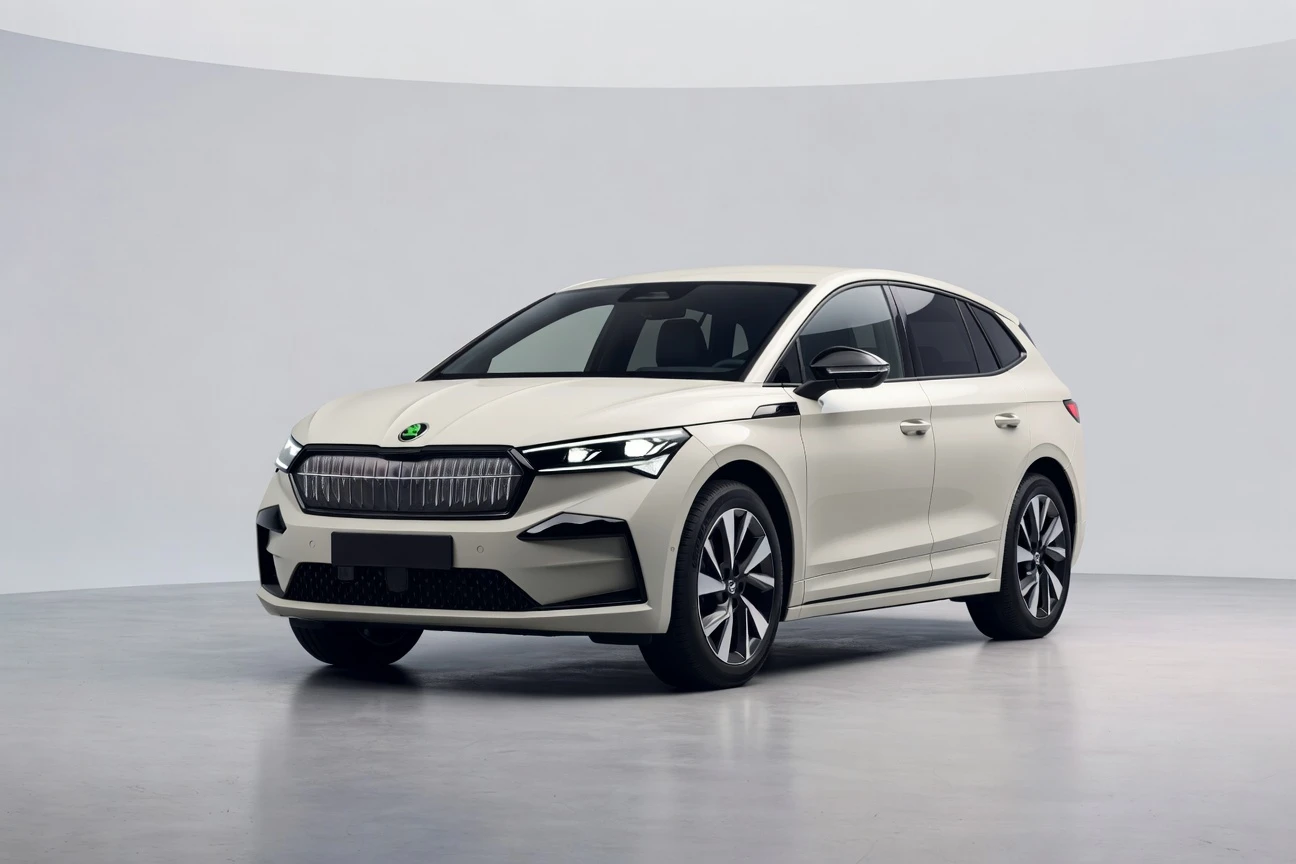
The £24,950 Question and the Kamiq Parity
The headline number, £24,950 OTR for the entry trim, sits within a few hundred pounds of the petrol Kamiq’s starting price. Skoda’s UK pricing team has aimed for what the industry calls “powertrain parity”, the moment a buyer picking between an internal-combustion and an electric version of a similar car can no longer use sticker price as the deciding argument. Across mainland Europe the equivalent figure is €25,900.
That puts the Epiq below the Kia EV2, which lists from €26,600 in continental markets, and well under the Volkswagen ID. Cross at roughly €28,000. The pricing logic comes from VW Group’s decision to source the Epiq’s LFP cell from CATL and assemble the car at the Navarra plant in northern Spain, where European labour costs are lower than at Wolfsburg or Mlada Boleslav. Skoda’s UK division said in its briefing that order books open in July with two launch trims, SE L and Edition, both paired with the larger 52 kWh battery. The £24,950 entry version, paired with the smaller 37 kWh LFP pack, arrives later in the run-out.
That sequencing matters because every recent VW Group EV launch has used the same staircase. The ID.3 launched with a higher-spec battery first; the Cupra Born did the same; the Skoda Elroq did the same. The pattern is well established, and it sets up reviews and first-driver impressions against the more expensive variant, not the price the marketing team is selling on.
Two Batteries, One Front Axle
The Epiq is sold globally in two main configurations, with Skoda confirming a third entry-level variant for some European markets only.
- 37 kWh LFP battery, 133 bhp motor, claimed WLTP (Worldwide Harmonised Light Vehicles Test Procedure) range of 305 km (about 190 miles). Front-wheel-drive.
- 52 kWh NMC battery, 208 bhp motor, claimed WLTP range of 425 km (about 272 miles). Front-wheel-drive.
- 105 kW peak DC charging, allowing 10 to 80 per cent state of charge in under 25 minutes.
- 11 kW AC charging standard across all variants.
The split between LFP (lithium iron phosphate) for the entry car and NMC (nickel manganese cobalt) for the long-range version mirrors the choice Tesla made on the Model 3 in 2022 and that Volkswagen quietly adopted on the ID.3 mid-cycle refresh. LFP packs are cheaper per kilowatt-hour, last longer over deep-discharge cycles, and tolerate full charging to 100 per cent without degradation worries. They are also heavier per unit of energy and lose noticeable range in cold weather.
The 105 kW DC ceiling will draw scrutiny. Hyundai-Kia’s 400-volt E-GMP architecture claims up to 102 kW on its compact crossover. The Renault 4 E-Tech tops out around 100 kW. So the Epiq sits in the middle of the pack rather than pushing it forward. Buyers planning motorway runs of more than 250 km in a single day will spend roughly 25 minutes plugged in for every 80 per cent fill at a fast charger that can deliver the full headline rate, of which there are still relatively few outside the Ionity and Tesla Supercharger networks.
Bidirectional charging is the more interesting line in the spec sheet. The Epiq can supply power back to a home or to external appliances where the local hardware supports it, a feature Volkswagen has been piloting in Germany on the ID.5 with E.ON. One-pedal driving with adjustable regenerative braking modes completes the powertrain story.
First on MEB+, a Platform Test in Production Form
The Modular Electric Drive Matrix Plus (MEB+, Volkswagen Group’s updated EV platform succeeding the original MEB) makes its production debut under the Epiq.
The architecture supports front-wheel-drive layouts that the original MEB never offered in this size class, faster onboard chargers, and a battery management system designed around LFP cells from the start rather than retrofitted to take them.
That’s the line VW Group’s investor relations team has been pushing since its most recent Capital Markets Day. The Epiq is the first car on the new platform, with the Volkswagen ID. Polo, ID. Cross and the Cupra Raval following over the next 14 months.
Sending the Skoda first is deliberate. Skoda buyers tend to be older, more practical and less brand-tribal than Volkswagen or Cupra customers, which means launch teething problems generate fewer angry social-media posts. The same model played out when the Enyaq launched on the original MEB six months before the ID.4 hit serious volume.
If MEB+ delivers on its software promises (over-the-air updates, faster cabin tech responses, fewer of the bricked-screen complaints that hounded early ID.3 owners) the architecture will carry an enormous chunk of the group’s volume by the back end of the decade. Volkswagen, Audi, Skoda, Cupra and Seat are all expected to ship products on the platform by the end of 2027. If it stumbles, those launches get repriced and the group’s EV margin guidance gets revisited.
Skoda’s engineering team in Mlada Boleslav handled the cabin-software integration directly, a departure from previous joint development with Cariad, the in-house software unit Volkswagen has been restructuring for two years.
Tata Motors has signalled its own platform play with the Sierra EV and an updated Punch EV due this year, per Tata Motors’ published EV roadmap through the end of the decade, suggesting the budget-EV race will run across continents through the rest of the decade.
The Compact EV Field Just Got Crowded
The Epiq lands into a segment that did not exist 18 months ago and that now has four serious contenders, with two more expected before the calendar turns. Below is how the Epiq compares to the rivals it will sit next to on shopping forecourts.
| Model | Starting Price (Europe) | Max WLTP Range | Battery (Largest) | Platform |
|---|---|---|---|---|
| Skoda Epiq | €25,900 | 425 km | 52 kWh NMC | MEB+ |
| Kia EV2 | €26,600 | 453 km | NMC (capacity TBC) | E-GMP |
| Volkswagen ID. Cross | ~€28,000 | ~420 km | 52 kWh NMC | MEB+ |
| Renault 4 E-Tech | ~€28,000 | ~400 km | 52 kWh NMC | AmpR Small |
The Epiq starts cheapest, the Kia EV2 carries the highest claimed range, and the Renault 4 leans hardest on retro design. The ID. Cross sits closest to the Epiq mechanically because they share the platform.
The Kia EV2 Threat
The Kia is the Epiq’s most direct rival on every spec line that matters to a private buyer. It hits 453 km of WLTP range against the Skoda’s 425, brings the brand’s triple-screen ccNC cabin software, and arrives with Plug & Charge support the Epiq does not list in its launch specification. Kia’s UK arm has briefed dealers to position the model against the Renault 5 on character and against the Epiq on practicality.
The In-House Sibling Rivalry
The Volkswagen ID. Cross will share MEB+, the 52 kWh battery, and most of the underbody hardware with the Epiq. Where it diverges is interior trim, exterior styling, and a likely €2,000 to €2,500 premium for the badge. VW Group has historically protected Volkswagen-branded products from in-house pricing pressure by positioning Skoda and Seat-Cupra below; the ID. Cross will follow the same template.
What the Renault 4 Brings
The Renault 4 E-Tech is the design wildcard. It uses Renault’s smaller AmpR platform shared with the Renault 5, comes with a 52 kWh battery in long-range trim, and has the strongest brand-heritage hook of the four. For buyers picking on emotion rather than specification, the Renault wins. For everyone else, the Epiq’s boot space and Simply Clever packaging close that gap.
Where the Spec Sheet Has Holes
Three details get less attention in the launch material than they probably should.
- No all-wheel-drive option is planned for any Epiq trim at launch. MEB+ supports rear-axle motors, but the Epiq stays single-motor front-wheel-drive across the line-up. Buyers who want twin-motor traction will be pushed up to the Elroq or Enyaq, which costs roughly ten thousand pounds more.
- The 105 kW DC ceiling is segment-average, not segment-leading. Hyundai-Kia’s 800-volt E-GMP architecture on the larger EV6 and Ioniq 5 hits 240 kW; the Epiq will not get close.
- The headline entry trim arrives later in the launch sequence, not at the front of it. UK order books in July open with the 52 kWh battery and SE L or Edition trims, which list closer to £29,000.
Skoda’s UK division has not yet confirmed whether the Epiq will qualify for any continuing UK electric-vehicle incentive, the most relevant of which is the £350-per-charger home installation grant. Most equivalent EVs in the segment qualify. The omission is conspicuous.
The promised over-the-air update cadence is also undefined. Volkswagen’s Cariad-managed updates have been criticised for shipping every nine to twelve months when rival manufacturers ship them every six weeks. Skoda has hinted that the new platform will improve this, but the production cars launching in mid-2026 will be the first real test. Buyers signing for July deliveries are betting that the software experience matches the hardware spec.
What Happens Between July and Year-End
UK order books open in July with the SE L and Edition trims paired with the 52 kWh battery, and mainland European configurators follow within the same window. First customer deliveries are scheduled for the start of 2027, after production ramps from the Navarra plant. Three pressure points decide whether the entry price holds beyond the first 12 months: the cell-supply contract with CATL has to deliver volume at price, MEB+ software has to ship without the bricked-screen drama that scarred its predecessor, and Kia putting its compact crossover on dealer floors at €26,600 will set the ceiling above which Skoda cannot move the Epiq without surrendering the segment-leader title it just claimed.
If those three lines hold, the Epiq sells out its first production run and VW Group’s broader rollout on the platform gets the validation it needs before the ID. Polo arrives. If even one breaks, the Epiq becomes a discounted launch and the platform’s reputation is set against it before its second model has even shipped.