Severe weekend storms caused power outages that left more than 623,000 customers across eight U.S. states without service, capping a heat wave that pushed the country’s largest grid operator to its highest alert level. As of Sunday night, the live U.S. outage tracker counted outages in Pennsylvania, Michigan, New York, New Jersey, Maryland, Connecticut, Virginia, and Texas, with Michigan and Pennsylvania carrying the largest share of customers without service. PJM Interconnection, which operates the largest U.S. electric grid, had a Maximum Generation Alert in place for July 3 as the heat wave peaked. PPL Electric Utilities in Pennsylvania called the storm one of the most damaging in its history, with full restoration work extending through Wednesday, July 8. Mutual assistance crews have poured in from Rhode Island, Kentucky, Canada, Florida, Texas, and Alabama.
Eight States in the Dark
The storm’s footprint stretched from Texas to Connecticut. PowerOutage.com’s Sunday night tally crossed 623,000 customers without service. Michigan carried 2% of its tracked customers offline, the highest share, with Pennsylvania at 1.7%.
The eight states span the Eastern Seaboard and into the Midwest. Each state runs its own restoration effort under different terrain and demand conditions. Pennsylvania and Michigan lead the totals, with thousands of utility crews deployed across both. Con Edison in New York added to its tally after destructive wind gusts swept through its service area. PJM Interconnection, which operates the regional grid, has held Maximum Generation Alerts through the same period.
- Pennsylvania
- Michigan
- New York
- New Jersey
- Maryland
- Connecticut
- Virginia
- Texas
PPL Calls It One of Its Worst Storms on Record
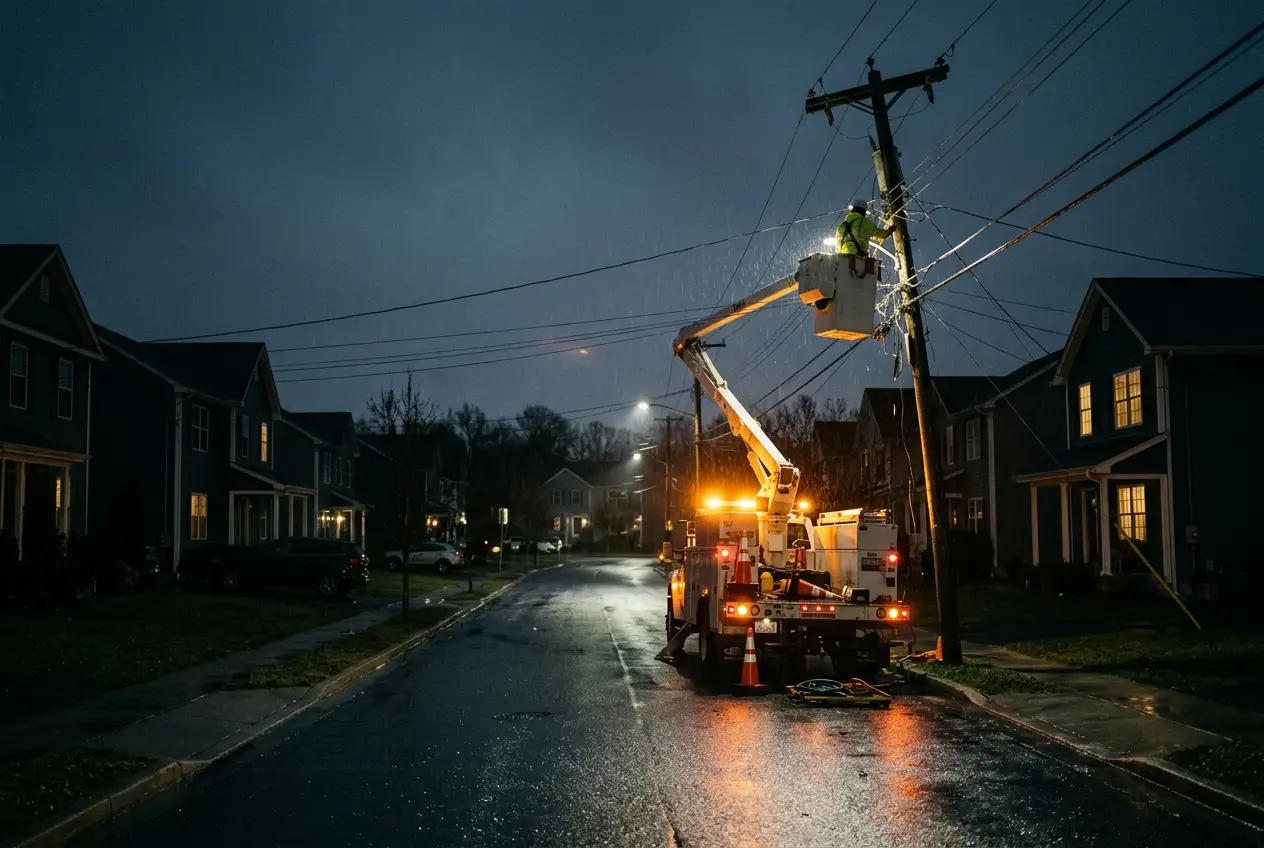
“This event ranks among the 10 most impactful storms in PPL Electric’s history,” the Pennsylvania utility said Sunday, after winds reaching 60 mph brought down trees, wires, and poles across its territory. Since Friday, crews had identified more than 2,360 individual damage locations. The storm hit during a heat wave that had already pushed regional demand near record levels.
PPL Electric delivers electricity to about 1.5 million homes and businesses in eastern and central Pennsylvania. The utility activated its emergency response plan before the storm and pulled in mutual assistance crews from sister utilities in Rhode Island and Kentucky, plus outside contractors from Canada, Florida, Texas, Alabama, and other states. By Monday afternoon the company had more than 2,000 personnel supporting restoration.
PPL is offering customers a bill credit for ice and water purchased during the outage, up to three gallons of water and three 10-pound bags of ice per day. The utility has waived the normal 24-hour outage requirement for the reimbursement program. All customers still without service have been assigned an estimated restoration time. The company said restoration work would continue through Wednesday, July 8, but many customers would be back sooner.
Crews continue to work around the clock as safely and quickly as possible. We understand that being without power is never easy, and we’ll continue to work nonstop until every customer is restored.
Christine Martin, president of PPL Electric Utilities, said that in a statement posted Sunday.
Michigan and New York Catch Up Faster
PPL Electric, DTE Energy, and Con Edison all reported progress by Monday morning, but at different paces. Some utilities had nearly completed restoration, while others were still working through a backlog of damage locations. Restoration timelines ranged from end of day Sunday to Wednesday, July 8.
Con Edison said the damage in its New York City and Westchester service area ran from record-breaking heat through severe thunderstorms with destructive wind gusts. DTE Energy warned Michigan customers to stay at least 25 feet away from any downed line and to assume it was live. PPL Electric offered a bill credit for ice and water purchased during the outage. Each utility credited crews that had been working since before the storm hit.
| Utility | Restoration Status |
|---|---|
| PPL Electric (Pennsylvania) | More than 225,000 customers restored since Friday; full repair work continuing through Wednesday, July 8 |
| DTE Energy (Michigan) | 85%-90% of impacted customers to be restored by end of Sunday, July 5 |
| Con Edison (New York) | More than 166,800 of approximately 173,700 impacted customers restored as of Monday morning |
The Heat Wave That Set the Stage
PJM Interconnection, the operator of the largest U.S. electric grid, issued a Maximum Generation Alert for July 3 asking power producers to maximize output as the heat wave pushed demand near record levels across 13 mid-Atlantic and Midwest states and the District of Columbia. The grid serves about 67 million people, and a separate Hot Weather Alert remained in effect through July 4. The alert did not require any action from customers but asked generators and transmission owners to defer maintenance and cancel testing so more units stayed online. The alert covered the same region where Saturday’s storms would later bring down lines and poles. Consecutive days of Maximum Generation and Load Management Alerts ran from late June into the July 4 weekend.
The North American Electric Reliability Corp flagged the strain in its 2026 Summer Reliability Assessment from May. Strong load growth continues in nearly all assessment areas, the agency said, and large computational and other large loads pose operational challenges for the upcoming summer. The same weeks that strained supply then damaged delivery.
The PJM alert asked producers to bring every available unit online and keep them there. Storm damage has now layered across the same region’s transmission and distribution lines. The heat-driven demand and the storm-driven outages are running through the same substations and corridors. Customers across both phases of the crisis are looking at the same calendar week.
Why Restoration Extends Through Wednesday
Restoration from a storm of this scale is not a single repair job. Before line crews can re-energize a circuit, forestry crews clear trees and debris, damage assessors evaluate the scene, and support personnel bring in replacement poles, wires, and transformers.
The work moves in phases: first assess, then clear, then repair, then test. Each phase takes time, and the most damaged sites often sit at the back of the queue. PPL’s Monday afternoon restoration update showed a measured pace of repairs through the morning and afternoon. The company warned that the remaining work was the most complex, with widespread tree damage, broken poles, and difficult-to-access sites.
- 2,360+ damage locations identified since Friday
- 225,000+ customers restored by Monday afternoon
- 2,000+ personnel supporting PPL’s restoration effort
- Multi-day restoration effort underway
Oklahoma Wind, Pennsylvania Floods
According to the July 5 weather recap data, a mature line of thunderstorms drove a 92 mph gust across the ground at the OU Westheimer Airport in Norman, Oklahoma. That kind of speed snaps limbs and peels shingles off rooftops. A Severe Thunderstorm Watch covered about 9.9 million people across North Texas that evening.
Farther east, the same day’s storm fired on a stalled front with precipitable water above 1.75 inches, and the water found Tyrone, Pennsylvania. Catastrophic flash flooding there needed high-severity rescues and helicopter support. Water got into the first floors of industrial facilities and homes. Crews were running water rescues through the afternoon. A bridge collapse was reported in Clarion County, tied to high water.
Trees on wires ran the length of the storm’s path. Reports from Pennsylvania, West Virginia, Virginia, Tennessee, and the Carolinas all logged trees down on power lines through the afternoon and into the night. Two different emergency responses, in two different geographies, came out of the same July 5 system.
Frequently Asked Questions
When will power be fully restored in the affected states?
PPL Electric Utilities in Pennsylvania says full restoration work will continue through Wednesday, July 8, with many customers restored sooner. Other utilities have set shorter timelines: DTE Energy said 85% to 90% of its impacted Michigan customers would be back online by the end of Sunday, July 5, and Con Edison had restored power to more than 166,800 of approximately 173,700 customers impacted in its service area as of Monday morning.
Which states had the most customers without power?
PowerOutage.com’s Sunday night count crossed 623,000 across eight states: Pennsylvania, Michigan, New York, New Jersey, Maryland, Connecticut, Virginia, and Texas. Michigan had the highest share of customers out of service at 2%, with Pennsylvania at 1.7%.
What caused the outages?
A storm system that moved through the eastern United States on July 4 and July 5 brought heavy rain, strong winds, and falling trees across multiple states. PPL Electric said wind gusts reached up to 60 mph in its Pennsylvania service area, while a 92 mph gust hit Norman, Oklahoma, and catastrophic flash flooding hit Tyrone, Pennsylvania, the same day.
How many utility crews are working on restoration?
PPL Electric alone had more than 2,000 personnel supporting its restoration by Monday afternoon, including line workers, tree crews, damage assessors, engineers, mutual assistance crews from Rhode Island and Kentucky, and outside contractors from Canada, Florida, Texas, and Alabama. Con Edison and DTE Energy had additional crews working in parallel in their own service territories.
Is the U.S. power grid stable right now?
PJM Interconnection, the operator of the largest U.S. electric grid, had a Maximum Generation Alert and Load Management Alert in effect through July 3, and a Hot Weather Alert through July 4. The grid serves about 67 million people across 13 mid-Atlantic and Midwest states and the District of Columbia. The North American Electric Reliability Corp said in its May 2026 Summer Reliability Assessment that strong load growth and large computational loads pose operational challenges for the summer.