The Port of Savannah moved 8.5 percent more frozen poultry over the past year, handling 55,957 twenty-foot equivalent units (TEUs, the standard shipping-container measure) of chicken bound for overseas tables in the 12 months through February. That keeps Georgia’s flagship port the country’s busiest exit door for frozen birds, accounting for 37 percent of all US frozen poultry shipped last year.
What makes the gain stand out is the backdrop. National broiler exports actually fell in 2025, squeezed by avian flu outbreaks and markets that slammed shut. Savannah grew anyway, and the reason sits in concrete and refrigeration as much as in chicken.
Savannah Gained Share While National Poultry Exports Slipped
The headline figure is a volume number, not a price one. The port added nearly 4,400 TEUs of frozen poultry year on year, the kind of steady single-digit climb that rarely makes news on its own. The context is what gives it weight.
Across the country, the broiler trade went the other direction. The US Department of Agriculture (USDA, the federal farm and food agency) pegged 2025 broiler exports at 6,506 million pounds, down 2.6 percent from the year before. Egg-and-poultry export value had already slid from a record near $6.2 billion in 2022 to roughly $5.5 billion in the two years that followed. So a port growing its poultry throughput by 8.5 percent in that climate was not riding a rising tide. It was taking share.
The two trends do not cover identical periods, and they measure different things: USDA counts pounds shipped nationwide over a calendar year, while Georgia Ports counts containers crossing its docks in the 12 months to February. But the direction of travel is the point.
| Measure | US broiler exports, 2025 | Savannah frozen poultry, year to Feb |
|---|---|---|
| Year-on-year change | Down 2.6% | Up 8.5% |
| Volume | 6,506 million lbs | 55,957 TEUs |
| Context | 13.6% of US production | 37% of US frozen poultry exports |
The Reefer Math Behind the 8.5 Percent Gain
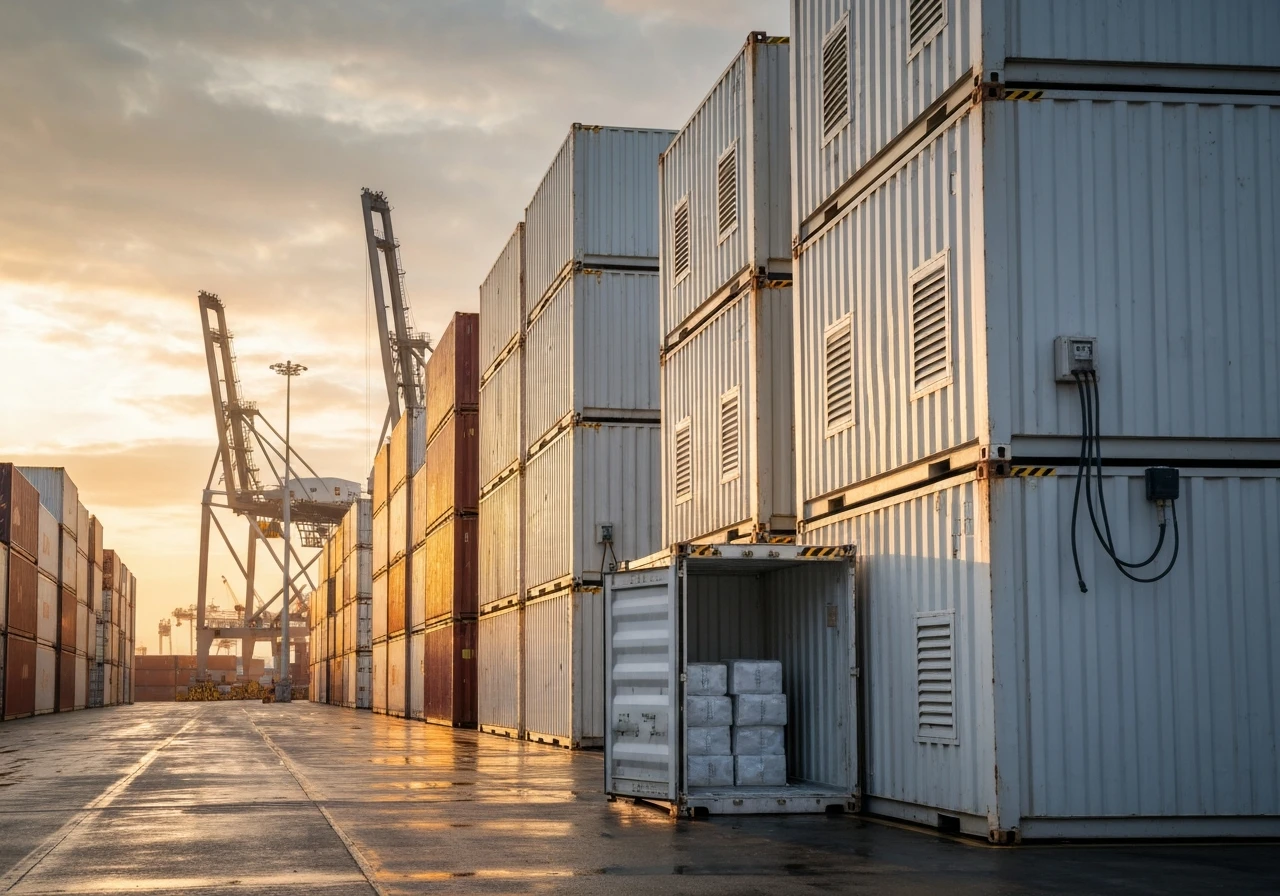
Frozen chicken does not move in ordinary boxes. It rides in refrigerated containers, or reefers, that need power and plug-in slots at every stop. A port’s poultry business is therefore capped by how many of those slots it can offer at the dock, and Savannah has built a deep bench.
The Garden City Terminal carries roughly 3,600 powered slots for refrigerated containers, with nearly 3,400 positions on dedicated reefer racks and more than 200 on wheeled chassis. That capacity is what lets time-sensitive cargo sit plugged in and cold while it waits for a vessel, instead of spoiling in a yard.
There is a quieter loop driving the growth too. Savannah pulls in a rising tide of chilled imported produce, and every refrigerated box that arrives full eventually empties out. Those empty reefers, already wired for cold cargo, become the cheap supply that poultry exporters fill on the way back out.
- 3,600 powered reefer slots keep frozen cargo cold while it waits dockside for one of the port’s vessel calls.
- 40 ocean carrier services connect Savannah to global routes, the most direct trade lanes of any South Atlantic or Gulf Coast port.
- 50 to 100 miles closer to major inland markets such as Atlanta than rival East Coast terminals, trimming the drayage bill on every load.
A $49 Million Inspection Building Opens at Garden City
Cold cargo also has to clear inspection, and that step used to mean trucking containers off-site and hoping nothing warmed up in transit. Georgia Ports spent $49.25 million on a new US Customs and Border Protection facility at Garden City to fix that, doubling the size of the old centralized examination station and putting it right on the terminal.
The building, which opened in February, also hosts inspectors from the USDA and the US Fish and Wildlife Service, and it adds 4,000 square feet of refrigerated space in June for chilled-cargo checks. Temperature controls, ventilation and sanitation systems are built in so product quality holds while an agent works a container.
Gainesville Hands North Georgia a Rail Lane to the Coast
Georgia’s poultry industry sits well inland, clustered in the northeast corner of the state across Hall, Franklin, Hart and Madison counties. Getting frozen birds from there to the coast has meant long truck hauls, and that is the gap the authority’s newest project targets.
The Gainesville Inland Port rail terminal opened May 4, a $134 million site that Norfolk Southern serves five days a week with direct trains to Savannah. At full build-out it will move 200,000 containers a year, swapping a 600-mile roundtrip truck route for a single rail leg.
Griff Lynch, president and chief executive of the Georgia Ports Authority, framed the project around road relief as much as cargo speed.
Our new inland rail facility in Gainesville will significantly offset truck traffic congestion in Atlanta and improve air quality by replacing an estimated 26,000 truck roundtrips in the first year alone.
For now frozen poultry still rolls to the port by truck, so the rail lane is upside the authority has yet to fully bank. Producers in the four-county cluster get a shorter, more predictable path to the same 40 carrier services that already make Savannah the leader in this trade.
Private Cold Warehouses Carry the Staging Load
Not all of the cold-chain muscle belongs to the port. A dozen private operators around Savannah run nearly 2.4 million square feet of refrigerated warehousing, split between 1.64 million square feet for frozen cargo and more than 752,000 square feet of chilled space for perishables.
Those near-port freezers and blast-freezing rooms act as staging grounds where exporters prepare and hold product before it moves to the terminal and onto a ship. Port officials say the private capacity effectively extends the authority’s own reach, speeding turnaround and distribution.
That private base keeps growing. A new $60 million PermaCold cold storage project near the Georgia coast is among the additions meant to deepen temperature-controlled logistics in the region, the kind of buildout that lets the port chase more reefer cargo without running short of staging room.
Avian Flu and Tariffs Still Shadow the Throughput
The infrastructure story is genuine, but it sits on ground that keeps shifting under the whole US poultry sector. The same forces that pushed national exports down in 2025 have not gone away, and they can reach Savannah’s docks fast.
Highly pathogenic avian influenza (HPAI, the bird flu strain devastating commercial flocks) remains the central threat. Georgia, the nation’s largest poultry state, has felt it directly, with a confirmed bird flu outbreak in Georgia poultry operations triggering statewide suspensions in recent seasons. An outbreak near the production cluster would cut the very supply the port depends on.
- China access stays largely closed, with HPAI-linked restrictions keeping most US states locked out of a market that once absorbed billions in chicken paws and other cuts.
- Tariff risk looms over Georgia farms, with industry officials warning that tariff turbulence threatening Georgia’s poultry industry could hit the state’s most valuable exports.
- Top-market softness showed up in early 2026 data, with US shipments to Mexico, the number one outlet for broiler meat, down about 7 percent over the prior 11 months.
USDA’s latest outlook still pencils in a modest rebound, projecting 2026 broiler exports up 1.6 percent to 6,610 million pounds, per its 2026 livestock and poultry outlook. If that recovery holds and the bird flu maps stay quiet, Savannah’s cold-chain bet pays off and the share gains compound. If a fresh outbreak hits the northeast Georgia counties, the reefer slots and the new rail lane will be waiting on chicken that never ships.