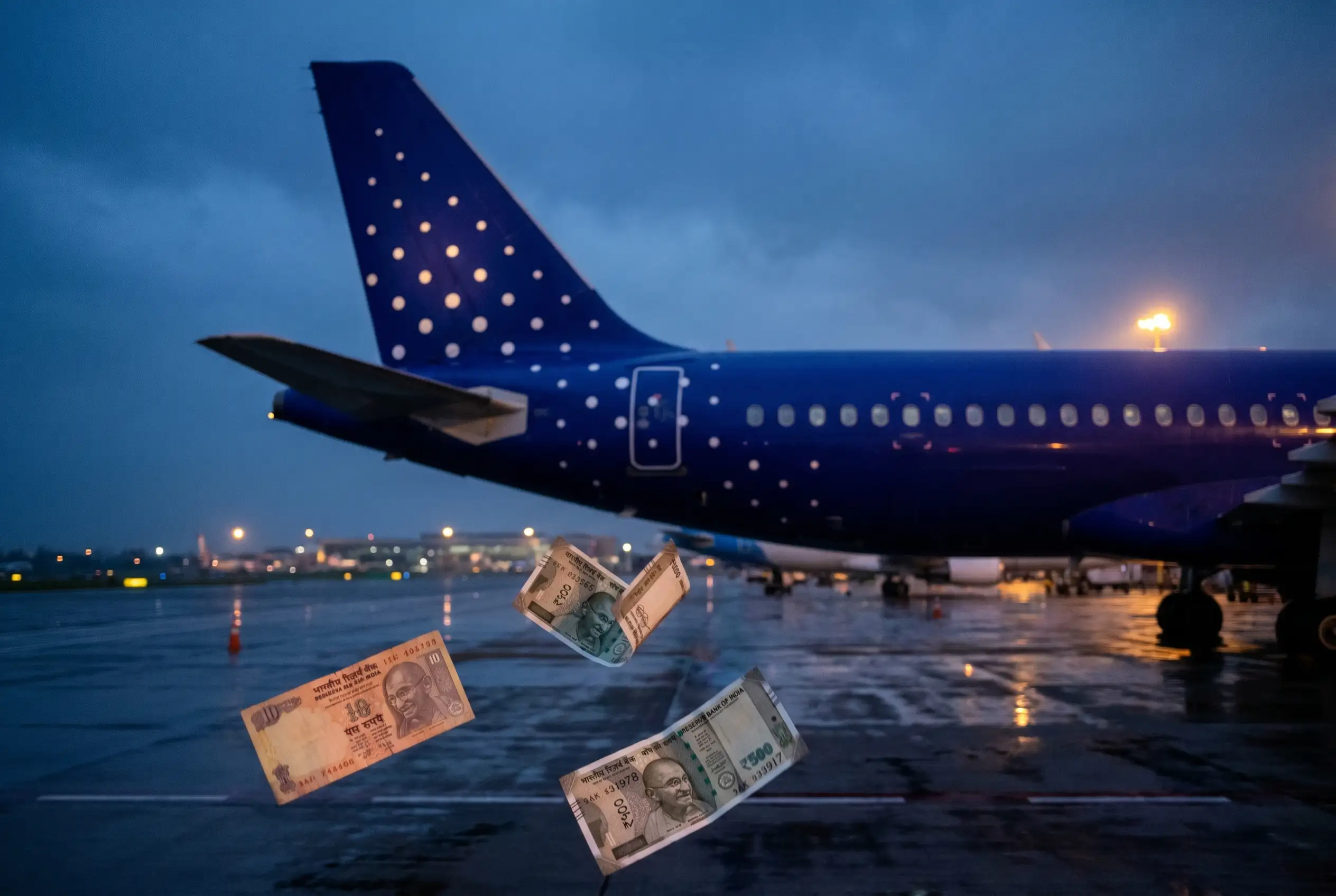
IndiGo, India’s largest airline by passengers carried, reported a full-year net loss of ₹2,393.6 crore for fiscal 2026, its first annual loss in years, after the rupee’s slide to record lows saddled the carrier with a foreign exchange loss of roughly ₹8,100 crore. Strip out that currency revaluation and exceptional items, and the same airline would have booked a profit of ₹7,502.5 crore (about $830 million). The loss is not a sign the business stopped working. It is a sign the currency it pays its biggest bills in moved the wrong way at quarter-end.
The rupee’s drop to 96.89 a dollar tends to get read as an oil-import and inflation problem. The more expensive consequence is landing on corporate balance sheets stacked with long-dated dollar obligations, and an airline that leases its jets in dollars is where it shows up first and largest.
₹8,100 Crore in Currency Losses Buried the Operating Year
For the March quarter, InterGlobe Aviation, the listed parent of IndiGo, posted a net loss of ₹2,536.9 crore against a profit of ₹3,067.5 crore a year earlier. Total income still rose about 3% to ₹23,830.7 crore. The swing was almost entirely the rupee. A quarterly forex charge of close to ₹4,820 crore turned what would have been a thin operating profit of around ₹192 crore into one of the carrier’s deepest quarterly losses on record.
Across the full year the pattern repeats on a larger scale. Total income for fiscal 2026 grew 6.4% to ₹89,513.4 crore as the airline flew more seats than ever, yet the bottom line went red. The gap between the two numbers below is the whole story.
| Measure | Q4 FY26 | Full year FY26 |
|---|---|---|
| Reported net result | Loss ₹2,536.9 cr | Loss ₹2,393.6 cr |
| Result excluding forex and exceptional items | Profit ₹192.06 cr | Profit ₹7,502.5 cr |
| Total income | ₹23,830.7 cr (up ~3%) | ₹89,513.4 cr (up 6.4%) |
| Year-ago net result | Profit ₹3,067.5 cr | Profit |
Full detail sits in the company’s quarterly financial results on IndiGo’s investor relations site. The headline you read this week was the loss. The number that actually describes the business is the one beside it.
Why the Rupee Slid From 87 to 96.89
The currency that did the damage has been in steady retreat since late February, when conflict in West Asia reset global oil and capital flows. The rupee has fallen close to 6% from near 87 a dollar to a record 96.89 on May 20, just above the prior all-time low of 96.6150 set a day earlier.
Four forces are pulling in the same direction at once:
- Brent crude has surged more than 50% since the conflict began, from the low-$70s to roughly $109 to $110 a barrel, and India imports close to 88% of the oil it burns, paid in dollars.
- Foreign portfolio investors (FPIs, overseas funds that buy Indian shares and bonds) have pulled more than $22 billion out of Indian markets since late February, selling rupees to take dollars home.
- Every $10 rise in Brent adds an estimated $14 billion to $15 billion to India’s annual import bill, widening the trade gap that the currency has to absorb.
- The Reserve Bank of India (RBI, the country’s central bank) has been spending reserves to slow the fall, which caps the pace but not the direction.
The defence is visible in the numbers. India’s foreign exchange reserves stood at $681.4 billion in the week to May 22, down about $7.5 billion in a single week, and roughly $37 billion off their peak, according to the RBI’s weekly statistical supplement on reserves. Markets covered the same trajectory in detail when the rupee first cracked the 96 mark on the oil shock and again as domestic SIP inflows absorbed the foreign exit behind the slide.
Aircraft Leases and the Math of a Non-Cash Loss
Here is where the second-order effect lives. IndiGo flies one of the world’s largest narrow-body fleets, and almost all of those jets sit on its books as leases denominated in US dollars, alongside dollar liabilities tied to engine maintenance reserves. Those obligations stretch eight to ten years into the future.
Accounting rules force the airline to restate the rupee value of that entire future dollar liability every time it closes its books. When the rupee weakens 6% in a quarter, the rupee cost of paying off dollars owed years from now jumps, and the difference flows straight through the profit-and-loss statement as a loss, even though not a single extra rupee left the company this quarter.
That is the part the headline misses. The ₹8,100 crore figure is overwhelmingly a paper revaluation, not cash that walked out the door.
- ₹8,100 crore in full-year foreign exchange losses, the bulk of it non-cash mark-to-market on lease and maintenance liabilities.
- 8 to 10 years is the tenure over which those dollar obligations are actually paid, so the charge is spread far beyond this fiscal year.
- 441 aircraft in the fleet at the end of March, almost all leased and priced in dollars.
The flip side matters too. If the rupee recovers even part of its fall next year, a chunk of this charge reverses into a gain. The loss is loud, but it is also reversible in a way an operating loss never would be.
Beneath the Loss, IndiGo’s Busiest Year Yet
The operating story behind the red ink is, oddly, one of strength. Capacity rose 9.5% over the year, the airline carried more than 123 million passengers, and its domestic market share held around 63.3% in March. The adjusted profit of ₹7,502.5 crore reflects an aviation business running at scale, not one in distress.
FY26 was marked by an exceptionally challenging operating environment.
That assessment came from Rahul Bhatia, IndiGo’s managing director and co-founder, summing up a year that threw more than currency at the carrier. New labour-law implementation added about ₹1,200 crore in costs, a wave of December flight disruptions cost roughly ₹580 crore, and grounded jets from Pratt & Whitney engine issues hovered near 40 before easing. Those disruptions also drew regulatory heat, including a record ₹22.2 crore penalty over the December flight chaos.
None of that, individually, would have pushed the airline to a yearly loss. Stacked on top of the forex revaluation, they turned a strong commercial year into a reported deficit. The business grew; the accounting line that translates dollars into rupees did the rest.
Hedging Cover Triples to $3 Billion
The company’s answer is to buy more protection. IndiGo is widening its foreign exchange hedging programme, lifting its hedge target from about $1 billion to $3 billion, with part of that exposure spread across a two-to-five-year window rather than left fully open to spot moves. The aim is to blunt the kind of quarter-end swing that just hit the books.
Forward guidance, meanwhile, stays cautious. The carrier flagged capacity growth of only 3% to 4% for the first quarter of fiscal 2027, a sharp deceleration from the 9.5% it added last year, signalling it would rather protect yields than chase seats into an uncertain demand and cost backdrop.
Where the rupee goes next decides whether the hedge looks prudent or expensive. Amit Pabari, managing director at CR Forex Advisors, has pointed to 97 as the next technical focus, with little support until the 97.50 to 98 zone beyond it. Live levels track on the Indian rupee market data dashboard, and the RBI’s recent $5 billion dollar-rupee swap auction, which drew bids near $9.8 billion, shows how much defensive firepower is already in play.
If the rupee steadies near current levels through the next two quarters, much of this year’s charge stays a one-off and the operating profit reasserts itself in the reported number. If it grinds toward 98, the same dollar liabilities reprice again, and IndiGo will be explaining another non-cash loss while its planes keep filling.
Frequently Asked Questions
Is IndiGo’s FY26 loss a cash loss?
No. The bulk of the ₹8,100 crore forex loss is a non-cash accounting revaluation of dollar-denominated lease and maintenance liabilities that are actually paid over eight to ten years. Excluding forex and exceptional items, IndiGo earned an operating profit of ₹7,502.5 crore.
What caused the rupee to fall to 96.89 against the dollar?
The rupee hit a record 96.89 on May 20 driven by conflict in West Asia, Brent crude rising more than 50% to around $109 a barrel, and foreign investors pulling over $22 billion out of Indian stocks and bonds since late February.
How much did IndiGo’s operations actually earn in FY26?
Excluding the foreign exchange hit and exceptional items, IndiGo would have posted a profit of ₹7,502.5 crore on total income of ₹89,513.4 crore, with passenger traffic above 123 million and capacity up 9.5%.
Why does a weak rupee hurt IndiGo more than most companies?
Almost all of IndiGo’s 441 aircraft are leased in US dollars, and its maintenance reserves are dollar liabilities too. When the rupee falls, the rupee value of those future dollar obligations jumps, and the difference is booked as a loss at quarter-end.
What is IndiGo doing to manage currency risk?
The airline is expanding its hedging programme, raising the target from about $1 billion to $3 billion, and spreading part of that cover across a two-to-five-year horizon to reduce exposure to sudden spot-rate swings.
Disclaimer: This article is for informational purposes only and is not investment advice. Securities and currency markets carry risk, and figures cited are accurate as of publication on May 30, 2026. Readers should consult a qualified financial adviser before making investment decisions.