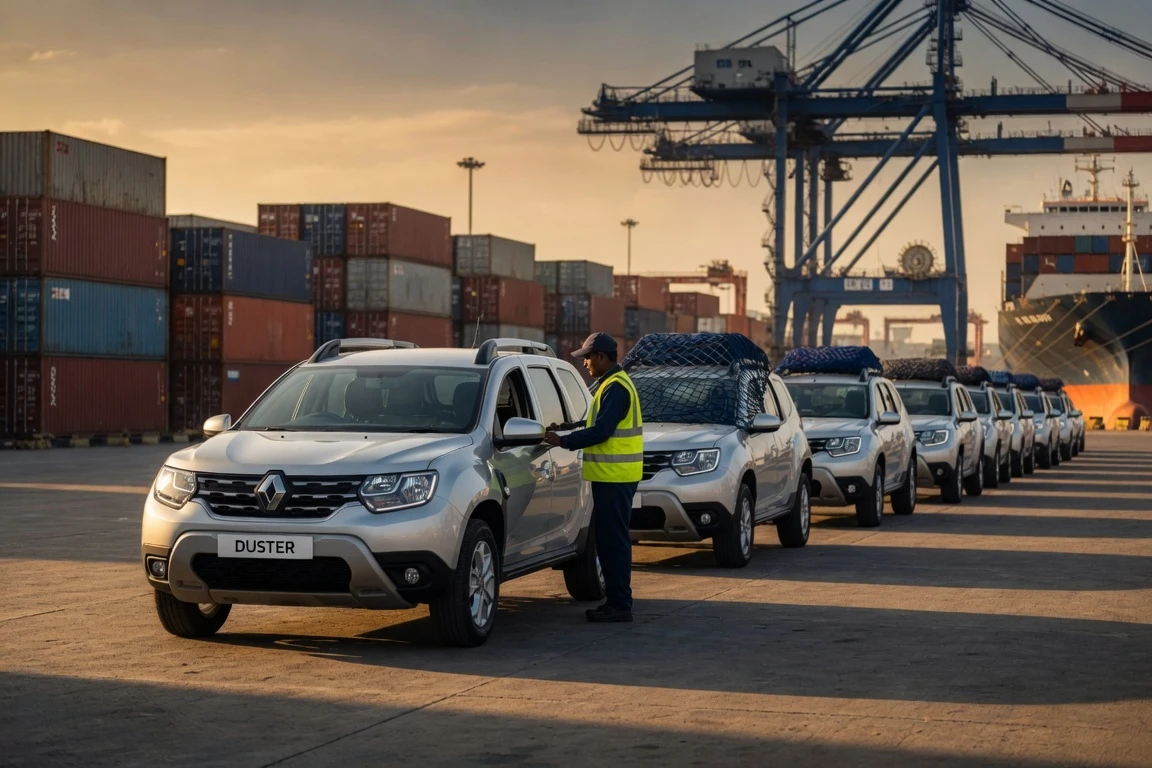
Renault has begun exporting the new Duster from India, shipping 750 units from Chennai Port to South Africa this week as the first batch of a wider international program. Stéphane Deblaise, CEO of Renault Group India, called the shipment a validation of the company’s Chennai manufacturing base.
The run opens a push that targets €2 billion in annual exports from India by 2030, anchored on the futuREady India strategy unveiled in April. Renault also wants India among its top three global markets by 2030, plans to grow the India line-up to seven models, and has set a market share goal of about 5%. François Provost, CEO of Renault Group, told CNBC TV18 the carmaker “could not put enough attention on India in the past 3-4 years… now it’s time to move outside Europe and India is the first priority.”
First 750 Dusters Cross to South Africa
The first shipment, comprising 750 units of the new Duster, departed Chennai Port bound for South Africa. It is the first export run of the new-generation Duster since the model returned to India on 26 January 2026. Renault said additional international markets will begin receiving India-built Dusters in the coming months.
Deblaise said the start of exports “validates the quality, competitiveness and manufacturing capabilities of Renault’s Chennai facility” and signals the Group’s confidence in its Indian manufacturing base. The export run sits inside a broader Renault Group’s August 2025 statement on its India buildout, in which the parent took full control of the Chennai plant. The first batch is small in absolute terms. It is the first move of a larger wager that places India at the centre of Renault’s international growth plan, and the model behind it ties back to the car that the 2026 Renault Duster reveal from earlier this year first put back on sale in India.
- 750 units in the first shipment
- Origin: Chennai Port, India
- Destination: South Africa
- India starting price: INR 10.49 lakh
- 5,000 units: Duster India sales milestone hit earlier this month
The €2 Billion Wager Behind the First Shipment
Renault has set a target of generating €2 billion in annual exports from India by 2030. The figure sits at the centre of the futuREady India strategy, announced on 16 April 2026, and covers vehicles, components and R&D services flowing out of the country. Renault already employs around 6,000 engineers in Chennai, and the 2030 ambition explicitly aims to position India among Renault’s top three global markets. Provost framed the moment as a catch-up, telling reporters the Group had “could not put enough attention on India in the past 3-4 years” and that India is now the first priority outside Europe. He has also said Renault is targeting about 5% India market share while explicitly avoiding volume-led growth.
The target is meant to be hit through a seven-model India portfolio by 2030 spanning internal combustion, hybrid, electric and CNG powertrains, paired with up to 90% localisation to drive cost competitiveness. Renault is also repositioning the country as a centre of engineering and design rather than only a market, with a 15,000-strong India workforce and full ownership of the Chennai plant now consolidated under the Group. The strategy builds on the Renault Group case for India as a global auto hub, in which the company lays out India as one of five strategic international hubs.
As Renault continues to expand its international footprint, India will play an increasingly strategic role in our future plans.
Stéphane Deblaise, CEO of Renault Group India, said in a statement issued with the first export shipment.
India as a Pillar, Not a Sideline
In August 2025, Renault Group acquired Nissan’s remaining 51% stake in the Chennai plant, Renault Nissan Automotive India Pvt Ltd, becoming its sole owner and consolidating RNAIPL into the Group’s accounts. The deal turned India from a joint venture into a wholly owned subsidiary and gave Renault full control of an industrial base it had been sharing with its alliance partner since 2010.
The Chennai plant has track record. Since launch in 2010, it has produced over 2.8 million vehicles, of which 1.2 million were exported to more than 100 countries. It has also built 4.6 million engines and gearboxes, supported by an ecosystem of nearly 300 local suppliers. The export muscle the new Duster program is meant to scale was already in the building. The new Duster itself was designed in Renault’s Chennai design studio, with Indian and European teams working side by side, and was the first Renault model in India to integrate Google Automotive Services.
Today’s footprint in India runs through the Oragadam plant, with an annual production capacity of 480,000 units, more than 350 sales outlets and 450 service points across the country, and around 6,000 engineers based in Chennai. The Group inaugurated its largest design centre outside France in 2025. Renault has named India as one of five strategic hubs alongside Morocco, Turkey, South Korea and Latin America, the brand’s Renault International Game Plan 2027 framework.
The corporate setup sits inside an auto industry in flux. India overtook Japan in 2025 to become the world’s third-largest automotive market, behind China and the United States. In just over a decade, the share of SUVs in India has surged from 12% to more than 50%. The new Duster was tuned for that body-style shift, with 17 Advanced Driver Assistance Systems and a Google-powered cabin aimed at younger Indian buyers, in a market where the regulatory backdrop is itself shifting (see where Indian car makers are split on emission rules).
RGMP Platform and a 5-Star Safety Score as Export Credentials
The new Duster is the first Renault vehicle in India built on the Renault Group Modular Platform, or RGMP, an architecture developed to support multiple powertrain technologies and engineered for 5-star safety under extreme conditions. The platform will host a 1.8-litre petrol-electric E-Tech full hybrid joining the line-up by November 2026. Renault Group’s own materials describe the architecture as validated for “extreme conditions” and built around future electrified powertrains.
The safety case the new Duster takes into export markets is a 5-star Bharat NCAP rating across all variants and powertrain options. Adult Occupant Protection scored 30.49 out of 32 and Child Occupant Protection scored 45 out of 49, with assessment carried out in March 2026 and the rating applicable from April 2026 onwards. Seventeen Advanced Driver Assistance Systems are standard across the range. The Duster’s closest rival on the BNCAP scoreboard is the Tata Sierra, and the head-to-head looks like this:
| Test metric | Duster | Sierra |
|---|---|---|
| Adult safety star rating | 5/5 | 5/5 |
| Adult Occupant Protection | 30.49/32 | 31.14/32 |
| Frontal Offset Deformable Barrier | 14.49/16 | 15.14/16 |
| Side Movable Deformable Barrier | 16/16 | 16/16 |
| Child safety star rating | 5/5 | 5/5 |
| Child Occupant Protection | 45/49 | 44.73/49 |
| Dynamic child score | 24/24 | 23.73/24 |
The two rivals take different routes to the same five-star result. Tata’s SUV pulls ahead on adult occupant protection and frontal offset performance, while the Renault edges the Sierra on child protection, posting a perfect 24 out of 24 in the dynamic child score. Detailed scoring is published on the Duster’s Bharat NCAP test score breakdown.
Demand at Home Tells a Mixed Story
The new Duster outsold the Triber in April 2026 to become Renault India’s No. 1 model in only its second month on sale. The SUV moved 1,402 units in March and 2,359 in April, a 68% month-on-month rise that took the two-month total to 3,761 units and gave the Duster a 36% share of Renault India’s PV sales of 10,459 across March-April. Renault India itself dispatched 5,413 PVs in April, the company’s highest monthly wholesales in 36 months, against 2,602 in April 2025.
Even so, the scale is small. Renault India’s PV market share was 0.88% in FY2025 and 0.90% in FY2026, and the 5,000-unit Duster milestone reached earlier this month is a tiny fraction of the segment the car is chasing.
The launch sits against a much larger legacy. Renault India’s peak year was FY2017, when it sold 135,123 units and held a near-4% PV market share, driven by the first-gen Duster and the Kwid. The original Duster, launched in 2012, sold an estimated 199,871 units in India over a decade, peaking at 46,786 units in FY2014 when it held a 9% share of the utility vehicle market. The new model’s 5% market share target by 2030 sits well above where the brand currently sits, but well below where the original Duster once did. Renault India closed FY2026 with 42,019 units total.
- 5,413 PVs: Renault India April 2026 wholesales (highest in 36 months)
- 2,359 Duster units in April 2026, up 68% MoM
- 3,761 Duster units across March-April 2026 (36% of Renault India PVs)
- 199,871 original Duster units sold in India over a decade
- 135,123 units: Renault India FY2017 peak, near-4% PV share
- 0.90% Renault India PV market share in FY2026
From South Africa to a Wider Export Map
South Africa is the first destination, not the only one. Renault Group’s own feature on the Duster says the SUV will “continue its journey to South Africa and the Middle East” as part of the wider program, with the export map covering vehicles, components and R&D services out of India.
The product pipeline out of Chennai is laid out in print. A Duster 7-seater version is planned for later this fiscal year. A sub-4 metre Bridger SUV is scheduled for a 2027 Diwali launch. The wider plan is to grow the India line-up to seven models by 2030, spanning internal combustion, hybrid, electric and CNG powertrains and built on two complementary platforms, RGMP small and RGEP, both designed with the Indian market in mind. The 1.8-litre petrol-electric E-Tech full hybrid will join the Duster line-up by November 2026.
The home-market battlefield is crowded. The midsize SUV segment the new Duster enters includes the Hyundai Creta, Kia Seltos, Tata Sierra, Maruti Victoris, Maruti Grand Vitara, Toyota Hyryder, Honda Elevate, Skoda Kushaq and Volkswagen Taigun. Renault’s wager is that the same Chennai plant that built 2.8 million vehicles since 2010 can ship them to South Africa, the Middle East and beyond in volumes large enough to fund a €2 billion export line by 2030.
- South Africa: first export market, June 2026
- Middle East: next confirmed market
- Duster 7-seater: later this fiscal year
- Sub-4m Bridger SUV: 2027 Diwali launch
- E-Tech full hybrid: Duster line-up, November 2026
- Seven-model India portfolio: target for 2030
Frequently Asked Questions
What is the new Renault Duster export from India?
Renault dispatched 750 units of the new Duster from Chennai Port to South Africa in June 2026, the first export run of the model since it returned to India on 26 January 2026. Renault India began customer dispatches of the car on 17 March 2026, with factory output then ramping to 4,466 units in April alone.
What is Renault’s export target from India by 2030?
Renault is targeting €2 billion in annual exports from India by 2030, including vehicles, components and R&D services. The figure sits inside the futuREady India strategy unveiled on 16 April 2026 and is paired with a goal to make India one of Renault’s top three global markets and to grow the India line-up to seven models.
Which markets will receive the India-made Duster?
South Africa is the first confirmed export market for the new Duster. Renault Group has said the SUV will also be shipped to the Middle East as part of the wider program, with additional international markets to be added in the coming months. Renault has not yet published a full country list.
Is the India-made Duster safe enough for export markets?
The new Duster holds a 5-star Bharat NCAP rating across all variants and powertrain options, tested in March 2026 and rated from April 2026 onwards. Adult Occupant Protection scored 30.49 out of 32 and Child Occupant Protection scored 45 out of 49. Seventeen Advanced Driver Assistance Systems are standard across the range.
How much does the new Renault Duster cost in India?
The new Duster is priced from INR 10.49 lakh to INR 18.49 lakh ex-showroom in India. The line-up currently runs on 1.0-litre and 1.3-litre turbo-petrol engines, with a 1.8-litre petrol-electric E-Tech full hybrid powertrain scheduled to join by November 2026.