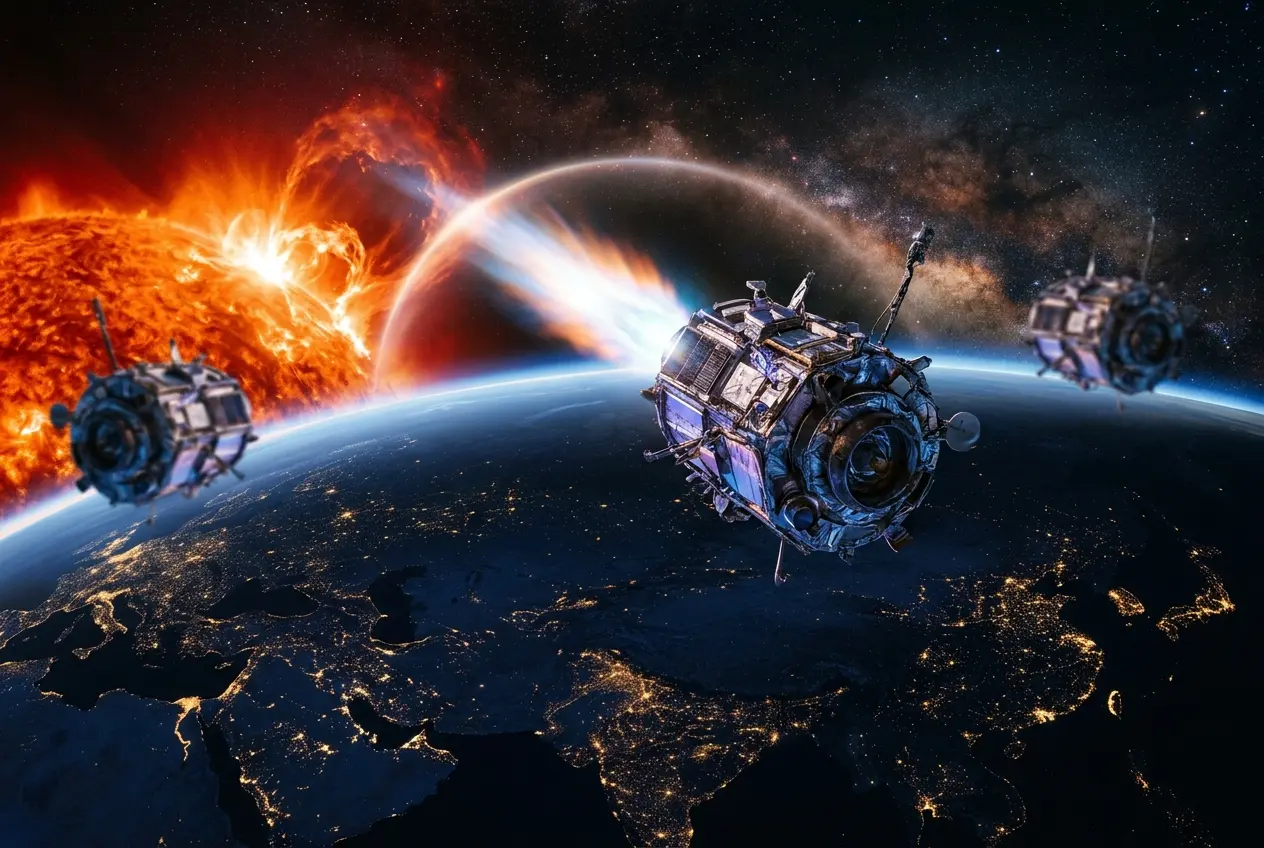
A Boston University-led team has proposed a satellite-based solar storm defense that simulations show could cut a major solar storm’s intensity by more than half. The concept, named StormWall, appears in a paper published on June 2, 2026 in the journal Space Weather by mechanical engineer Brian Walsh with Dan Welling and Zhenguang Huang of the University of Michigan. The system would release material at the edge of Earth’s magnetosphere, mimicking a process the planet’s own atmosphere already performs on a smaller scale.
The proposal lands at a moment when the May 2024 Mother’s Day storm already exposed how vulnerable farming, aviation, and satellite operations have become to space weather. That storm cost US farmers more than $500 million in GPS-guided planting losses, disrupted landing guidance at roughly 2,000 US airports for three days, and pushed nearly 5,000 satellites into unplanned maneuvers. Walsh’s team argues the same kind of active defense could blunt what is coming, at a launch cost the team compares to NASA’s $4 billion Artemis II crewed lunar mission.
What StormWall Is and How It Would Work
Boston University mechanical engineer Brian Walsh has spent several years studying whether humanity could build a defense against major solar storms. His team, working with Dan Welling and Zhenguang Huang of the University of Michigan, has proposed a system they call StormWall. The plan calls for a constellation of spacecraft to release material at the edge of Earth’s magnetosphere, mimicking a process the planet’s own atmosphere already performs on a smaller scale.
| Specification | Detail |
|---|---|
| Spacecraft | Six in geosynchronous orbit |
| Mass-loading material | Alkaline element such as barium or lithium |
| Total payload | Roughly equivalent to a dozen oil trucks of material |
| Reusability | One and done; payload cannot be replenished |
| Status | Computer simulation only |
Magnetic reconnection is the gateway by which energy comes from the Sun into Earth’s space environment, Walsh told Physics World. The process works when magnetic field lines from the solar wind and from Earth’s own field snap together under pressure from a storm, depositing the storm’s energy into the magnetosphere. The rate of that energy transfer depends on magnetic field strength working against plasma density: the stronger the field and the thinner the plasma, the more energy crosses in. StormWall releases material at the sun-facing edge of the magnetosphere specifically to thicken that plasma layer. The team’s simulations showed total field-aligned currents being drastically reduced, a finding the paper frames as the ability to shut down solar wind-magnetosphere energy transfer.
The team’s material list leans on elements that photoionize quickly in sunlight, a property Walsh calls the most important. Salt water is among the candidates under study, with each option storable on board as a solid or a liquid and vaporized on command once a storm is inbound. The team is still working out which specific element best balances photoionization rate, storability, and cost per kilogram. Walsh said a larger constellation of smaller spacecraft carrying less material per craft might ultimately prove more efficient than the six-spacecraft baseline.
The 50% Number, Tested Against the May 2024 Storm
The paper’s headline figure, a 50% or better reduction in storm intensity, comes from simulations rather than measurements. The team ran two parallel global magnetohydrodynamic models of the May 2024 Mother’s Day storm: one with Earth’s magnetosphere under normal conditions, and one with a virtual StormWall fleet releasing mass-loading material at the dayside boundary. The shielded run showed the energy transfer from solar wind to magnetosphere effectively throttled.
Boston University framed the result as showing that “the intensity of a major geomagnetic storm could be actively reduced by 50 percent or more, protecting technology and human life.” Space.com, reporting on the same paper, wrote that the team’s simulations showed StormWall “could reduce its intensity by more than 50%.” Physics World summarized the same finding as the artificial plasma buffer “cutting the intensity of a solar storm by half as the bulk of the solar plasma is diverted around us, in the same way that stream-water flows around a stone.” The proposal lands in a research lineage in which active mitigation of space weather has been almost entirely theoretical, and the paper itself frames the work as a fundamental departure from the standard playbook.
What a Real Storm Already Cost in May 2024
The Mother’s Day storm of May 10 and 11, 2024 was the strongest geomagnetic event to hit Earth in more than two decades. It reached a peak Dst index of -412 nT, making it the most intense G5-class storm since the 2003 Halloween solar storms and the strongest to affect Earth since the March 1989 event. By the time the storm cleared on May 13, it had compressed Earth’s subsolar magnetopause from higher than 10 Earth radii down to about 5, drawing the planet’s protective boundary inside the orbits of geosynchronous satellites.
The damage fell hardest on infrastructure that the public rarely sees. GPS-guided tractors in the American Midwest, where 70% of planted acres now rely on automated guidance, drifted off course as the ionosphere over the central United States threw off positioning signals by up to 230 feet. Farmers suspended planting for days; Terry Griffin, an agricultural economist at Kansas State University, put the corn-belt losses at more than $500 million. The Wide Area Augmentation System, the FAA network that helps aircraft descend within 200 feet of a runway at roughly 2,000 US airports, lost its Localized Performance with Vertical Guidance feature for three days.
In orbit, GOES-16, the primary operational geostationary weather satellite covering the Americas, stopped transmitting all data at 00:19 UTC on May 13 and stayed dark for nearly two hours. Starlink’s low-Earth-orbiting fleet degraded but stayed operational. Roughly half of the approximately 10,000 payloads in low-Earth orbit, mostly Starlink satellites, performed what became the largest satellite migration on record, with nearly 5,000 satellites propelled to higher altitudes by autonomous guidance systems firing thrusters. New Zealand’s Transpower declared a grid emergency and took some transmission lines out of service as a precaution.
Researchers have estimated a return period of 12.5 years for events of the May 2024 magnitude, a cadence shorter than most grid-hardening budgets assume. The Mother’s Day event came in as the strongest G5-class storm since 2003 and still exposed single points of failure across systems society treats as redundant. The Boston University team picked the May 2024 storm as the test case for StormWall in part because its scale is something modern infrastructure can survive, while still being close enough to a future Carrington-class storm to be informative.
| Storm | Year | Peak Dst | Headline impact |
|---|---|---|---|
| March 1989 | 1989 | -589 nT | Nine-hour Quebec blackout |
| Halloween solar storms | 2003 | -383 nT | Satellite anomalies, drag on early commercial constellations |
| Mother’s Day / Gannon | 2024 | -412 nT | $500M US farming loss; 5,000 satellites maneuvered |
| Carrington Event | 1859 | -800 to -1,750 nT | Telegraph wires caught fire |
The Six-Hour Window and the One-and-Done Catch
The biggest engineering constraint in the proposal is also its most counterintuitive feature: StormWall is a single-use system. Once the spacecraft release their mass-loading material and sunlight ionizes it, the system is dead and cannot be replenished, Walsh told Boston University’s announcement of the work, calling the design “one and done.” That makes each launch a consumable: a working shield for one storm, after which the fleet has to be replaced before the next major event.
The plasma itself does not linger long. Once it has done its work, the magnetosphere flushes the material out within about six hours, Walsh said, and the system is empty. That tight residence time forces the deployment to be timed almost perfectly with the arrival of a coronal mass ejection, the giant plasma cloud hurled from the Sun’s outer atmosphere. Releasing too early means the protective plasma is gone before the storm; releasing too late means the storm has already coupled into the magnetosphere.
The timing problem is compounded by the same limitation that has defined solar storm science for decades: predicting when a coronal mass ejection will arrive. NOAA’s Space Weather Prediction Center currently forecasts CME arrival times to within about 10 hours of accuracy, according to a study by MIT researchers William Parker and Richard Linares. StormWall’s six-hour plasma lifetime leaves almost no margin against that kind of forecast error. Walsh and his team are studying whether a pulsed release of smaller batches of material could stretch the effective lifetime, and whether more efficient orbits might buy a wider release window.
- The payload is single-use; the spacecraft are empty after firing.
- The plasma drifts out of the magnetosphere within about six hours.
- Current CME-arrival forecasts are accurate to roughly 10 hours.
The Price Tag and the Stakes
Walsh’s estimate puts StormWall’s launch costs in the same region as NASA’s $4 billion Artemis II crewed lunar mission, possibly a little less, per Physics World’s reporting on the proposal. The bill covers the launch capacity required to put the full fleet into geosynchronous orbit in one campaign. With private companies investing billions in orbital infrastructure, including planned data centers in space, Walsh expects the cost-benefit ratio to eventually favor building a shield.
Those numbers sit against an exposure that the same team argues makes the spending math work. A Carrington-class storm today would cause power grid damage alone that tops $2.4 trillion, per the team’s own paper. The May 2024 Mother’s Day event exposed how vulnerable agriculture and aviation have become to even moderate space weather. Walsh said the contrast makes the case for active defense, even with StormWall’s price tag.
Why Nobody Has Tried This Yet
Active defense against solar weather has been largely absent from government planning, despite repeated warnings. The US Department of Homeland Security, in a 2018 assessment of the threats Americans were not paying attention to, listed a pandemic at number one and a solar storm at number two. Walsh said the global response since has stayed small: “There is a very small United Nations group that thinks about this, but there’s little action.” Most current resilience work focuses on hardening satellites and rerouting power grids, what Walsh dismisses as “Band-Aids” that do nothing about the underlying storm. NOAA’s Space Weather Prediction Center did lead what its own forecaster Shawn Dahl called “the most prepared for and successfully mitigated extreme space weather storm in history” during the May 2024 event, but that preparation was procedural, not architectural.
The academic path to StormWall started in a quieter place. Walsh runs Boston University’s Space Physics & Technology Lab, where most of the work is observational, and he recently helped send a telescope to the Moon to image Earth’s magnetic shield. The StormWall proposal grew out of noticing that Earth’s atmosphere itself leaks material into the magnetosphere to bolster it, a natural process Walsh wondered whether he could “turn up, increase the intensity of.” He and his colleagues published the result through Boston University’s announcement of the work and posted the simulation data for public review under submission number 2510.19477.
People have always thought, ‘space is huge, the sun is massive, we just have to sit here and take whatever it gives us.’ But what we found is that we can impact it.
Brian Walsh is an associate professor of mechanical engineering at Boston University and head of the university’s Space Physics & Technology Lab. Dan Welling and Zhenguang Huang of the University of Michigan are co-authors on the StormWall paper, which appeared in the journal Space Weather on June 2, 2026.
From Computer Model to Six Spacecraft
Walsh’s team is not proposing to launch StormWall next year. The Boston University paper documents the enabling physics and stops there, leaving the engineering bridge to a future generation of spacecraft. The paper’s stated purpose is to show that the proposal is feasible with current launch capacity, not to schedule a build.
Even if the engineering work goes smoothly, the political work is harder. A solar storm threatens no single country, since the magnetosphere covers the whole planet and the protective plasma would as well. “If you built it, if it was deployed, it would help all people on the planet,” Walsh said, adding, “You couldn’t make it in a way that helped only one country, one group of satellites.” That makes the project, if it ever flies, more naturally a UN-led or multinational effort than a national one, and a longer negotiation than a single government program. Researchers have put the return period for storms of that magnitude at 12.5 years, with the Mother’s Day event of May 2024 remaining the closest thing to a real-world test case.
- Cut the mass of material required
- Test pulsed release for longer plasma lifetime
- Find more efficient orbits
- Pin down the best chemical element
Frequently Asked Questions
What is StormWall?
StormWall is a proposed system of six spacecraft in geosynchronous orbit, each carrying canisters of an alkaline material such as barium, lithium, sodium, or calcium. Boston University mechanical engineer Brian Walsh and University of Michigan researchers Dan Welling and Zhenguang Huang proposed it in a paper published on June 2, 2026 in the journal Space Weather. When a major solar storm is detected, mission controllers would command the fleet to release the material; sunlight would ionize it into plasma that drifts to the dayside magnetosphere and disrupts magnetic reconnection, the process that lets solar energy into Earth’s magnetic field.
How much of a solar storm could StormWall block?
Global magnetohydrodynamic simulations run by the team indicate that artificial mass-loading of the dayside magnetosphere could reduce the intensity of a major geomagnetic storm by 50 percent or more, per the paper. The researchers tested the concept by simulating the May 2024 Mother’s Day storm twice, once under normal conditions and once with the StormWall plasma shield active, and found the energy transfer from the solar wind to the magnetosphere drastically reduced.
Is StormWall built yet?
StormWall exists only as a computer simulation. The Boston University and University of Michigan team has not built or launched any of the proposed spacecraft, and the paper documents the enabling physics with global magnetohydrodynamic models rather than hardware tests. Walsh said the team is studying ways to cut the mass of material needed, extend the system’s effective lifetime, and pick more efficient orbits before any hardware commitment.
How much would StormWall cost?
Walsh’s estimate puts the total launch cost of StormWall in the same region as NASA’s $4 billion Artemis II crewed lunar mission, possibly a little less. The six spacecraft would together carry roughly the equivalent of a dozen oil trucks’ worth of mass-loading material. Once that payload is fired and ionized, the system would be dead and unable to be replenished, making each deployment a one-and-done shot that has to be replaced with a new fleet for the next storm.
What is the Carrington Event?
The Carrington Event is the most powerful geomagnetic storm on record, a series of solar eruptions observed by British astronomer Richard Carrington in early September 1859 that sent telegraph wires sparking and, in some cases, catching fire. Estimates of its peak disturbance storm time index range from -800 nT to -1,750 nT, far stronger than the -412 nT recorded during the May 2024 Mother’s Day storm. The StormWall team cites an estimate that a Carrington-class storm today would cause more than $2.4 trillion in power grid damage alone.