A galaxy doesn’t announce when it has been knocked sideways. Astronomers at Durham University now say the Milky Way was hit so hard by an incoming dwarf galaxy about 10 billion years ago that its entire disc, the flattened structure holding our Sun, its planets and hundreds of billions of other stars, rotated by more than 90 degrees over the following few hundred million years.
The collision itself is not new news. What is new is the mechanism: supercomputer simulations that finally explain why stars in the Milky Way’s outer halo have always crept along at a fraction of the speed of everything else in the galaxy, and why that sluggishness might trace back to a fight our galaxy had long before it ever had a Sun to keep track of.
The Halo’s Suspiciously Slow Stars
Stars in the Milky Way’s disc, the bright spiral structure most people picture when they think of a galaxy, orbit the galactic center at roughly 220 kilometers (137 miles) per second. That figure comes from years of observations by the European Space Agency’s Gaia mission, which has mapped the positions and velocities of more than a billion stars.
Stars scattered through the Milky Way’s halo, the sparse, ball-shaped cloud that surrounds the disc, move at barely a tenth of that pace: about 25 kilometers per second. Astronomers have puzzled over that gap for years. The halo is mostly built from stars that originally formed in smaller galaxies that wandered too close and were absorbed, so a slower shared rotation hinted at something specific happening during those mergers, without anyone being able to say exactly what.
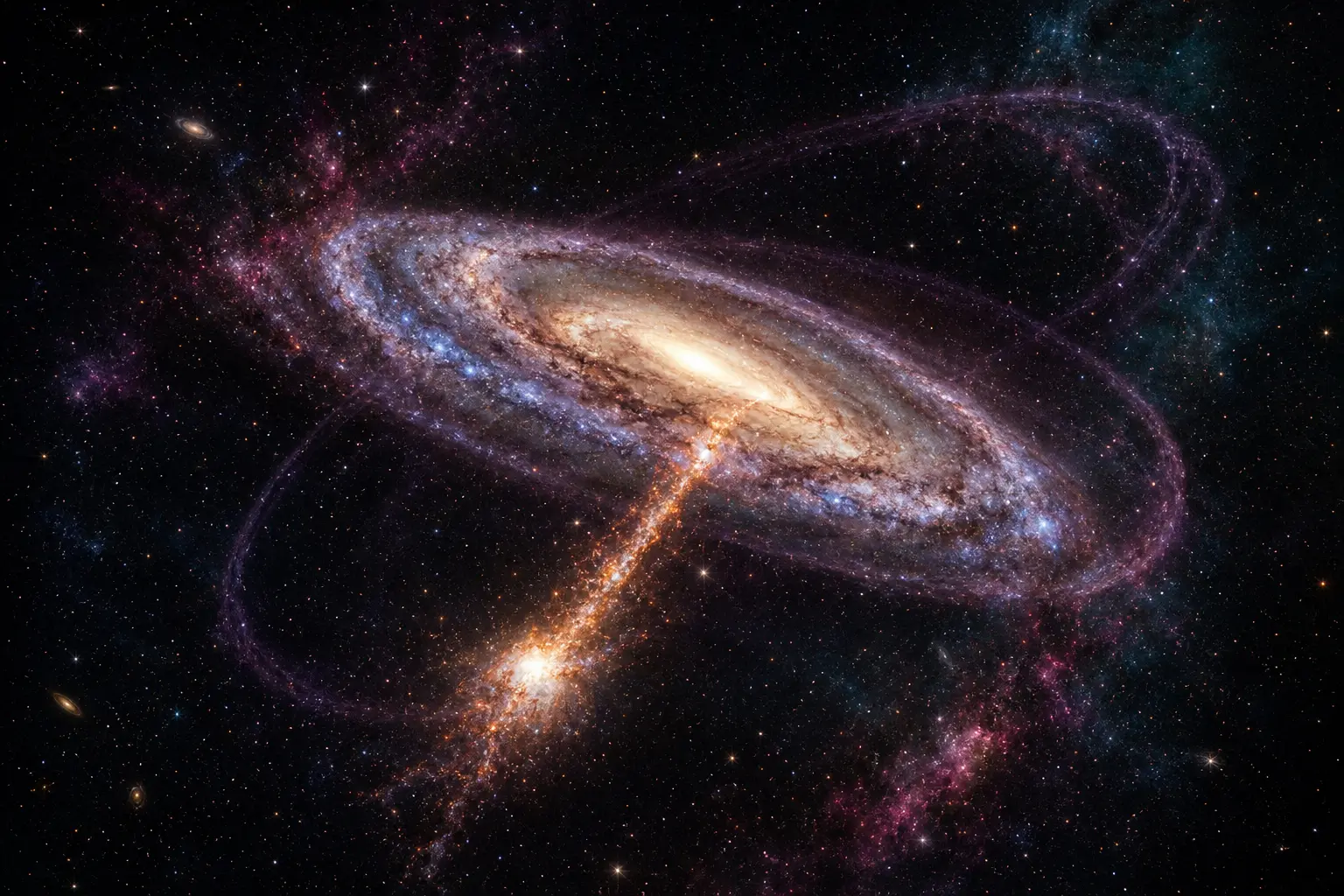
How Durham’s Simulations Found the Flip
Kirill Batrakov, the astronomer at Durham University who led the new research, said the project began modestly. It “started as an investigation of the rotational velocity of the stellar halo,” he said, before it led somewhere he did not expect.
His team ran a suite of cosmological simulations called Auriga, tracking 25 Milky Way-like galaxies as they evolved over billions of years. The pattern that emerged was consistent: galaxies that developed unusually slow-rotating stellar haloes were also the ones that had taken a direct hit from another galaxy early in their history, and had subsequently undergone a dramatic reorientation of their disc.
Certain fingerprints tend to show up together when a galaxy has swallowed a smaller one in the distant past. Astronomers look for a specific set of clues, including:
- Streams of stars whose chemistry marks them as having formed somewhere else entirely
- A gentle, ongoing warp bending the outer disc out of a flat plane
- A stellar halo that rotates far slower than the disc around it
- Stars locked onto extreme, elongated orbits that betray a violent past encounter
The Milky Way shows all four. Applied to a head-on collision with the Gaia Sausage, the simulations pointed to a disc flip. “It probably takes at least a few hundred million years,” Batrakov said of how long the reorientation would have unfolded once set in motion. Separate modeling of the galaxy’s dark matter distribution, posted to the physics preprint server arXiv, reached a related conclusion, describing a dark matter halo twisting vertical at large radii in a way that lines up with the same flip scenario.
A Dwarf Galaxy Named for Its Shape
The dwarf galaxy responsible carries an unusual name for a cosmic wrecking ball: the Gaia Sausage, sometimes called Gaia-Enceladus. Astronomers named it in 2018 after spotting stars tracing a sausage-shaped pattern when plotted by velocity, the signature of matter flung onto extreme, radial orbits during an ancient impact.
At the time of the collision, the Gaia Sausage was no lightweight. Guardian reporting on the discovery put its total mass, including stars, gas and dark matter, at more than 10 billion times the mass of the Sun. Separate research reconstructing the dwarf galaxy from its surviving stars and globular clusters put it at roughly a quarter of the Milky Way’s mass at the moment they collided, a big enough punch to leave a permanent mark.
The Milky Way tore the intruder apart and absorbed it. Many of its stars now populate the halo on those sausage-shaped orbits. Others were flung upward, and a separate press release from the National Astronomical Observatories of the Chinese Academy of Sciences described disk stars heated far above the galactic plane, a process that helped build the Milky Way’s thick disc.
Here is roughly how the timeline lines up:
- About 10 billion years ago: The Gaia Sausage collides head-on with the young Milky Way and begins to break apart.
- The following few hundred million years: The Milky Way’s disc gradually reorients by more than 90 degrees, according to the Durham simulations.
- About 4.6 billion years ago: The Sun and the rest of the solar system form, already inside the reshaped galaxy.
- 2018: Gaia mission data reveal the sausage-shaped stellar orbits and give the ancient merger its name.
- July 2026: Durham University presents the disc flip explanation at the Royal Astronomical Society’s National Astronomy Meeting in Birmingham.
Did the Sun Inherit an Unsettled Galaxy?
Short answer: quite possibly. The Sun formed roughly 4.6 billion years ago, well after the Gaia Sausage collision and the disc flip itself had run their course. But Batrakov’s team suggests the galaxy’s dynamics kept shifting for a long stretch afterward, meaning the neighborhood the Sun settled into may not have stayed put.
A disc flip also means most of the Milky Way’s stars once moved on very different trajectories than they do today.
Batrakov added that the shift may have reached the Sun itself, meaning the solar system’s supposedly stable spot in the galaxy might not have stayed stable across its own entire lifetime.
Orientation shaping outcomes is a familiar idea closer to home, too. Earth’s own tilt outweighing distance in summer heat is a small-scale version of the same principle: how something is angled can matter more than how far it has traveled.
Two More Mergers Already on the Books
The Gaia Sausage was the Milky Way’s last major merger, but it was hardly the galaxy’s only one. Two more are already scheduled, at very different scales.
| Encounter | Timing | Scale | Expected Effect |
|---|---|---|---|
| Gaia Sausage (Gaia-Enceladus) | About 10 billion years ago | Roughly a quarter of the Milky Way’s mass at the time | Triggered the disc flip; built the stellar halo and thick disc |
| Sagittarius Dwarf Galaxy | Already under way | Far smaller than the Gaia Sausage | Adding stars, but limited overall influence |
| Large Magellanic Cloud | Expected in a few billion years | Substantial, but the Milky Way is now much larger | The next major upheaval, not yet modeled in detail |
Batrakov played down the Sagittarius merger already in progress. “It’s not as massive as the Gaia Sausage was, so it is not going to influence the Milky Way as much, and the Milky Way itself is far more massive now than it was back then,” he said.
The Large Magellanic Cloud is the bigger question mark. It is the next major dwarf galaxy expected to merge with the Milky Way, though on a timescale measured in billions rather than millions of years. By the time that happens, the Milky Way will be colliding from a position of far greater mass than it had 10 billion years ago, which is precisely why another full disc flip looks unlikely.
Why This Galaxy Matters to All the Others
Batrakov’s team also found something else buried in the data: the rotation of the stellar halo tracks closely with the rotation of the galaxy’s dark matter halo. That link, described in the stellar and dark matter halo rotating together, suggests the two evolved in tandem as the Milky Way grew by swallowing smaller satellite galaxies.
None of this only matters for one galaxy. Because we live inside the Milky Way, Batrakov said it works as “a key testbed for understanding galaxies more broadly,” since “we can study it in more detail than any other galaxy.” A disc flip does not happen to every galaxy, so confirming one happened here gives astronomers a data point for how similarly sized galaxies elsewhere came together.
It is also a reminder of how small a single galaxy is against the universe’s actual scale. Astronomers have separately cataloged structures like Quipu, a structure 13,000 times the Milky Way’s size, a reminder that even a galaxy-flipping collision is a local event on the largest cosmic scales.
“What excites me the most is that this complex history can be reconstructed just from present-day observations,” Batrakov said.
Frequently Asked Questions
What Is the Gaia Sausage Galaxy?
The Gaia Sausage, also called Gaia-Enceladus, was a dwarf galaxy that collided head-on with the young Milky Way about 10 billion years ago. Astronomers named it for the sausage-shaped pattern its stars trace when plotted by velocity, a signature of stars flung onto extreme, elongated orbits during the impact.
How Is a Disc Flip Different From the Milky Way’s Known Warp?
The Milky Way’s disc already has a documented warp, a gentle, ongoing bend in its outer regions that astronomers have mapped for years. A disc flip is different in scale and kind: a one-time reorientation of more than 90 degrees, triggered by a single ancient head-on collision rather than gradual, continuing bending.
Could the Milky Way’s Disc Flip Again?
It looks unlikely to happen the same way twice. Disc flips in the simulations followed head-on hits from galaxies roughly comparable in mass to the young Milky Way. Today’s Milky Way is far more massive, and both the ongoing Sagittarius merger and the future Large Magellanic Cloud collision involve proportionally much smaller galaxies.
What Happened to the Gaia Sausage’s Stars?
The dwarf galaxy was torn apart and absorbed. Many of its stars now populate the Milky Way’s halo on distinctive sausage-shaped orbits, while others were dynamically heated far above the galactic plane, contributing to the formation of the Milky Way’s thick disc.
How Long Does a Galactic Disc Flip Actually Take?
According to Batrakov, a disc flip probably takes at least a few hundred million years once triggered. That sounds enormous by human standards, but it is a relatively short stretch against the roughly 13-billion-year history of the Milky Way itself.