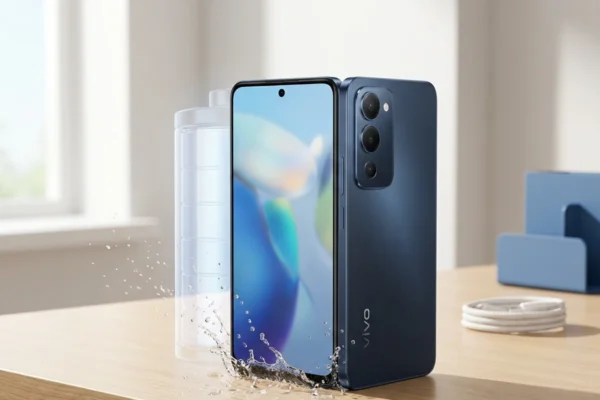
Lava International has revealed almost everything about its new Virat V1 phones, except what they will cost. The Noida-based handset maker released full specifications for the Virat V1 5G and Virat V1 on Saturday, six days before both launch exclusively on Flipkart on July 24.
The reveal lands as a global memory chip shortage pushes smartphone prices higher across every price band in India, hitting hardest exactly where Lava has staked its comeback: phones that sell for less than ₹15,000.
Every Spec but the Price
Lava will hold a launch event on July 24, when it says pricing for both phones will finally go public just before they go on sale through Flipkart. Nothing else about the two phones is a mystery.
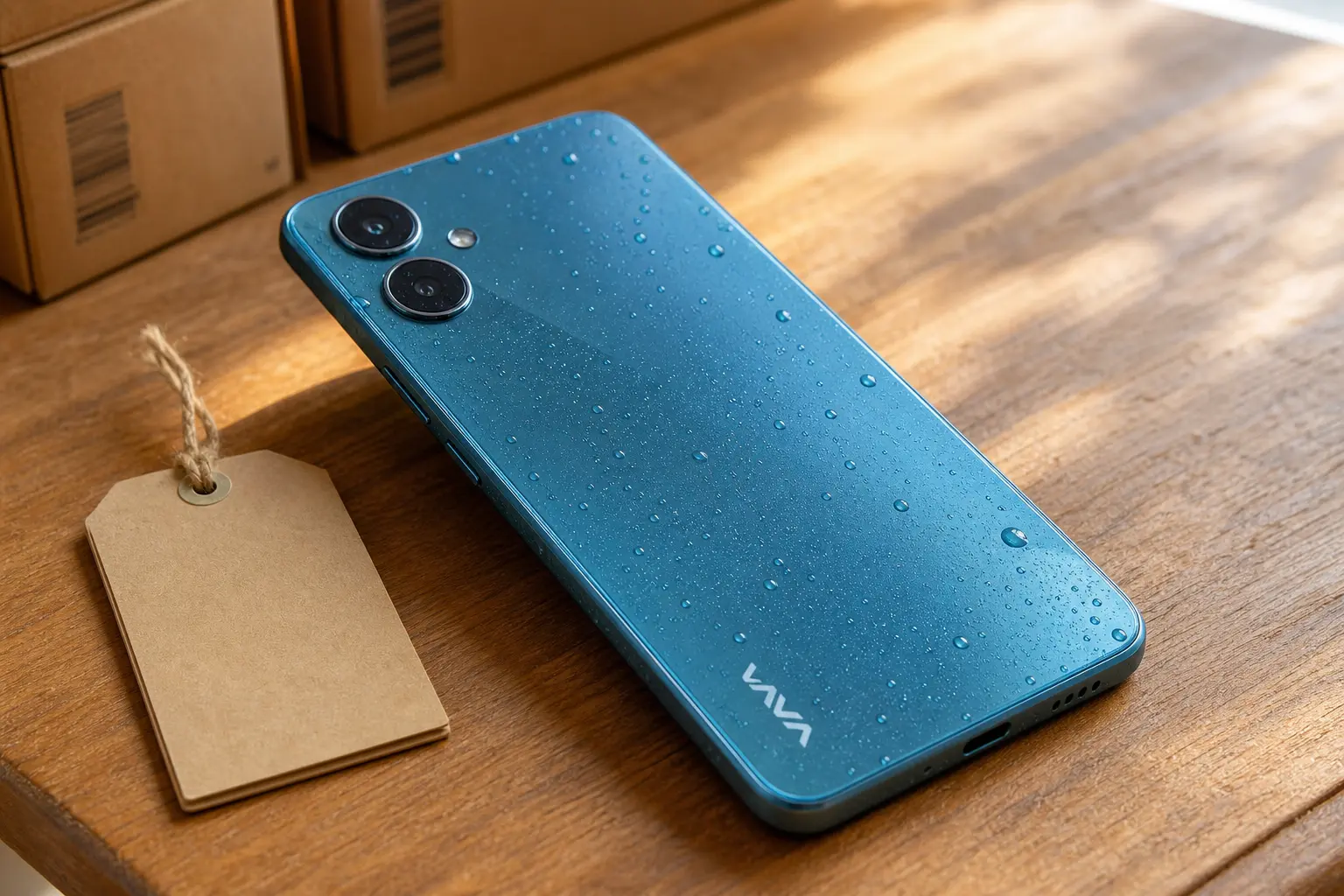
The Virat V1 5G carries a 6.75-inch HD+ display running at a 120Hz refresh rate, a 6,000mAh battery and an IP64 rating for dust and splash resistance. It runs on the UNISOC T8200 chipset with 4GB of RAM, expandable with another 4GB of virtual memory, and 64GB of storage. A 13MP AI dual rear camera and a 5MP front camera handle photos, and the phone ships without pre-installed apps or advertising. It comes in Arya Blue and Sonar Gold.
The standard Virat V1 keeps the same screen, cameras, RAM and storage. It swaps in the older UNISOC SC9863A chipset and a smaller 5,000mAh battery, and it comes in Nilgiri Blue and Himalayan Silver instead.
| Spec | Virat V1 5G | Virat V1 |
|---|---|---|
| Display | 6.75-inch HD+, 120Hz | 6.75-inch HD+, 120Hz |
| Processor | UNISOC T8200 | UNISOC SC9863A |
| RAM | 4GB + 4GB virtual | 4GB + 4GB virtual |
| Storage | 64GB | 64GB |
| Battery | 6,000mAh | 5,000mAh |
| Rear camera | 13MP AI dual | 13MP AI dual |
| Durability | IP64 | IP64 |
| Colours | Arya Blue, Sonar Gold | Nilgiri Blue, Himalayan Silver |
Both phones carry the same IP64 rating and the same Free Service@Home coverage, Lava’s doorstep repair programme, despite the gap in price the two chipsets suggest is coming.
A Recycled Chip Headlines the 5G Model
The UNISOC T8200 doing the work in the 5G model is not new silicon. Notebookcheck lists it as a rebadged T765, built around two 2.3GHz Cortex-A76 cores and six 2.1GHz efficiency cores on a 6-nanometer process.
UNISOC’s own marketing for the chip touts support for up to 108-megapixel cameras and 4K video, a 120Hz display and dual-SIM 5G, features that show up almost line for line in Lava’s spec sheet.
This is not the first time UNISOC has recycled a chip under a new badge. The T8100 launched the same way, as a rebrand of the older T760. In real-world terms, the T8200 sits close to Qualcomm’s Snapdragon 695 and MediaTek’s Dimensity 6100+, with AnTuTu scores landing around 460,000. That is fine for everyday apps and casual gaming. It is not new ground.
Why Is India’s Budget Phone Segment Under Pressure?
India’s budget phone segment is under pressure because a worldwide shortage of memory chips, the DRAM and NAND flash inside every phone, has pushed component costs sharply higher. Data centres racing to build AI capacity have soaked up much of the world’s chip supply, and the International Data Corporation (IDC) now expects average smartphone prices to climb 14% in 2026.
- 14% price rise: IDC’s forecast for average smartphone retail prices this year as memory costs bite.
- 1.12 billion units: IDC’s global 2026 shipment forecast, down from 1.26 billion units in 2025.
- Weakest since 2013: how analysts describe the second quarter of 2026 for global shipment volume.
IDC’s Francisco Jeronimo has described the crunch as a structural shift in how the supply chain allocates memory, not a passing blip that eases on its own.
India’s own smartphone shipments fell 10% year-on-year in the June quarter, Counterpoint data show, extending a slide that began earlier in the year. This is the market Lava is asking buyers to spend in, days before it names a number.
Lava’s Climb From Under 2% to a 10% Target
Lava’s own numbers explain why it keeps talking. Managing Director Sunil Raina told reporters in Kolkata last month that the company holds well under 2% of India’s smartphone market today, a share built on a 40 to 50% compound annual growth rate over the past four years.
The prize is the sub-₹30,000 (about $340) category, which Raina says makes up 70 to 75% of the roughly 150 million smartphones India sells every year.
We are targeting 10 per cent market share in this category of smartphones by 2030.
Raina said, describing the goal for that specific price band.
The company’s smartphone ambitions were not always this steady. Raina has said Lava paused them after 2017, when the segment turned brutal for homegrown brands, and restarted only in 2022. Lava is also preparing an Agni-series launch in the United Kingdom, its first entry into Europe, while weighing expansion into African markets too.
Vivo, Xiaomi and the Rest of the Field
Lava is not climbing into an empty field. Vivo remains India’s top smartphone brand by shipments, with Samsung in second place, while Chinese-owned rivals such as Xiaomi and Oppo still command scale and offline reach that Lava has yet to match. Vivo’s own share slipped from 19.2% to 17.8% year-on-year in the same quarter, though it kept the top spot.
At the exact spec tier Lava is targeting, rivals already sell close to the ₹9,999 mark. Realme’s Narzo 30 5G and Narzo 60X, both configured with 4GB of RAM and 64GB of storage, matching the Virat V1 5G’s memory, have retailed near that price.
Lava’s own back catalogue offers a rough guide to where the Virat V1 pair might land. Its Blaze phone launched at ₹8,699, and its Play Ultra 5G arrived at ₹14,999 with a larger spec sheet last year. The Virat V1 pair likely sits somewhere in that stretch.
Free House Calls, No Bloatware
Hardware is only half of Lava’s pitch. Both Virat V1 models come with Free Service@Home, letting eligible buyers get repairs done without a trip to a service centre.
- Free Service@Home: doorstep repairs for eligible buyers on both models.
- Zero-bloatware policy: no pre-installed apps or advertising on either phone.
- Matching IP64 rating: dust and splash resistance regardless of which chipset a buyer picks.
- Shared design: identical displays, cameras, RAM and storage across both models.
Raina has credited that approach, along with product design and after-sales support, for Lava’s growth last year. The company told Indian Retailer its smartphone portfolio grew 63% year-on-year in 2025, alongside a 74% jump in online sales and expansion past 1 lakh retail outlets.
The price, still unknown, will decide whether that formula wins over budget buyers on July 24.
Frequently Asked Questions
What does the IP64 rating on the Virat V1 phones mean?
IP64 means both phones are sealed against dust and protected against splashing water from any direction, though neither is rated to survive being submerged. It sits a notch below the IP65 and IP67 ratings some pricier phones carry, but it is still uncommon at this end of Lava’s lineup.
Is the UNISOC T8200 inside the Virat V1 5G a new processor?
No. Notebookcheck’s benchmark database identifies the T8200 as a rebrand of the 2023-era UNISOC T765, built on the same 6-nanometer process with the same core layout. Its real-world performance lands close to Qualcomm’s Snapdragon 695 and MediaTek’s Dimensity 6100+, chips that are themselves several years old.
Will the Virat V1 series sell anywhere besides Flipkart?
Lava has not announced any other retail channel. Both phones are confirmed Flipkart exclusives, following the same online-first approach the company used for last year’s Play Ultra 5G launch.
What might the Virat V1 5G cost at launch?
Lava has not named a price, but its own history offers a range: the Blaze launched at ₹8,699 and the Play Ultra 5G at ₹14,999. Rival 5G phones with similar RAM and storage, like Realme’s Narzo 30 5G, have sold near ₹9,999, though rising memory costs make any prediction shakier than usual this year.