Physicists have observed Hawking radiation backreaction in a laboratory analog of a black hole made from light. The experiment, published in Nature on July 1, 2026, shows the energy transfer is a single direct step, not the complicated cascade predicted by earlier theoretical work.
The work was led by Lorenzo M. Procopio, a physicist based at Paderborn University in Germany who was previously affiliated with the Weizmann Institute of Science. Co-author Ulf Leonhardt, also at the Weizmann Institute, built the fiber-optical analog more than a decade ago. Researchers from Cinestav in Mexico round out the team.
The 1974 Prediction That Would Not Stay Quiet
In 1974, physicist Stephen Hawking proposed that black holes are not entirely black. Quantum effects near the event horizon, the boundary beyond which nothing can escape, should cause them to emit a faint thermal glow. The phenomenon, now called Hawking radiation, implied something heretical: black holes slowly lose mass and, given enough time, evaporate entirely.
Earlier work by Soviet physicists Yakov Zeldovich and Alexei Starobinsky had pointed in a similar direction in 1971, arguing that rotating black holes could radiate particles. Hawking extended the idea to non-rotating holes, an enormous conceptual leap for theoretical physics.
If Hawking radiation is real, smaller black holes evaporate faster than larger ones, with the rate inversely proportional to mass. For an astrophysical black hole, the timescale is so long the effect is functionally invisible, a constraint that applies even to distant systems like the Shadow Blaster galaxy’s dust-shrouded black hole. Micro black holes, if they exist, would vanish in a cosmic instant. The background radiation that fills the Universe drowns the signal even before the distance problem starts.
The catch has always been direct observation. The signal is far too faint to disentangle from the noise, so confirming Hawking’s prediction requires indirect routes.
Why Physicists Build Tabletop Black Holes
Physicists cannot watch a real black hole evaporate, so they build tabletop systems that obey the same underlying equations. A water vortex mimics the flow of spacetime around a horizon. Ultra-cold Bose-Einstein condensates and chains of atoms have been used to recreate the relevant quantum mechanics. The analog used in this study is older than most of the scientists now running it. Earlier results from those analogs were enough to lend Hawking’s prediction more credibility, but not enough to pin down the mechanism.
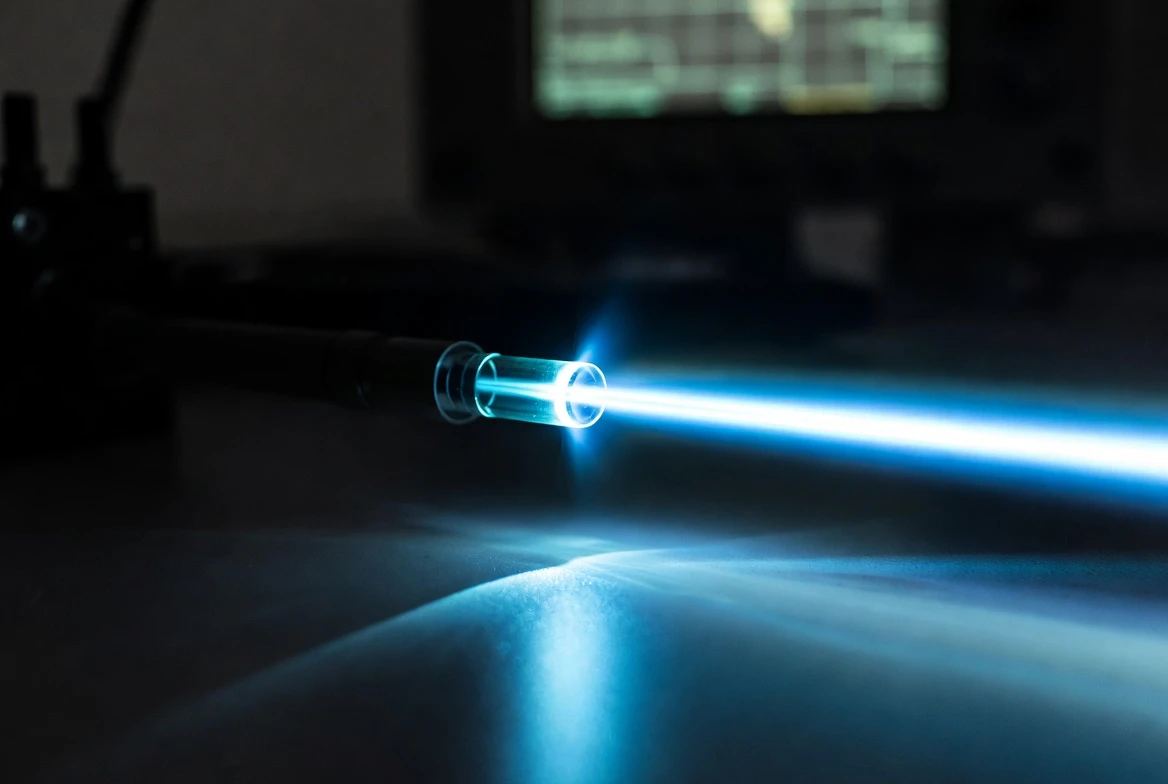
Ulf Leonhardt of the Weizmann Institute developed the fiber-optical approach more than a decade ago, building on the original fiber event horizon experiment from his group. Two ultrafast laser pulses travel through a specially patterned optical fiber. The first pulse distorts the fiber’s optical properties just enough to create, for the second pulse, an analog of an event horizon. Previous experiments with the same setup had reproduced Hawking radiation itself.
This time, Procopio’s team was looking for something subtler: the recoil that the radiation leaves behind.
Inside the Fiber-Optic Event Horizon
Backreaction is the black hole analog of Newton’s third law. When one object pushes another, the pusher must give up energy in return. If Hawking radiation carries energy away from a black hole, the hole must pay for it through a measurable loss.
The Paderborn-led team tracked the tiny shift left behind in the pulse that had created the horizon, the recoil from the outgoing Hawking radiation.
Three features defined what they saw:
- The backreaction matched theoretical expectations in magnitude and timing.
- The outgoing radiation and the recoil arose from the same step, not a chain of intermediate interactions.
- The interaction between the radiation and its optical analog of gravity was biquadratic, a term describing how the strength of the coupling scales with the field.
What the Recoil Looked Like
The previous understanding held that Hawking radiation in laboratory analogs emerged through a complicated cascade of optical interactions. The new results replace that picture with a single, direct process.
This simplifies the theoretical understanding and opens up new ways of calculating effects in such systems. It might even shed light on how Hawking radiation arises in the context of gravity.
Lead author Lorenzo M. Procopio, a physicist at Paderborn University, is quoted in coverage of the result.
In their published research paper on the backreaction result, the researchers write that “maybe astrophysical black holes radiate by a process as simple and direct as ours” and that the backreaction “would describe in microscopic detail how black holes evaporate.” The fiber analog now offers a measurable route into the mechanism, even if real black holes remain out of reach.
Why a Simple Mechanism Reshapes the Debate
If Hawking radiation comes from a single direct step, the math becomes dramatically simpler. Calculations that previously required tracking multiple interacting processes can now be collapsed into a few equations, opening new ways to model black hole thermodynamics.
That matters most for the information paradox, the puzzle Hawking wrestled with until his last paper in 2018. The paradox asks what happens to the information that falls into a black hole when the hole evaporates. Quantum mechanics forbids information from being destroyed, yet naive thermodynamics says the evaporation leaves no trace of it.
A simple, direct mechanism for the radiation gives theorists a cleaner framework to ask where, exactly, the information goes. The paradox remains open. The new framework, though, puts the question in a form that may eventually yield to calculation.
The implications extend beyond the information paradox, into the broader question of how to test quantum theories of gravity in any laboratory at all. Astrophysical black holes sit at distances and signal sizes current technology cannot reach. Tabletop analogs are the only route to experimental data on those predictions. The Paderborn result shows that route can produce quantitative measurements, not just qualitative demonstrations. The next test will be whether the biquadratic mechanism shows up in other analog platforms, from Bose-Einstein condensates to acoustic horizons in flowing fluids.
The Limits of a Light-Made Black Hole
Observing the same backreaction around a real astrophysical black hole is likely to remain impossible for the foreseeable future. The cosmic distances and signal sizes involved are simply beyond current technology. The fiber-optic analog can probe the mechanism, yet it cannot prove that real black holes evaporate by exactly the same route.
The researchers acknowledge that point in their paper. If the biquadratic mechanism turns up in other kinds of black hole analogs, the case strengthens that something fundamental has been found.
Until then, the result is one clean experiment, not a settled answer. Astrophysical puzzles such as how massive stars can die without leaving a black hole will keep depending on indirect evidence, and the wider information paradox stays open. For now, the experiment delivers something rarer than a final solution: a working experimental handle on the mechanism that has eluded theorists since 1974.
Frequently Asked Questions
What is Hawking radiation?
Hawking radiation is thermal radiation predicted by physicist Stephen Hawking in 1974 to arise from quantum effects near a black hole’s event horizon. If real, it causes black holes to slowly lose mass and eventually evaporate.
What is a black hole analog?
A black hole analog is a laboratory system built to reproduce the equations that govern real black holes. Examples include water vortices, ultra-cold gases, and optical fibers carrying ultrafast laser pulses.
What is backreaction?
Backreaction is the recoil effect that occurs when one system pushes on another. In Hawking radiation terms, it is the energy the black hole must give up to emit the radiation in the first place.
Could this experiment help solve the information paradox?
The paradox remains open, and a simpler, direct mechanism gives theorists a cleaner framework to model where information goes during black hole evaporation. The Nature paper itself flags the information paradox as the next major theoretical step.
Can this method be used to study real black holes?
Not directly. The cosmic distances and faintness of real Hawking radiation make direct observation impossible with current technology. The experiment probes the mechanism in a tabletop analog, not real astrophysical holes.