Argentina escaped Cape Verde 3-2 in extra time on Friday to reach the World Cup Round of 16, but the reigning champions needed 111 minutes, two equalisers conceded, and a deflection off a defender’s arm to avoid the deepest upset of their title defence. Lionel Messi opened the scoring at Miami Stadium in the 29th minute with his seventh goal of this tournament and his 20th across six editions of the men’s World Cup, a figure that puts him clear of the all-time scoring record. Cape Verde, ranked 67th in the world and playing in their first finals, refused to fold and twice dragged the champions back to level terms. Cristian Romero settled it with a header from a Messi corner that struck the arm of Cape Verde centre-back Diney Borges before flying past Vozinha. Argentina now travel to Atlanta for a Round of 16 meeting with Egypt next Tuesday.
First Goal, First Equalizer
Miami Stadium filled with 64,478 supporters on Friday, most of them in Argentina’s pale blue and white, and the first quarter-hour passed in kept possession. Argentina’s midfield trio of De Paul, Mac Allister, and Enzo Fernández circulated the ball without forcing a save, and Cape Verde sat in two banks of four to absorb the pressure. Messi’s scoring record across the tournament had already pushed him past Miroslav Klose’s mark after Argentina’s final group game.
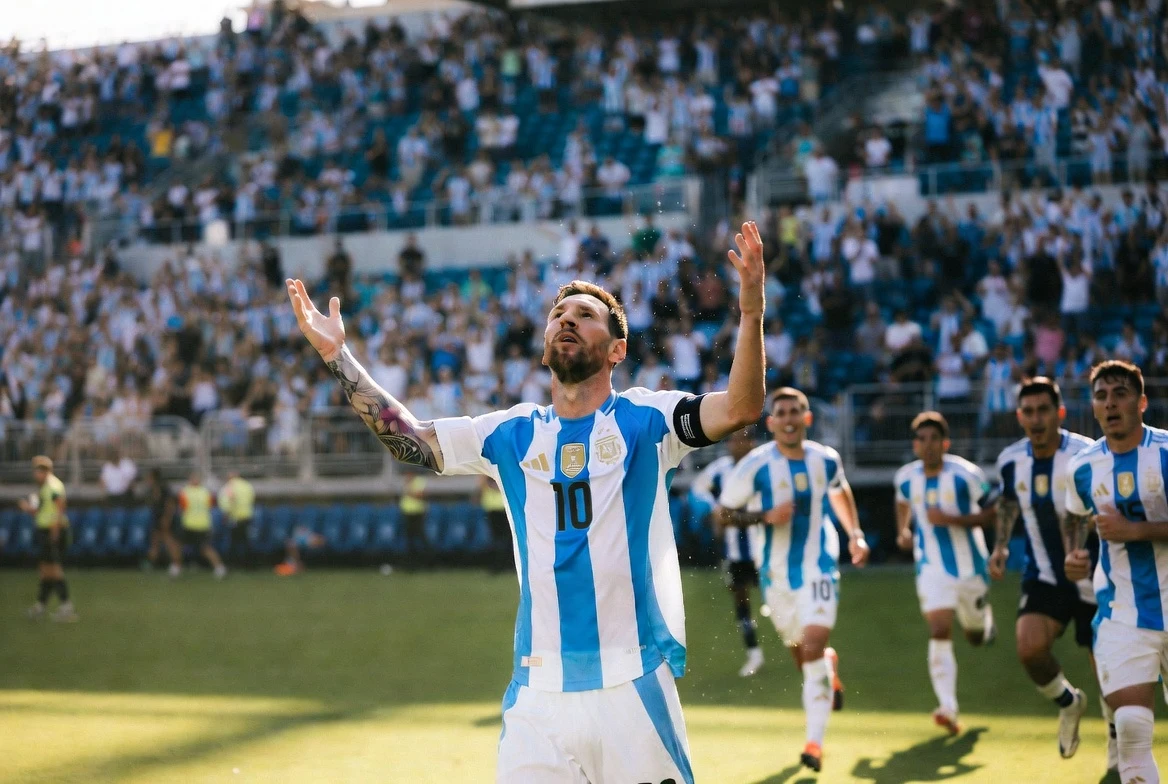
Messi offered the first real sign of danger on 14 minutes, when he ghosted into a narrow channel and pinged a low shot past the far post. The game’s tempo lifted from there, and in the 29th minute Lisandro Martínez lofted a long diagonal pass into the Argentine captain’s run. The 39-year-old took a back-spun cushion on the run, dropped his shoulder, and whipped the ball high into Vozinha’s net. It was his seventh of the tournament and his 20th in men’s World Cups across six editions, a tally that broke the record Klose held at 16.
Cape Verde’s response was patient. They pressed higher after the interval and forced Emiliano Martínez into his first meaningful save midway through the half when Deroy Duarte drove a low shot from the edge of the box. Eight minutes later they were level. Ryan Mendes had been a peripheral figure before his assist, but the captain found space on the right that Argentina kept leaving vacant, and Scaloni’s full-backs paid for pushing high.
- 14′ Messi pings a low shot past the far post, Argentina’s first real chance.
- 29′ Messi opens the scoring from a Lisandro Martínez pass.
- 53′ Duarte forces Emiliano Martínez into a low diving save.
- 59′ Duarte levels from a Ryan Mendes pass, 1-1.
- 90′ Regular time ends 1-1; extra time required.
Cape Verde Refuse the Champions’ Script
Cape Verde arrived 67th in the world, the only one of the four World Cup debutants to reach the last 32, and a roster stitched together from Portugal’s second tier, the Dutch top flight, and lower European divisions. Cape Verde had played the group stage with the kind of resilience that put Argentina’s comfortable path in doubt before this match had even kicked off. The Guardian’s match report described a side that grew into the contest as the night wore on and gave Scaloni’s team its least comfortable stretch of the tournament. Cape Verde holding Spain scoreless in Atlanta had earlier shown they were willing to dig in against giants.
The equaliser in the 59th minute was a study in poise. Captain Ryan Mendes, four years younger than Messi at 36, swept a pass inside from the right, and the Dutch-born Duarte took two touches before hammering a right-footed shot across Martínez and into the far corner. Cape Verde’s players massed into a leaping huddle by the corner flag while their fans in the stands burst into tears. Argentina kept sending on attacker after attacker. Vozinha kept turning them away.
- FIFA rank: 67th
- Joined FIFA: 1986
- Capital: Praia
- Tournament status: First World Cup; only debutant to reach the last 32
- Group stage record: Drew Spain 0-0, drew Uruguay, beat Saudi Arabia
Extra Time Becomes Three-Goal Theater
Two minutes into the first period of extra time, Lisandro Martínez collected a corner on the edge of the box, cut inside onto his right foot, and lashed a sumptuous shot into the roof of Vozinha’s net. The Argentina end of the stadium exhaled. Cape Verde had absorbed group-stage draws with Spain and Uruguay and a win over Saudi Arabia, and they had done it in three different styles.
With 103 minutes on the clock, left back Sidny Lopes Cabral took the ball wide on the left, nipped inside, and curled a right-footed shot into the far top corner past Emiliano Martínez. He sprinted to the touchline, vaulted the advertising boards, and disappeared into the crowd beyond. Three goals in twenty minutes of extra time had turned a cagey knockout tie into one of the tournament’s great matches. Relief spread through one end of the stadium, then silence.
Romero’s winner, 111 minutes in, came as Argentina’s last meaningful chance. From Messi’s corner, the centre-back rose highest and nodded the ball down, off the arm of Borges and across Vozinha into the net. Lopes Cabral tested Martínez again with a free kick in the 116th minute, and the Argentina goalkeeper had to claw the ball away at his near post to snuff out the last serious threat of a chaotic night.
Scaloni’s bench had stopped celebrating by then and started shouting for the final whistle. The final whistle came. Argentina were through.
Vozinha and the Island Behind Him
Vozinha, the 40-year-old Cape Verde goalkeeper who plays his club football for Chaves in Portugal’s second division, was the breakout character of this World Cup. His career arc has taken him through stints at clubs in Angola, Moldova, and Slovakia, including a run at Batuque FC in Mindelo, before he arrived at Chaves, and the keeper’s profile from earlier in the tournament tracked that journey. He tipped a Messi free kick over the bar in the 72nd minute and stood tall to deny the same player from open play later in extra time. Scaloni’s substitutions, Lautaro Martínez for Julián Álvarez at centre-forward among them, found no way through Vozinha’s gloves. By the end of the night Scaloni had turned to every attacking option he could find.
Cape Verde joined FIFA in 1986 and travelled to this tournament with a squad drawn from a diaspora spread across Portugal, the Netherlands, and France. The team’s centre of gravity sits in Lisbon’s lower leagues and in the academy systems of clubs few neutrals can name. Cape Verde’s path from qualifier to first World Cup described how the federation built that pipeline from island talent and overseas diaspora into a side that has now reached the last 32. Cabral’s late equaliser, plus the answers Vozinha kept producing, captured what the nation has been building for two decades.
Their exit closes the run of a side most had pegged to be the politest of the debutants. They leave with a draw against Spain, a draw against Uruguay, a win over Saudi Arabia, and an extra-time loss to the champions. That record is theirs.
Atlanta Awaits on Tuesday
Messi covered 120 minutes in Miami’s heat in his least influential game of the tournament, and Argentina’s title defence heads to Atlanta with questions to answer. Egypt, who beat Australia on penalties to reach this stage, will have watched the same tape Argentina just survived and seen the same vulnerabilities. Lautaro Martínez, Enzo Fernández, and Julián Álvarez offer Scaloni the kind of fresh legs Messi did not have in Miami. Argentina’s Round of 16 fixture in Atlanta kicks off a knockout run that grows harder with every round.
Scaloni has four days to install fresh legs in his midfield. Argentina are through to the last 16. Egypt awaits.
Frequently Asked Questions
When does Argentina play next at the 2026 World Cup?
Argentina meet Egypt at Mercedes-Benz Stadium in Atlanta next Tuesday in the Round of 16, four days after the 3-2 extra-time win over Cape Verde in Miami.
Who scored for Cape Verde against Argentina?
Deroy Duarte equalised in the 59th minute and Sidny Lopes Cabral struck Cape Verde’s second in the 103rd minute. Cristian Romero’s 111th-minute header, deflected off the arm of Diney Borges, decided the match in Argentina’s favour.
Who is Vozinha?
Vozinha is the Cape Verde first-choice goalkeeper whose real name is Josimar José Évora Dias. He plays his club football for Chaves in the Portuguese second division, turned 40 during the tournament, and made several saves against Argentina, including one from a Messi free kick in the 72nd minute.
What is Cape Verde’s FIFA ranking?
Cape Verde entered the 2026 World Cup ranked 67th in the world. They were the only one of the four debutant nations at this tournament to make it out of the group stage.