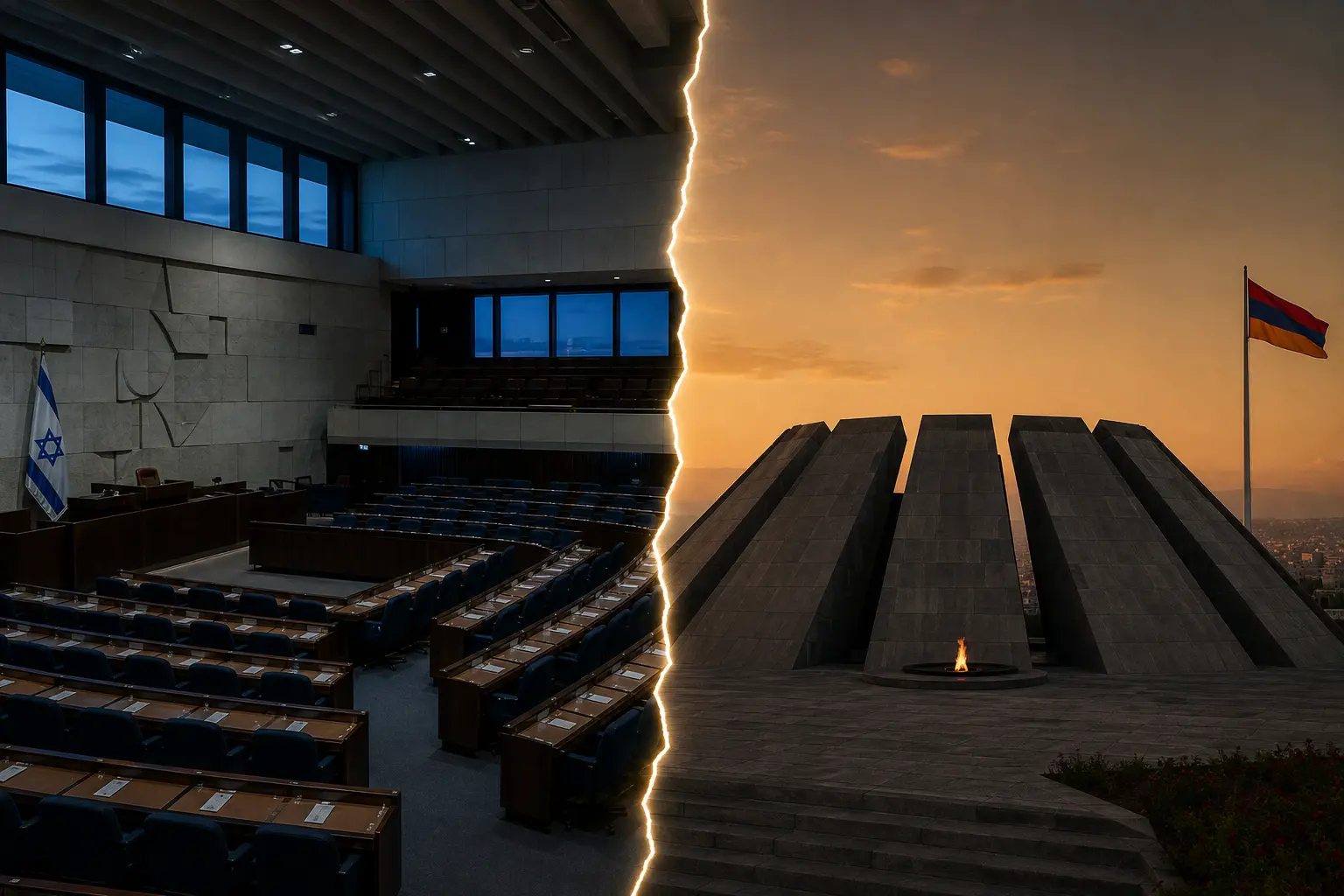
Israel’s Knesset has postponed a vote on recognizing the Armenian Genocide, an Israeli official confirmed Sunday, stalling a resolution the Cabinet passed unanimously five weeks earlier. Lawmakers leave for summer recess this week and will not reconvene before the country’s October 27 elections, so the measure now carries no date at all.
It is a familiar stopping point. Records show recognition has stalled at the edge of a binding Knesset vote at least four times since 2011, and each time, the state of relations with Turkey was the reason given.
A Cabinet Vote Stalls Just Before It Counts
The suspension came with no official explanation attached. JNS (Jewish News Syndicate), an Israel-focused wire service, cited an unnamed Israeli official who confirmed the freeze on Sunday. Outlets across Israel, Armenia and the Caucasus picked up the report within hours.
The story traces back to June 28, when Israel’s Cabinet unanimously approved a resolution recognizing the mass killing of Armenians under the Ottoman Empire as genocide. Foreign Minister Gideon Sa’ar, who introduced the measure, called it “a moral duty” and told fellow ministers it was “never too late to do the right thing.”
That Cabinet vote was supposed to be the opening step, not the final one. Recognition would put Israel alongside more than thirty countries that have already taken the same position, according to the Armenian National Institute’s list of recognizing states. But a Cabinet resolution is not law. It still needed Knesset approval to become binding government policy, and that floor vote is the one that just got pulled.
A spokesperson for Sa’ar did not respond to requests for comment on the postponement. With the Knesset now breaking for recess and not returning until after the October 27 vote, the resolution sits untouched for months at minimum.
Israel Has Been Here Before
This is not the Knesset’s first flirtation with the subject, and it is not the first time timing killed it either.
In 2011, the Knesset held its first open floor discussion on the genocide and voted 20 to 0 to send the question to the Education Committee for further study. A special plenum session in 2012 was convened specifically to settle the matter. It ended without a vote. In 2016, the Education, Culture and Sports Committee went further and recognized the genocide itself, though the finding carried no force outside the committee room.
A full floor vote was scheduled for 2018 and canceled before it reached the plenum. In 2019, a ministerial debate on recognition was shelved at Prime Minister Benjamin Netanyahu’s request after the Foreign Ministry warned it might hand Turkish President Recep Tayyip Erdogan a boost ahead of a Turkish election.
| Year | Development | Outcome |
|---|---|---|
| 2011 | Knesset holds its first open floor debate on recognition | Unanimous 20-0 vote refers the question to the Education Committee |
| 2012 | Special plenum session convened to decide the issue | Session ends without a vote |
| 2016 | Knesset’s Education, Culture and Sports Committee takes up the question | Committee recognizes the genocide, a non-binding committee-level step |
| 2018 | Plenum vote scheduled | Canceled before reaching the floor |
| 2019 | Ministerial debate on recognition planned | Delayed at Netanyahu’s request over a Turkish election |
| 2026, June 28 | Cabinet unanimously approves Sa’ar’s resolution | Sent to the Knesset for ratification |
| 2026, July 12 | Knesset vote suspended ahead of recess | No new date; Knesset returns only after the Oct. 27 election |
Each attempt broke the same way. Momentum built inside the Knesset, then evaporated once officials weighed the cost to relations with Turkey or Azerbaijan.
Why Turkey and Iran Are Driving the Timing
Turkey is the reason recognition moved at all this year. Relations between Ankara and Jerusalem have deteriorated sharply since the Gaza war began in October 2023, with Erdogan repeatedly accusing Israel of war crimes and at times comparing its conduct to Nazi Germany. Israeli officials had weighed recognition for years and pulled back every time out of concern for ties with Turkey and Azerbaijan. That calculus flipped only once the relationship with Ankara hit a historic low.
The rhetoric has sharpened since the Cabinet vote, even as the survey data compiled in the Armenian National Committee of America’s youth awareness survey shows roughly a third of young Turks privately acknowledge the killings as genocide. Turkey’s foreign minister, Hakan Fidan, said Israel had become “a burden humanity can no longer bear.” Sa’ar dismissed the remark as sickening and accused Fidan of inciting genocide in turn. Erdogan, for his part, brushed aside the criticism by invoking Gaza’s civilian toll as proof Israel had no standing to lecture Turkey on history.
Turkey is also the reason the vote got shelved. The postponement lands amid a ceasefire with Iran unraveling after fresh attacks in the Gulf, including a missile strike on Iranian state television that sent an anchor fleeing mid-broadcast, and a NATO summit in Turkey days earlier where Ankara pushed U.S. President Donald Trump to approve the sale of F-35 fighter jets. Freezing the Knesset vote right as Washington and Ankara discussed a major arms sale reads as an attempt to avoid adding fuel to an already strained relationship.
Azerbaijan Calls the Move a Red Line
Azerbaijan’s response went beyond a diplomatic statement. Azerbaijan’s ambassador to Israel left the country shortly after Sa’ar announced the initiative, though the reason was never officially confirmed. Azerbaijan’s Foreign Ministry called the decision “a matter of serious concern” and urged Israel to reconsider.
Ynet, citing unnamed Azerbaijani officials, reported that the rift runs deeper than either government has acknowledged publicly. Azerbaijani officials described the move as crossing what they called “a red line” and said they learned of the Cabinet’s decision only after it became public.
Three grievances stand out in Baku’s account:
- The substance – Azerbaijan says recognition distorts a complex historical issue and does nothing to advance reconciliation between Armenia and Azerbaijan.
- The process – Azerbaijani media reported that Sa’ar telephoned his counterpart, Jeyhun Bayramov, only after the Cabinet decision was already public, leaving Baku to react to a fait accompli.
- The politics at home – leaders of Baku’s Jewish communities, including Rabbi Zamir Isayev of the Sephardic congregation, wrote to Knesset members asking them not to adopt the resolution.
Azerbaijan supplies a significant share of Israel’s oil imports and serves as a security counterweight near Iran’s northern border, which is why the public rebuke registered as unusual for a partnership built on decades of quiet cooperation.
Armenia Refuses to Celebrate
Armenia’s government offered no applause either. Prime Minister Nikol Pashinyan declined to comment on Israel’s decision in June, saying Yerevan did not wish to engage in what he called the weaponization of the Armenian Genocide, telling reporters at the time that “we will not consider ourselves obliged to comment on such an event.”
That reticence has held through the Knesset’s suspension. Armenia, which discussed regional cooperation with Georgian officials in a meeting on economic cooperation and regional issues around the same period, has announced no diplomatic push to secure a floor vote in Jerusalem.
Reaction inside Israel’s own Armenian community has been warmer, but not uncomplicated.
On the other, many people feel it came at the wrong political moment.
Marina Kozliner, a community activist based in Bat Yam who has campaigned for recognition for years, made the remark to the Jerusalem Post, describing a mix of relief and unease among the roughly 10,000 Armenian Jews and Christians living in Israel.
Is Sa’ar’s Timing About Armenia or About Erdogan?
Analysts are split on what actually drove the initiative, and the divide runs straight through Israel’s own foreign policy establishment. Supporters call it overdue justice finally freed of political constraint. Critics call it a calculated jab at Erdogan timed for domestic benefit, one that risks a working partnership with Azerbaijan for a symbolic hit on Turkey.
Gerald Steinberg, a professor at Bar Ilan University, said flatly, “This decision is strictly political,” pointing to criticism circulating inside Israel’s own diplomatic and security circles. Efraim Inbar, president of the Jerusalem Institute for Strategy and Security, went further in an interview with Kol Barama Radio, calling it “a childish and petty mistake” that risked a genuine strategic partner over a symbolic hit on Turkey.
Not every critique lands on Israel. Some regional analysts argue Baku’s fury is misplaced, since the underlying dispute over 1915 sits between Armenia and Turkey and never directly involved Azerbaijan.
Where the disagreement stands:
- Gideon Sa’ar frames recognition as an overdue moral reckoning rooted in Jewish memory of the Holocaust, not a strike against any specific government.
- Gerald Steinberg calls the timing strictly political and says internal Israeli critics agree.
- Efraim Inbar calls it a costly swipe at Turkey that needlessly damages ties with Azerbaijan.
Whichever reading holds, the resolution’s fate now depends less on historians than on an election.
The Resolution Now Waits on a Ballot Box
The Knesset will not reconvene before Israel’s October 27 elections. Whatever government forms afterward inherits the resolution exactly where it sits: approved by the Cabinet, unratified by parliament, with no date attached.
A diaspora publication tracking the process closely, Armenian Weekly, has argued that a Cabinet resolution is fundamentally different from law, calling it “reversible by any future government” and noting that only a binding floor vote, which still has not happened, meets the threshold for actual state recognition.
The Cabinet’s vote was still unprecedented, the furthest recognition has ever traveled inside Israeli government. The Knesset’s silence extends a fifteen-year pattern that has never once produced a binding vote.
Frequently Asked Questions
How Many Countries Recognize the Armenian Genocide?
More than thirty countries have formally recognized the 1915 killings of Armenians under the Ottoman Empire as genocide, though exact counts vary by source, with figures ranging between 32 and 34 depending on the country-by-country recognition dataset used. Uruguay was first, in 1965. The United States followed only in 2021, when President Joe Biden signed a congressional resolution after decades of prior presidents declining to do so.
Did Israel Officially Recognize the Armenian Genocide?
Not yet in the way that matters legally. Israel’s Cabinet approved recognition unanimously on June 28, 2026, but that is an executive decision, not a law, and a future Cabinet could reverse it. Full recognition requires a Knesset floor vote, now pushed past the October 27 elections. Netanyahu has separately said in a podcast interview that he personally recognizes the genocide, though that comment carries no legal standing either.
Why Does Turkey Deny the Armenian Genocide?
Turkey argues the deaths occurred amid wartime chaos rather than a coordinated campaign and disputes the scale historians cite. Academic accounts, including a resource guide from the University of Minnesota describing systematic deportations and death marches beginning in 1915, document a different picture, one most historians outside Turkey and Azerbaijan treat as settled.
When Will the Knesset Vote on the Resolution?
No date has been set. Lawmakers begin summer recess this week and will not reconvene until after the October 27 elections, meaning any vote is at least several months away and depends on the priorities of whatever coalition forms next.
Why Is Azerbaijan Involved in a Dispute Between Israel, Turkey and Armenia?
Azerbaijan is a close security and energy partner of Israel, supplying oil and buying Israeli weapons, and it shares Turkey’s refusal to call the 1915 killings genocide. Baku fought wars with Armenia over the Nagorno-Karabakh region, the most recent ending in 2023 with Azerbaijan retaking the territory, which is why officials there read Armenian genocide recognition as siding with an old rival.