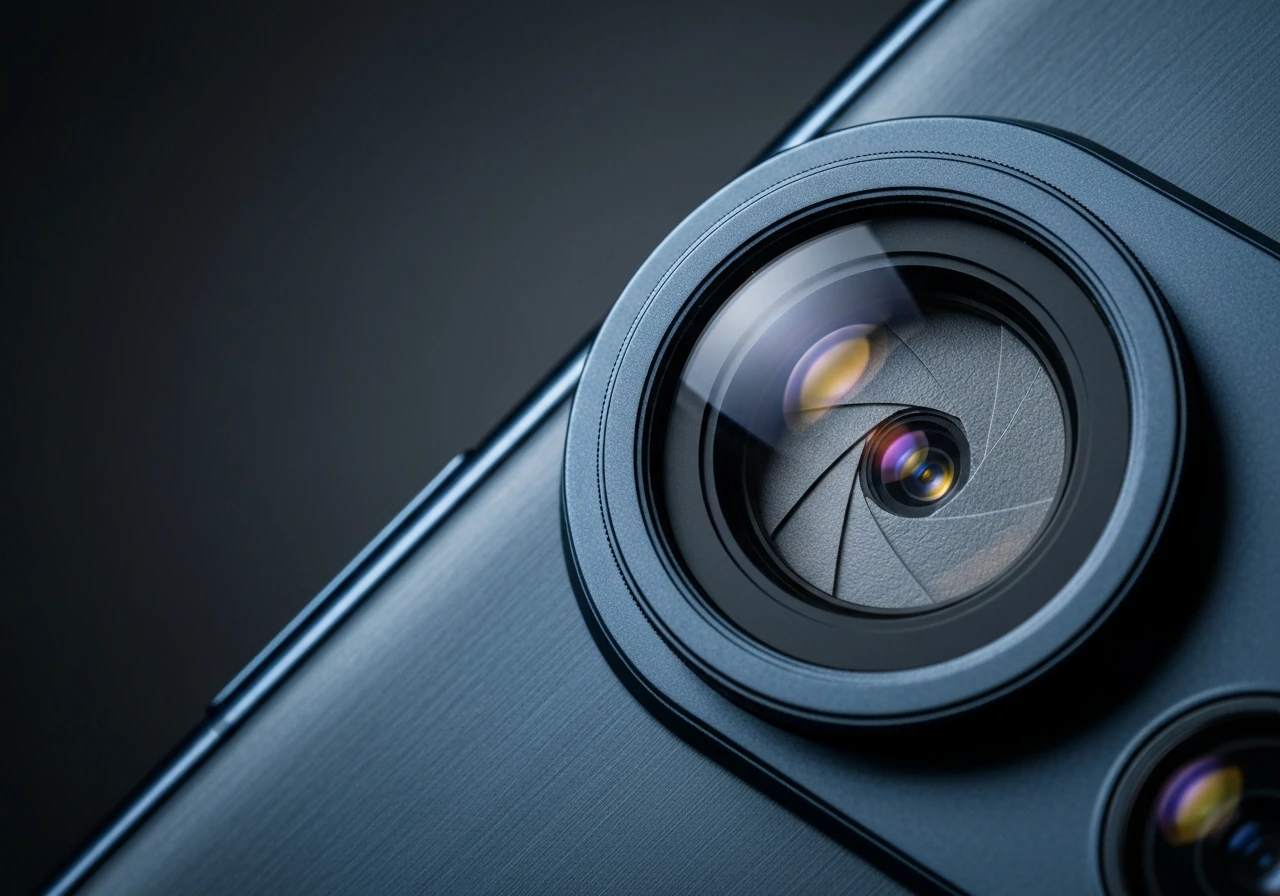
Apple’s next flagship camera change has a moving part. The iPhone 18 Pro variable aperture camera is the headline upgrade tipped for the company’s late-2026 Pro models, replacing the fixed f/1.78 main lens with a mechanical iris that opens and closes to control how much light reaches the sensor. Supply-chain analyst Ming-Chi Kuo, who first flagged the feature in late 2024, says the new module costs Apple roughly 50 percent more than the part going into the iPhone 17 Pro.
One company gains more than any other from that swap. Sunny Optical, a Chinese lens maker that supplied barely a sliver of Apple’s camera orders two years ago, is now lined up to handle close to half of this premium component. The photography story is real. The supply-chain shift sitting underneath it is the one that moves money.
What Apple’s Variable Aperture Lens Changes for Photographers
A variable aperture lens does something every iPhone before it could not: physically resize the opening that light passes through. Recent Pro models from the iPhone 14 Pro to the iPhone 17 Pro have used a single fixed f/1.78 opening, which forces the camera to manage exposure entirely through shutter speed, ISO and software. A moving iris adds a real optical lever.
The payoff shows up in a few specific situations. A wider opening pulls in more light for night shots, while a narrower one sharpens landscapes and tames blown-out highlights in bright sun. It also hands video shooters smoother exposure control and gives portraits a more natural fall-off in background blur instead of a software-drawn edge.
Here is what the mechanism is expected to enable on the iPhone 18 Pro:
- Better low-light capture when the iris opens wide to flood the sensor with light
- Sharper depth of field across the frame when the opening narrows for daytime scenes
- Cleaner exposure transitions while recording video, with fewer abrupt brightness jumps
- More optical, less computational background blur in portrait shots
None of this is brand new to phones. Samsung shipped a two-stop iris on the Galaxy S9 back in 2018, switching between f/1.5 and f/2.4, and Huawei went further on the Pura 80 Ultra with a multi-blade diaphragm spanning f/1.6 to f/4.0. What would be new is Apple putting the technology into a camera system that hundreds of millions of buyers actually use, which is exactly why the order is large enough to reshape a supplier’s year.
Sunny Optical’s Climb Into Apple’s Priciest Lens Slot
Sunny Optical, based in Ningbo, has spent years as a junior name on Apple’s lens roster behind Taiwan’s Largan Precision. According to Kuo’s note on Apple’s optical order growth and spec upgrades, that position is changing fast, and the variable aperture lens is the clearest sign yet.
From a 5% Sliver to Half the Order
The trajectory is steep. Sunny held roughly 5 percent of Apple’s lens allocation in 2024, climbed to a 15 to 20 percent band across 2025, and is now slotted to supply between 40 and 50 percent of the variable aperture lens for the iPhone 18 Pro and iPhone 18 Pro Max. That is not a low-margin commodity part. It is the single most expensive lens in the phone.
- 5 percent of Apple lens orders in 2024, the starting point
- 15 to 20 percent allocation through 2025 as Sunny rebuilt its share
- 40 to 50 percent of the iPhone 18 Pro variable aperture lens, its highest-value win yet
- 230 million iPhones projected to ship in 2025, up about 5 percent year over year, expanding the order pool
What Sunny Already Builds for Apple
The lens is not Sunny’s only foothold. Kuo has the company positioned as the primary supplier of the shutter actuator that drives the iris, with Luxshare as the secondary source, and it has already begun producing those actuators ahead of camera module assembly. Sunny also picked up compact camera module work for Apple’s MacBook line, broadening its relationship beyond a single product.
That diversification matters for Apple as much as for Sunny. Spreading a high-value, mechanically complex part across more than one vendor reduces the risk that a single factory problem stalls a flagship launch, and it gives Apple leverage on price. For Sunny, the same arrangement converts a low-margin past into a much richer order book.
Why the New Camera Module Carries a 50% Premium
The cost jump comes from added moving hardware. A fixed lens is essentially a stack of glass elements held in place; a variable aperture adds a tiny mechanical iris plus the actuator that drives it, more assembly steps and tighter tolerances. Kuo’s figure puts the module at roughly 50 percent more than the equivalent part in the iPhone 17 Pro lineup.
The table below lays out how the main rear camera is expected to change between the two generations.
| Attribute | iPhone 17 Pro | iPhone 18 Pro (expected) |
|---|---|---|
| Main lens aperture | Fixed f/1.78 | Variable aperture |
| Exposure control | Shutter, ISO, software | Plus a physical iris |
| Module cost to Apple | Baseline | About 50% higher |
| Lead lens supplier | Largan Precision | Largan, with Sunny at 40 to 50% |
| Shutter actuator | Not applicable | Sunny primary, Luxshare secondary |
The Price Question Facing iPhone 18 Pro Buyers
A pricier bill of materials usually flows toward the shelf. Reports suggest Apple has been working to hold iPhone prices steady to protect market share, but a component that costs half again as much puts pressure on that plan, especially stacked on broader hardware inflation across the industry.
Kuo’s read is that Apple may absorb part of the increase rather than pass the full amount to customers. Even so, there is open speculation that the Pro models specifically could climb above the iPhone 17 Pro’s sticker, since that is where the most expensive new parts are concentrated.
Pricing also bends to geography. The company has been threading a careful needle in fast-growing markets, as our look at Apple’s quiet India price strategy for the iPhone 18 Pro laid out, where a few thousand rupees can decide whether a buyer upgrades or waits. A camera-driven cost bump complicates that math in every region at once.
For buyers, the practical takeaway is simple. The iPhone 18 Pro is expected to launch around September 2026, and if the variable aperture system lands as described, the camera is the feature Apple will lean on to justify whatever the new price turns out to be.
Apple’s Camera Roadmap Past the iPhone 18
The variable aperture lens is one move in a longer plan. Kuo has pointed to a future iPhone, possibly arriving around 2028, that would redesign the ultra-wide module using chip-on-board packaging, a technique that mounts the sensor directly onto the circuit board to shave thickness and free up internal space.
That direction lines up with where Apple’s hardware appears to be heading. Prototype work on dramatically reshaped designs is already underway, as our report on iPhone 19 Pro quad-curved screen prototypes for 2027 detailed, and thinner camera stacks are part of making those bodies work.
For now, the iPhone 18 Pro camera is the test case. If the variable aperture upgrade sells the phone and Sunny Optical delivers the volume at quality, Apple gets both a marquee feature and a second high-end lens source it can play against Largan on price for years.
Frequently Asked Questions
When will the iPhone 18 Pro launch?
The iPhone 18 Pro and iPhone 18 Pro Max are expected to launch around September 2026, in line with Apple’s usual fall release window. The variable aperture camera reportedly entered production earlier in 2026, with full camera module assembly slated to follow ahead of the launch.
What is a variable aperture camera?
It is a lens with a physical iris that resizes the opening light passes through, instead of one fixed opening. A wider setting pulls in more light for dark scenes, while a narrower one sharpens depth of field and controls bright highlights, giving the camera an optical exposure lever beyond software.
Will the iPhone 18 Pro cost more than the iPhone 17 Pro?
It might. The new camera module is said to cost Apple about 50 percent more than the iPhone 17 Pro’s part, and while Apple may absorb some of that, analysts expect the Pro models could see a price increase. Apple has not confirmed any pricing.
Who makes the iPhone 18 Pro camera lens?
Largan Precision remains Apple’s lead lens supplier, but Sunny Optical of China is set to handle 40 to 50 percent of the variable aperture lens and serve as the primary shutter actuator supplier, with Luxshare as a secondary source for the actuator.
What aperture range will the iPhone 18 Pro offer?
Apple has not confirmed the range. For reference, Samsung’s Galaxy S9 switched between f/1.5 and f/2.4, and Huawei’s Pura 80 Ultra spans f/1.6 to f/4.0, so the iPhone’s variable system is likely to move within a comparable window once specifications are official.