Petrol and diesel rose by about 90 paise per litre across India on Tuesday, the second hike inside five days and the first time in more than four years that pump prices have moved twice in the same week. The combined increase since Friday now sits at roughly ₹3.90 per litre, a small number that obscures a much larger one: state-owned oil-marketing companies (OMCs, the trio of Indian Oil, Bharat Petroleum and Hindustan Petroleum that sells most of India’s fuel) are still absorbing about ₹750 crore in daily losses on petrol, diesel and cooking gas combined after both moves.
Brent crude was trading at $109.34 per barrel on Tuesday morning, India’s basket of imported crude has averaged $106.69 this month, and the West Asia risk premium inside both numbers is not going anywhere soon. The pace of hikes from here is the next question.
What 90 Paise Looks Like Across Four Metros
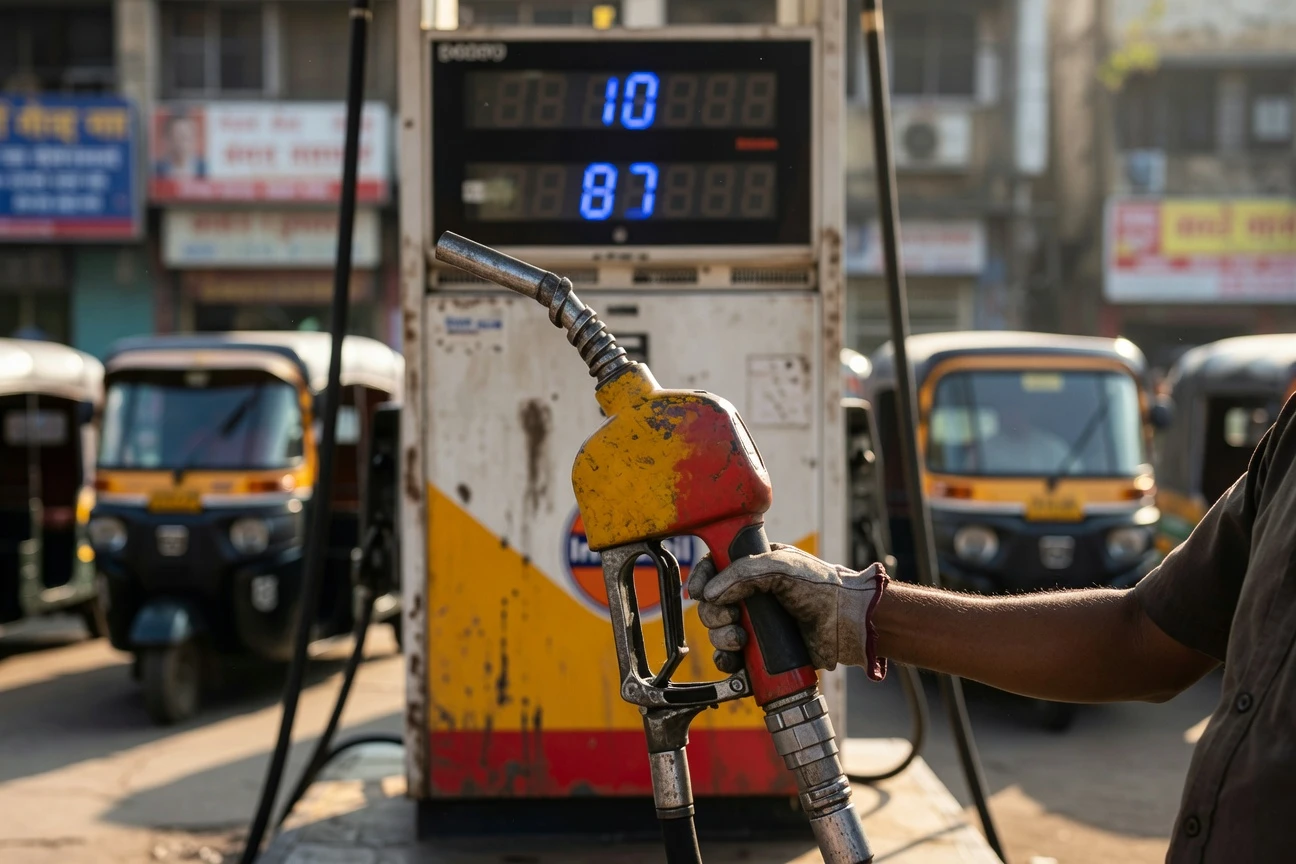
Tuesday’s increase landed at pumps in the morning hours. In Delhi, petrol rose 87 paise to ₹98.64 per litre, while diesel climbed 91 paise to ₹91.58. The variant fuels tracked the same pattern. Indian Oil’s XP95 high-octane petrol moved up 87 paise to ₹105.76, and the XG premium diesel grade was hiked 91 paise to ₹96.90.
Kolkata took the steepest hit on the day. Petrol there rose 96 paise to ₹109.70, the highest pump price among the four big metros, while diesel climbed 94 paise to ₹96.07. Chennai posted the smallest move, with petrol up 82 paise and diesel up 86 paise. Mumbai sat between the two, with petrol up 81 paise to ₹107.49 and diesel up 88 paise to ₹94.02.
| City | Petrol (₹/L) | Diesel (₹/L) | Petrol Hike (paise) | Diesel Hike (paise) |
|---|---|---|---|---|
| New Delhi | 98.64 | 91.58 | 87 | 91 |
| Mumbai | 107.49 | 94.02 | 81 | 88 |
| Kolkata | 109.70 | 96.07 | 96 | 94 |
| Chennai | 104.49 | 96.11 | 82 | 86 |
Friday’s first move was the bigger jolt. A flat ₹3 per litre across both fuels, applied uniformly across the metros, ended a price freeze that had held since April 2022. Tuesday’s 90-paise top-up is the first signal that the May 15 hike was not a one-shot reset, but the opening move in a sequence.
Why a Four-Year Freeze Just Cracked
Retail fuel prices in India had not moved meaningfully since April 2022, when state-owned OMCs quietly stopped passing through the daily Brent revisions they are technically free to make. The reason was political. A calendar of state elections through 2023 and 2024, culminating in the 2024 general election, made any pump-price increase a Cabinet-level decision rather than a refinery-level one. The freeze was interrupted only once, by a small ₹2-per-litre cut ahead of the 2024 vote.
That cover ran out in the second week of May. With state elections done and the general election a year behind it, the petroleum ministry allowed Friday’s ₹3 hike, the first material reset in over four years. Tuesday’s follow-up suggests OMCs and the ministry have now agreed on a stepped trajectory rather than a single corrective shock.
The sequence inside the past week has been compressed:
- Friday, May 15: First reset in over four years, ₹3 per litre flat across petrol and diesel in all metros.
- Monday, May 18: The petroleum ministry confirms combined daily OMC losses on petrol, diesel and LPG dropped from about ₹1,000 crore to ₹750 crore after Friday’s hike.
- Tuesday, May 19: A second hike of roughly 90 paise lands at pumps, taking the cumulative weekly increase to about ₹3.90 per litre.
Industry sources reading the cadence describe it as deliberate, sized to ease margin pressure without producing the inflation shock a single ₹6 or ₹8 hike would deliver. The risk is that crude does not co-operate.
The Oil Companies’ Balance Sheet Is the Story
The reason for the urgency sits on OMC balance sheets. Petroleum Minister Hardeep Singh Puri told the CII Annual Business Summit last week that cumulative under-recoveries at Indian Oil, BPCL and HPCL had climbed to nearly ₹1.98 lakh crore, and that a single quarter of losses at current crude levels could wipe out the sector’s full-year profit after tax for FY26.
The daily run-rate before this week’s moves was around ₹1,000 crore in combined losses on petrol, diesel and LPG. Friday’s hike trimmed that to ₹750 crore. Tuesday’s 90-paise increase will narrow it further, though the ministry has not yet quantified the new daily figure.
- ₹1,000 crore: estimated daily OMC absorption rate before the May 15 reset.
- ₹1.98 lakh crore: cumulative under-recoveries flagged by the petroleum minister.
- ₹250 crore: daily loss reduction the ministry attributes to Friday’s ₹3 hike alone.
The minister was also explicit, on Monday, that there is no bailout package under active consideration for the three OMCs. That leaves pump-price increases as the only mechanism currently on the table for restoring margins, and explains why the second hike followed the first inside five days rather than after the usual quarter-long pause.
Brent at $109 and a Hormuz Risk Premium
The trigger behind the OMC numbers is the crude market. India’s basket of imported crude has averaged $106.69 per barrel through the first half of May, and Brent futures for July delivery were quoted 0.156% higher at $109.34 per barrel in early Tuesday trade in Asia, per the Petroleum Planning and Analysis Cell.
The premium is geopolitical. India imports roughly 85% of the crude it burns, and a substantial share of those cargoes transits the Strait of Hormuz. Tensions between the United States, Israel and Iran through March and April have kept a war-risk premium of $10 to $15 a barrel inside the Brent print that India’s refiners pay. Every $10 lift in crude widens India’s current-account deficit by 40 to 50 basis points, according to an external-accounts assessment by the Observer Research Foundation.
None of those drivers sit inside the petroleum ministry’s control. Until crude eases or the West Asia risk premium fades, the OMC under-recovery math gets worse, not better, in the absence of further pump-price action. That is the box this week’s two hikes were designed to open.
The Inflation Channel Has Started to Open
Retail inflation in India ticked up to 3.48% in April from 3.40% in March, the fastest reading in a year and the third consecutive month of acceleration. The wholesale number told a louder story. WPI inflation surged to 8.3% in April, a 42-month high, driven almost entirely by a 24.71% jump in the fuel and power sub-index.
Petrol contributed 32.40% to WPI’s fuel print in April; diesel added 25.19%. Both figures pre-date the May 15 reset and Tuesday’s top-up, so the next two WPI releases will land on a higher base. Crude petroleum and natural gas inflation was 67.18% year-on-year, the kind of feeder rate that pushes through manufactured goods within two reporting cycles.
Industry sources framing the May hikes argue they are sized small enough to avoid a major inflationary shock. The WPI numbers complicate that argument. Reserve Bank of India watchers are already pushing rate-cut expectations for the August meeting further out, with one note flagging that headline WPI could cross 10% by July if pump-price hikes continue at this cadence.
Private Retailers Showed the State Pumps the Way
India’s private fuel retailers stopped waiting for the state OMCs months ago. Nayara Energy, the country’s largest private retailer, raised petrol prices by ₹5 per litre and diesel by ₹3 on March 26, citing the same Brent run-up the state companies have been absorbing.
Shell followed on April 1 with a steeper move: petrol up ₹7.41 per litre and diesel up ₹25.01 per litre, the latter the largest single revision by any retailer in the current cycle. In Bengaluru, Shell now sells petrol at ₹119.85 per litre and diesel at ₹123.52. Both figures sit well above any state-OMC pump price in the metros.
That gap is the politically awkward number. State-OMC pumps still undercut Nayara by roughly ₹10 per litre on petrol in most cities, and undercut Shell’s Bengaluru diesel by close to ₹30. The wider that spread runs, the louder the case that the public-sector retailer is bearing a subsidy that sits on no government balance sheet, with no Parliament vote behind it.
What the Government Asked of Households
The political layer arrived from Prime Minister Narendra Modi last week. The PM urged citizens to conserve fuel, allow work-from-home where possible, and cut down on non-essential travel. The framing was unusual; government appeals to conserve energy are rare in India outside genuine supply crises.
Several state governments followed quickly. Departments in at least three states have been instructed to limit official travel, replace physical meetings with video calls, and operate with reduced office staffing for the rest of the month. None of these moves carry the legal weight of rationing, but the cadence resembles it.
Cooking-gas LPG sits in the same uncomfortable column. A ₹60-per-cylinder hike landed in March, but Indian Oil and its peers still report a loss of ₹674 on every 14.2-kg domestic cylinder sold at the regulated price. The petroleum ministry has flagged that LPG under-recoveries alone could touch ₹80,000 crore in FY27 if Brent stays around $120 a barrel.
If Brent eases back toward the mid-$90s by month-end, the May 15 reset and Tuesday’s top-up together can plausibly be defended as a one-time recalibration of the four-year freeze. If Brent holds at $109 or pushes higher on any fresh Hormuz incident, weekly 80-to-90-paise hikes start looking less like calibration and more like the model. The next round of OMC daily-loss math, due from the ministry within the week, will tell which one this is.