India’s CPI inflation rose to 4.38% in June, the first breach of the Reserve Bank of India’s medium-term 4% target in 17 months and the highest reading since December 2024. The Ministry of Statistics and Programme Implementation said on Monday that consumer prices accelerated from 3.93% in May as the West Asia war lifted transport and food costs and a parched-then-recovering monsoon squeezed food supplies. Headline inflation printed above the 4.30% expected in a Reuters poll, and forecasters differ on whether the central bank will pause through August or begin raising rates before year-end.
The consequential levers sit in two places, and they arrive separately. At the pump, the May 7.4% petrol and 8.4% diesel hike has now flowed into the CPI line for a full month; at the field, June was India’s fifth-driest since 1901 and the IMD has forecast July rainfall below 94% of the long-period average. Together they explain why a 4.38% print did not surprise the RBI, which had already penciled in 5.1% CPI for the full financial year.
What’s in the 4.38% June Print
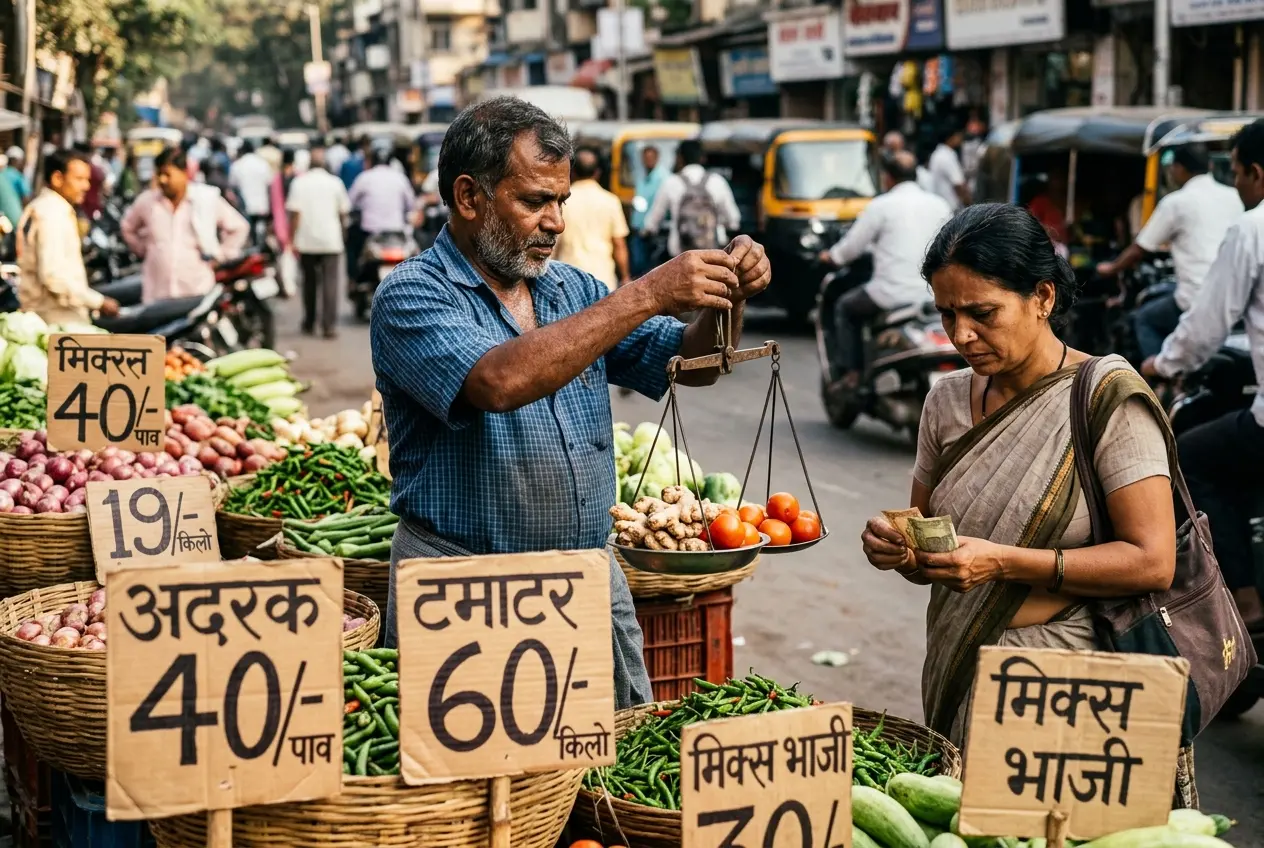
Provisional data from the Ministry of Statistics showed retail inflation at 4.38% year-on-year in June, up from 3.93% in May and the highest since December 2024 (5.2%). It is the first print above the RBI’s 4% target in 17 months, even as it remains inside the 2-6% tolerance band. Rural inflation rose to 4.74%, urban to 3.92%, with food and beverages crossing 5% for the first time in the 2024-base CPI series. Ginger inflation surged to 50.41% from 32.50% in May, and tomato prices rose 31.92% year-on-year, with restaurants and accommodation services at 6.91%.
- 4.38% June CPI (combined sector)
- 5.32% Consumer Food Price Index, year-on-year
- 4.3% transport inflation in June, versus 1.75% in May
The transmission of higher fuel costs shows up inside the transport line, which doubled in a single month. Core inflation, which excludes food and fuel, climbed to 4.1% from 3.7%, a multi-month high in this series. For India’s hinterland, food at 5.32% combined and 5.45% rural leaves the central bank little room to declare the print a one-off.
The geopolitical backdrop sits behind the move. After a brief ceasefire between Iran and the United States in June, hostilities resumed last week, lifting oil prices and renewing the risk premium on crude shipments that run through the Strait of Hormuz. An S&P Global-owned research firm, Crisil, split the contribution to headline between food (185 basis points) and non-food (250 basis points), and how the same Iran war shock forced an IMF cut to UK growth underlines how widely the energy shock has now spread. India’s response is harder because it sits closer to the source.
The Pump Has Priced In the West Asia War
The June print is the first to capture a full month of the May hike in retail petrol and diesel. The National Statistics Office records pump prices as on the 15th of each month, so the May 7.4% petrol and 8.4% diesel hikes implemented after mid-May were fully reflected this time. Higher transport costs sat at the centre of the lift, with the transport line nearly doubling inside a single month, as the official ministry page confirming the 4.38% June CPI and 5.32% food index prints made clear.
| Indicator | May 2026 | June 2026 |
|---|---|---|
| CPI (combined) | 3.93% | 4.38% |
| CFPI (food index) | 4.78% | 5.32% |
| Transport inflation | 1.75% | 4.3% |
| Petrol pump-price inflation | 3.1% | 7.5% |
| Diesel pump-price inflation | 3.4% | 8.4% |
RBI meeting minutes, released on June 19, quantified the direct hit at about 36 basis points on headline CPI, with second-round effects to follow. The May hike also filtered into food-serving services, where inflation rose to 6.91% in June from 2.7% in February as businesses passed the higher LPG cost onto cooked meals. On Brent, Crisil Intelligence’s forecast of $82-87 a barrel this fiscal is roughly 20% higher than the year-ago average. Food and beverages inflation crossed 5% for the first time in the new CPI series, driven by ginger and tomatoes, and the non-food component was the larger contributor at 250 basis points against food’s 185.
That split is what reads as warning to the central bank, since the non-food line tracks the pass-through it is supposed to manage. Input cost pressure has begun to spread beyond fuel. Higher commercial LPG, industrial raw materials, chemicals, base metals, rubber and plastic products all sit on the RBI’s warning list, with pass-through to consumer prices likely in the months ahead.
The passing-through is what the RBI has flagged. Governor Sanjay Malhotra said in June that the impact of the energy price shock is seen waning thereafter, after inflation reaches the upper bound of the RBI’s target range towards the end of 2026. That view still requires crude to remain in the $82-87 range and the monsoon to recover in July and August. Both assumptions are now being tested.
A Monsoon Pulled Two Ways
Food is half the story. June was India’s driest in more than a decade, and the fifth-driest since 1901, with southwest monsoon rainfall 39.8% below the long-period average. The country received 99.5 millimetres of rain during the month against a normal of 165.3 millimetres, according to the IMD. After the parched start, monsoon showers advanced rapidly in the first week of July and brought the all-India rainfall deficit down to 15% by July 8, Crisil said. The mixed reading, parched June and partial July rebound, is the second driver in the headline print.
The India Meteorological Department’s July outlook keeps the season below normal, at less than 94% of the long-period average. Weak El Niño conditions are currently prevailing over the equatorial Pacific Ocean and are forecast to strengthen further during the season. The southwest monsoon delivers more than 70% of India’s annual precipitation and feeds the 45% of the country that is unirrigated farmland.
For consumers, the cumulative swing shows up in the grocery basket. Food at the wholesale level rose 5.32%, with ginger and tomatoes leading the list and potato and peas still in mild deflation.
Brent crude fell to a three-month low earlier this week after Donald Trump said a US-Iran deal would reopen the Strait of Hormuz, and Brent dropping to a three-month low after Trump said a US-Iran deal would reopen Hormuz is the kind of relief rally that hasn’t yet flowed back into the Indian pump price. Crisil’s analysts described the binding constraint on rural India in the report that also set out the rainfall swing:
These swings between rainfall scarcity and surplus can be as disruptive to agriculture as a weak monsoon itself, as it influences sowing decisions, crop health and ultimately rural incomes.
Reservoir levels and foodgrain stocks remain adequate, the RBI noted, but adequate stocks are not the same as a normal harvest. The two serve the same buffering function only when the second arrives, and July and August rainfall are now the deciding inputs.
What the RBI Had Already Priced In
The 4.38% print sits inside the RBI’s June projections. On June 5 the Monetary Policy Committee kept the repo rate at 5.25% for a third consecutive pause and retained a neutral stance. At the same meeting it raised the FY27 inflation forecast to 5.1% from 4.6%, citing the energy shock and El Niño risk. The quarterly path it laid out pencils in 4.2% in Q1, then 5.1% in Q2, 5.9% in Q3 and 5.4% in Q4. The June print lands at the lowest end of that corridor; the Q3 reading of 5.9% sits near the upper bound of the RBI’s 2-6% tolerance band.
Core inflation is now forecast at 4.7% for FY27, up from 4.4% earlier. Malhotra warned that second-round effects from rising input costs, transportation and wages could become a distinct possibility if not contained. The MPC’s message was that policy would stay data-driven and not be used to offset oil supply disruptions directly.
| Quarter | RBI CPI forecast (FY27) |
|---|---|
| Q1 (Apr-Jun 2026) | 4.2% |
| Q2 (Jul-Sep 2026) | 5.1% |
| Q3 (Oct-Dec 2026) | 5.9% |
| Q4 (Jan-Mar 2027) | 5.4% |
Outside the RBI, the analyst split is sharpening. Capital Economics forecasts 75 basis points of hikes taking the repo to 6.00% by early 2027; HDFC Bank expects inflation to average 5.2% for the fiscal; Crisil’s own estimate is 5.1%; Kotak Mahindra Bank expects 50 basis points of rate hike in the second half of FY27. The RBI’s forecast remains the anchor, and the Q3 number is the binding one: it sits within striking distance of 6% even on the central bank’s own assumption set.
The Consequential Lever Sits at Hormuz
Why each print matters more for India than for most peers comes down to imports. The country sources nearly 85% of its fuel needs from abroad, and the Strait of Hormuz is the funnel: about 50% of crude imports, 60% of LNG, and almost all LPG. The Strait is a chokepoint that no central bank can ease by raising rates.
A separate explainer in DNA India puts the share of crude at 40-50% through the Strait, LNG at 55-60%, and LPG at 80-85%, and gold giving up ground as the Iran conflict lifted inflation and rate fears captures how the same forces are reshaping emerging-market currencies. The rupee has fallen over 5% since the West Asia conflict started in March 2026, and the RBI’s foreign exchange reserves have declined by nearly $46 billion as it intervened to stabilise the currency. Reserves stand at $682.3 billion as of May 29, 2026, providing about 11 months of import cover, a strong but finite cushion.
What the RBI is watching is whether the West Asia ceasefire survives. After a brief June ceasefire between Iran and the United States, hostilities resumed last week and the Strait of Hormuz remains contested. Imported energy cost is the channel through which a foreign war becomes a domestic print. Higher domestic fuel prices push transport, food services, and input costs across the consumer basket; the first full month of that transmission is what the June 4.38% reading measures. The RBI’s own message is plain: long enough disruption and inflation slips from food into core, where policy has less control.
Frequently Asked Questions
What is India’s CPI inflation rate for June 2026?
India’s consumer price index rose 4.38% year-on-year in June 2026, up from 3.93% in May, according to provisional data from the Ministry of Statistics and Programme Implementation. The reading is the highest since December 2024 (5.2%).
Why did India’s inflation rise in June 2026?
The print reflects the first full month of the May hike in retail petrol (+7.4%) and diesel (+8.4%) prices, a steep June rainfall deficit (39.8% below LPA), and food inflation driven by ginger (+50.41%) and tomatoes (+31.92%). Crisil split the contribution to headline at 185 bps food and 250 bps non-food.
When did India last breach the RBI’s 4% inflation target?
June 2026 is the first breach of the RBI’s medium-term 4% target in 17 months. Headline inflation had stayed below the target since January 2025.
What is the RBI’s inflation forecast for FY27?
The RBI raised its FY27 CPI forecast to 5.1% from 4.6% at its June 5, 2026 meeting, with a quarterly path of 4.2%, 5.1%, 5.9%, and 5.4% across Q1 through Q4. Core inflation for the fiscal is now pegged at 4.7%, up from 4.4%.
How much of India’s fuel imports pass through the Strait of Hormuz?
About 50% of crude imports, 60% of LNG, and almost all LPG arrive via the Strait of Hormuz. With India importing nearly 85% of its fuel needs, the Strait is the chokepoint that links every West Asia flare-up to the Indian consumer.