The Georgia Department of Natural Resources is asking residents to trap, kill, and report any Argentine black and white tegu they find. The four-foot invasive lizard has held a wild colony in two southeast Georgia counties since 2018, the agency says, when it first began investigating reports of "big lizards scuttling across dirt roads, hiding under homes and lurking around chicken houses."
Tegus will eat the eggs of ground-nesting birds, American alligators, and protected gopher tortoises, the DNR warns, and they carry salmonella. The colony traces back to escaped and released pet-trade animals, the kind of release channel the state moved against by listing the species as a wild animal and requiring registration and tagging by December 4, 2023.
A Wild Colony Has Held in Two Georgia Counties Since 2018
The Georgia Department of Natural Resources' Wildlife Resources Division is working with the U.S. Geological Survey and Georgia Southern University to assess and remove a wild population of Argentine black and white tegus in Tattnall and Toombs counties. The agency says the colony has held there since 2018, when it first began investigating reports of "big lizards scuttling across dirt roads, hiding under homes and lurking around chicken houses," per the agency's own November 2025 status check on the colony. The work pairs DNR field operations and law enforcement with USGS research funding and Georgia Southern's trapping and laboratory analysis.
The agency's count has crossed 20+ animals removed or observed in the wild in the two counties, and confirmed tegu reports in Tattnall and Toombs reached 11 in 2025, the most in any year since the program started.
The interactive sightings map kept by the University of Georgia shows at least 56 reports over the last few years, with the highest counts in Tattnall (16) and Toombs (10). The state's November 2025 status check logged 11 confirmed reports in the two counties in 2025 alone, "the most since 2018," and tied the rise to either more reports, more tegus, or both.
- 4 feet, 10+ pounds: the maximum size of an adult tegu in the wild
- 20+: tegus confirmed in the wild in Tattnall and Toombs counties
- 56: total sightings recorded on the University of Georgia's interactive map
- 11: confirmed tegu reports in the two counties in 2025, the most in any year since 2018
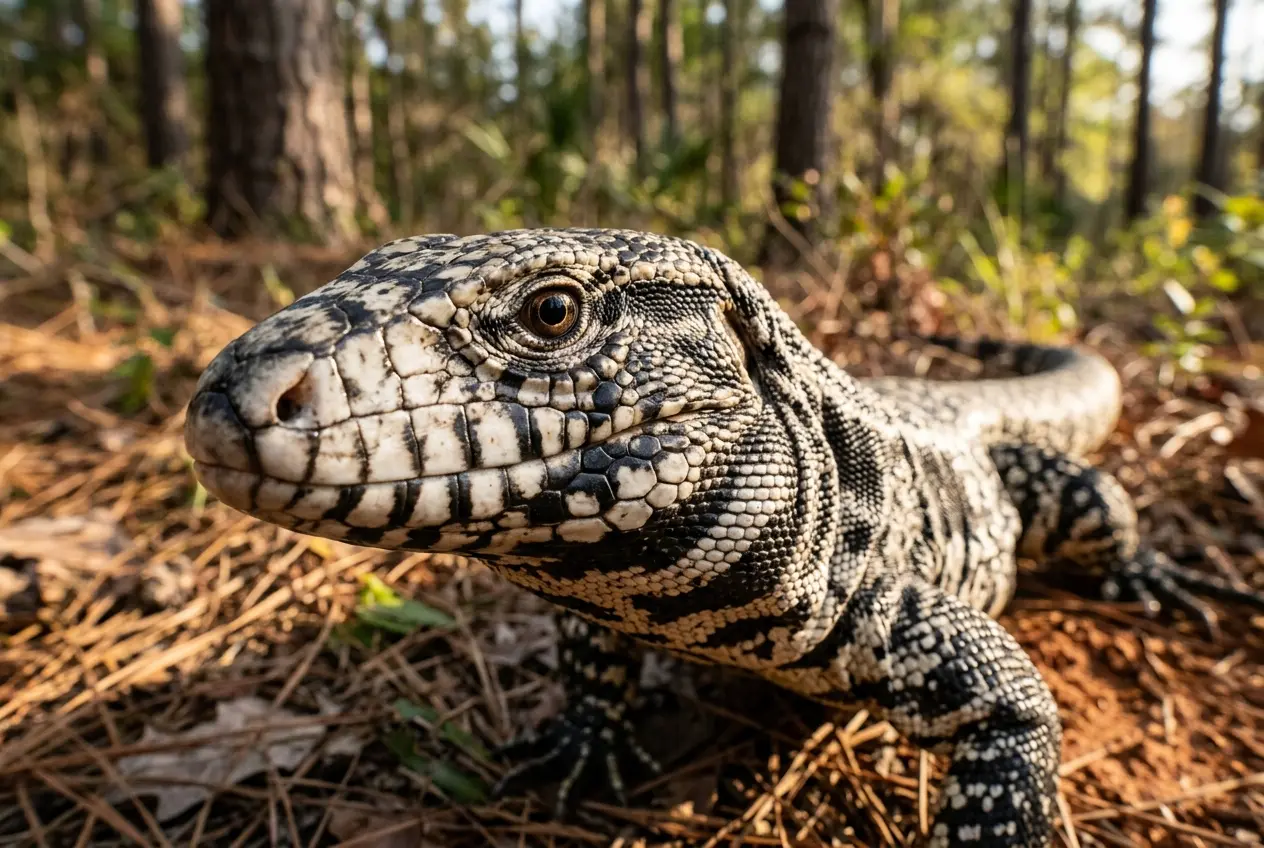
What a Four-Foot Lizard Actually Eats
Tegus will eat the eggs of ground-nesting birds, including quail and wild turkeys, and the eggs of reptiles such as American alligators and gopher tortoises, the Georgia DNR's official tegu page warns. The gopher tortoise is a federal species of concern, and the American alligator is protected under both state and federal law. The alligator nests in dense vegetation near water, and tegus are documented in that habitat.
The gopher tortoise is a federal species of concern, listed as protected under both state and federal frameworks. The DNR confirms tegus eat both tortoise eggs and young tortoises, and the agency's tegu response includes a recommendation to fill burrow holes and clear brush piles in Toombs and Tattnall yards.
The dietary list extends past wild species. The DNR confirms tegus also eat chicken eggs, fruit, vegetables, plants, pet food, carrion, and small live animals, from grasshoppers to young gopher tortoises. Researchers at Georgia Southern have been opening the stomachs of trapped animals and finding "a mix of invertebrates, plant matter and small vertebrates" in nearly every one, according to Dr. Lance McBrayer, a Georgia Southern biologist who partners with DNR on the colony. The stomach-content work has documented frogs, lizards, small snakes, muscadines, strawberries, and "bugs of all stripes" inside the captured tegus.
Tegus can carry salmonella, the DNR warns, raising a bacterial contamination concern for crops the state's agricultural extension agents have not had to plan around from this species before. There are also concerns the lizards could spread exotic parasites to native wildlife, the agency says.
Female tegus reach reproductive age after their second winter in brumation and can lay about 35 eggs a year, with hatching in Georgia expected in June and July, per the DNR. Hatchlings emerge about 6 to 8 inches long, with a bright green head that fades within their first month. Sollenberger said the signs point to a wild population: "There's no (other) reasonable reason for having that many tegus in such a small area."
- Quail and wild turkey (eggs)
- American alligator (eggs)
- Gopher tortoise (eggs and hatchlings)
- Frogs, lizards, and small snakes (Georgia Southern stomach-content data)
- Crops, fruit, and backyard chickens (eggs, plants, pet food)
The Pet Trade's Reach, A Decade Past the Regulatory Door
The colony's seed stock is the pet trade. Argentine black and white tegus are listed as wild animals in Georgia, banned from import and breeding in the state, but anyone who registered and tagged an animal before December 4, 2023 was allowed to keep it.
The wild colony most likely started with escaped or released captive animals, the DNR says, predating the wild-animal designation. Florida's self-sustaining population took hold in Miami-Dade County around 2008 through the same channel, escaped and released pets, and now anchors established tegu populations across the South. The number and spread of sightings in Toombs and Tattnall "speaks to the fact that the pet trade is a significant hurdle," Dr. Lance McBrayer of Georgia Southern University said in the November 2025 status check.
Tegus seen elsewhere in Georgia are considered one-offs, escaped pets or illegally released animals, but the Tattnall and Toombs concentration points to a breeding population that has held since 2018. Sollenberger's framing in the November 2025 status check was blunt: "Tegus in the wild are 'public enemy no. 1.' Wherever they are, we want them off the street." The same blog noted that no young tegus have been confirmed, but females in the colony have been found with eggs.
It's very difficult to find one of them, much less count enough of them. There's probably more possums than there are tegus, but fewer coyotes [than tegus.]
The quote is from Daniel Sollenberger, a senior wildlife biologist with the Georgia Department of Natural Resources' Wildlife Resources Division, speaking to reporters in early June.
Why the Lizards Are Built to Stay
Tegus brumate through Georgia's cold months in existing burrow systems, which is part of why winters have not pushed the colony out. The species is the largest of all tegu species, native to Brazil, Paraguay, Uruguay, and Argentina, with adults documented at up to 4 feet and 10 pounds or more, and a lifespan of up to 20 years, per the DNR.
They are fast-moving, terrestrial lizards rarely found more than a few feet off the ground, but they are strong swimmers and can stay submerged for extended periods. The species occupies mixed grassland and woodland habitats and disturbed areas like forest clearings, fence rows, and roadsides.
Females reach reproductive age after their second winter in brumation, and they can lay about 35 eggs a year, with hatching in Georgia expected in June and July. The November 2025 status check noted that, while tegu reports surged to 11 in the two counties in 2025, the population in Tattnall and Toombs does not appear to be increasing fast, a pattern McBrayer said can hold for years before a population takes off exponentially. The colony has held since 2018, and the DNR has confirmed more than 20 animals in the wild across the two counties.
Florida's Footprint, Eighteen Years In
Florida has had a self-sustaining wild tegu population since at least 2008, and the state has documented established wild populations in at least 35 counties. The species has also been documented in Alabama, South Carolina, and Texas, with Georgia joining the list after the Toombs and Tattnall colony was confirmed. Florida banned all tegu species from the pet trade in 2024, a year after Georgia moved against the Argentine species with its December 2023 wild-animal registration deadline.
The pattern of escapes and releases that built Florida's population is the same pattern that built Georgia's, and McBrayer, the Georgia Southern biologist, said the Toombs and Tattnall population "can simmer at a low abundance" for years before taking off. When the growth does start, he added, it is "exponential." The University of Georgia's sightings map shows reports expanding beyond Toombs and Tattnall in recent years.
- 2008: first self-sustaining wild tegu population documented in Florida
- 35: Florida counties with documented tegu sightings
- 2024: year Florida banned all tegu species from the pet trade
- December 2023: Georgia's wild-animal registration deadline for the Argentine species
What Georgia Wants From Residents
The state's ask is direct. "That is what people need to do if we're going to try to control or contain this infestation," Sollenberger said. The DNR is asking residents to trap, kill, and report any tegus they find.
On private property, with landowner permission, tegus can be legally trapped or killed year-round, and they are not protected under state wildlife law. Local ordinances still apply, as do basic safety precautions. On state Wildlife Management Areas, tegus can be taken only with firearms legal for the currently open hunting season on that area; traps are not allowed on WMAs. The DNR notes that appropriate safety precautions apply across all of these.
Residents in Toombs and Tattnall can keep pet food inside, fill holes that could serve as burrow entrances, and clear brush piles that young tegus use for cover. The June and July hatch window is now underway, and females in the colony have already been found carrying eggs, the DNR says.
- Note the location and, if possible, take a photo of the tegu.
- Report the sighting to the Georgia Invasive Species Task Force at the state's invasive species reporting form or by calling (478) 994-1438.
- On private property with landowner permission, trap or kill the animal year-round.
- On Wildlife Management Areas, use only firearms legal for the current hunting season.
- Reduce cover: keep pet food indoors, fill burrow holes, and clear brush piles.
Frequently Asked Questions
How big do Argentine tegus get?
Up to 4 feet long and 10 pounds or more, with adults documented in the wild in Georgia averaging slightly less than 2 feet, per the Georgia Department of Natural Resources.
Are tegus dangerous to people or pets?
Not usually aggressive toward people, but they can defend themselves with sharp teeth, claws, strong jaws, and a whipping tail, the DNR warns. The bigger day-to-day concern is what they eat, including pet food left outdoors and chicken eggs in backyard coops.
Can you keep a tegu as a pet in Georgia?
Only if the animal was registered with the state and tagged before December 4, 2023. Importing and breeding the species in Georgia is illegal, and tegus in the wild are not protected under state wildlife law.
Where in Georgia are tegus established?
Toombs and Tattnall counties in southeast Georgia host the only known established wild colony, and the November 2025 status check counted 11 confirmed reports from those two counties that year, the most in any year since 2018. The University of Georgia's sightings map shows at least 56 reports in recent years, with the highest counts in Tattnall (16) and Toombs (10).
What should I do if I see one?
Note the location, take a photo if possible, and report it to the Georgia Invasive Species Task Force at gainvasives.org or (478) 994-1438. Tegus are not protected under state wildlife law, and the animals can be legally trapped or killed year-round on private property with landowner permission.