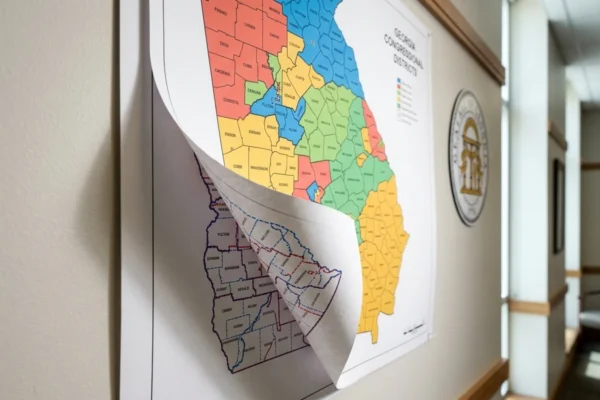
Georgia’s tap water earned a B in a 2026 nationwide analysis of nine municipal water systems serving 1,619,768 residents, but the grade hides a sharper split between cities. Atlanta and Sandy Springs both carry PFAS at 2.3 parts per trillion, the so-called forever chemicals, while the other seven systems tested clean. All nine cities still meet federal drinking water standards as of 2026, which is why the official answer to “is Georgia’s tap water safe?” remains yes. The more useful answer depends on which city you live in and which standard you’re measuring against.
The numbers come from PurityMap’s March 2026 update, an independent water quality data platform compiling EPA Safe Drinking Water data, Environmental Working Group tap water records, utility consumer confidence reports, and USGS regional monitoring. Georgia’s average PurityMap score of 78.7 out of 100 sits 0.8 points above the US average of 77.9, according to the platform’s March 2026 update. Two cities, Atlanta and Sandy Springs, scored 67, the only cities to fall into the “moderate” band, while the other seven tied at 82.
How Georgia’s Water Compares to the National Average
The 2026 PurityMap analysis covered water systems serving 1,619,768 residents across nine Georgia cities, including Athens, Atlanta, Augusta, Columbus, Macon, Roswell, Sandy Springs, Savannah, and Warner Robins. The platform pulled from four primary sources: EPA Safe Drinking Water Information System data, Environmental Working Group tap water records, state utility consumer confidence reports, and USGS regional monitoring. Georgia’s combined score of 78.7 puts it 0.8 points above the US average of 77.9. The state’s water also runs soft, with an average hardness of 1.9 grains per gallon, 4.4 GPG below the national average of 6.3 GPG, and none of the nine cities reached the “hard water” threshold.
All nine cities draw from surface sources: the Chattahoochee, Savannah, and Ocmulgee rivers, plus the North Oconee River and Bear Creek Reservoir. Lead levels across all nine systems averaged 2.1 parts per billion, well below the 15 ppb EPA action level that triggers regulatory response. The figure obscures a familiar caveat: older homes with aging plumbing can still test higher than the system-wide average, since lead typically leaches from household pipes rather than from the water leaving the treatment plant.
PurityMap rates Georgia’s overall water “Safe, Filtration Recommended,” a label that captures the gap between federal compliance and stricter health-based guidelines. The state’s 78.7 score puts it in the middle of the national pack, with seven cities in the “good” band of 70 to 84 and two in the “moderate” band of 60 to 69. No Georgia city scored “excellent” (85 to 100) or “poor” (below 60). The two moderate scorers, Atlanta and Sandy Springs, both pulled their scores down with detected PFAS, the same chemicals that have triggered nationwide drinking water rules. The seven cities that tied at 82 posted no PFAS and lead levels that never crossed the 2.5 ppb mark.
- 1,619,768 residents covered across nine Georgia systems
- 78.7/100 average PurityMap score for Georgia (Grade B)
- 0.8 points above the US average of 77.9
- 1.9 GPG average hardness (Soft), 4.4 GPG below the US average
- 2.1 ppb average lead, well below the 15 ppb EPA action level
Atlanta and Sandy Springs Both Show Detected PFAS
Atlanta and Sandy Springs are the two Georgia cities where PFAS were detected, according to PurityMap’s March 2026 data, and both scored 67 out of 100, the only cities to drop into the “moderate” range. Each system showed PFAS at 2.3 parts per trillion, the highest levels recorded across the nine cities analyzed. Atlanta’s water system, run by the city’s Department of Watershed Management, serves roughly 500,000 residents. Sandy Springs, just north of Atlanta on the Chattahoochee watershed, serves about 108,000 residents. Both systems run on the same river and both show the same PFAS reading, a pattern that pulled both cities’ scores below the rest of the state.
The federal threshold remains a 4 parts per trillion maximum contaminant level for two of the best-studied PFAS compounds, PFOA and PFOS, set under the EPA’s 2024 PFAS rule and upheld in an EPA proposed compliance extension announced May 18, 2026. Atlanta’s and Sandy Springs’ 2.3 ppt reading is below that 4 ppt limit, which is why both systems remain in compliance with federal law. The water is legal; the chemicals are still there.
PFAS, or per- and polyfluoroalkyl substances, are a class of thousands of synthetic compounds used to make products resistant to water, heat, and stains. They do not easily break down in the environment and have been linked in epidemiological research to kidney and testicular cancer, liver damage, increased cholesterol, thyroid disease, decreased fertility, and pregnancy complications, according to the American Association for the Advancement of Science. There is no clinical treatment for PFAS exposure, and blood testing cannot determine whether a person’s health has been or will be affected, the same source notes. Contamination sources include industrial facilities, landfills, and sites where PFAS-based firefighting foam has been used, such as airports and military installations.
The 2.3 ppt reading sits below the EPA’s 4 ppt MCL, which is why Atlanta and Sandy Springs remain in compliance, and PurityMap still recommends an under-sink reverse osmosis system for both cities because of the detected PFAS. Reverse osmosis is rated to remove more than 99% of PFAS, lead, and other contaminants. Standard pitcher filters do not remove chloramine, and all nine Georgia systems use chloramine or carry elevated chlorine residuals, according to the platform’s analysis.
We recommend an under-sink reverse osmosis system for drinking water in PFAS-affected areas of Georgia. RO removes 99%+ of PFAS, lead, and other contaminants.
PurityMap, an independent water quality data platform, makes the recommendation in its March 2026 Georgia report.
| City | Score | Hardness (GPG) | Lead (ppb) | PFAS |
|---|---|---|---|---|
| Atlanta | 67/100 | 1.1 | 2.2 | 2.3 ppt |
| Sandy Springs | 67/100 | 1.1 | 2.2 | 2.3 ppt |
The Gap Between Federal Limits and Modern Health Standards
The EPA’s legal maximum contaminant levels set the floor for what utilities must do; the Environmental Working Group’s health-based guidelines set a stricter ceiling for what independent scientists say is safe. Atlanta and Sandy Springs pass the EPA’s 4 ppt limit at 2.3 ppt, but the chemicals are still detected, still flowing, and not removed by the standard filtration most residents use. The two standards measure different things, and the gap between them is where most of Georgia’s PFAS risk actually lives.
EPA standards are legally enforceable limits, often set decades ago, and many have not been updated to reflect newer cancer risk assessments and epidemiological research. EWG guidelines are typically far stricter than EPA maximum contaminant levels, reflecting more recent science rather than older regulatory compromise. Neither is “the” definitive standard; the agencies offer two different frameworks for two different purposes, and a utility can pass one while failing the other. PFAS in the Georgia dataset show the same split: a utility can pass the federal test and still deliver water that fails the health-based one.
Where Every Georgia City Lands in the 2026 Rankings
All nine cities draw from surface sources. Lead averaged 2.1 ppb across the state, below the EPA action level of 15 ppb, though older homes may still test higher. Seven cities tied at 82/100, two at 67/100, and the gap between them tracks with whether PFAS were detected. Atlanta and Sandy Springs, both at 67/100 and both with detected PFAS, sit at the bottom; Savannah, Augusta, Columbus, Macon, Athens, Roswell, and Warner Robins, all with no PFAS detected, sit at 82.
Savannah, drawing from the Savannah River, finished as the cleanest system at 82/100, with no PFAS detected and a lead reading of 2.0 ppb. Augusta, drawing from a similar surface source, matched the score with no PFAS but a slightly higher 2.5 ppb lead. Columbus, Macon, Athens, Roswell, and Warner Robins all tied at 82/100 with no PFAS detected; their differences sat in hardness and lead levels.
Macon posted the highest hardness at 3.2 GPG, still within the soft range that affects 0 of the 9 cities tested. Warner Robins followed at 3.0 GPG, with a TDS reading of 105 ppm. Atlanta and Sandy Springs had the lowest hardness at 1.1 GPG, consistent with their shared source in the Chattahoochee watershed. Athens drew from the North Oconee River and Bear Creek Reservoir and posted the state’s lowest lead reading at 1.8 ppb. Across the rankings, PFAS detection, not hardness, separates Atlanta and Sandy Springs from the other seven cities.
| Rank | City | Score | Hardness | Lead | PFAS |
|---|---|---|---|---|---|
| 1 (lowest) | Atlanta | 67/100 | 1.1 GPG | 2.2 ppb | Yes (2.3 ppt) |
| 2 | Sandy Springs | 67/100 | 1.1 GPG | 2.2 ppb | Yes (2.3 ppt) |
| 3 | Augusta | 82/100 | 2.5 GPG | 2.5 ppb | No |
| 4 | Savannah | 82/100 | 2.0 GPG | 2.0 ppb | No |
| 5 | Columbus | 82/100 | 1.8 GPG | 2.0 ppb | No |
| 6 | Macon | 82/100 | 3.2 GPG | 2.5 ppb | No |
| 7 | Athens | 82/100 | 1.5 GPG | 1.8 ppb | No |
| 8 | Roswell | 82/100 | 1.2 GPG | 2.0 ppb | No |
| 9 (highest) | Warner Robins | 82/100 | 3.0 GPG | 2.0 ppb | No |
Practical Steps for Residents Worried About Their Tap Water
Georgia’s water quality is safe and moderately clean by federal standards, and most problems can be addressed with minor interventions. In PFAS-affected areas, PurityMap recommends an under-sink reverse osmosis system, which the platform says removes more than 99% of PFAS, lead, and other contaminants. Reverse osmosis systems typically run anywhere from $150 to $1,000 plus ongoing maintenance, depending on capacity and installation.
For residents not ready to install a filtration system, the CDC and EPA point to a smaller set of free or low-cost steps that reduce exposure without new equipment. Residents can request their utility’s annual water quality report, which utilities are required to send each year and which lists every detected contaminant. They can also contact their water provider directly to ask which contaminants, if any, have been detected in their specific service area. A granular activated carbon filter, certified to reduce the specific contaminants in the local water, can be added at the tap. Finally, residents in older homes can run cold water for a couple of minutes before drinking if the water has been sitting in pipes unused.
Researchers are also working on the removal side. Georgia Tech researchers have published work on a machine learning approach to removing PFAS from drinking water, using algorithms to design better membranes for the chemicals. Other research efforts are aimed at faster detection, shortening the time it takes to confirm contamination in a water system. Until those technologies scale, the fastest signal of what is in a resident’s tap water remains the annual consumer confidence report, which for Atlanta and Sandy Springs will keep listing the same detected PFAS readings year after year.
The split between federal compliance and modern health science is not unique to Georgia. EWG’s PFAS contamination map flags detections across community water systems nationwide, with the same gap between legal limits and health-based thresholds showing up in states well beyond the Southeast. Georgia’s two flagged cities are one local slice of a larger national picture, where the legal limit sets the floor for what utilities must do.
- Request your utility’s annual water quality report
- Contact your local water provider to find out which contaminants, if any, have been detected in your system
- Use a granular activated carbon filter certified to reduce the specific contaminants in your water
- Run cold water for a couple of minutes before drinking if water sits in pipes unused
Frequently Asked Questions
Which Georgia city has the cleanest tap water?
Savannah scored highest in the 2026 PurityMap analysis at 82 out of 100, drawing from the Savannah River with no PFAS detected and a 2.0 ppb lead reading. Augusta, Columbus, Macon, Athens, Roswell, and Warner Robins also scored 82, but Savannah tops the state on PurityMap’s combined metric.
Which Georgia city has the worst tap water?
Atlanta and Sandy Springs tied at the bottom with a score of 67 out of 100, the only cities in the analysis with detected PFAS at 2.3 parts per trillion. Both draw from the Chattahoochee River watershed and remain in compliance with federal EPA limits.
Has PFAS been found in Georgia drinking water?
PFAS were detected in 2 of 9 Georgia cities (22%) in the March 2026 PurityMap analysis, with Atlanta and Sandy Springs both at 2.3 parts per trillion. The federal maximum contaminant level for PFOA and PFOS is 4 parts per trillion under the EPA’s 2024 rule.
Is Georgia tap water safe to drink?
All 9 Georgia cities in the analysis meet EPA federal drinking water standards as of 2026, and PurityMap rates the state’s overall water as “Safe, Filtration Recommended.” Residents in Atlanta and Sandy Springs face additional exposure to PFAS, which reverse osmosis filtration can remove.
How does Georgia’s water compare to the national average?
Georgia’s average PurityMap score of 78.7 out of 100 sits 0.8 points above the US average of 77.9. The state’s water is also softer than average, with a hardness of 1.9 GPG versus 6.3 GPG nationally, and lead levels averaged 2.1 ppb against a 15 ppb EPA action level.