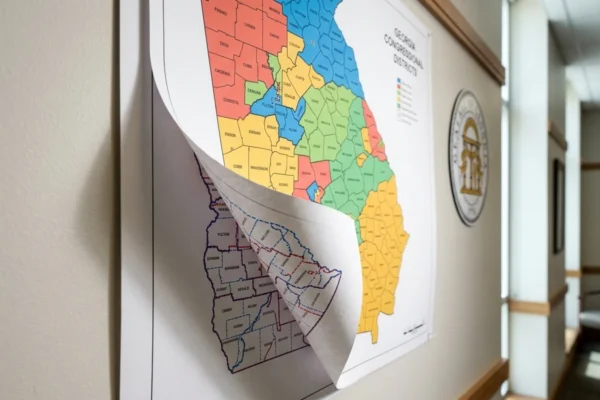
The Georgia sports betting fight just attracted more than $10 million in operator-funded spending on the state’s 2026 legislative races, the largest single-cycle push of its kind. The money arrived two months after the Georgia House killed the industry’s referendum bill on a 63-98 vote, the lopsided defeat that left operators no path inside the current chamber.
Most of the cash flows through Win for America, a federal super PAC funded by DraftKings, FanDuel, Fanatics and Bet365 that has raised roughly $48 million for state legislative races nationwide. Georgia is the lobby’s hardest seat on that map, a constitutional-amendment state where any wagering bill needs two-thirds of the House before voters get to weigh in.
The Playbook Operators Are Running in Georgia
The Atlanta Journal-Constitution disclosure that surfaced the spending shows the money moving through two state-level vehicles fed by Win for America. American Conservative Fund Action Georgia has spent more than $7.8 million backing Republican legislators and challengers. American Future, a Democratic-aligned arm, has spent more than $2.2 million on Democratic legislative races.
The split is deliberate. With control of the Georgia legislature contested in November, lobbyists are seeding both sides so that whichever caucus emerges intact has pro-betting members on its bench. House Speaker Jon Burns and House Appropriations Chair Matt Hatchett are among the legislators who have drawn PAC support, alongside Senate Majority Leader Jason Anavitarte on the upper-chamber side.
Analysts who track the contributions expect the headline figure to roughly double by the November vote, putting the Georgia push on track to clear $20 million. Even that ceiling looks modest if the fight extends into the 2027 session, when operators will need 57 additional House votes on top of the 63 they already had.
The lobby’s argument is the same one operators use everywhere: tax revenue. A 20% wagering tax on a market the size of Georgia would generate hundreds of millions a year for the HOPE scholarship, the state’s lottery-funded college tuition programme. Opposition groups push back, calling operator-funded races industry capture in a state where every prior attempt has been killed on moral and religious grounds.
The Vote That Sent Operators Looking for New Legislators
The trigger for the spending blitz was the failure of House Resolution 450 on the Georgia legislature’s calendar in March. The measure would have placed a constitutional amendment on the November 2026 ballot, asking Georgia voters whether to legalise online and retail sports wagering, with revenue earmarked for pre-K and education programmes and a carve-out for gambling addiction treatment.
On Crossover Day, March 6, the Georgia House rejected HR 450 by a vote of 63 to 98. Because constitutional amendments need 120 votes to clear the chamber, the bill was 57 short. With Crossover Day past, the measure could not be revived in the 2026 session. Our prior coverage of the Georgia sports betting referendum push for the 2026 ballot traced the bill’s path through committee before the floor vote killed it.
The defeat stung operators harder because the Senate side of the math has already been solved. Senate Resolution 131, introduced in the prior year and carried into the 2026 session, cleared the upper chamber with the required two-thirds vote in February. The Senate version went further than the House bill, authorising both sports wagering and a tiered casino licence regime. Both pieces died once the House killed the cheaper sports-betting-only vehicle.
Public polling has not been the constraint. Surveys commissioned by industry-aligned groups have put Georgia voter support for legal sports wagering at roughly 63%, comfortably above the simple majority a referendum would need. The wall is upstream: the chamber that decides whether voters even see the question.
That is the gap operators are spending to close. The $10 million already deployed targets House primaries where pro-betting challengers are pushing incumbents who voted no in March. The strategy assumes a Republican-tilted electorate in conservative districts will tolerate gaming legislation when revenue is paired with a religiously acceptable use case like education or first-responder funding.
Alabama and Missouri Bracket the Possible Outcomes
The Georgia spending is the latest entry in a sequence of multi-state campaigns that have produced wildly different outcomes. Two recent examples sit on opposite ends of the spectrum.
Alabama, 2024: a House-passed comprehensive gaming and lottery package would have created a state lottery, sports betting and casino licences. The Senate blocked it. Industry-aligned political spending in Alabama ran to roughly $15 million across the cycle. The bill died on tribal opposition from the Poarch Band of Creek Indians, whose existing gaming compact would have been disturbed, and on conservative caucus resistance to expanded gambling of any kind. Net result for operators: zero new market, fifteen months of work returned to zero.
Missouri, 2024: operators went around the legislature entirely. DraftKings and FanDuel funded Winning for Missouri Education, a ballot-initiative committee that put Amendment 2 directly to Missouri voters in 2024. The supporting campaign raised roughly $43 million, with the two operators each contributing $15.75 million. Caesars Entertainment funded a $14 million opposition campaign to protect its existing casino position. The amendment passed by about 7,000 votes out of nearly three million cast. The market launch is scheduled for December 2025.
Georgia inherits the worst characteristics of both. Like Alabama, the state requires legislative buy-in rather than a citizen-led ballot initiative. Like Missouri, the operators face well-funded incumbent gaming interests who would rather not share the market. And unlike either, Georgia’s threshold is a two-thirds constitutional supermajority, the steepest in the recent expansion fight.
| State | Industry-Aligned Spend | Path | Year | Outcome |
|---|---|---|---|---|
| Alabama | ~$15M | Legislative, simple majority | 2024 | Failed in Senate |
| Missouri | ~$43M support, $14M opposition | Citizen ballot initiative | 2024 | Passed, ~7,000-vote margin |
| Georgia | >$10M (rising) | Legislative, two-thirds constitutional | 2026 | HR 450 rejected 63-98 |
The takeaway from the comparison is that operator money buys access and turnout in citizen-initiative states. It has not, in this cycle, bought enough legislators to clear a supermajority floor.
The Constitutional Math in the Georgia House
Why the House remains the choke point comes down to four interacting numbers. None of them moves easily, and operators have to move at least one before the next legislative session opens.
- 120 House votes required for a constitutional amendment to advance to a statewide referendum. HR 450 got 63, leaving the bill 57 short. The Senate companion has already cleared its 38-vote threshold and would not need to be rerun if the House later moves.
- 180 total House seats are up in the November 2026 cycle. Industry-backed challengers are running primaries against several of the 98 representatives who voted against HR 450, but the realistic gain in a single cycle is closer to 10 to 15 flippable seats.
- 57-vote gap between current support and the supermajority threshold. Closing that in one election cycle is mathematically possible only if the lobby converts both flipped seats and previously-no-voting Republicans who could be persuaded by a revenue-earmarking compromise.
- Two-thirds rule applies to any constitutional gaming question, including the broader casino-and-betting package the Senate prefers. A narrower sports-betting-only bill faces the same floor as a comprehensive gaming overhaul.
Even an unusually successful November for pro-betting candidates would likely produce a single-digit move toward 120 votes. The lobby’s internal target, according to legislative tracking, is to get within 10 votes of the threshold by the 2027 session, then push for a compromise revenue allocation that peels off rural Republicans whose districts could use the HOPE scholarship money.
Atlanta’s Pro Teams Have Their Own Reasons to Be Loud
The Braves, Falcons, Hawks and Atlanta United have lobbied Georgia lawmakers as a unified coalition for the first time, formalising their effort as the Georgia Professional Sports Integrity Alliance’s lobbying coalition. Their letter to legislators argued the practical case first.
Georgia is the 12th largest state for illegal wagering. It is not going away. That is why we must ensure the industry is above-board and transparent.
The signatories were the presidents of the four franchises. A coalition lobbyist told reporters the teams expect no direct revenue from sports betting itself; the value sits in fan engagement, second-screen viewership and the in-game data-product market that legal wagering opens up for league partners.
That economic logic explains why the four franchises broke their usual practice of staying out of state-level fights. Live sports broadcasts where viewers can place bets see meaningfully higher minute-by-minute engagement, which translates into higher rights fees at the next television contract renewal. The Atlanta franchises sit closer to that revenue stream than the operators do. The same fan-engagement gap was visible during the most recent NCAA tournament, when Georgia fans were locked out of March Madness wagering while neighbouring Tennessee and North Carolina took bets legally.
Their support has not yet been enough. The March vote came in a chamber where teams had lobbied openly and visibly for two prior sessions. The constitutional supermajority simply does not respond to the same pressure that moves a simple-majority bill. Opposition from the Faith and Freedom Coalition and rural conservative caucuses has held even as the teams escalated their public posture.
Prediction Markets Are Already Taking Georgia Bets
Behind the legislative push sits a competitive threat that is reshaping why operators are spending at all. DraftKings Predictions and FanDuel Predicts are federally-regulated prediction-market platforms that already serve Georgia accounts, alongside larger players Kalshi and Polymarket. They do not require state authorisation because they trade event contracts as commodity derivatives, the same legal category as oil futures, under Commodity Futures Trading Commission (CFTC, the federal commodities regulator) oversight. The CFTC’s event-contract guidance and enforcement record is the document operators and state regulators are both reading.
Quick read on the prediction-market overlap:
- Four states where DraftKings Predictions and FanDuel Predicts already operate without state sportsbook licences: California, Texas, Georgia and Florida.
- Three federal appeals courts are weighing whether CFTC jurisdiction insulates these platforms from state gaming law, with the issue expected to reach the Supreme Court.
- $48 million raised across Win for America’s federal-level political activity, a figure operators tie explicitly to the prediction-markets threat in their own filings.
If the prediction-market loophole holds in court, operators retain access to Georgia revenue without ever passing a state law. The catch is that prediction-market contracts pay no state tax, leaving the HOPE scholarship and education-funding arguments without a financial leg. The state, the leagues and the addiction-services lobby all prefer a regulated sportsbook regime because it generates tax receipts and consumer protections that derivatives contracts do not provide.
That is why the spending continues even with the legislative path blocked. If prediction markets are ruled outside state authority, Georgia legislators lose leverage to extract a tax rate and licensing regime. If prediction markets are restricted only to states where sports betting is legal, the operators need Georgia legalised to keep serving Georgia customers. Either outcome resolves into the same lobbying push.
The Primary Calendar Now Owns the Industry’s Schedule
With the 2026 legislative session over and the next one not opening until January, the question is whether the spending already deployed, and the doubling analysts expect by November, shifts enough House seats to make the 2027 math survivable. The lobby’s internal target is closing the gap from 57 votes to roughly 10. Reaching that mark would force House leadership into a compromise conversation rather than an outright kill.
Three signals will tell operators whether the money is working. Primary turnout in the targeted districts is the first read. The share of contested races where industry-backed challengers either win or force closer-than-expected margins is the second. The November ballot’s effect on the rural-Republican seat composition is the third. None of those numbers is in yet.
If the post-November chamber looks roughly the same as the one that killed the March bill by 35 votes, the spending produces a longer fight, not a faster outcome. If the House moves to within 15 to 20 votes of the threshold, the 2027 session opens with a real negotiation over revenue allocation and the casino carve-out the Senate already supports. And if the federal courts close the prediction-markets loophole before then, every actor in the Georgia conversation has stronger reasons to deal.