Travel + Leisure’s national ranking of the country’s 30 most beautiful college campuses puts two Georgia schools on the map: Berry College in Rome at number two, sitting between Stanford and Notre Dame, and the University of Georgia in Athens at number 27. The list pairs a small private school of about 2,000 students with the flagship public university the state was built around, and it places both inside a single weekend’s drive.
Berry’s ranking is the surprise. The school enrolls fewer students than Stanford has on a single residential row, yet its 27,000-acre spread outranks every Ivy League quad on the list. UGA’s appearance at number 27 is steadier ground: a chapel built in 1832, an iron arch every student walks under, and a memorial garden tracing back to the country’s first garden club.
Two Peach State Picks in a Top Thirty
Travel + Leisure published its 30 most beautiful college campuses ranking last summer, and several outlets, including a January report on Cornell’s number-eight slot from the magazine’s beautiful campus ranking, have circulated through travel season. The top five reads as a deliberate mix of West Coast prestige, Southern landscape, Midwestern architecture, Florida modernism, and Hudson Valley estate.
Georgia is the only state with two entries inside the top 30 that sit roughly a 90-minute drive from one another. That proximity is the part road-trippers are noticing.
| Campus | Rank | Setting | Defining Feature |
|---|---|---|---|
| Stanford University | 1 | Palo Alto, California | Palm-lined Memorial Drive, Memorial Chapel |
| Berry College | 2 | Rome, Georgia | 27,000 acres, English Gothic Ford buildings |
| University of Notre Dame | 3 | South Bend, Indiana | Golden Dome, Touchdown Jesus mural |
| Florida Southern College | 4 | Lakeland, Florida | Largest single-site Frank Lloyd Wright collection |
| Bard College | 5 | Annandale-on-Hudson, New York | Hudson Valley estate, Fisher Center |
| University of Georgia | 27 | Athens, Georgia | 1832 Chapel, North Campus, Founders Garden |
That ordering matters. A small Floyd County school landed ahead of Bard, Cornell at number eight, Princeton at 11, and Yale at 15. The magazine’s editors made a clear choice: acreage and English Gothic, not endowment, was the deciding factor at the top.
Why Berry’s 27,000 Acres Land at Number Two
The number that anchors the ranking is the land. Berry’s contiguous campus runs across roughly 27,000 acres of fields, forests, lakes, and the slopes of Lavender Mountain in northwest Georgia. The World Record Academy has certified it as the largest contiguous college campus in the world, and its own admissions material describes the footprint as twice the size of Manhattan Island.
The Founder and the Ford Money
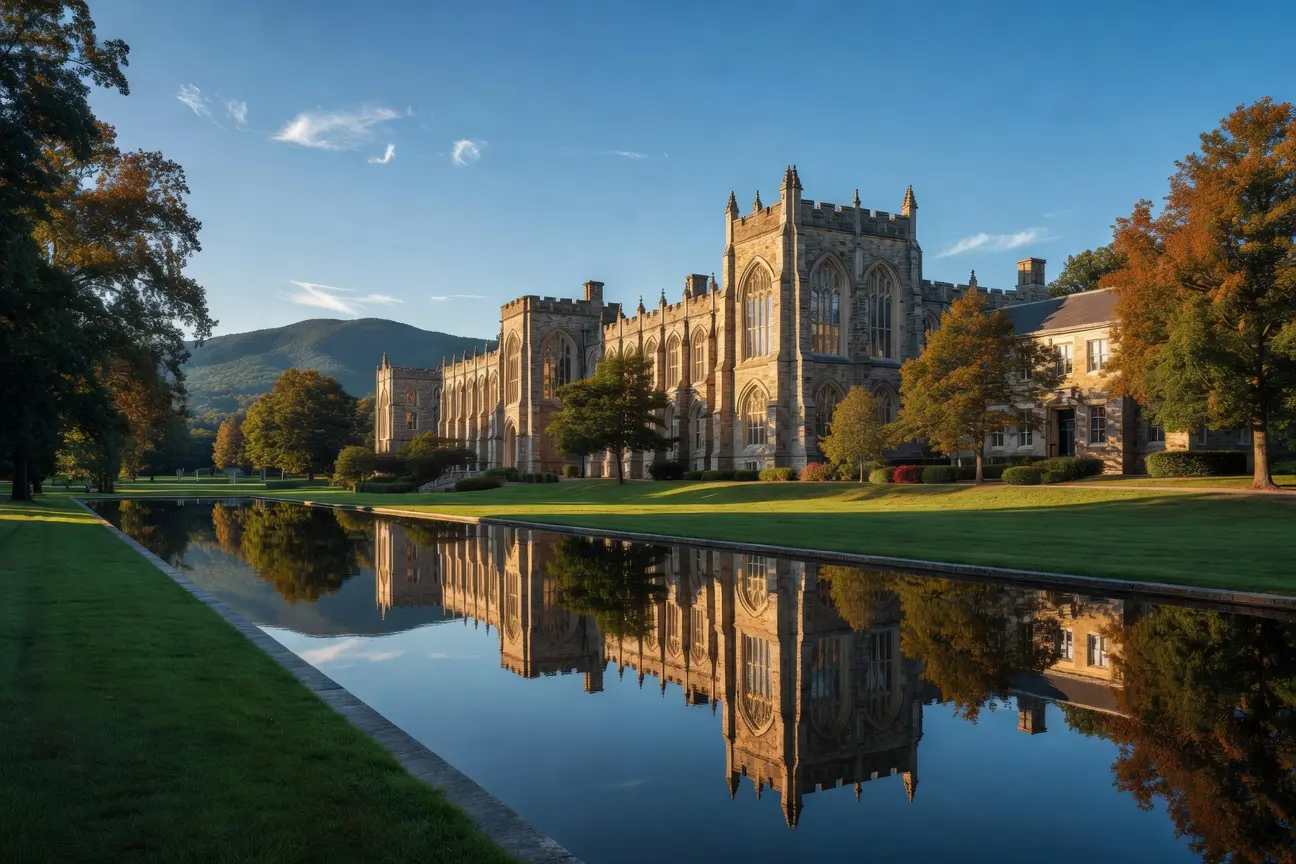
Martha Berry founded the school in 1902 as a rural boarding institution for mountain children. The English Gothic core that Travel + Leisure singled out arrived later. Auto industrialist Henry Ford and his wife Clara visited in the 1920s and bankrolled a cluster of cathedral-scale buildings that still define the campus today: Ford Dining Hall, Ford Auditorium, Mary Hall, and the surrounding quad. Reflecting pools and fountains were placed to frame the stonework, and the magazine’s editors cited those exact features in their writeup.
How the Land Reads in Person
Visitors do not see all 27,000 acres. Most of that figure is forest, pasture, and a working farm operation tied to Berry’s student-labor tradition. What a day-tripper experiences is the manicured quad, the Gothic buildings, the deer that wander the grounds in the late afternoon, and the trails that climb toward House o’ Dreams, a stone cottage on Lavender Mountain with a panoramic view of the campus below.
Public access is wide. Designated portions of the land are open for hiking, cycling, and horseback riding, and Berry publishes a visitor guide for the recreational trails. That openness is part of why the campus translates so well to a travel ranking: the public is welcomed onto the same grounds the enrolled students cross every day.
The Hollywood Files: Berry as a Working Movie Set
Berry’s other claim is that its landscape has been doubling for other places on screen for decades. The school maintains a complete filming history on its own website, and the list of productions is long enough to read as a small studio’s back catalogue.
The titles most readers will recognize, in order of release:
- Remember the Titans (2000), shot at the Ford Buildings, the Old Mill, and Oak Hill
- Sweet Home Alabama (2002), with the Oak Hill estate standing in for the Carmichael family home
- The Haves and Have Nots (2013), Tyler Perry’s long-running drama
- Constantine (2014), NBC’s supernatural series
- Stranger Things Season 4 (2022), with select location work on the grounds
- The Six Triple Eight (2024), the Tyler Perry Netflix feature
The Oak Hill estate is the recurring set. Built as the Berry family home and now operated as a museum on the edge of campus, it has played antebellum mansion, modern-era family seat, and period drama exterior across half a dozen scripts.
UGA at Twenty Seven: A Living Archive of Athens
The University of Georgia’s case for inclusion is older and smaller in scale. The school is the nation’s oldest state-chartered public university, founded in 1785, and its historic North Campus sits at the original heart of Athens.
The Chapel and the Bell
The campus Chapel, completed in 1832 for about $15,000, was one of the first Greek Revival buildings in Athens. The city’s boundaries were once measured outward from a point at the base of its steps. During the Civil War the structure served as an army hospital and then briefly as a prison. Today it seats 433 people and hosts lectures and weddings. The Chapel Bell, originally on the roof and moved to a wooden tower behind the building in 1913, is rung after every Georgia football win.
Founders Memorial Garden
The garden Travel + Leisure cited was built between 1939 and 1946 on a 2.5-acre plot at the edge of North Campus. It commemorates the Ladies Garden Club of Athens, founded in 1891 and recognized as the first garden club in the United States. The planting palette runs to more than 300 species and includes a boxwood parterre, a perennial garden, and a courtyard centered on a fountain. Hubert Owens, who founded UGA’s landscape architecture program, designed the original layout with his students.
The Arch
The cast-iron Arch at the College Avenue entrance, modeled on the Great Seal of Georgia and installed in the 1850s, is the photograph almost every visitor wants. Tradition holds that undergraduates do not walk under it until graduation. The Arch, the Chapel, and the Founders Garden form a triangle of less than a quarter mile.
Planning a Drive Between the Two Campuses
The pairing only works as a travel idea if the geography cooperates, and it does. Berry sits about 75 miles northwest of Atlanta in Floyd County; UGA is about 70 miles east of Atlanta in Clarke County. A traveler can land at Hartsfield-Jackson, see both campuses on consecutive days, and return without backtracking.
Practical notes for a self-guided visit:
- Berry visitor center: Open weekdays year-round; weekends during peak admissions seasons. The Mountain Campus and House o’ Dreams are accessible by car along Stretch Road.
- Oak Hill and the Martha Berry Museum: Operated by Berry and ticketed separately from the rest of campus.
- UGA Chapel: Open for self-guided viewing during university hours; check the events calendar to avoid lecture and wedding bookings.
- Founders Memorial Garden: Free to walk through; best photographed in April for the perennials and October for the boxwood structure.
- The Arch: Photographed from outside the campus on Broad Street; cross under only if you are not a current student.
Hotels in Rome, Georgia and Athens both run on a Friday-Saturday football calendar, and home game weekends at UGA push room rates and traffic well above weekday levels. Out-of-season visits trade crowd density for the chance to walk the grounds alone.
Where the Ivies, Stanford, and the Rest Landed
Cornell at number eight was the highest Ivy on the list, recognized for its main quad overlooking Cayuga Lake, the McGraw Tower, and the Johnson Museum of Art. Princeton came in at 11 and Yale at 15, both lower than several smaller and less-endowed institutions. The University of the South at Sewanee, Rice in Houston, and the University of San Diego all placed inside the top 10, reinforcing the editors’ clear bias toward dramatic settings and architectural unity over name recognition.
Other Southern and regional names dotted the list, with Vanderbilt in Nashville, Duke in Durham, and the University of Chicago drawing mentions. The full ranking, including all 30 entries and the editorial criteria, runs on Travel + Leisure’s website behind the magazine’s standard travel coverage.
Frequently Asked Questions
Is Berry College open to the public?
Yes. Berry welcomes visitors to drive, hike, and cycle through designated portions of its 27,000-acre campus year-round. The Mountain Campus, House o’ Dreams, and the Ford buildings quad are all accessible without an appointment, though the Oak Hill estate and Martha Berry Museum require a paid admission ticket.
How long does it take to see Berry College?
Plan three to four hours for a meaningful visit. That covers the main Ford quad, a drive to the Mountain Campus, a short hike to House o’ Dreams, and an Oak Hill tour. A full day allows time for the trail system and the working farm overlook.
Where exactly is Berry College?
Berry is in Mount Berry, immediately adjacent to Rome, Georgia, in Floyd County. The campus sits about 75 miles northwest of Atlanta and roughly 60 miles south of Chattanooga, Tennessee, off US Highway 27.
Can you walk under the UGA Arch?
Anyone who is not a UGA undergraduate may walk under it. Campus tradition discourages enrolled students from passing beneath the Arch until they graduate, and the iron structure stays open to visitors and alumni at all hours.
When is the best time of year to visit UGA’s North Campus?
Mid-April delivers the most color in Founders Memorial Garden, when the perennials and azaleas peak together. Late October brings the boxwood and the Chapel quad’s hardwoods into their strongest photograph window. Avoid home football weekends if your priority is quiet walking.
What films were shot at Berry College?
Berry’s filming credits include Remember the Titans, Sweet Home Alabama, Stranger Things Season 4, The Six Triple Eight, Constantine, and The Haves and Have Nots. The Oak Hill estate is the most-used location across the catalogue.
How does Travel + Leisure decide its rankings?
The magazine’s editors evaluate campuses on landscape, architecture, the integration of buildings with their setting, and the traveler experience rather than academic reputation. That methodology is why Berry’s 27,000 acres and Gothic core outranked every Ivy in the most recent list.
Stand at the base of Berry’s reflecting pool at sunset, with the Ford buildings catching the last light, and the case for second place writes itself. The Ivies have the names. Georgia has the picture.