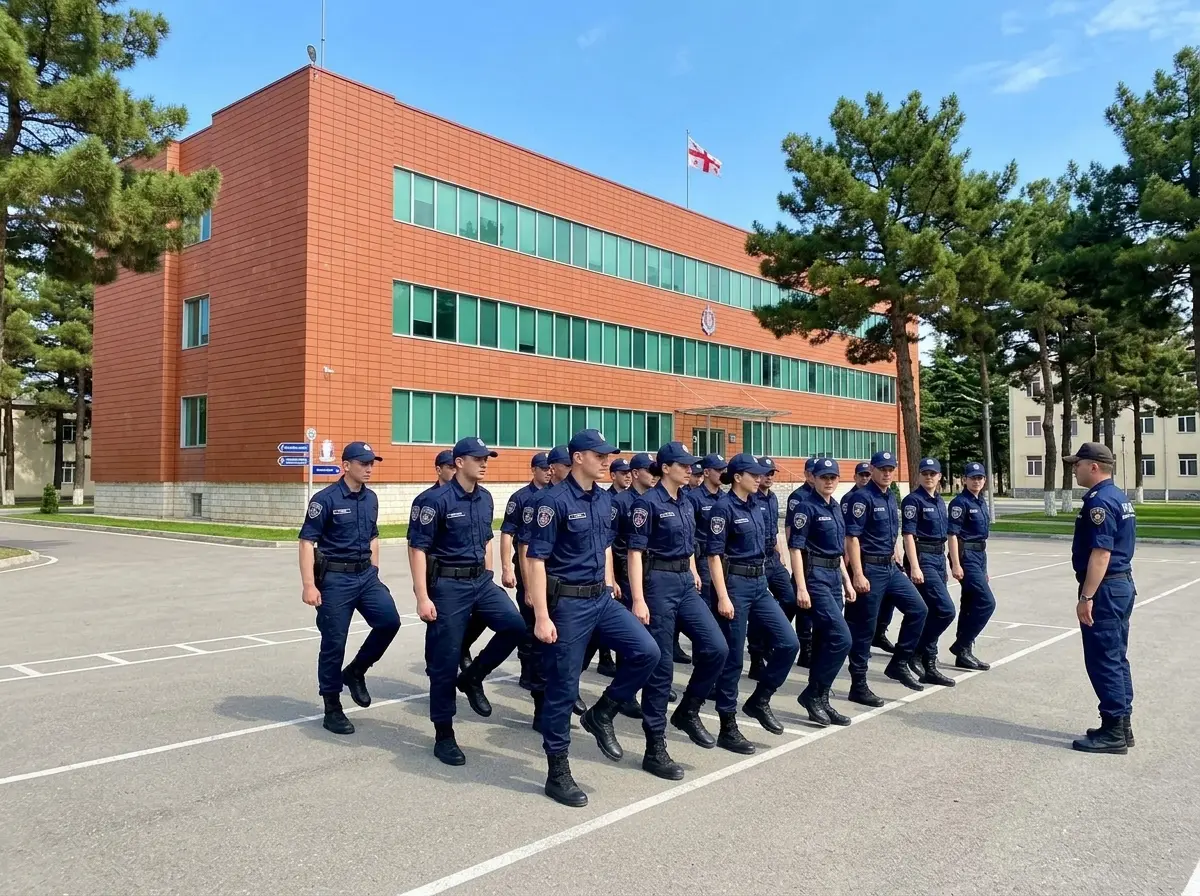
The Public Safety and Police Academy of Georgia’s Ministry of Internal Affairs received unconditional authorization for six years on 18 August 2026 and now holds full higher education institution status. The step lets the academy apply to the National Center for Educational Quality Enhancement for accreditation of its bachelor’s degree program in Public Safety and Police Affairs.
The Ministry said the program sits at the first level of higher education. Its goal is to train personnel in public safety and law enforcement, covering detection, prevention, investigation, analysis and suppression of crimes and other offenses. Graduates receive a bachelor’s qualification in Public Safety and Police Affairs. The academy will run higher education programs alongside its existing professional ones.
Unconditional status opens the bachelor track
Authorization is the institutional gate that lets a Georgian school issue state-recognized diplomas. The academy’s six-year unconditional grant means it met the full set of standards without conditions attached. Once program accreditation follows, the bachelor course can enroll students and award degrees.
The Ministry of Internal Affairs statement, carried by outlets including Georgia Today and SOVA, confirmed the academy can now seek that accreditation from the National Center for Educational Quality Enhancement. The program title appears in sources as Public Safety and Police Affairs or Public Safety and Policing; official materials also use Public Security and Police Studies.
Giorgi Sakhokia, previously a deputy interior minister, serves as rector. Interior Minister Sulkhan Tamazashvili introduced him to staff in June 2026 and reviewed the academy’s facilities and development priorities.
What the bachelor program actually delivers
The Police Law of Georgia sets the concrete rules. The Public Safety and Police Science Bachelor’s degree programme combines physical readiness, tactical and firing proficiency with compulsory academic subjects on public safety and police work. Students receive access to state secrets under legal procedures.
| Element | Detail |
|---|---|
| Level and duration | Bachelor’s, first cycle; materials indicate three years / 180 ECTS |
| Qualification | Bachelor of Public Security and Police Studies (or equivalent Public Safety and Police Affairs) |
| Entry rank | Special junior rank of private on enrolment |
| Graduation rank | Medium special rank of lieutenant (unless already holding another rank) |
| Funding and support | State-funded; academy supplies study materials, food, uniform, motivation means; dormitory possible |
| Service outcome | Ministry provides employment in its system; study period counts toward calendar years of service |
Admission requires meeting criteria set by ministerial order and passing an examination. Successful completion of the Unified National Exams may be added as a further requirement. During study a student must follow academy conduct rules, police ethical norms and ministry disciplinary regulations.
The academy may sign an agreement that binds the graduate to work inside the ministry system for a set period. Failure can trigger disciplinary or material liability. These Police Law rules on the bachelor programme turn the degree into a direct career contract rather than an open academic credential.
From 1930s militia school to dual-track academy
- 1930s, Founded as a school for senior militia staff; later trained ordinary officers.
- 1941, Renamed Tbilisi School of Militia under the USSR Commissariat of Internal Affairs; women appear in student records.
- 1994, Cabinet decision transforms the High School of the Militia into the Academy of the Ministry of Internal Affairs.
- 2006, Special Training Center incorporated.
- 2012, Ministry archive transferred to the academy.
- 2016, Remote education introduced across regions; alumni association formed with first master’s graduates.
- 2025-2026, Legislative changes under the ruling Georgian Dream party restore and expand higher-education capacity; Sakhokia appointed rector; unconditional HEI authorization granted August 2026.
The academy’s stated mission is to join the European family of police education through study of Western standards while serving ministry needs. It already runs professional training, retraining and advanced courses for ministry staff and can offer similar work to other law-enforcement and private bodies. Headquarters sit at Gmiri Kursantebi Street No. 4 in Tbilisi.
How NCEQE authorization works
The National Center for Educational Quality Enhancement is Georgia’s sole body for external quality assurance of higher education. NCEQE as Georgia’s sole quality body conducts both institutional authorization and programme accreditation.
Authorization of higher education institutions is an expert-panel evaluation based on a self-evaluation report and a site visit. It confirms the institution meets standards required to operate and issue state-recognized diplomas. Authorization is obligatory for every HEI.
The center applies seven authorization standards for HEIs: mission and strategic development; organizational structure and management; educational programmes; staff; students and support services; research, development or creative activities; and material, information and financial resources. The academy’s unconditional six-year result shows it cleared the full institutional review.
Programme accreditation is the next separate step. Only after that can the bachelor course award the degree that carries full legal weight.
The pipeline students actually enter
Once accredited, the programme creates a closed loop. Students enter as privates, study under state funding with full material support, graduate as lieutenants, and receive ministry employment. Study years count as service time. A possible contractual bond keeps them inside the system for a defined period.
- State covers tuition and living costs during study.
- Automatic junior-to-medium rank progression on successful completion.
- Guaranteed placement inside the Ministry of Internal Affairs system.
- Legal and social security guarantees of a police officer apply, adjusted for student status.
- Possible multi-year service obligation after graduation, enforceable by liability rules.
This structure differs from open civilian criminal-justice degrees. Graduates leave already socialized into ministry norms, cleared for state secrets, and holding a rank that places them above entry-level civilian hires. The academy continues its professional programmes, so vocational and academic tracks now run side by side under one roof.
The same ministry that runs the academy has recently invested in operational tools, including recent MIA crowd-control equipment upgrades. The education move complements those hardware investments by shaping the people who will use them.
Fit inside Georgia’s higher-education changes
Georgia has been compressing degree cycles and centralizing planning. Three-year bachelor structures appear in the broader reform package. The police academy’s three-year programme aligns with that direction while remaining inside the ministry rather than a civilian university.
Legislative amendments to the Police Law in late 2025 already prepared the ground for the bachelor track, student status and rank awards. The August 2026 authorization is the institutional confirmation of that earlier political decision. Critics of the wider higher-education overhaul have argued it recentralizes control; the academy’s in-house degree gives the interior ministry a direct channel for recruiting and retaining officers without relying solely on external universities.
At the same time, the academy’s European-oriented mission language and NCEQE process keep a formal quality layer. Whether the resulting officers prove more effective or simply more institutionally loyal will show only after the first cohorts graduate and enter service.
Next step is programme accreditation
With institutional status secured for six years, the academy’s immediate task is to submit the bachelor programme for accreditation. Once that is granted, recruitment under the new rules can begin in earnest. Students will enter under the dual academic-and-service regime set out in the Police Law, graduate with both a degree and a rank, and move straight into ministry posts.
The academy retains its older professional training role. Higher education is now an additional, fully authorized track rather than a temporary experiment. For the Ministry of Internal Affairs the result is a self-contained supply of degree-holding officers whose training, ranks and obligations all sit inside one controlled pipeline.
Frequently Asked Questions
What does unconditional authorization for six years mean for the academy?
It means the National Center for Educational Quality Enhancement found the institution fully compliant with all authorization standards and granted higher-education institution status without any corrective conditions; the academy may operate and, after separate programme accreditation, issue state-recognized bachelor diplomas for the full six-year term.
How long is the Public Safety and Police bachelor programme and what qualification does it award?
Official programme materials list a three-year (180 ECTS) bachelor’s degree awarding the qualification Bachelor of Public Security and Police Studies (also referred to as Public Safety and Police Affairs or Public Safety and Policing).
Do students receive police ranks while studying?
Yes. Under the Police Law a student is awarded the special junior rank of private upon enrolment and, upon successful graduation, the medium special rank of lieutenant unless already holding another special or military rank; the study period counts toward years of service.
Who pays for the programme and is employment guaranteed?
The state funds the student’s studies; the academy supplies materials, food, uniform and possible dormitory places; the Ministry of Internal Affairs is required to provide employment within its system to those who successfully complete the programme, often under a contractual service obligation.
What is the role of the National Center for Educational Quality Enhancement?
NCEQE is the independent sole national body that conducts external quality assurance for Georgian higher education; it carries out institutional authorization of HEIs and separate accreditation of individual educational programmes so that diplomas are recognized by the state.