On July 17, 1969, the Cordele Rotary Club christened a 98-foot Titan I missile in a Krystal parking lot in South Georgia. Around the state, a 4,000-square-foot Sasquatch museum, the world’s largest Elvis collection, the first Waffle House, and ten Pizza Huts still wearing 1980s red cups now sit a few hours apart. Together, they form an unintended museum of American 20th-century life that most road trippers drive right past.
The five stops span the state’s mountains, foothills, and South Georgia plain, and they run on a mix of Rotary Club labor, religious conviction, corporate nostalgia, and one artist’s lifetime obsession. None of them started as a tourist attraction, and all of them can be visited this summer.
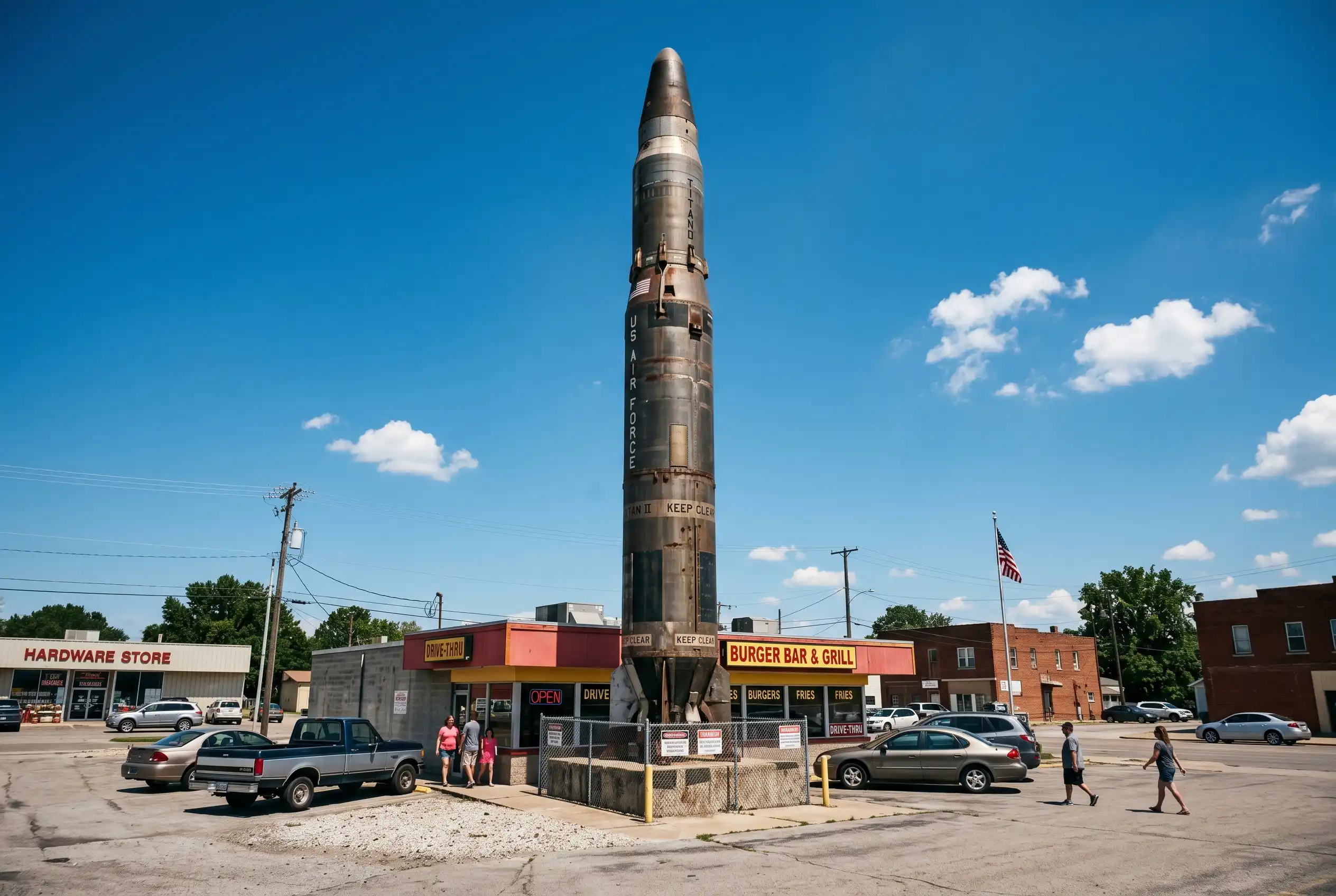
The 98-Foot Missile Over a Krystal
The 98-foot Titan I missile stands today where it was christened in 1969, in a public lot off I-75 in Cordele. It was once an active multistage ICBM; the warhead and propellant were removed in California before the federal government shipped the metal tube east.
The Cordele Rotary Club paid to have it transported and donated the structure to Crisp County that same year. Local lore credits then-Rotary President John S. Pate Jr. with the idea. The missile is no longer a weapon, but the Rotary Club still maintains the lot, and the site is open to anyone who pulls off the highway. Visitors can stand at its base and look up, all 98 feet, framed against a Georgia sky.
Georgia’s piece of Cold War history sits in an unlikely place, a fast-food parking lot. The site’s historical marker for the missile credits the Cordele Rotary Club and lists the missile as the tallest object in the city. A working aerospace plant in Marietta, where Switzerland’s first F-35 in major assembly, sits in the same state as a Titan I in a Krystal lot.
- 98 feet: the height of the Cordele Titan I missile
- July 17, 1969: the date the missile was christened by the Cordele Rotary Club
- $0: the cost to view the missile in its public lot
- 1 Krystal: the fast-food restaurant standing beneath the missile in Cordele
A Sasquatch Museum on a Biblical Proverb
Expedition: Bigfoot! The Sasquatch Museum, a 4,000-square-foot Sasquatch museum on Highway 515 in Blue Ridge, has been gathering field reports, plaster casts, and life-size models of Bigfoot since opening in 2016. The museum treats Sasquatch research as compatible with a literal reading of Genesis. Its website quotes Proverbs 25:2 in the footer: ‘It is the glory of God to conceal a thing; but the honor of kings to search out a matter.’ Visitors who step inside find a Sasquatch theater, a Bigfoot reference library, a gift shop, and recordings of alleged Bigfoot sounds. The museum’s official site lists admission at $9 for adults and teens, $6 for children 5 to 12, and free entry for kids under 5 and active military with ID.
Last admission is at 4:30 p.m., and the museum is open 10 a.m. to 5 p.m. daily, with closings on Easter, Thanksgiving, Christmas, and New Year’s Day. No RVs, trailers, or buses can park on the lot, which keeps the visit on foot. The Sasquatch museum is the northernmost stop on a North Georgia loop that also includes the Elvis rooms in Cornelia, down the road on Highway 441.
30,000 Elvis Artifacts in a 1908 Boarding House
The Loudermilk Boarding House, a 1908 house on the National Register of Historic Places, holds what its founders call the world’s largest and most unique collection of Elvis Presley artifacts. The collection belongs to Joni Mabe, a performance artist and lifelong Presley obsessive who began collecting at age 12 and has turned the third floor into a Panoramic Encyclopedia of Everything Elvis. Her self-guided rooms contain 30,000 Elvis items, a number Mabe has registered with the Guinness Book of World Records. Each room is open to the public on a self-guided tour, and the gift shop sells Presley-themed gifts year-round.
The museum sits at 271 Foreacre Street in Cornelia, a small town in the northeast Georgia foothills, and its hours and admission for the Cornelia museum are listed on Georgia’s tourism site. Admission is $10 for adults, free for kids under 6, and the building is open only on Fridays and Saturdays from 10 a.m. to 4 p.m. The annual Big E Festival, a Presley-themed street party, takes over the first Saturday in August.
Among the strangest pieces is a preserved wart Mabe says was removed from Presley by a doctor in 1957. Tampa Bay Times and the Chicago Tribune both profiled the museum’s wart claim back in 2002, when Mabe was promoting the collection on the Elvis trail.
I own an actual piece of Elvis’s flesh.
The line is Joni Mabe, a performance artist who has run the Cornelia rooms for years. A 2017 visit by Ozzy Osbourne and his son Jack, filmed for the Discovery Channel, gave the museum one of its biggest publicity moments. For a $10 ticket, visitors get a tour of a 1908 house, a Guinness-registered collection, and a slice of southern Elvis fandom that has outlasted three generations of Presley tribute acts. Mabe keeps the museum open on a Friday-Saturday schedule that fits a one-tank drive from Atlanta or Greenville. The Big E Festival, held the first Saturday in August, fills Foreacre Street with Elvis impersonators and ties the boarding house to a Presley trail that runs from Tupelo to Memphis.
The First Waffle House, Frozen in 1955
The first Waffle House opened on Labor Day weekend 1955, in a former lunch counter in Avondale Estates, a small town just east of Atlanta. The founders, neighbors Joe Rogers Sr. and Tom Forkner, had no plans for a second location when they flipped the sign on Labor Day. Within two years they had opened a second; the chain now operates nearly 2,000 restaurants across 25 states.
The original building at 2719 East College Avenue still stands, and it now houses the Waffle House Museum. The museum is free, but visits are by appointment only, with tours booked through the Waffle House Museum’s tour page for Wednesdays at 11 a.m. and 1 p.m., capped at 25 people, and the company recommends them for ages 10 and up. The main floor is a recreation of the 1955 restaurant, complete with the original menu, counter stools, and the company’s first jukebox. The exhibit floor covers Waffle House history, including uniform and menu changes, plus a section on the Waffle House Index, the chain’s informal gauge of how a community is doing after a storm. For travelers who can’t make a Wednesday, the museum holds four open-house Saturdays a year with no appointment needed: the 2026 dates are March 7, May 30, September 5, and December 5.
The Wednesday tour is the most common way to visit, and reservations go through the museum’s email. The free admission makes the stop one of the easier sells on a Georgia road trip, especially for a family that has already paid $9 to see Bigfoot and $10 to see Elvis.
| Museum | Address | Hours | Admission |
|---|---|---|---|
| Expedition: Bigfoot! | 1934 Hwy 515, Blue Ridge | Daily 10 a.m.-5 p.m. (last entry 4:30) | $9 adults/teens, $6 ages 5-12, free under 5 & military |
| Loudermilk / Everything Elvis | 271 Foreacre St., Cornelia | Fri-Sat 10 a.m.-4 p.m. | $10 adults, free under 6 |
| Waffle House Museum | 2719 E College Ave., Decatur | Wed 11 a.m. & 1 p.m. (by appointment) | Free |
| Titan I missile landmark | 1815 16th Ave E, Cordele | 24/7, outdoor lot | Free |
Ten Pizza Huts Still Wearing 1980s Red Cups
The Pizza Hut Classic program, Pizza Hut’s quiet revival of its red-roofed 1980s and 1990s restaurant design, has left its heaviest footprint in Georgia. Ten confirmed Classic locations operate across the state, more than any other state. The format is simple: a modern Pizza Hut kitchen hidden behind a vintage dining room, with the red roof, the red plastic cups, and the period lighting that defined the chain in its 1980s heyday.
The retro treatment started as a single store and has since expanded to most Pizza Hut markets. Georgia’s roster stretches from the Blue Ridge mountains to the South Georgia plains, which is why road trippers planning a multi-stop Georgia itinerary tend to hit at least one Classic along the way.
A Classic is not a museum. The dining room looks like 1985 and the food is 2026. The contrast, eating a current menu in a period room, is the whole point. The location in Dahlonega, the most photographed of the ten, still has the original exterior cupola, and the Jasper location on West Church Street is one of the few freestanding Huts left in the Southeast. The Cornelia location sits in the same town as the Loudermilk Elvis Museum, so a Saturday loop can hit both.
- Blue Ridge, 4231 East 1st St.
- Clayton, 248 Highway 441 North
- Cornelia, 1604 441 Bypass
- Dahlonega, 1352 South Chestatee
- Eatonton, 815 South Oak St.
- Greensboro, 2270 South Main St.
- Jasper, 1529 West Church St.
- Lavonia, 14249 Jones St.
- Newnan, 124 Jefferson St.
- Royston, 200 Franklin Springs Cir
The Pizza Hut Classics round out a Georgia road trip that touches Cold War history, cryptid field research, and a Guinness-registered Elvis collection. Across a single summer, travelers can hit the Sasquatch museum near Blue Ridge, the Elvis rooms in Cornelia, the first Waffle House in Avondale Estates, and the Cold War missile in Cordele, with a Classic Pizza Hut stop somewhere between.
What the Five Have in Common
None of the five stops was planned as part of the same tour, and none started as a deliberate act of preservation. The missile was a Rotary Club gift to Cordele. The Sasquatch museum is a private business built on a couple’s faith. The Elvis collection, the Waffle House, and the Pizza Hut Classics are each the work of a single decision by the people who own them.
Georgia is home to all five because someone, somewhere, decided they should stay. The Titan has been in Cordele since 1969, the Waffle House sign on the Avondale Estates building since 1955, the Elvis rooms in Cornelia for years, and the Bigfoot complex on Highway 515 since 2016. The ten Georgia Pizza Hut Classics are part of a national program that has reached most of the chain’s markets, and each of the five stops is open this summer.
Frequently Asked Questions
Is the Cordele missile still an active weapon?
No. The federal government removed the Titan I missile’s warhead and propellant in California before the structure was shipped east. The Cordele Rotary Club, which accepted the missile as a donation in 1969, maintains the metal tube today as a public landmark in a lot off I-75. Visitors can walk up to it any time of day.
Who started the first Waffle House?
Joe Rogers Sr. and Tom Forkner, neighbors in Avondale Estates, opened the first Waffle House on Labor Day weekend 1955. The chain they founded now operates nearly 2,000 restaurants across 25 states, and the original building at 2719 East College Avenue in Decatur houses the Waffle House Museum.
Does the Loudermilk Elvis Museum really have a piece of Elvis?
Founder Joni Mabe, a performance artist who has run the Cornelia museum for years, says she bought a wart removed from Presley in 1957 from the doctor who had treated him. The Chicago Tribune and the Tampa Bay Times both profiled the wart claim in 2002, when Mabe was promoting the collection on the Elvis trail. The museum also displays a ‘Maybe Elvis Toenail’ and lists more than 30,000 Elvis items with the Guinness Book of World Records.
Are the Pizza Hut Classic restaurants still serving food?
Yes. The ten Georgia locations are functioning Pizza Huts with dine-in and takeout, but the dining rooms are restored to the chain’s 1980s and 1990s look. The format pairs a current menu with a period interior, including the red roof, the red plastic cups, and the lamps that defined the chain in its 1980s heyday.
Do you need a reservation for the Waffle House Museum?
Yes. Tours run on Wednesdays at 11 a.m. and 1 p.m. by appointment, capped at 25 people, and recommended for ages 10 and up. Admission is free. The museum also holds four open-house Saturdays a year with no appointment: the 2026 dates are March 7, May 30, September 5, and December 5.