The first Swiss F-35A has entered major assembly at Lockheed Martin’s Center Wing Assembly line in Marietta, Georgia, the U.S. defense company said this month. Engineers at the Marietta facility are fastening multiple bulkheads together to form the CWA, the F-35’s largest single component, representing about 25% of the aircraft’s fuselage. The bulkhead work is the most concrete sign yet that Switzerland’s 36-jet F-35A order, signed in 2022, is moving from paperwork into metal, with eight of those jets scheduled to reach Ebbing Air National Guard Base in Fort Smith, Arkansas, in mid-2027 for pilot training.
A Bulkhead in Marietta Marks the Swiss F-35 Milestone
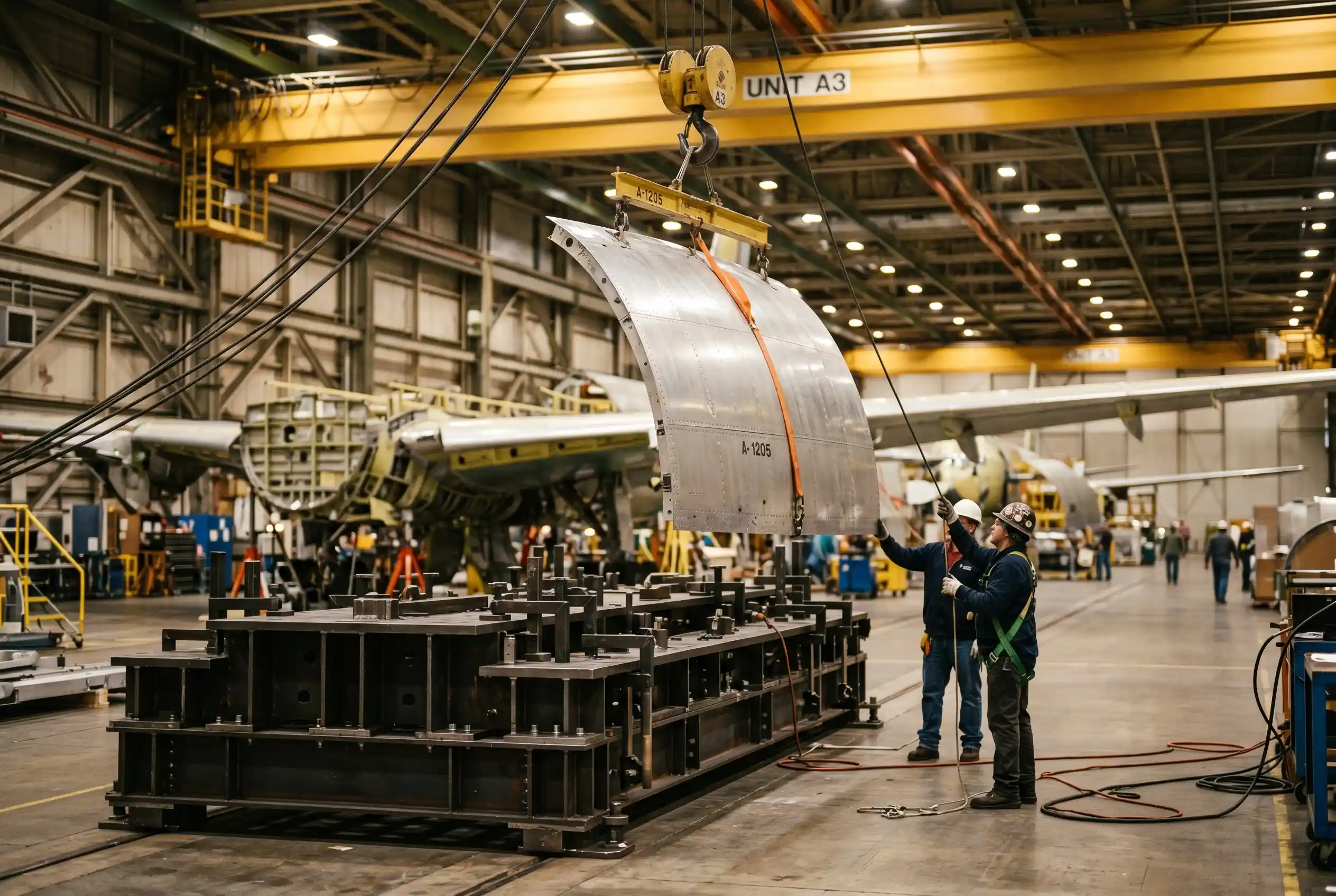
The first Swiss F-35A has begun major assembly at Lockheed Martin’s F-35 Center Wing Assembly line in Marietta, Georgia. The milestone follows the recent start of Swiss F-35 component production at the same plant. A Lockheed Martin photographer, Thinh D. Nguyen, captured a worker handling one of the bulkheads that will be joined into the CWA for Switzerland’s first jet, in photos published with the F-35 program page on the assembly milestone.
The CWA is the F-35’s largest single component, representing about 25% of the F-35’s fuselage, and serves as the structural location for wing installation. Engineers at the Marietta facility fasten multiple bulkheads together to form the CWA, with the assembly line producing airpower at five times the rate of any other allied fighter in production. That production line draws on a global supply chain of more than 2,100 suppliers, Lockheed Martin said. The bulkhead unveiling for the Swiss fleet follows a similar first-assembly moment for Germany’s first F-35 earlier this year, and a separate Georgia aerospace industry alliance launch last year highlighted Lockheed Martin’s footprint at the Marietta site.
The Path From Marietta to Swiss Skies
Switzerland’s path to the F-35A runs through three assembly points and two continents. The first eight jets are planned to deliver to Ebbing Air National Guard Base in Fort Smith, Arkansas, for pilot training in mid-2027.
Swiss pilots will complete their training at Ebbing before the next batch of aircraft transitions to Switzerland from 2028, with the first jets reaching the country from mid-2028. The remaining Swiss F-35 aircraft will be delivered from the final assembly plant in Cameri, Italy, which builds F-35s for several European buyers, according to the Swiss federal production milestone release. Lockheed Martin operates 24/7 sustainment centers that work directly with F-35 customers worldwide, the company said.
Switzerland’s overall F-35A order is 36 aircraft, decided in 2021 and contracted following parliamentary approval in September 2022. The contract includes the aircraft, logistics, training, ammunition, and required infrastructure, with delivery originally set to run from 2027 through 2030.
- 36 F-35A jets in the Swiss order
- 25% of the F-35 fuselage represented by the CWA bulkhead
- 2,100+ suppliers across the global F-35 production network
- 5x the production rate of any other allied fighter in production
- 156 expected annual F-35 production rate going forward
What the F-35A Is Supposed to Do Over the F/A-18s It Replaces
Switzerland is buying the F-35A to replace its F/A-18C/D Hornets, which date from the 1990s. A 2020 referendum narrowly approved the purchase, with 50.1% of voters in favor of the deal at the set price of CHF 6 billion. The aircraft is intended to give Switzerland fifth-generation capabilities in sensory analysis, interaction, and situational perception that the older Hornet cannot match, the Swiss Federal Department of Justice and Police said in its release.
The F-35A is the conventional takeoff and landing variant used by the United States Air Force and most international customers. Switzerland joins a global F-35 operator community that now includes 20 nations, Lockheed Martin said.
Lockheed Martin describes the jet as a “force multiplier” for Switzerland, citing stealth, data sharing, and enhanced sensing. Those capabilities are framed in the program as supporting Swiss sovereignty, security, and “seamless cooperation with allies,” the company’s release said. The F-35 selection has been controversial because the jet is a low-observable multirole combat aircraft suited to air-policing work, an air-defense mission that critics argued could have been met by a lighter and cheaper platform, according to an analysis of the Swiss F-35 cost and fleet question. Switzerland’s choice of multirole capability for what is predominantly an air-policing requirement raised eyebrows, the IISS wrote.
Bern has also signaled interest in stronger air-policing cooperation with neighbors Austria, Germany, and Italy, and joined the European Sky Shield Initiative in October 2024 under a neutrality-suspension clause. The plane is set to replace Switzerland’s F/A-18C/D Hornets, which date from the 1990s, as the backbone of the country’s fighter fleet.
Pilatus and the Industrial Side of the F-35 Deal
Lockheed Martin frames the F-35A program as more than a fighter purchase; it is also an industrial commitment that the company says will create jobs in Switzerland for the next 50 to 60 years. The jet is the only allied fighter in production with that runway, according to the program. To meet F-35 offset commitments, Lockheed Martin partners with Swiss industry on research and development, production, and sustainment work. The bulkhead milestone comes with the offset machinery already in motion.
The flagship Swiss offset project is a technology transfer with Pilatus Aircraft, announced in March 2025. Under that deal, Pilatus continues collaborating with Lockheed Martin to develop a tailored next-generation pilot-training system that will serve 5th Gen operators. Pilatus Swiss engineers have also worked alongside Lockheed Martin teams in F-35 Cockpit Demonstration System workshops, Lockheed Martin said.
The offset work covers four channels:
- Research and development projects with Swiss industry
- Production work on F-35 components
- Sustainment and maintenance activities
- The Pilatus technology transfer for next-generation pilot training, announced in March 2025
The IISS noted that Washington had pointed out FMS deals carry original prices that are estimates, undercutting the Swiss Federal Council’s earlier position that the price was fixed. The original contract price did not include an estimated CHF 9.4 billion ($10.68 billion) in operating costs over 30 years, the IISS highlighted.
The CHF 1.3 Billion Question Hanging Over the Deal
The Marietta milestone is unfolding against a different backdrop in Bern, where the cost of the F-35A program has crept up since 2022. The original Swiss plan was a fixed price of 6 billion Swiss francs ($7.55 billion) for 36 aircraft, decided in 2021 and contracted in September 2022. The Swiss government announced this summer that the buy could end up anywhere from CHF 650 million ($817 million) to CHF 1.3 billion ($1.63 billion) more expensive than originally planned, according to the September 2025 audit of the Swiss F-35 contract.
Negotiations between Bern and Washington, including talks between the two countries’ defense ministers, failed to secure a fixed price, the Swiss government reported in August. The Pentagon has cited inflation, rising raw material prices, and supply chain disruptions as drivers of the F-35 cost increase, with the Trump administration’s tariffs also cited. The Swiss defense procurement office, Armasuisse, told Defense News that “the upper estimate contains a sizeable risk buffer, given the current economic uncertainties.” Switzerland has been hit with 39% U.S. tariffs, the highest in Europe, drawing political criticism across the Swiss spectrum.
The question is not whether the project will be continued, but rather an in-depth examination of the options for how to deal with the increased costs of procurement.
A parliamentary commission will audit the 2022 contract, the Swiss defense ministry confirmed, with a report expected by November. No alternative aircraft are being considered, ministry spokesperson Kaj-Gunnar Sievert said, but the door is open to buying fewer jets.
The Social Democrats, the second-largest party in Switzerland’s National Council, had floated a mixed-fleet idea combining the F/A-18 with the Italian Leonardo M-346FA for air policing. Those proposals were tabled in November 2025 but go back to a 2020 Social Democrat campaign paper. A separate working group created by the defense ministry will propose options from a military standpoint.
The IISS estimates Switzerland had spent around CHF 1 billion ($1.2 billion) on the F-35A program by the end of 2025. Cancelling the purchase before 2027 would leave Switzerland facing contract-termination costs on top of that sum, the IISS wrote.
Decisions Still Pending in Bern
Switzerland is still publicly committed to the F-35A, the government reaffirmed by email to Defense News. A parliamentary audit of the 2022 contract and a defense ministry working group are running in parallel with the assembly work in Marietta. The fleet size itself is on the table, the working group tasked with reevaluating the 2017 specifications and “taking a look at the size of the fleet,” Sievert said.
The bulkhead going together this month in Georgia does not depend on those decisions, since eight of the 36 aircraft are already deep in the production pipeline. Lockheed Martin says the F-35 program expects an annual production rate of 156 aircraft going forward, supported by more than 2,100 global suppliers. Bern’s deadline for the first pilot-training cohort is now less than two years out. The Marietta milestone is the first physical marker that the clock has started.
Frequently Asked Questions
When will Switzerland receive its first F-35A?
The first eight Swiss F-35s are planned to deliver to Ebbing Air National Guard Base in Fort Smith, Arkansas, in mid-2027 for pilot training. Additional aircraft are expected in Switzerland from mid-2028, with the remaining jets built at the final assembly plant in Cameri, Italy.
Where will Swiss pilots train on the F-35A?
Swiss pilots will train at Ebbing Air National Guard Base in Fort Smith, Arkansas. The first eight Swiss jets will deploy there in mid-2027, before additional aircraft transition to Switzerland from 2028.
How many F-35A aircraft is Switzerland buying?
Switzerland is buying 36 F-35A jets. The procurement was decided in 2021 and the contract was signed following parliamentary approval in September 2022.
How much will Switzerland’s F-35A program cost?
The original contract was set at a fixed price of 6 billion Swiss francs ($7.55 billion). The Swiss government announced in August 2025 that the buy could end up CHF 650 million ($817 million) to CHF 1.3 billion ($1.63 billion) more expensive than originally planned. The original price did not include an estimated CHF 9.4 billion ($10.68 billion) in operating costs over 30 years, the IISS noted in its May 2026 analysis.
What is the Pilatus offset project with Lockheed Martin?
The Pilatus technology transfer project, announced in March 2025, has Pilatus continuing to collaborate with Lockheed Martin on a tailored next-generation pilot-training system that will serve 5th Gen operators. Pilatus Swiss engineers have also worked alongside Lockheed Martin teams in F-35 Cockpit Demonstration System workshops, Lockheed Martin said. The project sits inside a broader F-35 offset framework that Lockheed Martin says will create jobs in Switzerland for the next 50 to 60 years.