Georgia farmers have until July 31 to answer questions the state has never really put a number on: how thin is the margin, how deep is the debt, how close is the breaking point. The Georgia Farm Profitability Survey, built by the University of Georgia, the Georgia Farm Bureau and the Georgia Foundation for Agriculture, is the first coordinated attempt to turn that stress into hard, countable data.
It lands at an odd moment. Federal figures already show the typical American farm household loses money on the farm itself and survives on outside paychecks and emergency federal aid. Georgia’s own agricultural economists are describing 2025 and 2026 in almost identical language, cash receipts flat, crop margins weak, cotton stuck in a losing stretch that predates this survey by years.
A Ten-Minute Survey Chases Missing Numbers
The survey itself is short. Farm Bureau officials describe it as an anonymous, roughly ten-minute questionnaire open to any Georgia farmer, member or not, through July 31. It asks about overall profitability, debt levels, risk management strategies and labor costs, among other topics.
Three groups are behind it. The anonymous ten-minute questionnaire is live online now, funded by the Georgia Foundation for Agriculture (GFA), the charitable arm of the Georgia Farm Bureau (GFB). Research oversight runs through Dr. Christina Proctor, a researcher at the University of Georgia’s College of Public Health, and Dr. Stephanie Basey, founder of the Hive Research Collective and a research consultant on the project who has previously studied farmer wellbeing.
Whitney Sangster, who works with the Georgia Foundation for Agriculture, put the reasoning bluntly.
We really want the hard data because we can sit here and say farmers are struggling, they’re suffering, but we don’t have the hard data to back that up.
Basey framed it as an unusual chance to document something normally left to anecdote. Georgia Farm Bureau President Tom McCall said the group wants to hear directly from farmers so it can focus advocacy where it will do the most good. The survey’s own introduction tells respondents plainly that many producers are experiencing increasing financial pressure and that the data will help show what is driving those challenges.
Georgia Farm Bureau will push the questionnaire through its network of 158 chapter offices covering all 159 counties, and the results will feed the group’s ongoing Strong Farms Strong Georgia campaign once a report is drafted.
The National Data Already Points to a Squeeze
None of the ten Georgia news outlets that ran the Farm Bureau’s press release mentioned the federal numbers already sitting in USDA’s own books. Those numbers are not subtle.
- Net farm income is forecast at $153.4 billion for 2026, a 2.6% decline in inflation-adjusted terms from 2025, according to the USDA Economic Research Service’s farm income forecast.
- Farm debt is projected to climb $30.8 billion, or 5.2%, to $624.7 billion in 2026, the second straight year of roughly 5% growth.
- Median on-farm household income, after inflation, is forecast at a loss of $1,161 in 2026, an improvement over a loss of $1,498 in 2025, but still negative.
- Direct government payments are forecast to jump to $44.3 billion in 2026, up $13.8 billion, much of it tied to disaster relief and bridge assistance rather than crop sales.
Median off-farm income, by contrast, is forecast near $92,815 in 2026. Put simply, farm households are increasingly staying afloat on jobs that have nothing to do with the farm, plus one-time government checks, not on what the land itself produces. That is precisely the dynamic Matt Berry, who raises cattle on a family farm in Sumter County in south Georgia, described from his own kitchen table.
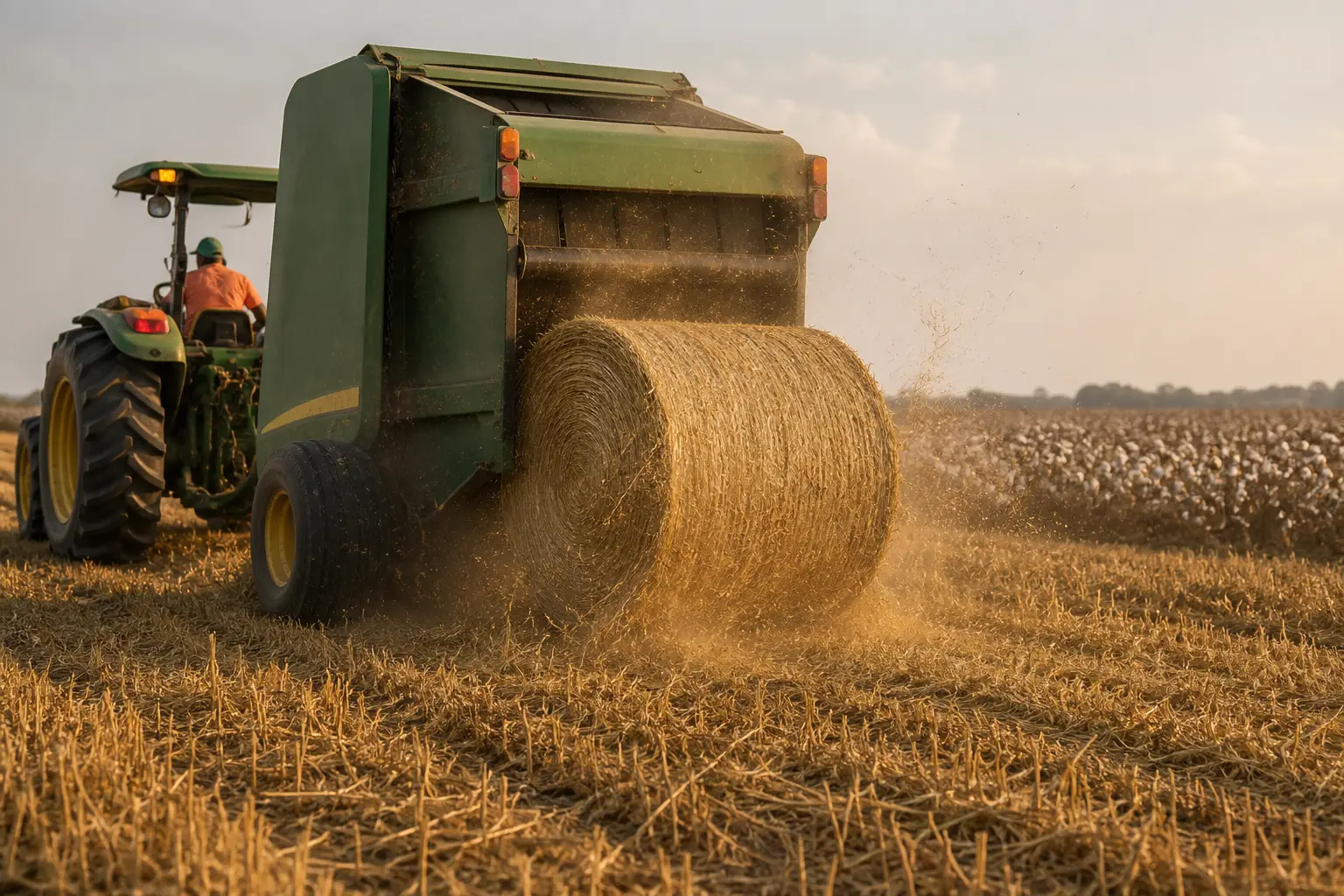
His family’s costs for fuel, feed and fertilizer are higher than he has ever seen, he said, and even a strong yield does not guarantee a profit. Berry has taken up hay harvesting on the side just to cover the gap.
Cotton and Peanuts Carry Georgia’s Losses
Georgia agriculture is not a marginal industry. The 2026 Georgia Ag Impact Report puts the sector’s total economic footprint at more than $100 billion and over 370,400 jobs, built on a direct farm gate value that topped $18 billion in 2024. But UGA’s own economists describe 2025 as a mixed year at best, with weak prices and thin profits across most major row crops and little relief expected in 2026.
Two of the state’s flagship commodities illustrate the split.
| Commodity | Georgia’s Standing | 2026 Financial Signal |
|---|---|---|
| Poultry (broilers) | Georgia’s top commodity at $6.1 billion, 36.1% of the state’s farm gate value; 48% of all Georgia commodity cash receipts | Nationally, poultry-specialized farm businesses are forecast to see the steepest income drop of any tracked specialization, down 20.3% |
| Peanuts | Georgia grows more peanuts than any other state | Oversupply is pushing 2026 forward contracts toward $425 to $500 a ton, keeping exports and profitability under pressure |
| Cotton | A top Georgia row crop and export commodity, shipped mainly to Pakistan, Turkey and Vietnam | UGA economists describe a long-term trend of economic losses driven by high input costs, elevated interest rates and weak prices |
| Cattle and calves | A growth area within Berry’s own operation and Georgia livestock generally | Nationally, cattle-specialized farm income is forecast to rise 21.8%, one of the few bright spots amid record cattle prices |
The pattern nationally is that crop-side income gains in 2026 are frequently a function of government support rather than the market. Cotton farm businesses, for instance, are forecast to post the largest dollar increase in average income of any crop specialization next year, even as Georgia’s own 2026 Georgia Ag Forecast warns of a continuing cost price squeeze for the same crop. Aid can lift the accounting number without fixing the underlying math.
Why Do Bridge Payments Only Scrape the Surface?
Bridge payments cover part of the gap but were never designed to close it, and Berry’s own description, that the money only scrapes the surface of what farmers actually need, matches how USDA and Farm Bureau researchers describe the program on paper.
The Farmer Bridge Assistance (FBA) Program is a one-time, $11 billion slice of a broader $12 billion package Washington approved to help row-crop growers through 2025’s losses. Payments are flat, per-acre amounts: corn growers received $44.36 an acre, cotton growers $117.35, and peanut growers were set at $55.65 an acre, among other crops. The Farm Service Agency’s program page caps any single producer or entity at $155,000, with an income limit shutting out anyone whose average adjusted gross income tops $900,000.
The American Farm Bureau Federation’s own market analysts have said as much themselves: the aid provides timely relief but was never meant to fully cover farmers’ losses built up over several years. It is explicitly a bridge, meant to carry row-crop growers until new reference prices under the One Big Beautiful Bill Act, set to rise 10% to 21% for major commodities, take effect after October 1, 2026.
Georgia’s cattle operations like Berry’s do not even qualify for FBA, which is limited to row crops such as corn, cotton, peanuts, wheat and soybeans. For a livestock family working through fertilizer, feed and fuel bills, the program was never going to be the fix.
Will Family Farms Get Passed to the Next Generation?
More than 80% of Georgia farms are run by individuals or families, not corporations, which is part of why the survey’s authors keep returning to a harder question than any single balance sheet.
If farms are struggling now, Basey has asked, do the families running them even want to hand them down. Berry sees a different, more immediate value in the data: knowing that other farmers are absorbing the same losses he is, he said, is its own kind of relief.
What we know:
- The survey closes July 31 and covers operating margins, debt, cash flow, risk management and labor costs.
- It is anonymous, open to any Georgia farmer, and takes about ten minutes.
- Georgia Farm Bureau and the Georgia Foundation for Agriculture will jointly publish a report once the window closes.
What’s unconfirmed:
- How many farmers will actually respond, and whether the sample will be large enough to represent the state’s roughly 42,000 farms.
- Whether the findings translate into new state-level aid, tax relief or loan programs.
- Whether younger family members plan to keep operating once current owners step back.
Georgia counted 42,439 farms as of the 2022 agricultural census, spread across nearly 10 million acres, with an average farm size of 235 acres. Those are mostly small, family-scale operations, exactly the kind most exposed if margins stay this thin.
The Report Lands After July 31
Once the survey closes, GFA and GFB plan to analyze the responses and publish a report meant to steer both the Strong Farms Strong Georgia campaign and future legislative conversations. Georgia’s meat producers are already organizing around similar pressure from a different angle, forming a new association as imports keep climbing, a sign that the state’s agricultural groups are increasingly willing to build their own data and coalitions rather than wait on Washington.
For now, Berry is still out baling hay between cattle chores, and Georgia’s farm economy is still running on livestock strength, government checks and whatever else producers can find to fill the gap. The survey closes July 31. What the numbers actually show will not be public until after that.