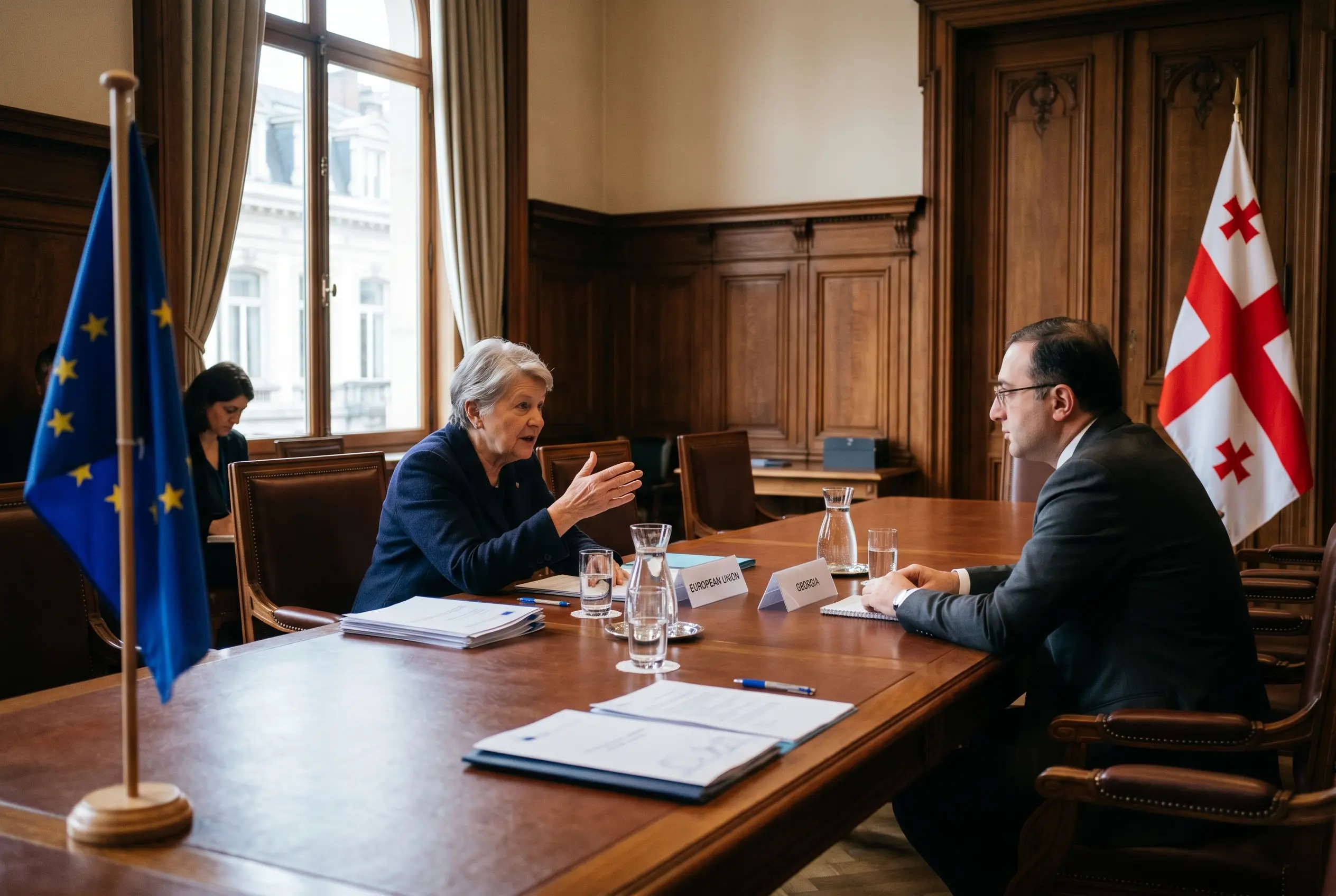
The first EU-Georgia visa dialogue meeting since the bloc suspended visa-free travel for holders of Georgian diplomatic passports ended on June 11, 2026 in Brussels with a sharply split readout. Georgia’s Foreign Ministry called the underlying March 6 suspension ‘unfair’ and reaffirmed its readiness for ‘constructive cooperation’ with the European Union, citing the importance of ‘high-level political dialogue.’ An EU official, by contrast, told Radio Free Europe/Radio Liberty the talks had been ‘rather unfruitful.’
The June 11 session was the inaugural sitting of an ‘enhanced dialogue’ that EU law requires whenever the bloc’s visa suspension mechanism is activated, and the first formal exchange between the two sides since the European Commission announced the suspension on March 6, 2026. Ordinary Georgian passport holders continue to travel to the Schengen Area without a visa, a right they have held since March 2017. The new restriction applies only to holders of diplomatic, service, and official passports travelling for official purposes.
First Working Meeting in Brussels, With a Sharp Split in the Readout
The dialogue convened at the invitation of the European Commission’s Directorate-General for Migration and Home Affairs. It was the inaugural session of a process that EU regulations require whenever the visa suspension mechanism is activated. Both sides were given the floor to lay out their positions in detail, Commission spokesperson Markus Lammert said at a midday briefing in Brussels. The parties agreed to report back to their respective leaderships once the talks concluded. The European Commission said in a follow-up statement that the discussions had taken place in a ‘fact-based environment.’
Georgia’s delegation was led by Giorgi Tabatadze, director of the International Legal, Consular and Diaspora Affairs directorate of the Foreign Ministry, with representatives of other state agencies joining. On the EU side, the Commission fielded officials from the directorate-general that had invited Tbilisi to the table.
After the talks, Tabatadze described the meeting as a working session where both sides had exchanged positions. He told Georgian journalist Tamara Nutsubidze of Euroscope that he had a ‘positive’ outlook, and added that ‘time will show’ whether further meetings would follow. An EU official, briefing RFE/RL’s Rikard Jozwiak in the same hours, called the same meeting ‘rather unfruitful.’ The official, speaking anonymously, told Jozwiak that ‘the EU side wasn’t impressed’ with the reforms presented by the Georgian side.
| What | Georgia’s readout | EU’s readout |
|---|---|---|
| Purpose of the meeting | Exchange positions; review Georgia’s reforms and the EU’s recommendations | Remedy the circumstances that led to the visa suspension being activated |
| Tone of the talks | Working meeting, constructive | Technical, fact-based |
| Verdict | ‘Positive’ outlook (Tabatadze) | ‘Rather unfruitful’ (EU official via RFE/RL) |
| On repealing disputed laws | Calls to repeal ‘groundless’; the laws reflect national interest | Asked Georgian side about willingness to change the legislation; Georgian side said the issues were ‘political’ in nature |
| Next steps | Future meetings to involve ‘more in-depth discussions’ | Parties agreed to ‘report back to respective leaderships’ |
Georgia Frames the Underlying Decision as ‘Unfair’
Georgia’s post-meeting MFA statement went on the offensive over the substance of the EU’s March decision, describing the suspension as ‘unfair.’ The Foreign Ministry said the suspension rested on a report that ‘biasedly assesses the situation in Georgia’ and, on its own, did not ‘allow for proper and objective conclusions to be drawn.’ The Commission had announced the suspension on March 6, 2026, the first time the EU’s revised visa suspension mechanism had been used.
The MFA called EU demands to repeal specific Georgian laws ‘groundless’ and said the legislation ‘was adopted based on Georgia’s national and public interests and does not contradict any international convention or agreement to which the country is a party.’
The reference, in context, pointed to the foreign agents law and the anti-LGBT legislation that Brussels has called on Tbilisi to revisit. Tbilisi argued in Brussels that its Constitution and current legislation ‘ensure the protection of citizens’ fundamental rights and freedoms, including freedom of expression, assembly and demonstration, association, privacy, and equality.’ The ministry also pointed to ‘the regularly organised protests by political parties and civic activists over a long period’ as proof that the right to peaceful assembly was being respected.
This was the first meeting at the working level. Our goal was to exchange positions and provide information.
That phrasing came from Georgian Foreign Minister Maka Botchorishvili in a comment to the JAMnews outlet on June 11, the day of the meeting. The minister said the meeting was ‘only an initial step’ in the process and stressed that no specific agreements or final decisions had been discussed. Botchorishvili added that future meetings were expected to involve ‘more in-depth discussions.’ The Foreign Minister’s comments came as Georgia’s side pushed back against the EU’s framing of the suspension as triggered by ‘deliberate and persisting’ violations of visa-free regime commitments.
What the Two Sides Discussed in the Room
According to the Georgian Foreign Ministry, the meeting was technical rather than political in nature, with both sides presenting their positions in detail. The agenda covered the reasons the Commission had cited for activating the visa suspension mechanism, the recommendations the Commission has issued, and the reforms Georgia says it has already implemented or has in motion.
Migration management, anti-corruption work, and readmission cooperation with EU member states and European agencies were also on the table under the EU visa liberalisation framework for partner countries. On the corruption file, Georgia highlighted the creation of an asset recovery office, the development of a new anti-corruption strategy, and the strengthening of the institutional capacity of the State Audit Office. The sides also reviewed Georgia’s progress in preventing illegal migration and readmitting migrants with EU member states and European agencies.
The European Commission, for its part, said the talks had taken place in a ‘fact-based environment,’ with both sides presenting their positions and assessments. Spokesperson Lammert told journalists that the purpose of the meeting was to ‘remedy the circumstances’ that led to the suspension. He also stressed that the mechanism was triggered by ‘Georgia’s violation of its commitments under the visa-free regime in key areas of democracy and fundamental rights.’ The Commission’s underlying position, set out in March and reiterated in the lead-up to the meeting, is that the EU’s revised visa suspension mechanism was designed to be a faster and stronger tool to respond to abuses of visa-free travel and fundamental rights backsliding. Botchorishvili added that the process would continue and that future meetings were expected to involve ‘more in-depth discussions.’
The EU Readout, ‘Rather Unfruitful’
The Commission’s public line after the meeting was procedural, not political. Spokesperson Markus Lammert said the meeting was ‘technical in nature’ and focused on the issues that triggered the visa suspension mechanism, and he added that the Commission had explained its decision in detail while the Georgian side presented its own position. Lammert also said the parties had agreed to ‘report back to their respective leaderships.’ The Commission’s wider June 8 framing of the upcoming talks was sharper: it considered the actions of the Georgian authorities to be ‘undermining the principles on which visa liberalization is based.’
RFE/RL’s Europe editor Rikard Jozwiak reported a still sharper tone behind the scenes. Citing an EU official speaking anonymously, he said the dialogue was viewed as ‘rather unfruitful’ and that ‘the EU side wasn’t impressed.’ The Georgian service of RFE/RL, citing the same source, reported that Georgian representatives at the meeting defended the legislation that Brussels has called on Tbilisi to repeal, and that when asked whether they were ready to change it, the Georgian side said they represented a ‘technical group’ and that the issues raised were ‘political’ in nature. Tbilisi is seeking a political-level dialogue with Brussels, the outlet added, while the EU continues to view the process primarily through the lens of reforms. The same EU official also dismissed as ‘propaganda’ the Georgian delegation’s talking points about alleged efforts by ‘foreign-funded agents’ to change the government in Tbilisi and organise a ‘violent protest.’
How the March 2026 Suspension Works
The visa suspension that Georgia and the EU are now negotiating over was activated on March 6, 2026, and runs for 12 months, until 6 March 2027. Under the Commission’s March 6 regulation, holders of Georgian diplomatic, service, and official passports must now hold a Schengen visa to enter the EU for official and diplomatic purposes, and Georgian representatives who attempt to enter the Schengen Area on regular passports for ‘official and diplomatic purposes’ could face an entry ban.
Member states are also encouraged to conduct enhanced screening of all Georgian nationals at the EU’s external borders, including checks against the Visa Information System and the Schengen Information System. The EU has the option to extend the suspension by up to 24 months if the governance and rule-of-law issues are not addressed, the Commission said in March. Brussels can also decide to extend the measure to all Georgian citizens, not just those holding official passports. The current 12-month suspension was the first ever activated under the bloc’s revised visa suspension mechanism, which entered into force in December 2025.
The mechanism was triggered, the Commission said, by ‘Georgia’s deliberate and persisting violation of the commitments taken under its visa-free regime in key areas of democracy and fundamental rights.’ The Commission also said the actions of Georgian authorities since October 2024 ‘have negatively impacted the situation in Georgia and resulted in breaches of several fundamental rights and international legal standards.’ Georgia has also refused to align with the EU visa policy, which is an essential condition of maintaining visa-free travel, the Commission added.
These actions are incompatible with the norms and values of the European Union and hinder the stable development of economic, humanitarian, cultural, scientific, and other ties between the EU and Georgia.
That phrasing came from Commission spokesperson Markus Lammert at a Brussels press briefing on June 8, three days before the visa dialogue meeting took place. Lammert’s wider framing on the suspension was that it is up to the Georgian authorities to redress the situation during the 12-month window.
What Both Sides Said About 2024
The June 11 talks also touched on the protest movement that began in late 2024, which the Commission had explicitly cited in March as part of the rationale for the suspension. The Georgian Foreign Ministry described those protests as violent and said they were accompanied by attacks on state institutions and law enforcement officers. The protests have continued in some form ever since, with civil activists and political parties organising regular demonstrations, according to Tbilisi. Georgia said the right to peaceful assembly and demonstration is protected in the country, pointing to those regular protests as evidence. Tbilisi also stressed that the Constitution and current legislation guarantee fundamental rights and freedoms, including freedom of expression, assembly, association, privacy, and equality before the law.
The ministry said investigations are continuing into alleged abuses of authority by public officials and law enforcement officers during the dispersal of the 2024 protests. According to the statement, five individuals are currently detained and facing court proceedings on charges of abuse of power, along with one episode of obstructing a journalist’s professional activities. RFE/RL reported earlier in June that the June 11 meeting was being viewed in Brussels as ‘a last warning’ to Tbilisi to come into compliance with the visa-free regime’s commitments.
The Commission said in March that its suspension was ‘a response to the violent repression against peaceful protesters, political opponents and independent media which started following the Georgian authorities’ announcement not to open negotiations with the EU until 2028.’ Georgia rejected that framing in Brussels, saying the report behind the decision ‘biasedly assesses the situation in Georgia.’ EU member states voted in February 2026 to suspend visa-free travel for holders of Georgian diplomatic passports, under the new legal mechanism that ensures EU-wide application. That vote followed the critical December 2025 EU Commission visa report, which had warned of visa-free travel suspension.
From Brussels to the December Review
The June 11 meeting is the opening round of a process that has at least two fixed markers ahead. The European Commission is scheduled to publish its annual visa suspension report by December 2026, with EU member states expected to take a decision on the measure in January 2027. The current 12-month suspension expires on 6 March 2027, after which the Commission can extend it by up to 24 months, or extend the measure to all Georgian citizens.
RFE/RL reported that Brussels officials view the June 11 talks as a ‘last warning’ to Georgia, suggesting that further restrictions are on the table if Tbilisi does not move. Tbilisi, for its part, is signalling that any escalation should be framed as a political question. ‘Political manipulation regarding this issue is unacceptable,’ the Foreign Ministry’s statement said. The Georgian delegation ‘stressed the importance of high-level political dialogue,’ the same statement added. For now, both sides agree the channel is open; the December report will be the next test of whether the suspension expires on 6 March 2027, is extended, or is expanded to all Georgian citizens.
Frequently Asked Questions
When did the EU suspend visa-free travel for Georgian diplomatic passport holders?
The European Commission activated the visa suspension mechanism for Georgia on March 6, 2026. The measure runs for 12 months and expires on 6 March 2027, unless the Commission decides to extend it.
Does the suspension affect ordinary Georgian citizens?
No. The restriction applies only to holders of Georgian diplomatic, service, and official passports travelling to the EU for official purposes. Ordinary Georgian passport holders continue to enjoy visa-free travel in the Schengen Area, a right they have held since March 2017.
Could the suspension be extended to all Georgians?
Yes, under the EU’s revised mechanism. The Commission has the option to extend the current 12-month suspension by up to 24 months and to extend the measure to all Georgian citizens if the governance and rule-of-law issues are not addressed.
Why did the EU invoke the suspension mechanism?
The Commission said in March that the move was triggered by ‘Georgia’s deliberate and persisting violation of the commitments taken under its visa-free regime in key areas of democracy and fundamental rights,’ and that the actions of Georgian authorities since October 2024 ‘have negatively impacted the situation in Georgia and resulted in breaches of several fundamental rights and international legal standards.’
What is the EU-Georgia visa dialogue, and what happens next?
Under EU Visa Regulation 2018/1806, the Commission must establish an ‘enhanced dialogue’ with the affected country whenever the visa suspension mechanism is triggered. The June 11 meeting was the first session of that dialogue. The Commission’s annual visa suspension report is due by December 2026, and EU member states are expected to take a decision on the measure in January 2027.