Georgia’s domestic exports reached a record $1.9 billion in January-May 2026, up 66.1% from a year earlier, according to the National Statistics Office, GeoStat. The surge was powered by oil and petroleum products, which vaulted to the top of the country’s domestic export list. The record rests on a small set of categories and buyers, and the petroleum boom is rooted in a single Black Sea refinery.
The Kulevi oil terminal, which began processing crude in late 2025, lifted Georgian petroleum product exports to $208 million in the first quarter of 2026, a near sevenfold rise from a year earlier, JAM News reported. Domestic exports made up 62.1% of Georgia’s $3.1 billion in total goods exports during the period, with overall exports up 19.8% year-on-year. Brussels almost added Kulevi to the EU’s 20th sanctions package in March 2026 before stepping back after commitments from Tbilisi and the terminal’s operator. The data describe a country whose export base is now structurally tied to a small set of commodities and buyers.
A Record Built on a Few Categories
The record $1.9 billion in domestic exports places Georgia in unfamiliar territory. The growth is concentrated in a narrow set of categories and a small set of buyers.
Three commodities alone made up 38.4% of all domestic exports through May: oil and petroleum products at 18.3%, precious metal ores and concentrates at 13.3%, and ferroalloys at 6.8%. Three countries took most of the rest: China was the top market at $317.4 million, Russia at $229 million, and Turkey at $207.2 million. The top 10 destination countries accounted for 66.9% of domestic exports, GeoStat said. Total goods exports reached $3.1 billion, with domestic exports making up 62.1% of that. The overall total grew 19.8% year-on-year, well below the 66.1% rate of the domestic subset. GeoStat released the preliminary January-May figures on 19 June 2026.
China took $317.4 million, the largest share of any single market. Russia followed at $229 million, with Turkey at $207.2 million. All three sit inside a top 10 of destination countries that together took 66.9% of Georgia’s domestic exports.
The top three markets, by value, were:
- China: $317.4 million
- Russia: $229 million
- Turkey: $207.2 million
The product side is similarly thin: three commodities made up 38.4% of all domestic exports through May. Oil and petroleum products led at 18.3%, precious metal ores and concentrates came second at 13.3%, and ferroalloys were third at 6.8%. All three are commodity categories whose values track global prices. Each one has its own demand cycle, set by markets outside Georgia. The figures came from GeoStat’s January-May 2026 release.
The Q1 Picture That Set Up the Surge
The petroleum surge that lifted the January-May figures had already shown up in the first quarter of 2026. Total exports reached $1.72 billion in Q1 2026, up 23.4% year-on-year, JAM News reported, citing GeoStat’s preliminary release. Domestic exports made up around 75% of that Q1 total, at $1.12 billion.
Passenger cars remained the single largest export category in Q1 2026, at $365 million, though their value was down 27% year-on-year, JAM News reported. Oil and petroleum products rose to second place, up from $26 million a year earlier. The Kulevi refinery had been operating for only a few months by the end of Q1 2026. Around $200 million of the Q1 2026 petroleum product total came from domestic production, with re-exports accounting for just $8 million.
The Q1 figures set the pattern that the January-May release confirmed. In Q1 2026, oil and petroleum products were the second-largest export category overall, behind passenger cars.
Oil Vaulted to the Top of the List
Oil and petroleum products are now the largest single category in Georgia’s domestic export mix. The segment was worth $352.2 million in the first five months of 2026, GeoStat’s data show. The next two categories were precious metal ores at $255.6 million and ferroalloys at $130.8 million. The shift is a recent one: in the first quarter of 2025, petroleum product exports stood at just $26 million.
The Q1 2026 figures show the speed of the move. Petroleum product exports reached $208 million in the first three months of 2026, JAM News reported, citing GeoStat’s preliminary release. The $26 million recorded in the same quarter of 2025 puts the year-on-year rise at 698%. In local exports alone, the segment grew 3,714% over the same period, the same data show. Around $200 million of the Q1 2026 total came from domestic production; re-exports accounted for just $8 million.
- $352.2 million: oil and petroleum exports, January-May 2026
- $26 million: oil and petroleum exports, Q1 2025
- 698%: year-on-year rise in oil and petroleum exports, Q1 2026 vs Q1 2025
- 3,714%: rise in local oil and petroleum exports, Q1 2026 vs Q1 2025
- 18.3%: share of all domestic exports, January-May 2026
The data show the scale of the move: from $26 million in Q1 2025 to $208 million in Q1 2026. The full set of January-May figures extends that trajectory to $352.2 million.
Kulevi and the EU Sanctions Watch
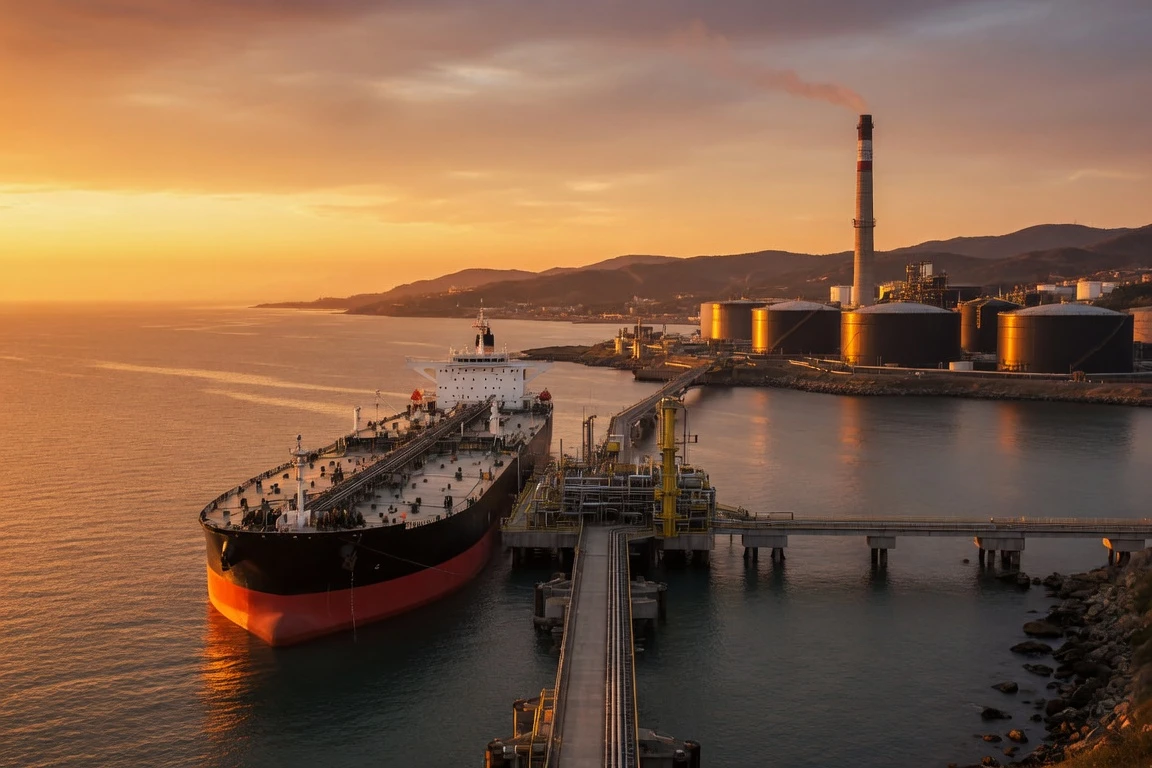
The petroleum surge traces to a single facility. The Kulevi oil terminal and refinery, on Georgia’s Black Sea coast, began processing crude in late 2025, JAM News reported. The plant is operated by the Azerbaijani energy company SOCAR.
Georgia produces very little of its own crude oil, the JAM News report said. In the first quarter of 2026, all crude oil imported into the country came from Russia, with its value reaching $118 million. The imported crude is refined locally at Kulevi and exported as petroleum products, the same data show. Company representatives say efforts are under way to diversify supply sources, including towards Turkmen and Kazakh oil, JAM News reported. The Q1 2026 data showed 100% Russian crude, with no crude from other sources.
EU sanctions monitors watched the project closely. The European Union had considered including Kulevi in its 20th sanctions package against Russia over the port’s role in transporting Russian oil and visits by so-called shadow fleet tankers, JAM News reported.
The EU dropped Kulevi from the sanctions list on 10 March 2026 after commitments from Tbilisi and the terminal’s operator to comply with sanctions, JAM News reported. EU Sanctions Envoy David O’Sullivan informed Georgian Foreign Minister Maka Bochorishvili of the decision in a letter dated 5 March 2026. SOCAR agreed to conduct its activities in full compliance with EU sanctions, including adherence to the price cap on Russian oil and EU import bans, per the same report. The decision removed the immediate risk, but the terminal remains under EU monitoring. O’Sullivan noted that the commitments played a decisive role in Brussels’ final decision, JAM News reported.
Where the Petroleum Goes
The petroleum boom has changed where Georgian exports end up. In the first quarter of 2026, Togo was the top destination for the country’s petroleum product exports, JAM News reported. The West African country took $55.3 million worth, or 71,280 tonnes.
Turkey and China followed Togo in the destination list, per the JAM News report. Other destinations included some of the world’s largest oil trading hubs, alongside smaller buyers in Central Asia.
- Togo: $55.3 million
- Turkey: $48.1 million
- China: $22.8 million
- Malta: $17.1 million
- Morocco: $16.7 million
- Singapore: $11.8 million
- UAE: $11.8 million
- Libya: $11.4 million
- Cyprus: $3.5 million
- Uzbekistan: $580,900
Three Products Drive the Growth
The product mix is the clearest signal of how thin the export base has become. Three commodities made up 38.4% of all domestic exports through May 2026, GeoStat said.
The three largest domestic export categories, by value, are shown in the table below. The figures come from the GeoStat January-May 2026 release. Together, the three account for 38.4% of all domestic exports. The next categories, by value, are not named in the GeoStat summary. Passenger cars, the leading total export category in Q1 2026 at $365 million, sit outside the domestic tally because they are re-exports, JAM News reported.
| Product | Value | Share of domestic exports |
|---|---|---|
| Oil and petroleum products | $352.2 million | 18.3% |
| Precious metal ores and concentrates | $255.6 million | 13.3% |
| Ferroalloys | $130.8 million | 6.8% |
The three lines are the three most exposed to global commodity cycles, since each value moves with global prices. Oil and petroleum products took the top slot in the first quarter of 2026, per the JAM News report. The remaining two categories are ferroalloys and precious metal ores.
Frequently Asked Questions
What are Georgia’s domestic exports and how does GeoStat define them?
GeoStat’s domestic exports are goods produced in Georgia, minus non-declared exports. For January-May 2026, the figure reached a record $1.9 billion, up 66.1% year-on-year. The measure is separate from total goods exports, which reached $3.1 billion over the same period, up 19.8% year-on-year. Total exports include re-exports of imported goods, such as passenger cars, which Georgia brings in and reships to other markets.
What is the Kulevi oil refinery and when did it start operating?
The Kulevi oil refinery is on Georgia’s Black Sea coast, at a port that has handled oil cargoes for years. It began processing crude in late 2025, JAM News reported, initially using Russian crude. The plant is operated by the Azerbaijani energy company SOCAR, which also runs the surrounding terminal.
Why did the EU consider sanctions on Kulevi port?
The EU considered including Kulevi in its 20th sanctions package against Russia over the port’s role in transporting Russian oil by sea and visits by so-called shadow fleet tankers, JAM News reported. The EU dropped the port from the list on 10 March 2026 after commitments by Tbilisi and SOCAR to comply with sanctions. SOCAR agreed to the price cap on Russian oil and EU import bans, per the same report.
Where do Georgia’s petroleum product exports actually go?
In the first quarter of 2026, Togo was the top destination for Georgia’s petroleum product exports at $55.3 million, JAM News reported. Turkey followed at $48.1 million and China at $22.8 million. The full list of ten destinations also included Malta, Morocco, Singapore, the UAE, Libya, Cyprus, and Uzbekistan.
Is Georgia at risk of further EU sanctions?
The EU dropped Kulevi from the 20th sanctions package in March 2026 after commitments from Georgia and SOCAR, JAM News reported. EU Sanctions Envoy David O’Sullivan wrote to Georgian Foreign Minister Maka Bochorishvili on 5 March 2026 with the terms. The terminal remains under EU monitoring, and the commitments include adherence to the price cap on Russian oil and EU import bans, per the same report.