Georgia’s government postponed its ban on single-use plastic food containers and cups for food service on July 6, setting new effective dates of January 1, 2027 for containers and July 1, 2027 for cups. The Ministry of Environmental Protection and Agriculture issued the change as an amendment to Government Resolution No. 304 of June 8, 2022, the technical regulation covering plastic materials that come into contact with food. It’s the second slip inside a year inside the country’s broader single-use plastic phase-down.
The first slip came in April, when Prime Minister Irakli Kobakhidze pushed the production, import, and sale ban on plastic-bottled beverages from February 1, 2027 to February 1, 2031, a four-year delay. Both moves followed what the government describes as active consultations with the business sector. The environment ministry’s own data, reported by independent outlets, still shows plastic accounts for about 88% of the waste found in Georgia’s rivers, with plastic bottles making up roughly 41% of that figure.
What the New Dates Cover
The amendment targets food service establishments, the cafés, restaurants, canteens, and catering operations that supply ready-made food and drinks to consumers. Under the revised text of Government Resolution No. 304 of June 8, 2022, the ban on supplying prepared food in single-use plastic food containers takes effect on January 1, 2027, six months later than the original July 1, 2026 trigger. The ban on single-use plastic cups used for prepared food and beverages follows on July 1, 2027, a full year behind schedule.
The original November 2025 phase-down framework covered a wider set of items than the amended rule does now:
- Production, import, and sale of plastic utensils and expanded polystyrene food containers and cups, effective January 1, 2026
- Federal procurement of single-use plastic cups, containers, and beverages in plastic bottles under three liters, effective April 1, 2026
- All single-use plastic food contact materials in food service settings, originally set for July 1, 2026
- Food packaged in or on any single-use plastic materials, originally set for February 1, 2027
The July 6 amendment covers two categories, prepared-food containers and cups. Exports remain exempt under the resolution, a carve-out that lets producers keep filling foreign orders even after the domestic ban takes effect. MEPA announced the change in a July 6 posting on the environment ministry’s site.
The Bottle Ban That Already Slipped
The food container and cup delays land four months after Georgia’s first major plastic ban postponement. On April 8, Kobakhidze told a government meeting that the production, import, and sale ban on plastic-bottled beverages would move from February 1, 2027 to February 1, 2031. The original schedule had also required food service establishments to stop serving drinks in plastic bottles from July 1, 2026, a deadline that the same April 8 announcement folded into the 2031 calendar.
The bottle ban had been billed as one of the largest single-use plastic measures in the region. Under the original plan, restaurants, cafés, and other catering venues were to be barred from serving drinks in plastic bottles from July 1, 2026, with a broader production, import, and sale ban to follow on February 1, 2027. Export shipments were exempted throughout, and bulk formats, three-liter or larger water bottles and twenty-liter or larger containers for other beverages, were carved out of the production ban.
Kobakhidze framed the reversal as a balance between environmental goals and economic practicality. “The use of plastic harms both human health and the environment, and several important steps have already been taken toward reducing plastic use,” he said at the April 8 meeting. The bottle ban was the first measure in the phase-down to be formally postponed; the foodware amendment announced on July 6 is the second.
Who’s at the Consulting Table
The visible pushback began in March with Guram Macharashvili, a Georgian Dream offshoot MP from the People’s Power movement, who described the planned plastic bans as a “rushed decision” that lacked sufficient economic analysis. Reporting on the April reversal said Macharashvili’s criticism preceded Kobakhidze’s announcement of the bottle ban delay, and echoed concerns that had circulated inside industry groups for months.
Kobakhidze’s “consultations with the business sector” framing reflected those concerns in official language:
At the same time, we must take into account the side factors associated with this process, including businesses’ subjective interests as well as the potential impact of specific regulations on consumer prices.
The line comes from Kobakhidze’s remarks at the April 8 government meeting. The April postponement moved the plastic bottle ban to February 1, 2031; the July 6 amendment moves the food service container ban to January 1, 2027 and the cup ban to July 1, 2027.
The July 6 amendment covers fewer categories than the original schedule planned. The November 2025 framework would have covered all single-use plastic food contact materials from July 1, 2026, then packaged food sold in or on plastic from February 1, 2027. The amendment removes the wider packaged-food ban from the near-term calendar and keeps only the prepared-food containers and cups served directly to consumers in food service settings.
The federal procurement ban on single-use plastic cups, containers, and plastic-bottled beverages under three liters has been in force since April 1, 2026, and the July 6 amendment did not touch it. The January 1, 2026 ban on plastic utensils and expanded polystyrene food containers and cups also stands. Together those two earlier measures are the part of the original schedule that has actually been implemented.
What the Rivers Are Still Carrying
The environment ministry’s most recent waste data has not been updated since the delays. Reporting citing the Ministry of Environmental Protection and Agriculture puts the share of plastic in waste found in Georgia’s rivers at about 88%, with single-use items making up a significant portion of that figure. Plastic bottles alone account for roughly 41% of the river plastic waste.
The numbers help explain the urgency behind the original schedule. The original January 2026 cutlery and polystyrene ban, still in force, was the first measurable step in the phase-down, and the April procurement rule cut single-use items out of the federal government’s own purchasing.
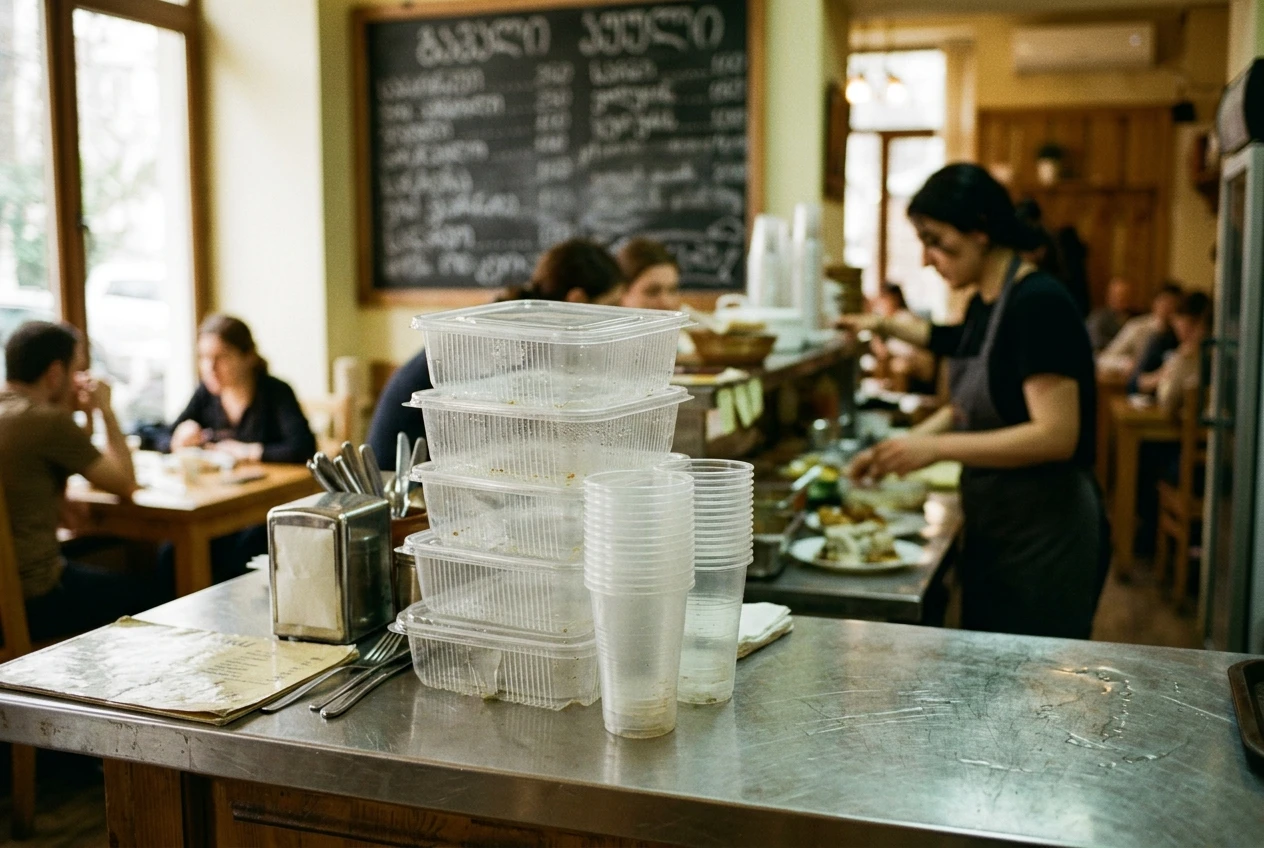
The delay of the container and cup bans keeps plastic inside restaurants and cafés through another year, where takeout orders typically carry the highest plastic volume per customer. The container deadline moved from July 1, 2026 to January 1, 2027 and the cup deadline moved to July 1, 2027, an extension the government framed as consumer-price protection.
How the Phase-Down Now Stacks Up
The phase-down now runs on a longer clock than the original schedule mapped out. The two measures that took effect on time, the January 1, 2026 ban on plastic utensils and expanded polystyrene food containers and cups, and the April 1, 2026 federal procurement ban, remain in force. The two measures the July 6 amendment delayed are the food service container and cup bans. The plastic bottle ban sits on a separate, longer delay set in April.
The full revised schedule is below.
| Measure | Original date | New date |
|---|---|---|
| Plastic utensils and expanded polystyrene food containers and cups (production, import, sale) | January 1, 2026 | January 1, 2026 |
| Federal procurement of single-use plastic cups, containers, and plastic-bottled drinks under three liters | April 1, 2026 | April 1, 2026 |
| Food service ban on single-use plastic food containers | July 1, 2026 | January 1, 2027 |
| Food service ban on single-use plastic cups for prepared food and beverages | July 1, 2026 | July 1, 2027 |
| Food service ban on serving drinks in plastic bottles | July 1, 2026 | February 1, 2031 |
| Production, import, and sale ban on plastic-bottled beverages | February 1, 2027 | February 1, 2031 |
The export carve-out runs through the entire schedule. Producers can keep making plastic items destined for foreign markets even after the domestic ban takes effect, a concession to international supply chains.
Frequently Asked Questions
When does Georgia’s plastic food container ban take effect?
The ban on supplying prepared food in single-use plastic food containers at food service establishments takes effect on January 1, 2027, under the July 6 amendment to Government Resolution No. 304 of June 8, 2022. The deadline is six months later than the original July 1, 2026 trigger.
When does the plastic cup ban in Georgia come into force?
The ban on single-use plastic cups used for prepared food and beverages takes effect on July 1, 2027, a full year after the original July 1, 2026 date. Both deadlines were set by the same amendment.
Why did Georgia postpone the single-use plastic foodware ban?
Prime Minister Irakli Kobakhidze has framed the broader phase-down as a balance between environmental goals and business consultation, citing businesses’ “subjective interests” and the potential impact on consumer prices. People’s Power MP Guram Macharashvili had argued in March that the planned bans were a “rushed decision” lacking economic analysis.
What does Government Resolution No. 304 cover?
Resolution No. 304 of June 8, 2022 sets the technical regulation for plastic materials and articles intended to come into contact with food. The July 6, 2026 amendment modifies only the timeline for the food service container and cup bans, leaving the resolution’s substantive scope unchanged.