The Food and Agriculture Organization of the United Nations (FAO) marked World Youth Skills Day by sending Georgian university students into a greenhouse instead of a lecture hall. The European Union and Sweden fund the climate-smart agriculture program behind that Marneuli farm day, which has already trained more than 820 university students hands-on.
That single day sits atop a bigger machine: a 234.5 million euro (roughly $253 million) EU pipeline that has run in Georgia, the Caucasus nation south of Russia, since 2013. The farm hosting it belongs to a village built once already by people fleeing a different kind of climate disaster.
Inside a Hands-On Farm Day with Georgia’s Next Agronomists
The session ran on the farm of Naira Paksadze, an FAO-designated lead farmer in Maradisi, one of two villages that make up FAO’s Marneuli demonstration site in southeastern Georgia. Students from the Agricultural University of Georgia spent the day working alongside FAO agronomy and extension specialists.
- Toured a modern seedling nursery and a greenhouse built for vegetable production
- Compared cultivation methods side by side across open-field plots
- Studied how drip and overhead irrigation systems are set up and run
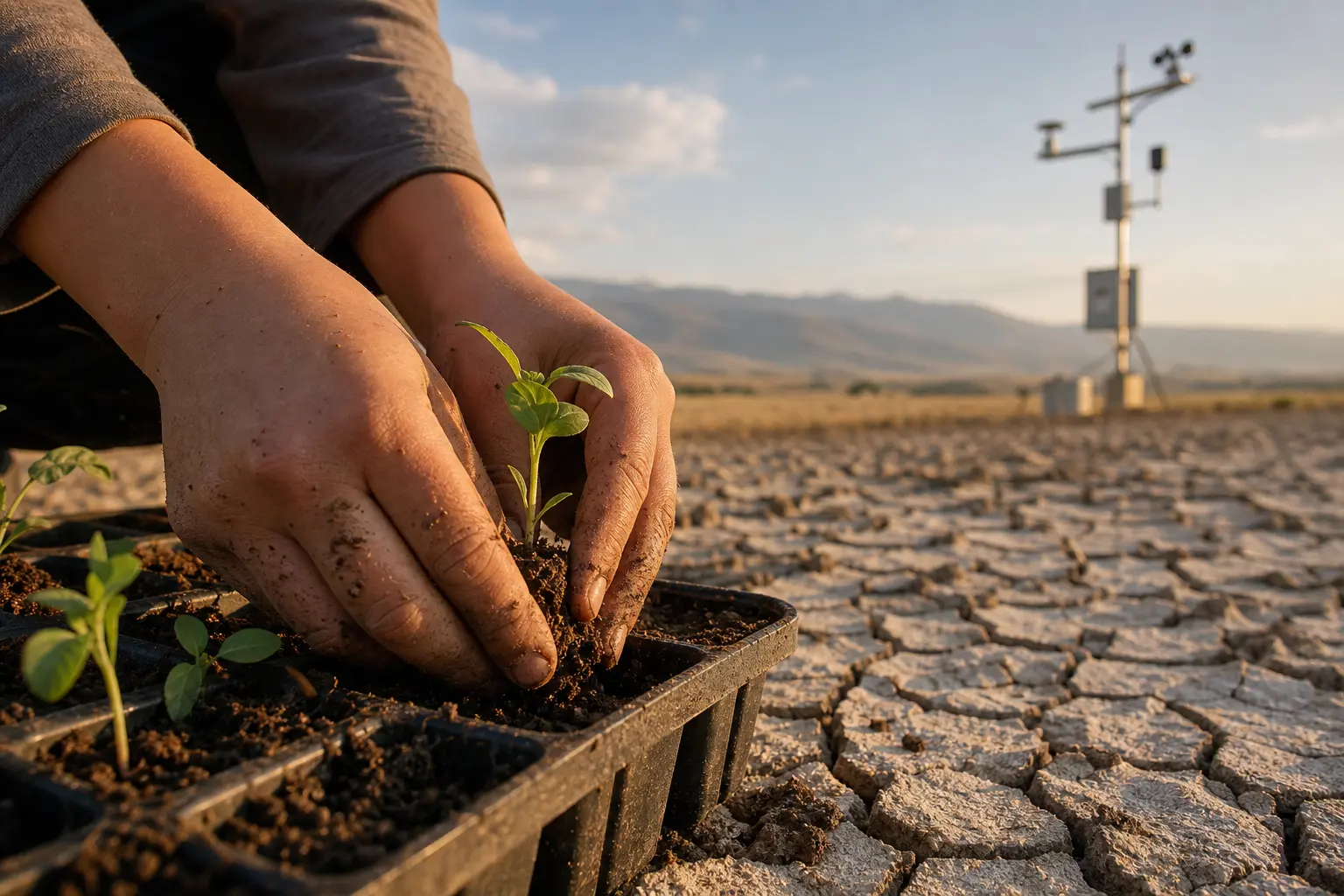
- Examined an agro-meteorological station that feeds real-time weather data back to the farm
- Mixed seedling substrate, filled planting trays and sowed drought-resistant seed varieties already used by local growers
None of it stayed theoretical. FAO says the day was built to bridge classroom study with the fieldwork future agronomists will need as Georgia’s growing seasons turn less predictable.
A Village of Climate Refugees Meets a New Kind of Climate Threat
Maradisi and Dioknisi did not appear by accident. The two villages, home to roughly 750 people in Georgia’s Kvemo Kartli region near the Armenian and Azerbaijani borders, were built by eco-migrants who fled landslides and avalanches in the mountainous Adjara region.
Greenhouse vegetables and dairy now carry most household incomes there, and women run much of the cooperative side of that economy. But the resettled villages have their own climate trouble now. Droughts parch the fields one season; heavy rain floods and erodes them the next.
Wind, frost and hail all damage crops, and rising temperatures are pulling salt to the surface of the soil faster than farmers can manage it.
The Weather Station the Students Studied Already Feeds an App
The weather station the students examined on Paksadze’s farm is not just a demonstration piece. It feeds the same kind of real-time data that already flows into GECSA (Georgian Climate Service for Agriculture), a mobile app that pushes hyperlocal forecasts straight to farmers’ phones.
Paksadze already leans on that data for her own crops. “With the right information, we can protect our crops, conserve water, and plan better for the future,” she told the UN Development Coordination Office last year. She belongs to the women-led Green Maradisi cooperative, which uses the app’s readings to time irrigation and watch for pests.
Marneuli’s tech push goes beyond one weather station. A separate donor gave the community its original weather hardware, and another supplier has wired a nearby cucumber greenhouse with internet-connected soil and air sensors that alert growers by phone.
What Is ENPARD, and Why Does It Fund a School Field Trip?
ENPARD stands for the European Neighborhood Programme for Agriculture and Rural Development, the EU’s rural aid program in Georgia since 2013. Its fourth phase pairs food-safety reform with farmer and student training, which is why an EU-and-Sweden-funded farm day for agronomy students exists at all.
| Phase | Period | Funding | Main Focus |
|---|---|---|---|
| ENPARD, all phases | 2013 to 2025 | €234.5 million | Cutting rural poverty nationwide |
| ENPARD III | 2016 to 2022 | €77.5 million | Cooperatives and Local Action Groups |
| ENPARD IV | Signed December 2020 | €55 million | Food-safety reform and rural development |
| Sweden’s food-safety top-up | Added from 2021 | Over €3 million | Sanitary and phytosanitary standards |
Cumulative EU rural spending in Georgia reached 234.5 million euro through 2025, up from 179.5 million euro as recently as 2018. Brussels and Tbilisi signed a 55 million euro deal in December 2020 to launch that fourth phase, betting on food-safety reform just as the pandemic was hammering rural incomes.
The program’s earlier phases already reshaped rural Georgia at scale. More than 1,000 agricultural cooperatives have formed under ENPARD, and over 8,000 farmers received EU-funded training on agricultural and business management before the fourth phase even began.
ENPARD IV’s reach does not stop at Marneuli’s greenhouses either. This year it also funded food-safety equipment for dairy cooperatives and a biosecurity course for aquaculture producers elsewhere in Georgia.
Officials Call It Insurance
The more students become familiar with an integrated farming systems approach, the better. Learning from experts, as well as from farmers, is crucial for promoting affordable and relevant technologies addressing climate change issues.
Denis Reiss, Programme Officer for Sustainable Food Systems at the Delegation of the European Union to Georgia, said that after the Marneuli session. Guido Agostinucci, FAO’s ENPARD IV Programme Manager, said the practical training builds both the technical know-how students need and their ability to help support steadier food systems once they enter the workforce.
Reiss made a similar case in May, when FAO relaunched matching grants tied to the country’s growing hazelnut export industry. “With the EU accounting for 70% of Georgia’s hazelnut export volume, these investments are crucial to secure market share and maintain reputation in Europe,” he said.
FAO also runs a paid agronomy internship that pulls students from Akhaltsikhe, Batumi, Kutaisi and Tbilisi, embedding them for months at a stretch on demonstration plots like the one in Maradisi. The Marneuli visit is one line in a busy ledger this year.
- 4,700+ schoolchildren have taken part in food-safety activities pairing classroom lessons with field visits.
- 102 dairy farmers received food-safety equipment through a separate ENPARD IV matching grant round.
- Over €3 million came from the Swedish Development Agency (SIDA) through an additional contribution signed for food safety.
- 40+ aquaculture producers completed a five-day biosecurity course under the same program.
Sweden’s money arrived as the food-safety component brought in the Czech Development Agency as a second implementing partner alongside FAO, starting in 2021.
Brussels Keeps Funding Farms While Patience with Tbilisi Thins
None of this rural spending depends on how Brussels feels about Tbilisi’s politics on any given week, but the contrast is hard to miss. Georgia applied for EU membership in March 2022 and was granted candidate status in December 2023.
Six months later, EU leaders voiced serious concerns about backsliding on the reform steps Brussels had laid out.
The friction has shown up closer to home too, in legislation that mirrors Russia’s foreign agents law and forms part of a broader legislative clampdown on Georgian organizations. Agricultural aid has kept moving anyway.
FAO signed new training and grant rounds in hazelnuts, dairy, aquaculture and viticulture through the first half of 2026, all funded under the same ENPARD IV umbrella that paid for the Marneuli session. The students who spent the day sowing drought-resistant seeds in Maradisi will graduate into that same landscape, one where the money for climate adaptation keeps arriving even as the politics around it do not.
Frequently Asked Questions
What Does ENPARD Stand For?
ENPARD stands for the European Neighborhood Programme for Agriculture and Rural Development. It has run in Georgia since 2013, and EU documents describe it as the single largest program backing the country’s national agriculture development strategy, spread across four phases and several implementing partners.
What Is the GECSA App?
GECSA is a mobile app that sends hyperlocal weather alerts to Georgian farmers’ phones, developed with support from the United Nations Development Programme and the Green Climate Fund. It draws on readings from FAO-installed agrometeorological stations, including the one Marneuli’s students examined during the training.
What Other ENPARD IV Training Ran in 2026?
FAO also ran a food-safety risk assessment course for 24 regulators, academics and industry representatives in Georgia’s sanitary and phytosanitary sector, led by international risk analysis expert Alberto Mantovani, and rolled out a new vineyard management module for university students, built with Georgian viticulturalists.
Is This Georgia the Country or the U.S. State?
This is the country of Georgia, a former Soviet republic in the Caucasus bordering Russia, Turkey, Armenia and Azerbaijan, not the U.S. state of the same name. Georgia signed its Association Agreement with the EU in 2014, which remains the legal foundation for the rural aid programs described here.