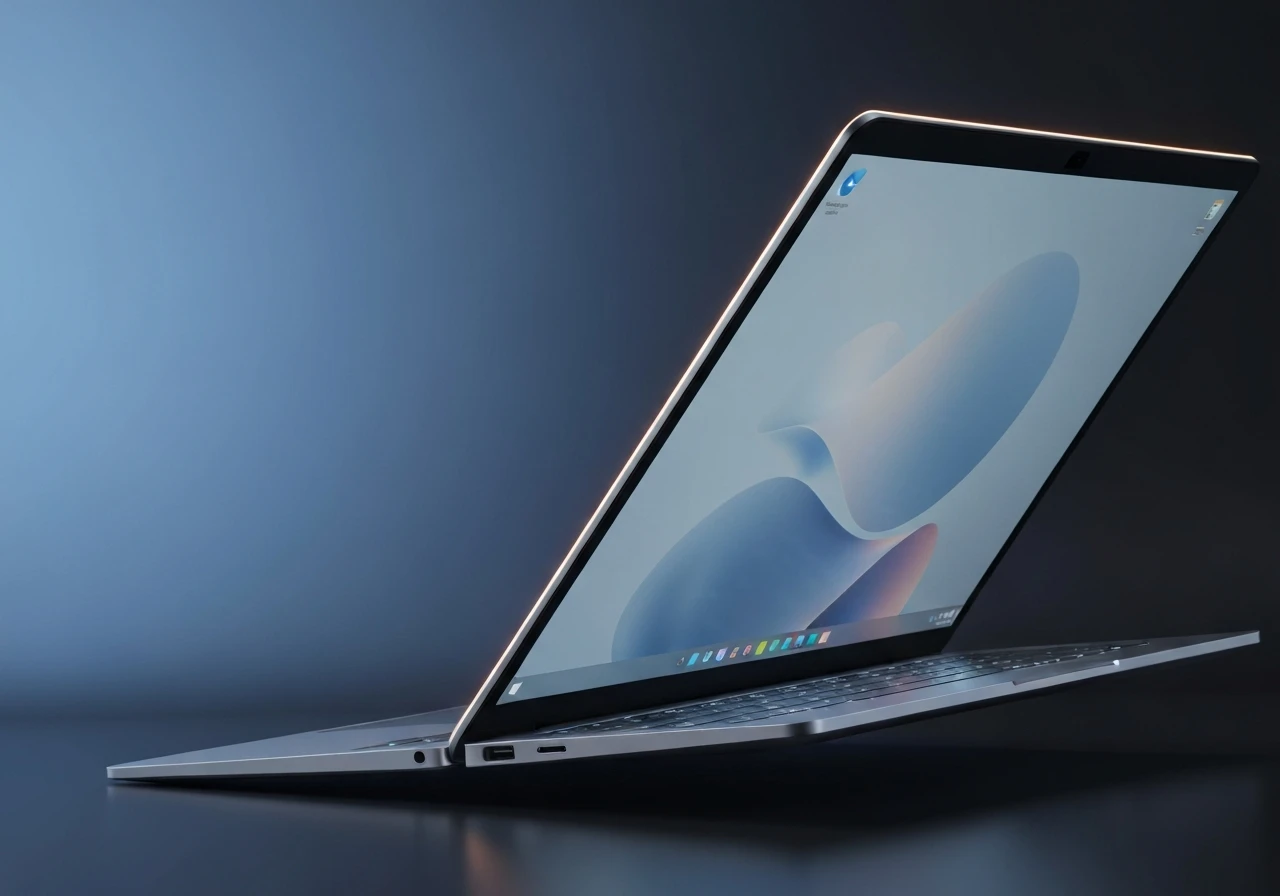
Dell is taking the premium XPS 13 name it has used for more than a decade and pushing it down the price ladder. The new Dell XPS 13 (2026) starts at $699 for consumers, or $599 with student pricing, and it is built to go after Apple’s $599 MacBook Neo in the entry tier of thin and light laptops. Dell calls it the thinnest and lightest XPS it has ever made.
The label most coverage reached for is “MacBook Neo killer.” The problem with that framing is simple arithmetic: Dell’s starting price sits $100 above Apple’s. So this is less a price war than a bet that Windows shoppers will pay a premium for the things Apple chose to leave out.
What $699 Buys in Dell’s New XPS 13
The entry model ships with Intel’s new Core 5 320 “Wildcat Lake” processor, 8GB of LPDDR5x (low-power memory soldered to the board) running at 7467 MT/s, and a 512GB solid-state drive. The chip pairs a 6-core processor, two performance cores and four low-power efficiency cores, with dual-core integrated graphics.
Dell still treats this as a premium machine, and the spec sheet climbs from there. Buyers can step up to 16GB or 32GB of memory, storage up to 1TB, and a top processor option of the Intel Core Ultra 7 355 “Panther Lake.” Dell has also said a smaller 256GB drive will arrive later, which opens the door to an even cheaper configuration down the line.
The Display and Build
Every unit gets the same 13.4-inch panel: a 2560 x 1600 IPS LCD (in-plane switching, the wide-angle screen type) touchscreen with 100% DCI-P3 color coverage, brightness up to 500 nits, and a variable refresh rate that swings from 30 Hz to 120 Hz to save power. The chassis is aluminum, measures 12.5mm (0.5 inches) at its thinnest point, and weighs 1 kilogram (2.2 pounds). Two colors launch first, called “sky” and “storm.”
The Headline Numbers
- $699 starting price for consumers, $599 for students
- 2.2 pounds, Dell’s lightest XPS to date
- 120 Hz touchscreen with a 2.5K resolution and 500 nits
The Hundred-Dollar Gap the Headlines Skip
Strip away the marketing and the comparison starts with one fact: the XPS 13 opens at $100 more than the Neo. Apple’s cheapest Mac launched in March at $599, or $499 for education buyers, and it has been shipping since March 11. Dell’s machine will not arrive until later this summer.
Dell’s answer is to load the base price with hardware Apple skipped. The XPS 13 ships standard with a backlit keyboard and a touchscreen, two things the entry MacBook does not offer at any price. It is also lighter, at 2.2 pounds against roughly 2.7 pounds for the Neo, and its display runs at a faster 120 Hz where Apple’s Liquid Retina panel is fixed.
That is the whole wager. Dell is not trying to undercut Apple on the sticker. It is asking a Windows buyer to spend an extra hundred dollars for touch input, a brighter high-refresh screen, and a path to 32GB of memory that the Neo cannot match.
XPS 13 vs MacBook Neo, Spec for Spec
Both laptops start with 8GB of memory and a 13-inch class screen, then diverge sharply on chip architecture, input, and upgrade headroom. The table below lines up the entry configurations as each company sells them.
| Attribute | Dell XPS 13 (2026) | Apple MacBook Neo |
|---|---|---|
| Starting price | $699 | $599 |
| Student / education price | $599 | $499 |
| Base processor | Intel Core 5 320 (Wildcat Lake) | Apple A18 Pro |
| Base memory | 8GB LPDDR5x | 8GB unified |
| Max memory | 32GB | 8GB |
| Display | 13.4-inch, 2560 x 1600, up to 120 Hz | 13-inch Liquid Retina, 2408 x 1506 |
| Touchscreen | Yes | No |
| Weight | 2.2 lb (1 kg) | About 2.7 lb |
| Battery (claimed) | Not disclosed | Up to 16 hours |
| Colors | Sky, Storm | Blush, indigo, silver, citrus |
| Availability | Later this summer | Shipping since March 11 |
The row that decides most buying calls is memory. Apple caps the Neo at 8GB, full stop. Dell will sell you four times that. For anyone who keeps a browser stuffed with tabs alongside a few apps, that ceiling is the difference between a laptop that ages gracefully and one that does not.
Wildcat Lake Meets the A18 Pro
The silicon inside these two machines comes from opposite worlds, and the gap explains a lot about how each will behave.
Intel’s Budget Push
Wildcat Lake is Intel’s new low-power, low-cost family, and the Core 5 320 inside the base XPS 13 carries a 15W thermal design power (TDP, the heat budget a chip is built around) with a turbo clock near 4.6 GHz. It is a modest part by design, two performance cores doing the heavy lifting and four efficiency cores handling light work. Step up to the Core Ultra 7 355 “Panther Lake” and the math changes, with eight cores and a 4.7 GHz peak, but so does the price.
Apple’s Phone Chip in a Laptop
The Neo runs the A18 Pro, the same system on a chip (SoC, the processor, graphics, and memory controller on one die) that powered the iPhone 16 Pro. It brings a 6-core processor, a 5-core graphics unit, and a 16-core Neural Engine for on-device AI. Apple’s pitch leans on efficiency, and the 16-hour battery claim is the payoff of putting a phone-class chip in a laptop body.
What That Means in Practice
Early Wildcat Lake benchmarks suggest the Core 5 320 can trade blows with the A18 Pro in raw processor tasks, and Dell’s configurations scale far higher than anything the Neo offers. Apple counters on battery and on the tight software pairing only it controls. Neither chip is built for heavy creative work, and both companies know it; these are everyday laptops, sold to people who browse, write, and stream.
Where Dell Trimmed to Hit the Price
Getting an XPS down to $699 meant cuts, and Dell made some that will frustrate part of its audience. The compromises are not hidden, but they are real.
- No headphone jack, a first for the line, with Dell suggesting a Bluetooth headset or a USB-C audio adapter instead.
- Two USB-C ports and nothing else; they handle data, video, and charging, but plug in a charger and you are down to one free port.
- Single-channel memory on the Wildcat Lake models up to 16GB, which can throttle graphics performance, while only the pricier Core Ultra builds get dual-channel.
- A slower port standard on the cheaper units: Wildcat Lake models use USB 3.2 Type-C, and only Panther Lake configurations get the faster Thunderbolt 4.
None of these is fatal on its own. Stacked together, they sketch the limit of the strategy. A $699 laptop that looks and feels premium still has to give something up, and Dell chose to spend its budget on the screen and chassis rather than on ports.
Who the XPS 13 Is For
The clearest buyer is a Windows loyalist who wants a touchscreen, a high-refresh display, and the option to load 16GB or 32GB of memory in a body that weighs barely two pounds. For that person, the extra $100 over Apple’s laptop buys a genuinely different machine, not a worse one.
The harder sell is the shopper who only cares about price and battery life. Apple already owns the lower number and the longer runtime, and it has had a head start of an entire season. Dell’s machine answers Apple’s push to bring its laptops to the mass market by competing on flexibility instead of cost, the same lane Dell has worked for years against the broader M5-series MacBook lineup. If Windows buyers reward the touchscreen and the upgrade path, the gamble pays off; if they fixate on the price tag, Apple’s hundred-dollar lead is exactly the kind of gap that decides a checkout cart.
Frequently Asked Questions
How much does the Dell XPS 13 (2026) cost?
It starts at $699 for consumer models and $599 for student configurations. Dell has also confirmed a future 256GB storage option, which could enable an even lower entry price later.
When will the new XPS 13 be available?
Dell says the laptop will go on sale later this summer. That is well behind the MacBook Neo, which has been shipping since March 11.
Is the XPS 13 cheaper than the MacBook Neo?
No. The XPS 13 opens at $699 against the Neo’s $599, so it costs $100 more at the entry level. Dell’s argument is that the base price includes a touchscreen and backlit keyboard that Apple’s laptop lacks.
Does the new XPS 13 have a headphone jack?
No. The laptop drops the 3.5mm jack entirely and offers only two USB-C ports. Dell recommends a Bluetooth headset or a USB-C to 3.5mm adapter for wired audio.
How much memory can the XPS 13 hold?
Configurations scale from 8GB up to 32GB. That is a key difference from the MacBook Neo, which is capped at 8GB of unified memory with no upgrade option.
What processor does the base model use?
The entry unit runs Intel’s Core 5 320 “Wildcat Lake” chip, a 6-core part. Higher configurations go up to the Intel Core Ultra 7 355 “Panther Lake” processor.