Under preliminary agreements with the National Park Service, two private families on Georgia’s Cumberland Island could soon build homes with footprints of up to 15,000 square feet inside the national seashore Congress ordered kept “primitive.” Each agreement would exchange federal acreage for private parcels still inside the park boundary. Draft deeds are already in hand with the McFadden family and the Foster family.
Both agreements would clear the way for single-family homes as large as the island’s only inn. Documents obtained by conservation groups through a Freedom of Information Act request show the preliminary agreements and detailed draft deeds were negotiated before the public review that normally accompanies federal land exchanges. The park service says it has not finalized the exchanges, and a formal environmental assessment and public comment period are still scheduled for this fall.
The Land Swap, in Two Preliminary Deals
The two executed agreements spell out how many homes each family can build, how tall the structures can rise, and how much NPS land each receives in return. In the first deal, a wilderness trust whose trustees are Nancy McFadden Cannon and Ledyard H. McFadden would send 10 acres to the park service in exchange for 20 NPS acres further north. In the second, the Foster family would convey about 90 private acres to the park service in exchange for about 60 NPS acres along Old House Road.
Per the deal terms, each exchange allows one single-family residence with a footprint of up to 15,000 square feet for every 10 acres of buildable area received. Under that formula, the McFaddens’ parcel could support two homes and the Fosters’ parcel could support six. Every house in either exchange is capped at 35 feet tall. The McFadden property sits in the island’s southern half; the Foster property lies further north along Old House Road.
The park service posted a notice about the four-parcel voluntary exchange on its planning portal for the Cumberland Island land exchange, where it calls the swaps an “early step” that “remains subject to additional review, including completion of an environmental assessment and a public comment period anticipated this fall.” The deals, the portal adds, are meant to consolidate ownership in places where federal and private lands are intermingled. The agency wants visitor trails and the main road to sit fully on NPS-managed ground. The exchanges also concentrate remaining private use in fewer, more contained spots, the agency says; none of the documents indicate the timing for any appraisal or closing.
| McFadden family | Foster family | |
|---|---|---|
| Private acres proposed to NPS | 10 | ~90 |
| NPS acres proposed to family | 20 | ~60 |
| Maximum new homes allowed | 2 | 6 |
| Maximum house height | 35 feet | 35 feet |
| Status | Agreement executed, draft deed prepared | Agreement executed, draft deed prepared |
How Eight Homes Could Get Built
The 15,000-square-foot figure applies to a single home’s footprint. The park service clarifies that the cap is the combined ground area of a home plus any small outbuildings on a parcel. The 35-foot height limit applies regardless of the number of stories. Greyfield Inn, the Carnegie-built mansion that runs as the island’s only hotel at $1,000 a night, was built long before any zoning-style cap existed on the island, so a 15,000-square-foot home would be considerably larger than most of the buildings the Gilded Age families originally put there.
The McFaddens and Fosters do not appear to have asked for that size. A park service spokesperson told The Current that the families “didn’t ask for that size and don’t intend to build that large.” Both draft deeds also record conservation easements on the swapped NPS land, language the park service frames as limiting future development. Critics from Defenders of Wildlife and the Southern Environmental Law Center note that those easements do not by themselves restrict new access roads, residential structures, or motorized use under the permits. Defenders of Wildlife received the agreements through a Freedom of Information Act request and shared them with The Current.
A ‘Primitive’ Mandate Tested by Gilded Age Property
Congress designated Cumberland Island a National Seashore in 1972 and explicitly ordered that the federal portion be “permanently preserved in its primitive state.” Even with that designation, descendants of the families who bought up the island in the late 1800s kept title to their parcels. Today the park service describes 11 privately owned properties totaling about 712 acres inside its 37,000-acre boundary.
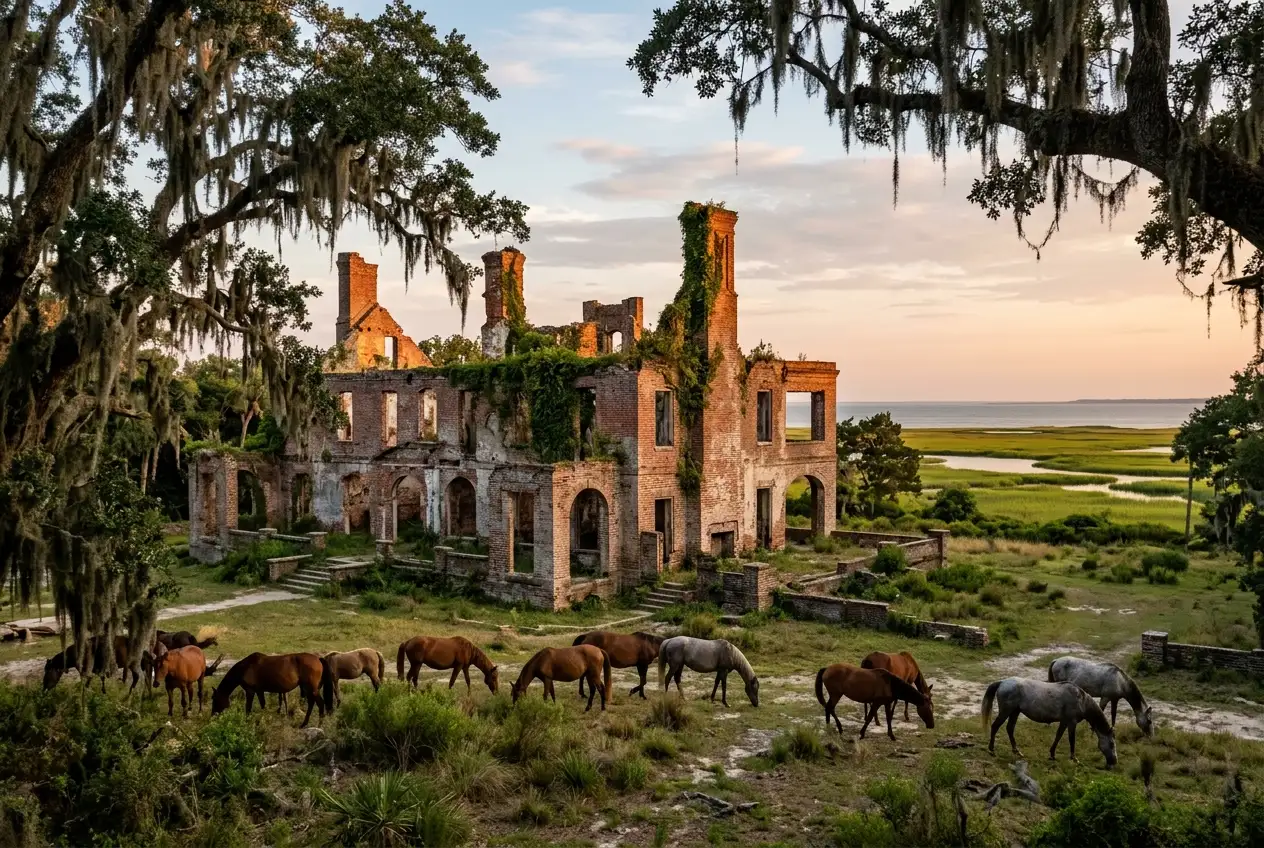
- Dungeness. A 59-room, 37,000-square-foot estate from the mid-1880s, once owned by Thomas Carnegie, Andrew Carnegie’s brother and business partner. Now in ruins.
- Plum Orchard. A 30-room, 22,000-square-foot mansion occupied by Andrew Carnegie’s nephew circa 1898. Now managed by the park service.
- Greyfield Inn. A Carnegie house where visitors can sleep for $1,000 a night. Serves as the island’s only hotel.
- High Point. A seven-home family compound built nearly a century ago by a son of Coca-Cola founder Asa Candler. Accessible by a private airstrip.
Through Lumar LLC, Candler descendants still own the 90-acre tract they once sought to subdivide. Ten years ago, the county planning commission granted Lumar a hardship variance to divide that tract into 10 parcels; the broader zoning change was later tabled by the county commission after residents and conservation groups objected, nudging the park service to come back with the swaps now on the table. Land exchanges have been a recurring idea on Cumberland, with the latest push publicly proposed in 2024. Advocates at the Wild Cumberland nonprofit organization, led by executive director Jessica Howell-Edwards, have called any new private construction at odds with Congress’s “primitive state” mandate.
Camden County Withholds Its Support Letter
The first formal airing of the swaps came in March, when park superintendent Melissa Trenchik asked the Camden County Commission for a written letter of support. Trenchik told commissioners that she could not share the size of the homes or the acreage involved until both sides had signed the documents. The commission declined to send a letter after residents and conservation groups criticized the park service for lack of transparency. Its decision did not directly block the swaps from moving forward, but it cut off access to federal Land and Water Conservation Fund money the agency had hoped to use.
Commissioners said the county had received 500+ emails urging the board to at least postpone its decision. Prominent environmental groups told the board there were too many unknowns in the NPS proposal for Camden to back it. The Current reports that documents obtained from the park service show “executed preliminary agreements and detailed draft deeds, which suggests the terms of these exchanges may already be largely set.” That is what has Wild Cumberland and Defenders of Wildlife asking for the process to start over. They want environment and wildlife reviews to come first, before any final deeds are drawn.
This has all been done behind closed doors, and from what we have received, it’s clear that there are going to be impacts to the park, like a 15,000-square-foot home is an impact.
Kelly Cox, senior policy and planning specialist for the National Wildlife Refuges and Parks Program at Defenders of Wildlife, told The Current in June.
The Park Service’s Argument, in Its Own Words
The park service says its restrictions are designed for restraint, not expansion. A spokesperson wrote that the 15,000-square-foot cap and 35-foot height limit were “designed to significantly restrict development, maintain the island’s natural character, and protect key visitor use areas and sensitive resources.” Trenchik told the Camden County Commission in March that the swaps would create “a more continuous corridor of federally managed property,” letting visitors move through the park without crossing private inholdings. The agency says it will not finalize anything until the fall environment and public comment process is complete.
Critics counter that the corridor logic could apply even tighter once the public is locked out. Southern Environmental Law Center staff attorney Zachary Hennessee told The Current that “the notion that these exchanges would allow multiple, 15,000 square foot houses on each of the newly privatized properties” is what “rankles a lot of people.” Wild Cumberland executive director Jessica Howell-Edwards said the agency’s lack of transparency, given the public opposition, is “mind boggling.”
Conservation groups also note that the park service did not fund monitoring of sea turtle nests on Cumberland last year, even as the 18-mile beach hosted 522 nests, the most of any Georgia barrier island. Howell-Edwards said the swaps are being financed while the agency has had to pass turtle monitoring costs to the state. In parallel, the park service is weighing a separate Visitor Use Management Plan that could more than double the current cap of 300 visitors a day. The Current reports the plan would let vendors rent kayaks and run paid tours, an option that would not pencil out under the existing 45-minute boat ride from the mainland. The park service faces decisions on both fronts before any new homes are built.
Cumberland Island by the numbers
- 37,000 acres in the National Seashore
- 11 private properties totaling about 712 acres
- Two preliminary agreements signed; up to four swaps on the table
- 500+ emails to Camden County opposing the swaps
- 300 visitors per day, the cap that could double
- 522 turtle nests last year, the most of any Georgia island
Frequently Asked Questions
What does the Cumberland Island land swap actually propose?
The park service has signed preliminary agreements with the McFadden family and the Foster family. Under the current drafts, the McFaddens trade 10 private acres for 20 NPS acres further north, and the Fosters trade about 90 private acres for about 60 NPS acres along Old House Road. Values of the swapped parcels have not been appraised yet, and the park service may need to add cash to balance any uneven deal. Each exchange lets the receiving family build one single-family home with a footprint of up to 15,000 square feet for every 10 acres of buildable land, capped at 35 feet tall.
Which families are involved in the Cumberland Island swaps?
The first agreement is with a wilderness trust whose trustees are Nancy McFadden Cannon and Ledyard H. McFadden. The second agreement is with the Foster family. Two more parcels remain under discussion, including the Lumar LLC tract, which the park service says is held by descendants of Coca-Cola founder Asa Candler.
How large could the new Cumberland Island homes get?
Each deal allows a single-family residence with a footprint of up to 15,000 square feet per 10 buildable acres. The McFaddens’ receiving parcel could fit two such homes and the Fosters’ parcel could fit six, with every structure capped at 35 feet tall. The footprint is a home’s combined ground area plus small outbuildings, the park service has clarified.
When can the public weigh in?
The park service plans to release a formal environmental assessment for public comment this fall. Defenders of Wildlife and the Southern Environmental Law Center obtained the preliminary agreements and draft deeds through a Freedom of Information Act request and shared them with The Current in June.
What does the park service say about the criticism?
A park service spokesperson wrote that the size restrictions were “designed to significantly restrict development, maintain the island’s natural character, and protect key visitor use areas and sensitive resources.” Superintendent Melissa Trenchik told the Camden County Commission in March that the swaps would create “a more continuous corridor of federally managed property” through the island.