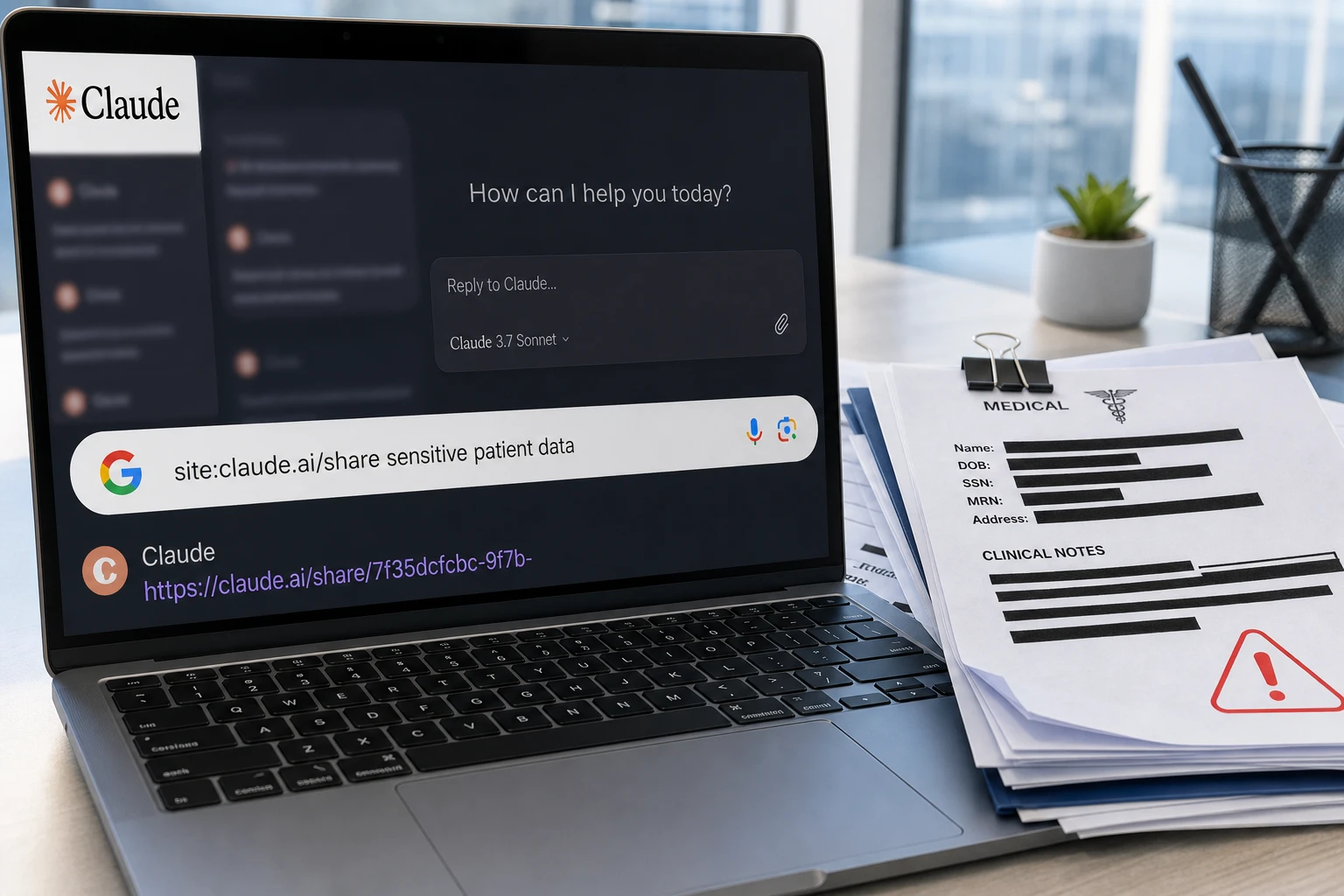
An untold number of Claude shared chats and Artifacts briefly appeared in Google search results this week, some holding medical reports, clinical trial patient names, children’s phone numbers and internal company files. Reddit users found them with a simple site:claude.ai/share operator over the weekend. By Monday afternoon the Google hits were gone.
The exposure tracked the same share-link design that already burned Anthropic once in 2025, plus OpenAI and xAI. Users hit “share,” created a public URL, and search engines treated the pages like any other web content.
What Turned Up in the Search Results
Futurism reviewed material that included a detailed medical report of a real patient, clinical trial results with patient names, documents listing names and phone numbers of primary school-aged children, internal-only company files and employee reviews carrying personal worker details. TechCrunch and 404 Media noted health records, private company documents and children’s contact information among the finds.
Artifacts, Claude’s interactive mini-apps and documents, also surfaced. Some held code and work notes. Fortune spotted at least one conversation labeled “shared by Anthropic” in which Claude produced erotica, material the company’s usage policy bars.
- Medical and clinical data: patient reports and named trial results
- Children’s details: names and phone numbers of school-age kids
- Corporate material: internal docs and employee reviews with personal info
- Credentials and keys: reports of API keys, crypto wallet details and logins circulating in user tallies
The pages were never private chats pulled from accounts. They were snapshots users themselves chose to share via Claude’s public-link option.
The Same Pattern Hit Claude, ChatGPT and Grok Before
In September 2025 Forbes reported hundreds of Claude transcripts indexed by search engines. Google estimated just under 600 conversations before the results vanished. Anthropic said then, as now, that users had posted the links somewhere crawlers could find them.
OpenAI faced a larger version the same year: a researcher scraped roughly 100,000 publicly shared ChatGPT conversations that became searchable. xAI’s Grok saw hundreds of thousands of shared transcripts indexed, some containing extreme content. OpenAI later removed the discoverable-share option, calling it too easy for users to share things they never intended for the open web.
| Company / Model | Year | Scale reported | Core mechanism |
|---|---|---|---|
| Anthropic Claude | 2025 | Just under 600 (Google estimate) | Share-link pages crawled after public posts |
| OpenAI ChatGPT | 2025 | ~100,000 scraped | Public share option made discoverable |
| xAI Grok | 2025 | Hundreds of thousands | Shared transcripts indexed without strong warnings |
| Anthropic Claude | 2026 | Untold / multiple users found lists | Same share feature, missing noindex on pages |
Each time the companies pointed to user choice. Each time the practical result was the same: material people treated as limited-circulation landed in front of strangers via search.
Why Robots.txt Alone Did Not Stop Indexing
Anthropic’s robots.txt has long told crawlers to skip shared chats. Wired confirmed the instruction dated back at least to the 2025 incident. Google and Bing still require a noindex meta tag or X-Robots-Tag header on the individual page itself when the URL is discovered from an external link. Wired checked the exposed Claude share pages and found no noindex tag.
Google spokesperson Ned Adriance said neither Google nor any other engine controls which pages become public, and that site owners receive clear controls site owners use for indexing. He added the pages were indexed across multiple engines and that Google respects the directives it receives. Anthropic did not answer Wired’s direct question about the missing noindex.
The mechanics are ordinary web behavior. A long UUID URL is hard to guess. Once someone pastes it on Reddit, X, Discord or a blog, crawlers can follow the link, fetch the page and index the content. how Google treats robots.txt and noindex makes plain that robots.txt is advisory for discovery; noindex is the stronger block once the URL is known.
Users Found Far More Than Work Notes
On X and Reddit the conversation quickly moved past abstract privacy talk. One widely shared post catalogued API keys and crypto wallets, full resumes with addresses and phone numbers, a lawyer working through a possible ethics violation, internal engineering project details, apparent Social Security numbers and deeply personal chats. Crowds treated the Google results as a temporary public archive and urged everyone who had ever shared a Claude link to audit their history immediately.
That crowd layer matches the reporting. People often hit share the way they would send a Google Doc or Slack message, expecting only the recipients to see it. The interface says “anyone with the link can view.” It does not stress that the resulting page can become a normal indexed web document. Artifacts carry a clearer warning about search engines; ordinary chat shares do not.
CLAUDE HAS A SERIOUS PRIVACY PROBLEM RIGHT NOW, A HUGE NUMBER OF SHARED CONVERSATIONS ARE PUBLICLY INDEXED ON GOOGLE FOR ANYONE TO FIND
Om Patel wrote that on X in a post that drew millions of views, listing the credential and personal-data examples users were pulling up before the results disappeared.
Anthropic’s Line and the Fix That Landed Fast
Anthropic spokeswoman Amie Rotherham told TechCrunch: “We give people control over sharing their Claude conversations publicly, and in keeping with our privacy principles, we do not share chat directories or sitemaps with search engines like Google. These shareable links are not guessable or discoverable unless people choose to share them themselves. When someone shares a conversation, they are making that content publicly accessible, and like other public web content, it may be archived by third-party services.”
The company drew a bright line: privately sent links stay out of search; links posted where crawlers can reach them do not. The issue was first flagged on Reddit Saturday, reported by 404 Media Monday morning, and by Monday afternoon TechCrunch’s test of the same operator returned nothing. Bing still showed residual results longer, according to Wired.
The speed of the Google cleanup is the practical upside. The downside is that any page once public can be archived by third parties, and the underlying share URLs remain live until the owner unshares them. Sensitive material that left the platform for a weekend is not guaranteed to stay uncopied.
How to Audit and Kill Old Share Links
Claude’s own help center lays out the process. Conversations stay private by default. Sharing creates a snapshot of messages up to that moment; later messages stay private unless the user re-shares. Attached files themselves stay out of the snapshot, though Claude’s text responses about them can appear.
To clean up:
- Open Settings then Privacy on claude.ai
- Click Manage next to Shared chats (and check Shared artifacts if listed)
- Review every title, date and link
- Unshare anything you would not want indexed or archived
The official share and unshare steps also note that Team and Enterprise plans restrict sharing to the organization. Free, Pro and Max users can revoke any public snapshot at any time. After the weekend’s scramble, many users reported the modal simply said “No shared content found.”
The episode sits beside other AI privacy and security friction points. Features that move medical or personal data into chat systems, such as the ChatGPT Health medical records feature, raise parallel questions about what stays private once a user hits share or export. Broader agent tools, including AI security agents that carry fresh risk, keep adding surfaces where a single misconfigured public link can amplify exposure.
For now the Google results are gone. The share feature remains. The design lesson from two Claude incidents, plus ChatGPT and Grok, is still sitting in plain sight: a public URL is a public web page, and search engines will treat it that way unless the page itself tells them not to.
Frequently Asked Questions
What exactly is a Claude shared chat snapshot?
It is a frozen public webpage of the conversation up to the moment you clicked share. Anyone with the URL can read those messages and any included Artifacts. Later messages stay private unless you share again and update the snapshot.
Did private unshared Claude chats appear in Google?
No. Only conversations and Artifacts where a user deliberately created a public share link were involved. Unshared chats remain inaccessible without account access.
How does this differ from the 2025 Claude indexing event?
The mechanism was identical: share-link pages discovered via external posts and indexed despite robots.txt. Google estimated just under 600 chats then. The 2026 scale was never independently tallied, though multiple users and outlets found long result lists containing more sensitive categories such as children’s contact details and medical records.
Can I permanently delete a shared link after unsharing?
Unsharing disables the public link so it no longer works for new visitors. Third-party archives or caches that already captured the page may still hold copies. Removing the share is still the strongest step available to the account owner.
Why did Artifacts carry a stronger search warning than regular chats?
Anthropic’s interface for publishing an Artifact states it will be accessible to anyone and potentially visible in search results. The ordinary chat share dialog emphasizes “anyone with the link” without the same explicit search-engine language, according to contemporary reporting of the UI.