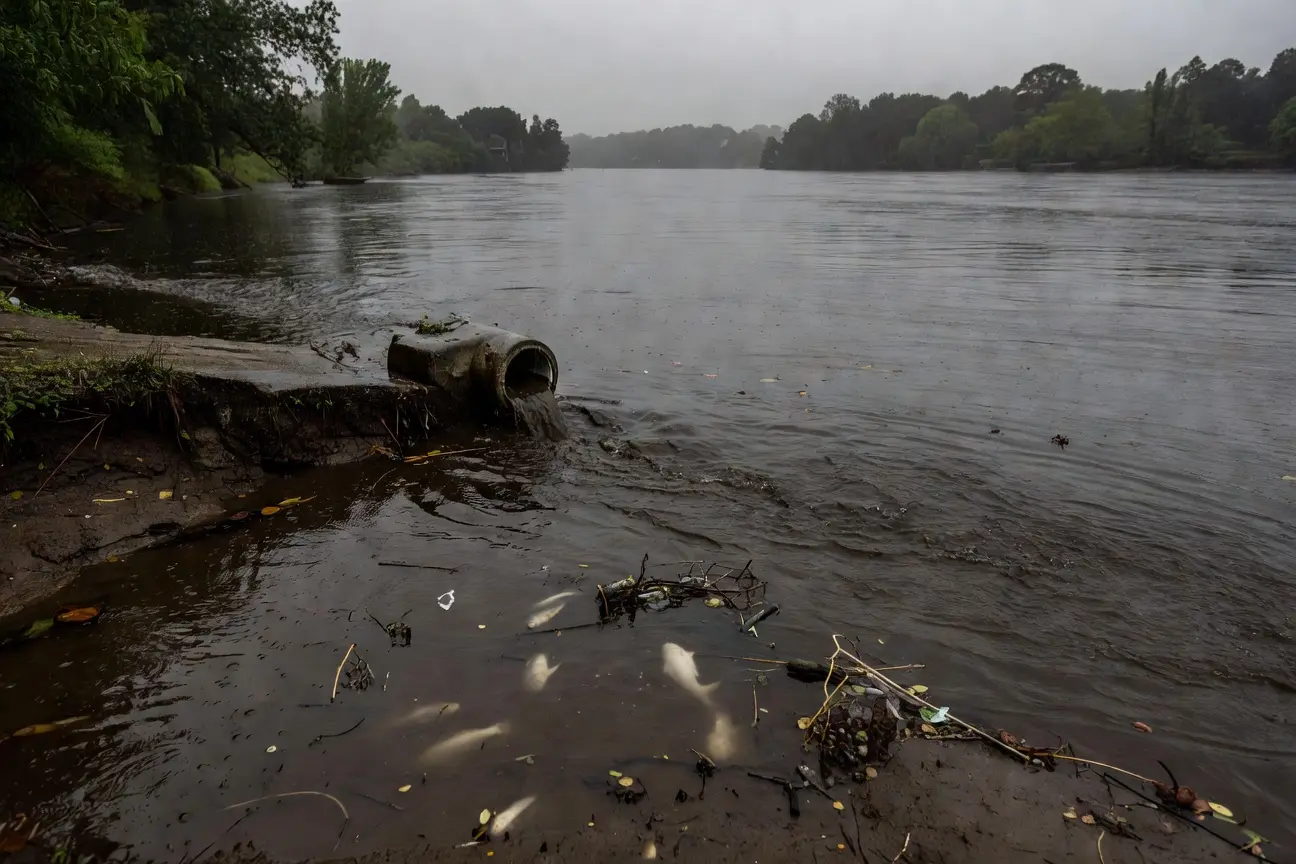
The Chattahoochee fish kill below Peachtree Creek followed a blunt sequence: months of drought, roughly three inches of rain in one hour, a rush of polluted stormwater, and sewer overflows that Atlanta and state investigators are still tracing. The result was thousands of dead fish on a river already running thin.
The public investigation now turns on a harder question than the weather. If a short storm can push runoff, heat, nutrients and sewage into the same reach of river, Atlanta has a water system problem that cannot be solved by waiting for the next rain to dilute it.
The Kill Zone Starts Below Peachtree Creek
Chattahoochee Riverkeeper, an Atlanta-based environmental nonprofit, said it discovered the fish kill on Friday, May 22, directly downstream of Peachtree Creek. Its May 23 fish kill investigation release said the Chattahoochee River National Recreation Area was not affected, a key boundary for residents who use the upstream park corridor.
The affected stretch begins where Peachtree Creek delivers urban runoff from Atlanta into the Chattahoochee. That matters because the river was already low, leaving less water to absorb a sudden pulse of warm, dirty stormwater. Low flow does not create a fish kill by itself. It leaves the river with less room for error.
- May 22: Chattahoochee Riverkeeper reported discovering the fish kill downstream of Peachtree Creek.
- 3 inches: The group cited a reported one-hour rainfall burst around metro Atlanta inside the Interstate 285 Perimeter.
- 24 hours: Polluted runoff then moved into Peachtree Creek and the Chattahoochee over the following day.
- 750 cubic feet per second: The nonprofit described the Chattahoochee flow near that junction as approximately this level.
The City of Atlanta Department of Watershed Management, the city water utility, said it received reports on May 22 and sent Commissioner Greg Eyerly, Deputy Commissioner Quinton Fletcher and field staff to investigate with Chattahoochee Riverkeeper. The city said the cause had not been confirmed and that no final conclusion had been reached.
A One-Hour Storm Hit a River Running Thin
The timing is the story. A drought left streams and the Chattahoochee near historic low flows, according to the riverkeeper. Then a rush-hour downpour hit pavement, roofs, parking lots and roads across a dense part of Atlanta. That kind of rain does not behave like a slow soaking storm. It runs.
In its national conditions update, Drought.gov’s May drought summary said 62.42% of the Lower 48 states were in drought as of May 19 and that 46 states had moderate drought or worse. The Southeast section of the U.S. Drought Monitor also described broad rainfall deficits across Georgia and neighboring states.
| Factor | What Happened | Why It Matters for Fish |
|---|---|---|
| Drought | Minimal rainfall for months left the river low. | Less water means less dilution and less oxygen buffer. |
| Rush-hour downpour | About three inches reportedly fell in one hour. | The surge moved too fast for soils and drains to absorb it. |
| Urban runoff | Water washed pollutants and nutrients from pavement into Peachtree Creek. | Organic material can feed bacteria that consume oxygen. |
| Sewer overflow | Atlanta’s combined sewer system and West Area Tunnel overflowed, according to the riverkeeper. | Untreated water mixed with stormwater before entering the river. |
The table points to a flow first failure. The rain was intense, but the damage came from what the rain carried and the condition of the river waiting below.
The Sewer Tunnel Becomes the Hidden Stakeholder
Atlanta’s West Area Tunnel is now central to the investigation. Chattahoochee Riverkeeper said it understands that the city’s combined sewer system and West Area Tunnel overflowed into Peachtree Creek, sending untreated water mixed with polluted stormwater toward the Chattahoochee.
The U.S. Environmental Protection Agency says combined sewer systems carry wastewater and stormwater in the same pipes, and during wet weather, outfalls can discharge untreated or partly treated stormwater and wastewater into nearby water bodies. The agency’s combined sewer overflow basics page is the plain-language version of what Atlanta faced: a system built to handle mixed flows until the volume exceeds capacity.
Warmer temperatures, changing rainfall patterns, high pollutant loads, overwhelmed infrastructure, and inadequate minimum flows stressed the river to the point of breaking
That was Chattahoochee Riverkeeper’s summary in its May 23 release. The line matters because it does not pin the event on one pipe or one storm. It places sewer capacity alongside river flow, heat and polluted runoff.
The City of Atlanta’s own May 22 statement, the watershed department’s fish kill response, took a more cautious posture. It said the investigation remained ongoing, water quality samples were being collected, and city, state and riverkeeper personnel were coordinating with environmental agencies.
Why Runoff Can Turn Into a Fish Kill
Fish kills often look sudden because the visible result arrives all at once. The chain behind them can be slower and more chemical. Warm runoff carries oxygen demand into a river. Nutrients and organic waste can feed bacteria. Bacteria use oxygen while breaking that material down. Fish then meet a water column with too little dissolved oxygen to survive.
Chattahoochee Riverkeeper did not release a final oxygen timeline in the May 23 statement. It did, however, identify the stressors that line up with that mechanism: low river flow, warm stormwater, high pollutant loads, untreated combined sewage and treated wastewater discharges entering the same system.
- Heat: Stormwater moving across warm pavement can enter a creek above its usual temperature range.
- Nutrients: Fertilizers, organic debris and sewage can raise the oxygen demand in the receiving water.
- Low dilution: A thin river gives pollutants less volume to spread through.
- Short travel time: A hard urban storm can move contaminants quickly from streets to creeks to the main river.
The U.S. Geological Survey, the federal science agency that tracks streamflow, says that when rainfall stays below normal for weeks or months, stream and river flows decline. Its South Atlantic drought monitoring page links drought directly to falling streamflow, the condition Chattahoochee Riverkeeper cited at the Peachtree Creek junction.
The Public-Health Question Moved Downstream
For residents, the most urgent question is not the agency timeline. It is whether to touch the water. Chattahoochee Riverkeeper’s Swim Guide says Escherichia coli, commonly called E. coli, tends to be higher during and after rain events, in tributary streams, during summer and at night. The guide uses E. coli as an indicator of fecal contamination risk in recreational water.
The group’s Chattahoochee Swim Guide water safety page gives the practical rule: be more cautious after storms, especially when the river is high or muddy. That advice has more force after this fish kill because the May 20 storm connected city surfaces, sewer infrastructure and the river in a single surge.
People planning regional paddling or fishing trips should treat river conditions as part of the itinerary, not an afterthought. Riverdale Standard has also covered Georgia river paddling events and trip planning, where weather and water quality can change the safety picture long before a launch time.
The Georgia Department of Natural Resources, Georgia Environmental Protection Division and Atlanta watershed officials are the agencies whose findings will matter most. Until they finish, the safe reading is simple: after rain, check local advisories before getting in the Chattahoochee below urban tributaries.
The Investigation Has to Answer a Flow Question
The investigation will likely sort facts into three buckets: what entered the river, when it entered, and how much water was available to dilute it. The first bucket covers pollutants and sewage. The second covers the storm pulse and the overflow window. The third goes to the U.S. Army Corps of Engineers, the federal agency Chattahoochee Riverkeeper identified as managing river flow at the junction.
That third bucket is why this story reaches beyond Atlanta’s pipes. Chattahoochee Riverkeeper has long argued for higher flows downstream for public health and safety. In the May 23 release, it said the Corps was maintaining only minimum flows at the critical waterway junction. Minimum may be legal, but minimum flows leave little margin when heat, drought and city runoff arrive together.
The final report should be judged by whether it names the trigger and the system conditions. A storm can explain timing. It cannot, by itself, explain why the Chattahoochee had so little room left to absorb what Atlanta sent downstream.