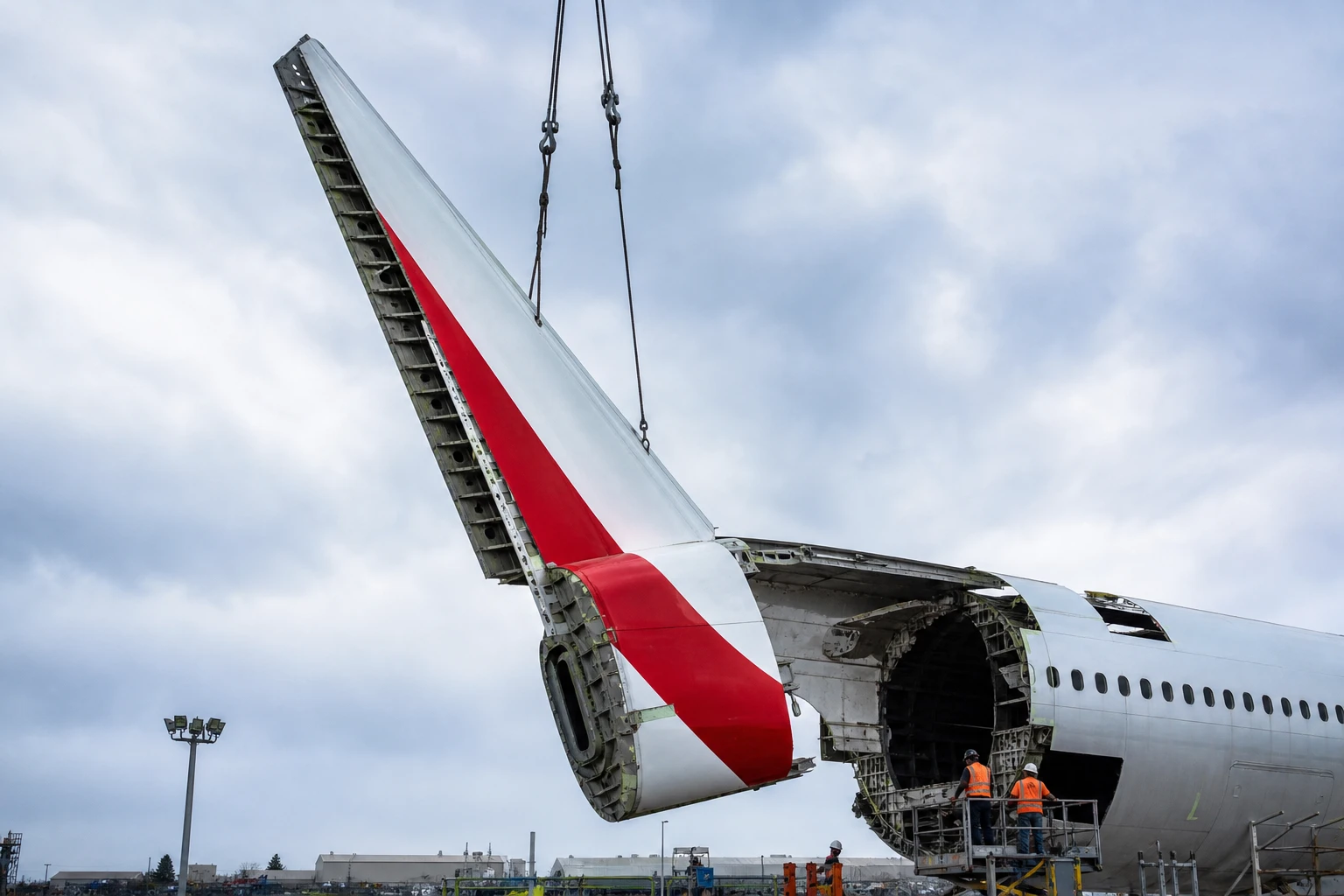
Boeing built a 777-9 for Emirates in 2019, then let it sit unflown at Everett’s Paine Field for six years before quietly cutting it apart last summer. The jet, known internally as WH007, never got engines. It was the seventh 777-9 Boeing ever assembled, and it is now scrap metal.
The teardown fits a pattern Boeing wrote first with the 787 Dreamliner, a cleanup job that took nearly two decades and, by some measures, still is not finished. That history is the part of this story almost nobody has connected yet.
The Seventh Jet Off the Line
The airframe carried the internal designation WH007 and production line number 1611. It rolled out of the Everett, Washington factory in the summer of 2019, one of the earliest 777-9s built, at 251 feet long and configured for roughly 400 seats.
Its folding wingtips wore Emirates colors. The rest of the fuselage stayed bare metal, a visual signal that the jet was still years from finished. Plane spotters photographed it with the wingtips removed just months after rollout, and its engines were never bolted on at all.
Boeing towed the jet from corner to corner of Paine Field for years to make room for newer, unfinished 777-9s crowding the airport’s taxiways. People close to the matter told The Air Current that WH007 was finally disassembled in the late summer of 2025. Boeing has confirmed the teardown, saying it chose not to finish one of its partially assembled 777-9s, though it has not said exactly which week or month the cutting began.
What Does Change Incorporation Actually Mean?
Change incorporation is Boeing’s term for retrofitting an already built aircraft to match the final, certified design. Every new jet program needs some of this work. The 777X has needed far more than most, because flight testing and new Federal Aviation Administration (FAA) requirements keep shifting the target after the airplane already exists.
Boeing is believed to have built up to 40 of these early 777X airframes, and all of them need some level of rework before an airline will touch them. As a rule, the older the jet, the more extensive and expensive that work becomes. WH007 was the second 777X built specifically for Emirates, following WH006, line number 1605, which is still expected to fly as A6-EZD.
Fifteen Billion Dollars, Four Chapters
The 777X was supposed to enter service in 2020. It is now targeted for 2027 with launch customer Lufthansa, and Boeing has disclosed the cost of that slip in pieces, one earnings call at a time.
| Reporting Period | Charge Disclosed | Stated Reason |
|---|---|---|
| Q3 2024 (October 2024) | $2.6 billion | First delivery pushed from 2025 to 2026 |
| Q4 2024 (January 2025) | $0.9 billion | Higher labor costs tied to new IAM contract |
| Q3 2025 (October 2025) | $4.9 billion | First delivery pushed again, from 2026 to 2027 |
| Cumulative since 2013 launch | Roughly $15 billion | Total program charges through Q1 2026 |
That October 2025 charge alone drove a GAAP loss of $7.14 per share for the quarter, according to Boeing’s own third-quarter earnings filing with securities regulators. Wall Street had modeled a charge closer to $2 billion to $4 billion. Boeing came in well above that. The company has still not said what its cumulative change incorporation bill will total once all the stored jets are worked through.
Boeing Already Ran This Experiment on the 787
This is not new territory for Boeing. The 787 Dreamliner went through an almost identical cycle, and the label stuck: the “Terrible Teens,” a batch of roughly a dozen early-production jets built before certification, then found to be too far off spec for any airline to want as delivered.
- Four of the early Dreamliners eventually went to Ethiopian Airlines after Boeing struggled to place them with original customers.
- One went to Korean Air, and another still flies for Air Austral between France and Reunion Island.
- The first three flight test airframes were declared to have no commercial value at all in 2009, due to what Boeing called the inordinate rework they would need, and never carried a paying passenger.
- Two more test jets were written off in July 2016, when Boeing reclassified $1.235 billion in build costs as a development expense.
The ones that did sell went for a fraction of sticker price. A 787-8 listed at $211.8 million in 2014, but one aviation consultant estimated the Terrible Teens carried a real market value closer to $115 million, with airlines still pushing for further discounts on top of that.
The cleanup was never actually finished. This spring, a 787-8 known as N947BA, an early-build jet carrying just 13 hours of total flight time, was broken apart at Roswell Air Center in New Mexico, seventeen years after Boeing first flagged the Terrible Teens as commercially worthless. Another early Dreamliner with a similar history has sat in storage for more than eight years, having made only three flights, its fate still undecided.
Emirates Draws Its Own Red Line
Emirates is the largest 777X customer by a wide margin, holding orders for 270 of the jets, close to half of all passenger 777X orders placed with Boeing. Its president has made the airline’s position on stored early jets impossible to miss.
I’m sick and tired of receiving aircraft that didn’t work, and we kept on having to ground them. We will not take aircraft that do not fly at 99.9% dispatch reliability.
Sir Tim Clark, Emirates’ president, said that in a wide-ranging interview laying out Boeing’s quality problems across the 737 Max, 787 and 777X programs. His stance has not softened since. Emirates has also declined to name a second carrier that has likewise refused to accept early-build 777X jets rather than wait for cleaner ones.
Clark’s own airline has absorbed real costs waiting. He has said Emirates spent roughly €20 million to €30 million scrapping its original 777X business class design once the delay dragged past the point the seats still looked current, and separately put $4.5 billion of its own cash into upgrading its existing 777 and A380 fleet to cover the gap.
The Engine That Was Never Bolted On
WH007’s engines were never installed, which is one reason its teardown is cheaper and cleaner than it might sound. The jet’s would-be powerplant, the GE9X built exclusively for the 777X by GE Aerospace, has problems of its own that have nothing to do with airframe rework.
GE Aerospace flagged a durability issue in the engine’s mid-seal component in January 2026, discovered during a routine shop visit on a flight-test engine. GE chief executive Larry Culp told investors in April that engineers had identified the root cause and were ramping up supplier production of a redesigned part, while Boeing has said the issue has not disrupted the flight-test program itself.
It is not the GE9X’s first rough patch. Back in 2024, Clark said Emirates planned to fly a 777X to Dubai the following summer to stress test the engine at maximum takeoff weight in extreme heat, a benchmark he called deliberately punishing. Every airframe still waiting for engines sits downstream of whatever GE finds next.
Thirty Jets, Several More Years
Boeing chief executive Kelly Ortberg has been direct about the scale of what remains. “We’ve got roughly 30 777s that’ll go through this change incorp process over several years,” he told investors on the company’s first-quarter 2026 earnings call, adding that Boeing must incorporate every change made since each jet was built.
- What we know: Boeing has confirmed WH007 was broken apart and already written off, and that dozens of early 777X jets await some level of rework before delivery.
- What’s unconfirmed: Boeing has not disclosed an exact teardown date for WH007, a total price tag for change incorporation across the fleet, or whether any other stored airframes are next in line.
Boeing’s next earnings report, due July 28, will be the next moment investors get a fresh look at how that bill is growing. Sitting at Everett right now is WH006, the first 777X ever built for Emirates and older than WH007 by one production slot. Boeing has not said what happens to it.