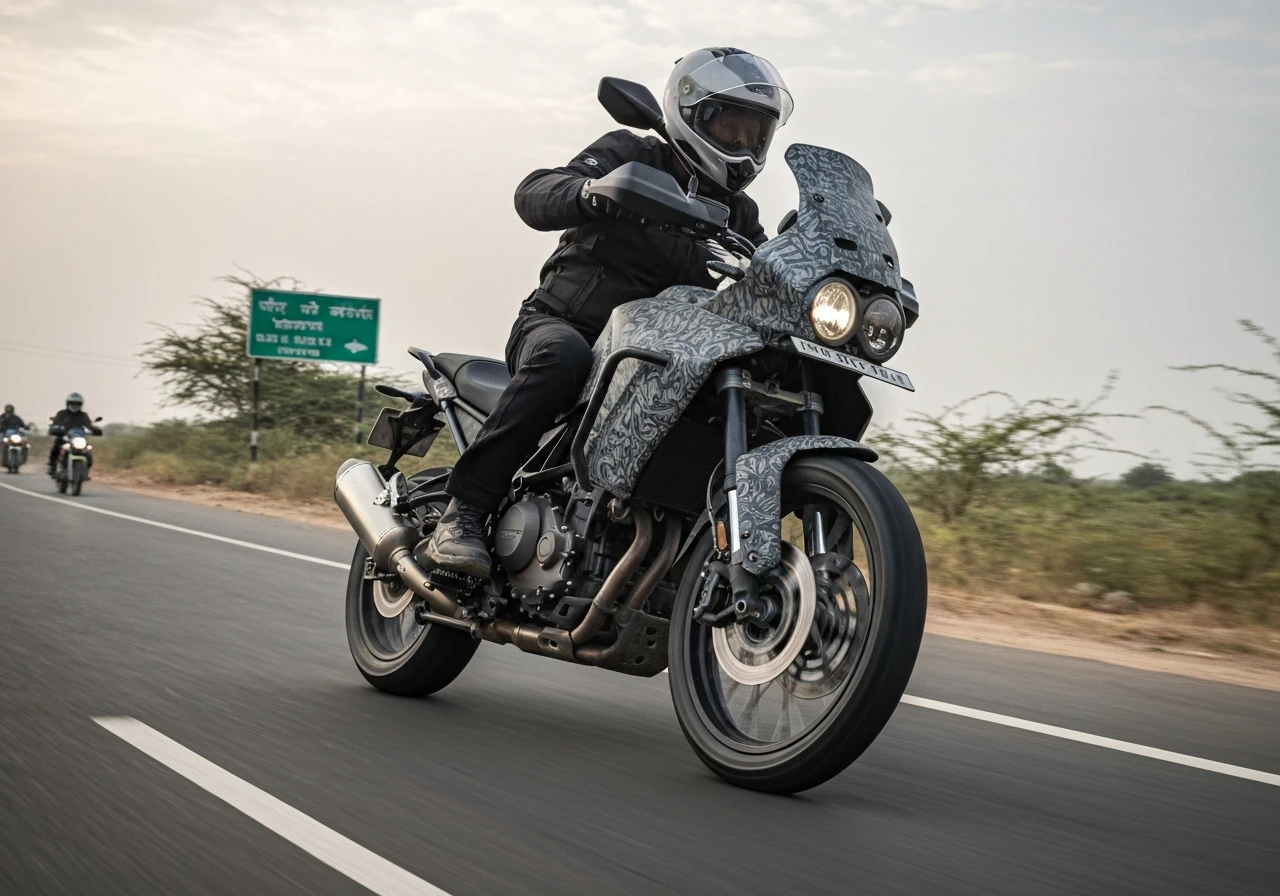
Bajaj has been spotted testing an adventure motorcycle on Indian roads, the clearest sign yet that the company is finally moving into a dual-sport class it has sat out for years. The test mule wears a tall beak-style fender, long-travel suspension and a 19-inch front spoke wheel, and on current evidence it could reach showrooms by late 2026 or early 2027.
The timing says as much as the hardware. Bajaj is the last of India’s big home-grown bike makers to commit to the mid-size adventure-class (ADV) space, a corner of the market that has gone from quiet niche to genuinely crowded in barely three years.
Bajaj’s Dual-Sport Test Mule Breaks Cover
The spy images show a motorcycle built to look the part. There is a tall beak-like front fender, a slim fuel tank, and a long single-piece seat that runs flat toward the tail, the classic upright ADV recipe. At the back, the tail section borrows heavily from the current Pulsar range, including the split LED lighting signature.
An upswept exhaust adds to the rugged stance. More telling is the running gear: offset telescopic forks up front and a link-type monoshock at the rear, both with the kind of long travel that off-road-leaning bikes need.
The wheels look like a 19-inch front and 17-inch rear spoke setup, a combination chosen to balance highway manners with light trail ability. The crankcase visible in the shots points to either a 250cc or a 350cc single-cylinder engine, though the camouflage keeps the details guarded.
The mule was running alongside the Pulsar N250, which fuels the strongest theory about what sits inside it. The bike also looks close to production-ready rather than an early prototype, which is why launch chatter has firmed up rather than stayed vague.
- 19-inch front, 17-inch rear spoke wheels for mixed-surface duty
- 250cc or 350cc single-cylinder engine indicated by the crankcase
- Offset long-travel telescopic forks and a link-type rear monoshock
- Pulsar-style split LED tail lamp and an upswept exhaust
Why Every Indian Brand Suddenly Wants an ADV
Strip away the camouflage and the bigger story is the company joining the party rather than the party itself. India’s adventure segment has swollen to more than 30 models, according to growth analysis of India’s adventure motorcycle segment by Frost & Sullivan, and the firm logs an exponential sales run between 2018 and 2022 with more expansion forecast over the next five years.
That demand has pulled in a wave of fresh metal. Some of it has already landed, some is queued for this year and next, and the buyers chasing go-anywhere bikes now have far more to choose from than a couple of seasons ago. Pricing tailwinds have helped too, with Royal Enfield’s GST-driven price cuts across its 350cc range showing how tax changes have reshaped what mid-size buyers pay.
The near-term entrants tell the story of a segment filling out at every price point:
- TVS Apache RTX 300, launched on October 15, 2025, marking TVS Motor Company’s adventure-touring debut
- Hero XPulse 421, the brand’s planned leap into the mid-capacity class with a 421cc single
- BMW F 450 GS, the German maker’s lightweight entry powered by a 420cc parallel twin
- CFMoto 450 MT, delayed to make it ethanol-blend compliant for India
- Royal Enfield Himalayan 750, shown at EICMA 2025 and tipped for a launch run
Set against that backdrop, a Bajaj dual-sport stops looking like a surprise and starts looking inevitable. The question was never whether the maker of the Pulsar would build one, but when, and at what size.
The KTM Engine Question
Several elements on the test bike hint at a tie to KTM, and that is where things get interesting. Bajaj Auto completed its takeover of the Austrian brand on November 18, 2025, after European Commission approval, leaving it with a 74.9% controlling stake in Pierer Mobility AG, KTM’s parent. The relationship goes back to 2007, but Bajaj is now the majority owner rather than just a long-term partner.
That ownership matters because it opens two very different engine paths for the new ADV. Because the mule ran beside the Pulsar N250, the simplest reading is that it shares that bike’s powerplant, a 249cc single-cylinder, oil-cooled unit making 24.1bhp and 21.5Nm. That would make this an affordable, accessible machine rather than a hardcore tool.
The alternative is a KTM-derived liquid-cooled single, which would push the bike upmarket in both performance and price. The crankcase shape alone is not enough to call it, and Bajaj has said nothing official, so both readings remain live.
Either way, the parent company has been busy showcasing its premium hardware, as seen in KTM’s 2025 adventure range launch in India. A cheaper Bajaj-badged ADV built on shared engineering would let the group cover a price band its Austrian flagship cannot reach.
Where the Bajaj ADV Would Slot Against Rivals
The engine choice decides which shelf this bike lands on. If it runs the Pulsar single, it squares up to Hero’s offering. If it gets the KTM-sourced motor, it climbs into pricier company. Here is how the most likely rivals stack up on ex-showroom terms.
| Model | Engine | Peak power | Price (ex-showroom) |
|---|---|---|---|
| Bajaj ADV (test mule) | 249cc to 350cc single (TBC) | ~24bhp+ (projected) | Not announced |
| Hero Xpulse 210 | 210cc liquid-cooled single | 24.2 bhp | ₹1.62 lakh |
| TVS Apache RTX 300 | 299cc single | 36 PS (≈35.5 bhp) | ₹1.99 lakh |
| KTM 390 Adventure | 399cc liquid-cooled single | 45.3 bhp | from ₹2.81 lakh |
The Hero Xpulse 210 reads as the obvious target if Bajaj keeps things small, with both bikes hovering around the 24bhp mark; you can check the Hero Xpulse 210 specifications for the full picture. Move up to the KTM-derived motor and the natural comparison becomes the TVS Apache RTX 300 and even the KTM 390 Adventure specifications, where pricing climbs past ₹2.81 lakh. KTM also created a 350cc-displacement variant to qualify for the lower Goods and Services Tax (GST) slab, which is how that entry figure sits below the 399cc bike’s full sticker.
The Tube-Tyre Catch and Other Open Questions
For all the promise, the test mule carries a few flags worth flying. The most practical concern is the likely use of tube-type tyres on those spoke wheels. For riders planning long-distance touring, a puncture far from help is a bigger headache with tubes than with tubeless rubber, and serious ADV buyers notice that.
There are larger unknowns too, and they all feed back into the same uncertainty about where this bike will sit.
- The engine itself: Pulsar-sourced 249cc single or a KTM-derived unit, a choice that swings the price by a wide margin.
- The launch window: the mule looks production-ready, yet Bajaj has confirmed no date, so the late-2026-to-early-2027 estimate stays an estimate.
- The positioning: an affordable Xpulse fighter and a KTM-lite tourer are two different products, and only one can be built first.
None of this dents the headline takeaway. A Bajaj adventure bike is coming, the hardware looks credible, and it arrives into a segment that has already proven it can absorb new entrants without running out of buyers.
Frequently Asked Questions
When Will the Bajaj Adventure Bike Launch in India?
There is no official date. Based on how close the test mule looks to production, the bike is expected to launch around late 2026 or early 2027. Bajaj has not confirmed timing, so treat the window as an estimate drawn from the testing stage.
What Engine Will the Bajaj ADV Use?
The crankcase points to a 250cc or 350cc single-cylinder engine. Because it was spotted testing beside the Pulsar N250, the leading theory is the N250’s 249cc oil-cooled unit, though a KTM-derived liquid-cooled single is also possible given Bajaj’s ownership of KTM.
Which Bikes Will the Bajaj ADV Rival?
If it uses the Pulsar engine, it will line up against the Hero Xpulse 210. If it gets the KTM-derived motor, it moves up to challenge the TVS Apache RTX 300 and offer a cheaper alternative to the KTM 390 Adventure.
Does Bajaj Own KTM?
Yes. Bajaj Auto completed its acquisition on November 18, 2025, and holds a 74.9% controlling stake in Pierer Mobility AG, KTM’s parent company. The two firms had partnered since 2007 before the majority buyout.
How Much Could the Bajaj ADV Cost?
Pricing has not been announced. Reports suggest Bajaj wants it to be a more affordable alternative to the KTM 390 Adventure, which starts from about ₹2.81 lakh ex-showroom, so a competitive sub-₹2 lakh figure is plausible if the Pulsar engine is used.
If the production bike keeps the Pulsar’s 249cc single, Bajaj walks straight into a knife fight with the Hero Xpulse 210 on price. If it adopts the KTM-derived motor instead, it becomes the cut-price KTM the group has never sold in India, and the rivals it threatens change overnight.