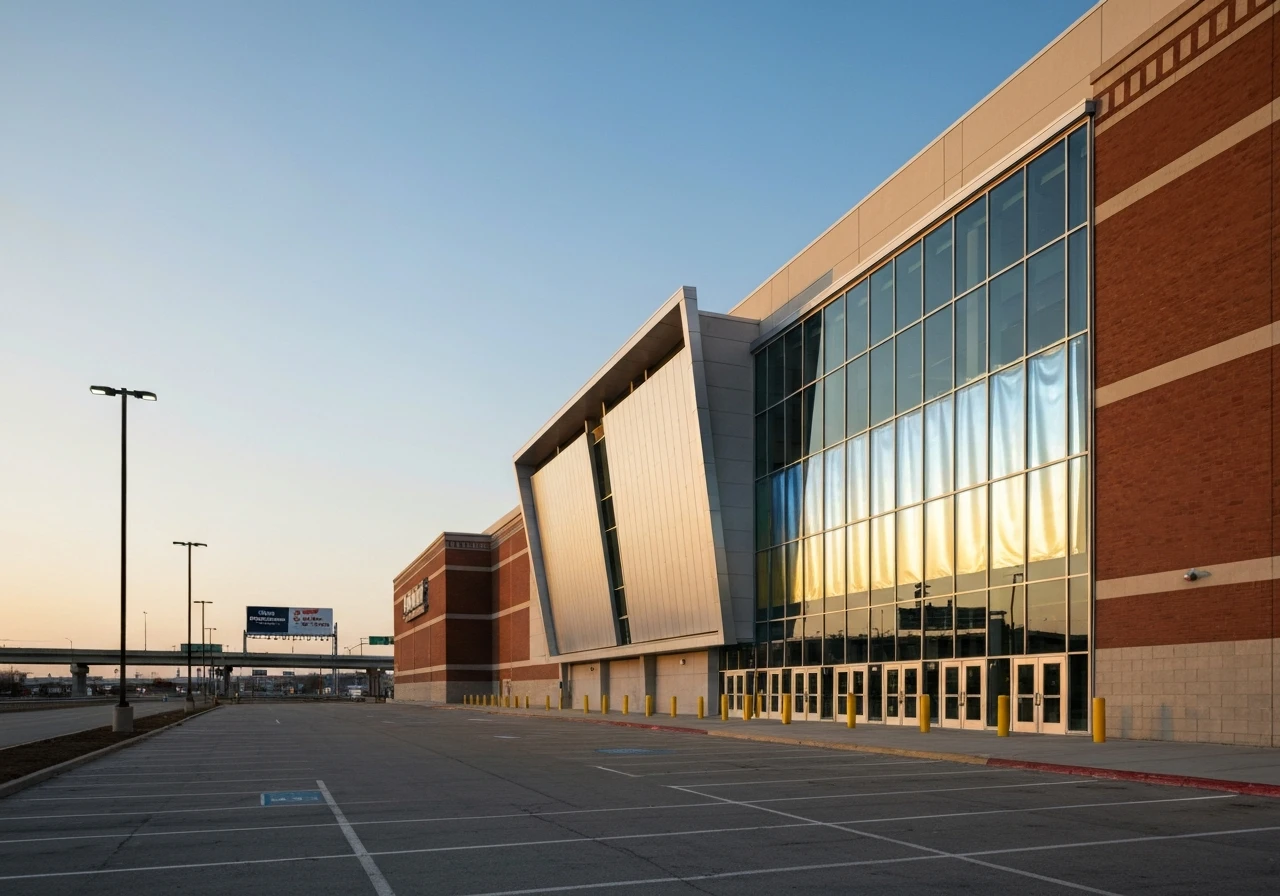
The Arena at Southlake opened in April 2026 on the concrete pad where a Sears once anchored a fading Atlanta-area mall. Clayton County Public Schools bought the dead box in 2021 for $4.4 million, demolished it, and spent roughly $117 million turning the footprint into an 8,000-seat venue designed first and foremost to host high school graduations.
That priority, graduations before anything else, explains why a public school district decided to own an arena at all. It also puts Clayton County near the front of a national shift in what gets built inside the carcasses of dead malls.
From Sears Liquidation to 8,000 Seats
For decades the store held down a corner of Southlake Mall in Morrow, a suburb about 15 miles south of downtown Atlanta. When the retailer liquidated, the school system bought the roughly 15-acre parcel, knocked the building down, and started over.
What replaced it is a 268,000-square-foot venue with seating for 8,000, built by MEJA Construction and designed by Perkins & Will, the Chicago-based practice that trade rankings place as the second-largest architecture firm in the United States by revenue, at about $720 million a year. The doors opened in April with a ribbon-cutting on the 22nd.
The interior was built to change clothes. A wall near the main lobby is wrapped in a fabric woven from stainless steel and threaded with lights that shift to the colors of whichever school is using the building that day. The district runs a dozen high schools, and each one can make the room briefly its own.
There is a rooftop terrace wired to conference rooms, plus concession stands, bars, and studio space for students. Graduations were the design brief. The rest of the program, the planners concede, came after.
Why Graduation Rentals Pushed the District to Build
Renting a graduation venue is a recurring tax on big school systems, and metro Atlanta districts pay it every spring. “Most big public school districts in metro Atlanta spend hundreds of thousands of dollars a year renting graduation facilities,” said Jared Serwer, a principal at Perkins & Will, in comments to CoStar News. Owning the room erases that line from the budget for good.
The arithmetic only works if the building earns its keep the other 360 days, so the district designed for resale value: basketball-ready floors, conference layouts, fine-arts staging, and a venue easy to rent to outside groups. County officials expect it to compete for Georgia High School Association (GHSA, the state’s governing body for school sports) tournaments, and it has already hosted the state wrestling finals. The money for all of it came from more than one pocket.
- About $117 million in total project cost, with the school system committing the largest share.
- Roughly $10 million in county Special Purpose Local Option Sales Tax (SPLOST, a voter-approved penny tax that funds capital projects) money, detailed on the county’s SPLOST arena project page.
- Added contributions from the local chamber of commerce and the area’s Junior Achievement chapter, which is renting office space inside the building.
Statewide school funding has been climbing too, which makes a capital swing of this size easier to defend, and Georgia lawmakers recently approved a state budget with a major boost for school support services. None of that pays an arena’s operating bill, though.
Dead Anchors Are Becoming America’s New Civic Buildings
At its peak, Sears and its sister chain Kmart ran nearly 3,500 stores. By the summer of 2025, the brand was reportedly down to a handful of locations, leaving a few hundred former boxes scattered across the country in the hands of its real estate arm. Those empty anchors are the single largest pool of cheap, big-floor, well-located space in American retail, and the buyers showing up are not other retailers.
From Retail Anchor to Public Anchor
A university medical center in upstate New York gutted a former Sears for an outpatient orthopedics campus. A developer is converting fallen malls into thousands of units of affordable housing. A fitness operator dropped a three-story club with a rooftop pool onto a former Sears Auto Center outside Chicago. The Clayton County arena belongs to the same wave, except the owner is a public school district rather than a private operator.
| Former retail site | Location | New use | Owner type |
|---|---|---|---|
| Southlake Mall anchor | Morrow, GA | 8,000-seat graduation and events arena | Public school district |
| Former department store | Rochester, NY | Outpatient orthopedics center | University medical center |
| Sears Auto Center | Oak Brook, IL | Three-story fitness club | Private operator |
| Downtown anchor box | Miami, FL | 1,050-unit mixed-use housing | Private developer |
Why Institutions Are the New Buyers
The logic is the same one Clayton County followed. A graded slab, structural steel, acres of parking, and a freeway exit already exist, so an institution skips years of land assembly and infrastructure work. Research groups tracking the sector, including CBRE’s work on mall evolution and the Urban Land Institute’s research on repositioning U.S. retail, describe a steady move from pure shopping toward mixed civic and residential use.
What sets the Morrow project apart is the buyer. Hospitals and housing developers chasing dead anchors answer to balance sheets. A school district answers to voters, and it is spending public capital on a building whose return depends on an events calendar it has never had to fill before.
Inside Clayton County’s Architecture Habit
The arena is not the district’s first swing at ambitious design. Clayton County Public Schools serves about 51,000 students across 67 schools and 142 square miles, with a student body drawn from more than two dozen countries and a large share of low-income households, and in recent years its building program has read more like a design portfolio than a procurement file.
Schools Designed to Make a Point
The $90 million Morrow High School, opened in 2022, runs 350,000 square feet as a long, curving structure, and the shape was deliberate. The district’s former superintendent, Morcease Beasley, wanted students walking longer distances between classes to push back against obesity in a community with many low-income families. The next project goes further.
- $246 million North Clayton High School, under construction in College Park, laid out in the shape of an “X” with classroom wings branching from a central entrance.
- A campus around it that includes tennis courts, walking trails, an indoor athletics training facility, and a 3-hole golf course, a near-unheard-of amenity at a Georgia public school.
- Morrow High’s gray-brick exterior, angular walls, and concrete columns that lift parts of the building off the ground to create covered gathering space.
A County With an Award-Winning Streak
The appetite predates this superintendent. Back in 1991, the Atlanta firm Mack Scogin Merrill Elam won the American Institute of Architects (AIA, the profession’s main U.S. body) National Award for the county’s Jonesboro library, whose metal skin mimics the black-and-white covers of vintage school notebooks. “He told us that he was tired of building red brick boxes,” said Steven Brown, an associate principal at Perkins & Will, recalling Beasley’s brief, “and that he wanted something different.” Other Georgia districts are adding non-classroom facilities of their own, from health clinics to athletics centers, a pattern visible in Bulloch County’s first school-based health center.
The Junior Achievement and Delta Tie-In
The arena carries an education program inside its walls, not just a scoreboard. Its anchor tenant is the Junior Achievement (JA, a nonprofit that teaches work and money skills to young people) Delta Discovery Center of Clayton County, an immersive learning hub built with JA of Georgia, Delta Air Lines, and the Delta Air Lines Foundation.
That partnership matters to the financial story. A corporate-backed learning center gives the building a daytime purpose tied to the district’s core mission, which softens the politics of spending nine figures on a venue. It also hands the arena a paying tenant on day one, alongside student hubs, studios, and a career academy folded into the floor plan.
For a county that sits in Delta’s home metro and lives in the shadow of the world’s busiest airport, the airline tie-in is more than a logo on a banner. It connects a low-income district’s students to one of the region’s largest employers inside a room they will also walk across to collect their diplomas.
The Revenue Bet on a South-Metro Events Market
Geography is the wager. The arena sits near two major interstates and a short drive from Hartsfield-Jackson Atlanta International Airport, in a part of the region that has long lacked a mid-size venue while the conference and tournament business clustered to the north.
Most of these kinds of facilities are in the northern area of Atlanta, so having something south of the city is attractive to the rest of the state.
That was Serwer, the Perkins & Will principal, making the case that the south-metro location is the building’s competitive edge rather than its handicap. The early signs are real: the state wrestling finals have already filled the seats, and officials believe the venue can pull GHSA basketball tournaments away from older north-side gyms.
The unproven part is everything between graduation seasons. A school district is now in the business of booking concerts, conventions, and fine-arts shows against private operators who have done it for decades, and it is doing so with taxpayer money in a county where many families count every dollar.
If the bookings hold, a county better known for its airport flight paths than its event calendar will own a south-metro venue that covers the cost of its own graduations. If they do not, Clayton County will still hold the most expensive graduation hall in Georgia, and the bill for the other 360 days will land on the same residents who approved it.