Apple raised the on-device AI bar to 12GB at WWDC 2026, but the threshold only gates two Siri features, and the rest of Apple Intelligence runs on hardware that already supported it. A third tier, the cloud model that handles agentic tool use and complex reasoning, now sits on Nvidia GPUs inside Google Cloud, the first time Apple has extended its Private Cloud Compute to a third party. DIGITIMES analyst Luke Lin said on a podcast that the post-keynote 12GB panic was just Apple’s messaging, since most on-device AI features only need 8GB of memory.
What Apple Set in Stone at WWDC 2026
Apple opened WWDC 2026 on June 8 at Apple Park in Cupertino with a rebuilt assistant, Siri AI, that the company called “an entirely new version of Siri, powered by Apple Intelligence.” The headlining feature list runs from onscreen awareness to web answers to a dedicated Siri app with persistent conversation history, and the iOS 27 device list for Apple Intelligence and Siri AI extends across iPhone 16 models or later, iPhone 15 Pro, iPhone 15 Pro Max, iPad mini with the A17 Pro, MacBook Neo with the A18 Pro, iPad models with M1 or later, Mac with M1 or later, Apple Vision Pro, and Apple Watch Series 9 or later paired with an Apple Intelligence-enabled iPhone, per Apple’s Siri AI announcement and device list.
Buried in the same release is a tighter line. The 12GB requirement applies to a smaller group: “Apple’s most powerful on-device model and the features it enables, like expressive voices and more advanced dictation, are available on iPhone Air, iPhone 17 Pro, iPhone 17 Pro Max, iPad (M4) or later with at least 12GB of unified memory, and Mac (M3) or later with at least 12GB of unified memory.” The base iPhone 17, which ships with 8GB of memory, sits just below that line and is excluded from the most capable on-device model. Coverage of the keynote on this site walked through the broader What the WWDC 2026 keynote actually unveiled and the device list that followed.
MacRumors, reviewing the same release language, called out the shift as “the first time Apple has raised that bar, given that Apple Intelligence has required 8GB since its introduction two years ago.” The bar moved by a single feature tier, not by the whole stack, and that distinction is the source of the confusion that spread through coverage in the days after the keynote.
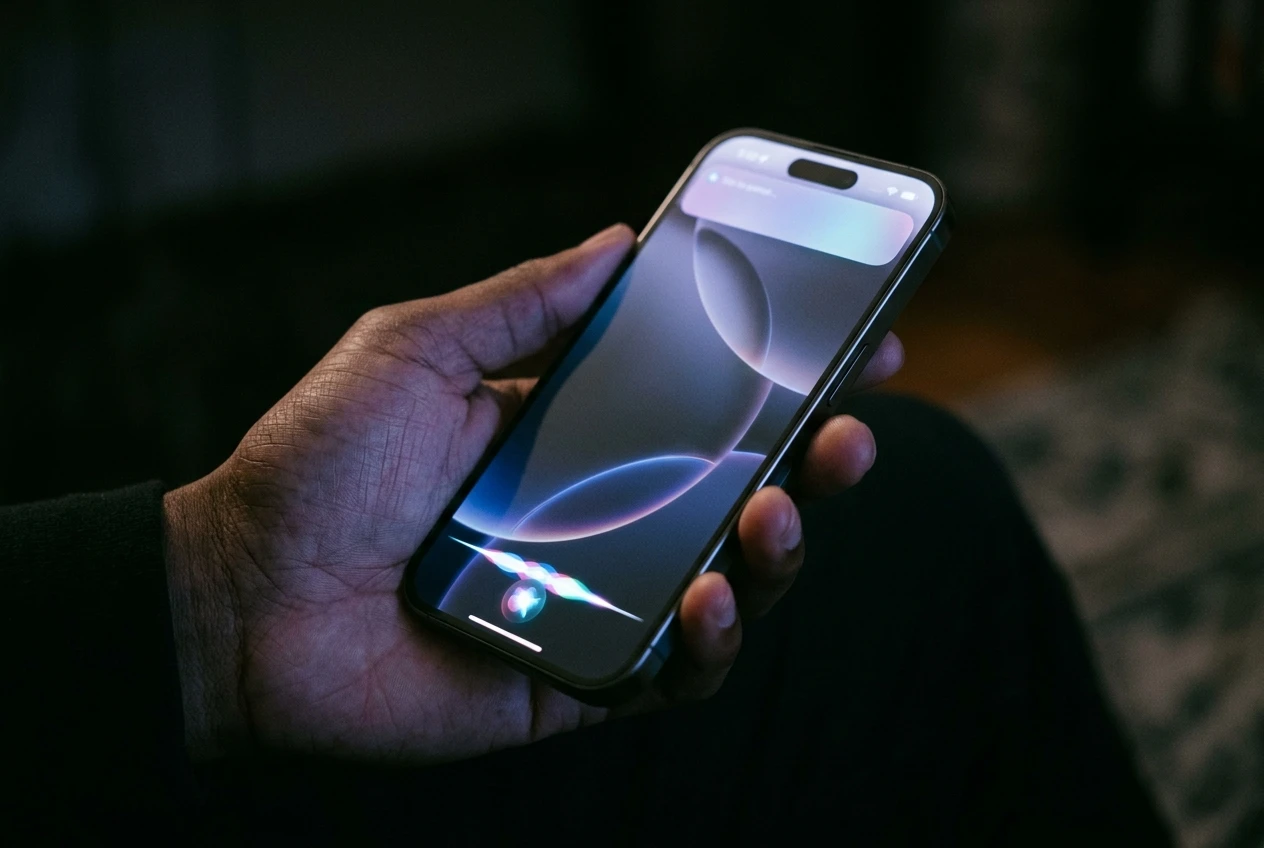
The Two Features Behind the 12GB Bar
The on-device model that needs 12GB has a name. Apple’s Machine Learning Research blog calls it AFM 3 Core Advanced and describes it as “our most powerful on-device model. It’s natively multimodal, enabling helpful features like expressive voices and higher-accuracy dictation.” Under the hood, it is a 20-billion-parameter model that uses a sparse architecture, activating just 1 to 4 billion parameters at a time depending on the prompt, and the model is “unlocked by and optimized for our most capable Apple silicon systems.” Apple’s framing, quoted at length by 9to5Mac, is the clearest statement of what the threshold actually buys a user.
AFM 3 Core Advanced, our most powerful on-device model. It’s natively multimodal, enabling helpful features like expressive voices and higher-accuracy dictation.
What that gets an iPhone 17 Pro or iPhone Air owner, in practice, is two specific things, per MacRumors’ breakdown of the WWDC 2026 announcement. Expressive voices let users adjust the pace and tone of Siri’s speech, and advanced dictation turns speech into polished text on the fly, handling capitalization, punctuation, and formatting automatically with a meaningful accuracy gain over Apple’s existing production dictation system. Both require 12GB. Nothing else in the new Siri AI rollout does.
What 8GB Devices Still Get With Siri AI
The 8GB tier is not a downgrade path. It is the bulk of the new assistant. MacRumors confirmed that “most iOS 27 AI features run on the same hardware supported today, including iPhone 15 Pro,” and the 8GB-eligible device list still includes iPhone 15 Pro, iPhone 15 Pro Max, the iPhone 16 series, and the iPhone 17. The standard memory requirement for Apple Intelligence has been 8GB since its introduction, and that floor did not move at WWDC 2026.
The features that still run on 8GB devices are the parts of the rollout that Apple spent the bulk of the keynote on, including:
- Personal context across Mail, Messages, Photos, Notes, Calendar, and Contacts
- Onscreen awareness
- Web answers
- The dedicated Siri app with chatbot-style conversation history
- Visual Intelligence
- Writing Tools
That is the chatbot-style assistant, the cross-app context that Apple promised at WWDC 2024 and failed to ship, the image generation tools, and the bulk of the writing and summarization features. The base iPhone 17 owner “will still get the new chatbot-style assistant with iOS 27, they’ll just get the older voices and a less precise dictation engine,” per MacRumors.
Whether that difference matters depends on how the device is used. For someone who dictates messages and notes all day, the better transcription is a noticeable step up. For everyone else, the gap is something they can live with, and they keep the rest of the Siri AI stack that was the headline of the keynote.
The Cloud Tier Now Runs on Nvidia in Google Cloud
The third layer of the split is server-side, and it is the one Apple spent less of the keynote on. Apple’s third-generation foundation model lineup includes five models: AFM 3 Core and AFM 3 Code Advanced, which run on-device, and AFM Cloud, ADM 3 Cloud (Image), and AFM 3 Cloud Pro, which run on Apple servers or third-party infrastructure, per 9to5Mac. AFM 3 Cloud Pro, the most capable server-based model, handles the heaviest use cases, including agentic tool use and complex reasoning. And it runs on Nvidia GPUs in Google Cloud, made possible because Apple extended Private Cloud Compute to third-party infrastructure for the first time. The earlier coverage on this site of The Gemini deal that fixed Apple’s Siri tracked how Apple got there.
We work with both Google and Nvidia to extend our private cloud compute infrastructure to Nvidia GPUs in Google’s cloud, while maintaining Apple’s unmatched privacy guarantees.
Apple AI executive Amar Subramanya said at a tech talk at Apple headquarters on June 8, per CNBC, that AFM Cloud Pro is comparable to Google’s Gemini frontier models. On the model lineage, Subramanya was explicit: “These four models that we just talked about – AFM Core, Core Advanced Cloud, and Cloud Image – all of these are custom built for Apple Silicon, trained using proprietary data with reinforcement learning and refined using outputs from Gemini frontier models.” VP of software Sebastian Marineau-Mes, in the same talk, said the path opened when “recent Nvidia improvements, such as a technology called ‘Nvidia confidential compute,’ allowed Apple and Google to build a system that met its standards.” The privacy architecture stays Apple’s; the silicon and the data center are Google and Nvidia’s.
Why a 20-Billion-Parameter Model Needs the Extra Memory
Apple’s previous on-device work set the bar at 3 billion parameters. AFM 3 Core, the baseline model, is “the next generation of our 3-billion-parameter dense model that delivers a step up in quality.” AFM 3 Core Advanced, the 12GB-gated model, jumps that to 20 billion parameters, with a sparse architecture that activates up to 4 billion at a time. The math behind the cut, in other words, is the difference between a 3-billion-parameter dense model and a 20-billion-parameter sparse model that still activates up to 4 billion parameters per request.
That gap matters because most on-device models aimed at the general public stay in the low-single-digit billions of parameters, and Apple shipped 3B as the previous ceiling. The 20B Core Advanced model uses selective activation, an approach that 9to5Mac noted relies on a technique Apple detailed in a research paper titled “Instruction-Following Pruning for Large Language Models” released a year ago. The result is a model that fits a single iPhone’s memory but only the most capable Apple silicon, and only when the system has 4GB of headroom beyond the previous 8GB floor.
| Model | Where it runs | Parameter count | What it does | Memory requirement |
|---|---|---|---|---|
| AFM 3 Core | On-device | ~3 billion (dense) | Baseline Siri AI features (personal context, web answers, onscreen awareness, Writing Tools, Visual Intelligence) | 8GB unified memory (existing Apple Intelligence minimum) |
| AFM 3 Core Advanced | On-device | 20 billion total, 1-4 billion active (sparse) | Expressive Siri voices; advanced dictation | 12GB unified memory (iPhone Air, iPhone 17 Pro/Pro Max, iPad M4+, Mac M3+, Vision Pro M5) |
| AFM 3 Cloud Pro | Cloud (Nvidia GPUs in Google Cloud) | Comparable to Google’s Gemini frontier models, per Apple | Agentic tool use; complex reasoning | N/A (server-side) |
The Devices Caught in the Cutoff
Across the iPhone 17 family, the line lands cleanly. The iPhone 17 ships with 8GB of RAM and is excluded from AFM 3 Core Advanced. The iPhone Air, iPhone 17 Pro, and iPhone 17 Pro Max ship with 12GB and qualify, with the RAM split confirmed in Xcode 26 and reported by wccftech. On the iPad and Mac side, the threshold is the chip plus the memory: iPad with M4 or later with at least 12GB of unified memory, and Mac with M3 or later with at least 12GB of unified memory, with Apple Vision Pro (M5) also on the list.
For everyone who owns a current iPhone 15 Pro, iPhone 15 Pro Max, iPhone 16, iPhone 16 Pro, or iPhone 16 Pro Max, nothing changes from the device side. They get Apple Intelligence, they get the new Siri AI, and the only thing they do not get is the two specific features tied to AFM 3 Core Advanced. The base iPhone 17, despite being the newest standard flagship, is the one device in the lineup that the new on-device model does not reach.
DIGITIMES analyst Luke Lin, the only named commentator on the record about the 12GB framing, said on a podcast that “after Apple’s WWDC 2026 keynote, online rumors claimed that only premium devices with 12GB of memory could run on-device AI, but [the] 12GB spec” is the floor for the Apple-defined advanced model, not for on-device AI as a whole, per the The analyst’s read on Apple’s memory messaging piece from Rod Chang in Taipei. The threshold is real, and the bar is narrower than the post-keynote panic suggested.
Frequently Asked Questions
Do I need 12GB of memory for Apple Intelligence?
No. Apple Intelligence and the new Siri AI work on iPhone 15 Pro, iPhone 15 Pro Max, the iPhone 16 series, and the iPhone 17, all of which Apple lists as supporting Apple Intelligence on 8GB of memory. The 12GB requirement applies only to AFM 3 Core Advanced, the most capable on-device model, and only gates two specific Siri features.
Which iPhone 17 models are excluded from the most advanced on-device AI?
The base iPhone 17 is excluded, since it ships with 8GB of memory, below the 12GB threshold. The iPhone Air, iPhone 17 Pro, and iPhone 17 Pro Max all ship with 12GB and qualify for the advanced on-device model and its two gated features.
What does Apple’s 12GB memory requirement actually unlock?
Two specific Siri features: expressive voices that let users adjust the pace and tone of Siri’s speech, and a major accuracy gain for systemwide dictation that handles capitalization, punctuation, and formatting automatically. Both ride on AFM 3 Core Advanced.
Does Apple’s new Siri AI run on Google servers?
Apple’s on-device models do not. AFM 3 Core and AFM 3 Core Advanced run on the device. AFM 3 Cloud Pro, the most capable server-based model, runs on Nvidia GPUs hosted in Google Cloud, the first time Apple has extended Private Cloud Compute to third-party infrastructure, with Apple maintaining its own privacy architecture on top.
What is AFM 3 Core Advanced?
AFM 3 Core Advanced is Apple’s most capable on-device foundation model, a 20-billion-parameter sparse model that activates 1 to 4 billion parameters per request, optimized for the most capable Apple silicon systems, and the model that powers the expressive voices and advanced dictation features in iOS 27.