Adani Group chairman Gautam Adani used the group’s 2026 annual general meeting on Wednesday to back three of India’s most capacity-hungry bets: nuclear power, artificial intelligence infrastructure, and a record capital expenditure programme that, by the chairman’s own figure, now makes up over 30 per cent of India’s private-sector capex.
The AGM, held a day after Adani’s birthday, mixed operational milestones with forward targets. Adani described FY26 as a defining year for the conglomerate, opened with the line that the group had “built when it was hardest to build,” and rolled out a roadmap that touches Adani Power, Adani Ports, the airports business, a new nuclear venture, and a multi-billion-dollar data centre pipeline with Google.
Nuclear at the Centre of the New Bet
The single new commitment of the day was a formal entry into nuclear energy through a new vehicle, Adani Atomic Energy. The group has identified land and is targeting 10 GW of nuclear power capacity by 2035. Adani framed the move as a response to two pressures on India’s grid: rising industrial demand and the round-the-clock power needs of new data centres.
10 GW of nuclear capacity, on the timeline Adani has set, would be one of the largest private-sector nuclear build-outs outside the United States and China, and it slots into a federal push to expand India’s nuclear baseload as the country chases its clean-energy targets.
On stage, the chair made the case directly. India’s grid, Adani argued, must absorb the load from AI data centres and industrial electrification at the same time, and the answer is more nuclear, expanded transmission lines, and capacity owned by groups with the balance sheet to build.
The AI Buildout and the Google Anchor
Adani’s data centre business is targeting a 3 GW platform by 2030. The anchor is a binding agreement with Google for a gigawatt-scale data centre project in Visakhapatnam, signed in October 2025 as part of a five-year, USD 15 billion investment by Google into an AI hub in the city. The deal is detailed in the Adani and Google partnership press release.
The Google hub is built around three campuses, supported by subsea cable networks and a co-investment in new transmission lines and clean energy generation in Andhra Pradesh. AdaniConneX, the group’s 50:50 data centre joint venture with EdgeConneX, is the local partner.
The chairman used the AGM to read the AI and infrastructure themes as a single sentence.
Infrastructure gives a nation muscle. Intelligence gives a nation mastery.
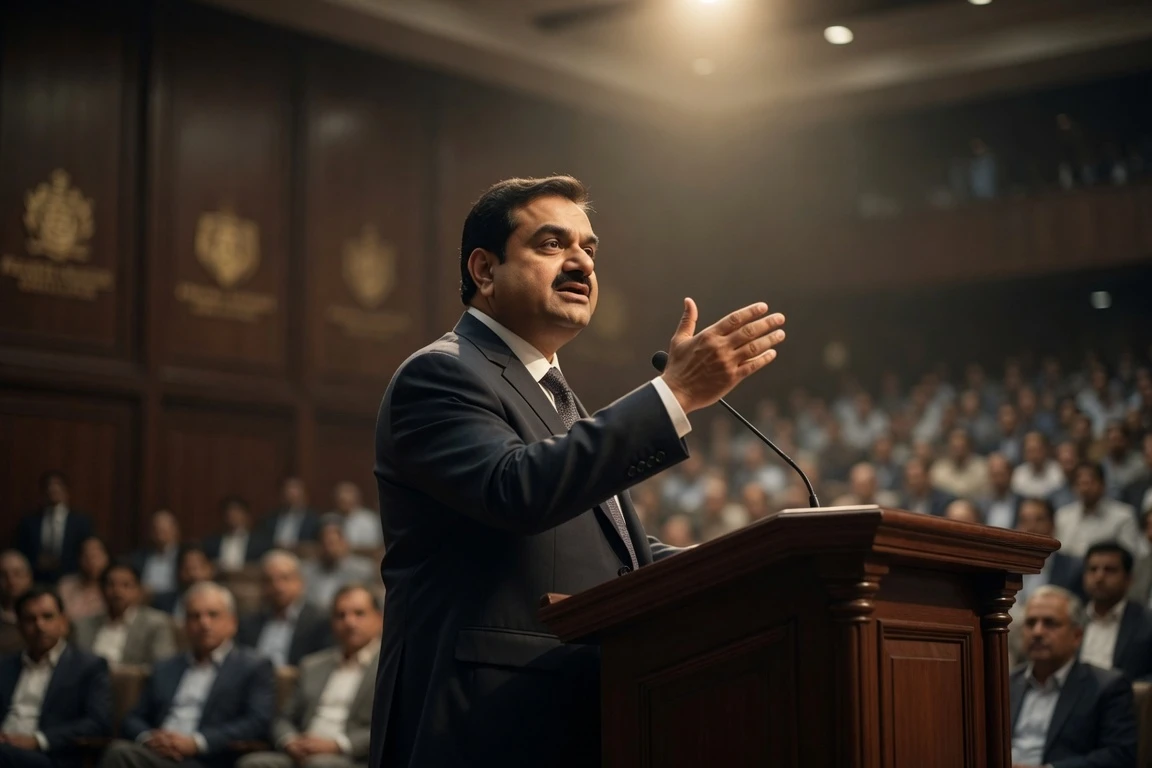
Adani, Chairman of the Adani Group, told shareholders at the group’s 2026 AGM in Mumbai on Wednesday.
For the group, the data centre pipeline is also a way to monetise the same power, transmission, and renewables build it is already pursuing elsewhere. Each new AI campus is a new baseload customer.
Where the Record Capex Is Going
Adani told shareholders the group invested more than Rs 1.5 lakh crore in infrastructure during FY26, an amount he said represented over 30 per cent of India’s total new private-sector capital expenditure during the year.
That money is being deployed across at least five named lines:
- 10 GW of nuclear capacity by 2035, through Adani Atomic Energy.
- 3 GW of data centre capacity by 2030, anchored by the Google deal in Visakhapatnam.
- 45 GW of generation capacity from Adani Power over the next five years, under a programme the company called India’s largest private-sector power expansion, with investments of over Rs 2 lakh crore.
- One billion tonnes of cargo handled annually by Adani Ports by 2030, up from more than 500 million tonnes in FY26. The group’s flagship Vizhinjam port crossed one million TEUs in its first year, which the chairman called one of the fastest starts in the country.
- 5,000 MW of hydropower with Bhutan’s Druk Green Power Corporation, a partnership Adani said was moving forward.
Aviation is a sixth leg. The chairman highlighted the launch of Navi Mumbai International Airport, built in just over four years and designed to handle 90 million passengers annually, and a new integrated terminal at Guwahati Airport.
Defence and Aerospace Step Out of the Wings
Defence and aerospace, a smaller line on the balance sheet, took a long share of the speech. Adani said partnerships with Italy’s Leonardo and Brazil’s Embraer are helping build a domestic manufacturing base for helicopters and regional aircraft. He added that the group’s drones, anti-drone systems, missiles, and ammunition supported Indian armed forces during Operation Sindoor.
The defence push is one part of a strategy to use Adani’s manufacturing footprint for non-civilian work, alongside Adani Power’s capacity and the airports and ports businesses, which the Indian military uses for logistics.
FY26 Closed as a Capex Year
The financial backdrop to the roadmap is a year of growth on the top line, steady margins, and higher cash outflow. Consolidated revenue rose 7.4 per cent to Rs 2.92 lakh crore, with EBITDA at Rs 94,834 crore and profit after tax up nearly 14 per cent to Rs 46,376 crore.
- Consolidated revenue: Rs 2.92 lakh crore, up 7.4 per cent year-on-year.
- EBITDA: Rs 94,834 crore.
- Profit after tax: Rs 46,376 crore, up nearly 14 per cent.
- Infrastructure capex in FY26: more than Rs 1.5 lakh crore, or over 30 per cent of India’s total new private-sector capital expenditure.
The chairman framed the year’s results as a credit to shareholders. “We built when it was hardest to build,” he said, calling FY26 a defining year for the group.
The Credibility Vote at the Heart of the Bet
A second thread ran through the address: defence of the group’s credibility. Adani referred to the Rs 25,000 crore rights issue the group completed earlier in 2026 and described it as “a referendum on our credibility.” He thanked shareholders for backing the company and used the same platform to thank employees, partners, and lenders.
The framing recasts the capital raise as a shareholder endorsement. Adani called the capex roadmap a record for the group, and the rights issue it sits alongside is the funding the chairman thanked shareholders for.
Beyond the balance sheet, the chairman said the group would strengthen worker welfare, simplify organisational structures, and expand healthcare and education initiatives through the Adani Foundation. As the foundation enters its 30th year, the health push includes Adani Health City campuses in Ahmedabad and Mumbai, the same two-city footprint the group announced with Mayo Clinic in 2025 (see the Adani and Mayo Clinic partnership announcement). Skill-development programmes in rural India will continue, the chairman said.
Frequently Asked Questions
What did Adani announce at the 2026 AGM?
The chairman announced a formal entry into nuclear energy through Adani Atomic Energy, with a target of 10 GW by 2035, a binding data centre agreement with Google for a gigawatt-scale project in Visakhapatnam, a Rs 2 lakh crore, 45 GW expansion at Adani Power over five years, and a 3 GW data centre platform by 2030.
Why is Adani entering nuclear energy now?
The chairman said rising industrial demand and the round-the-clock power needs of new data centres made nuclear a baseload priority, framing the move as a way to meet AI-driven load growth.
What is the Adani-Google data centre deal?
It is a binding agreement, first announced in October 2025, to build a gigawatt-scale AI data centre campus in Visakhapatnam as part of Google’s USD 15 billion, five-year AI hub investment in India. AdaniConneX, Adani Enterprises’ 50:50 joint venture with EdgeConneX, is the local partner.
How big is Adani’s FY26 investment plan?
The group reported an infrastructure capex of more than Rs 1.5 lakh crore in FY26, an amount the chairman said represented over 30 per cent of India’s total new private-sector capital expenditure for the year.
What is the credibility vote Adani mentioned?
At the AGM, the chairman cast the Rs 25,000 crore rights issue the group completed earlier in 2026 as “a referendum on our credibility” and used the same platform to thank shareholders, employees, partners, and lenders.