Motorola has begun the stable Android 17 rollout on its Signature smartphones in India, becoming the first non-Google phone maker to push the final build. The 5.75 GB package lands first on the Signature before a phased expansion to more than 50 other eligible models.
T.M. Narasimhan, Managing Director of Motorola India, said the company remains focused on fast, stable software that improves personalisation, security, AI features and everyday use. The move arrives months after Google’s own Pixel launch and ahead of major rivals.
Speed alone does not define the story. The same release also tests a seven-year software promise, a redesigned HelloUI layer, and a long queue that still stretches into 2027 for many budget phones. India is the proving ground. Other regions follow only if the first batches stay clean.
Signature Gets Android 17 First in India
GSMArena reported the Signature update reaching Indian units around mid-August with build A171WVH.21-16-1-3-4. Users checking Settings then System then System Update may still wait days or weeks as waves proceed by region and carrier.
The phone launched in January as Motorola’s high-end statement piece. It carries a seven-year OS and security promise that matches only a handful of rivals. That commitment now faces its first real test with Android 17.
- Download size: about 5.75 GB on Signature
- First markets: India confirmed for stable Signature builds
- Next priority: Razr 70 series and Edge 70 line
- Check path: Settings → System → System updates
Early reports also noted the Edge 2025 receiving stable code in the US around the same window. Signature owners in other regions should see the wave expand if the India batch stays clean.
A first-wave device carries more weight than a later one. Bugs found on Signature can be fixed before Razr and Edge units open their gates. That is why the India batch matters beyond the owners who install it today.
The 5.75 GB package is large by phone standards. Users on metered connections will want Wi-Fi before they tap download. Once the file lands, the install still follows the usual reboot and optimize cycle.
HelloUI Centers Live Updates Like a Dynamic Island
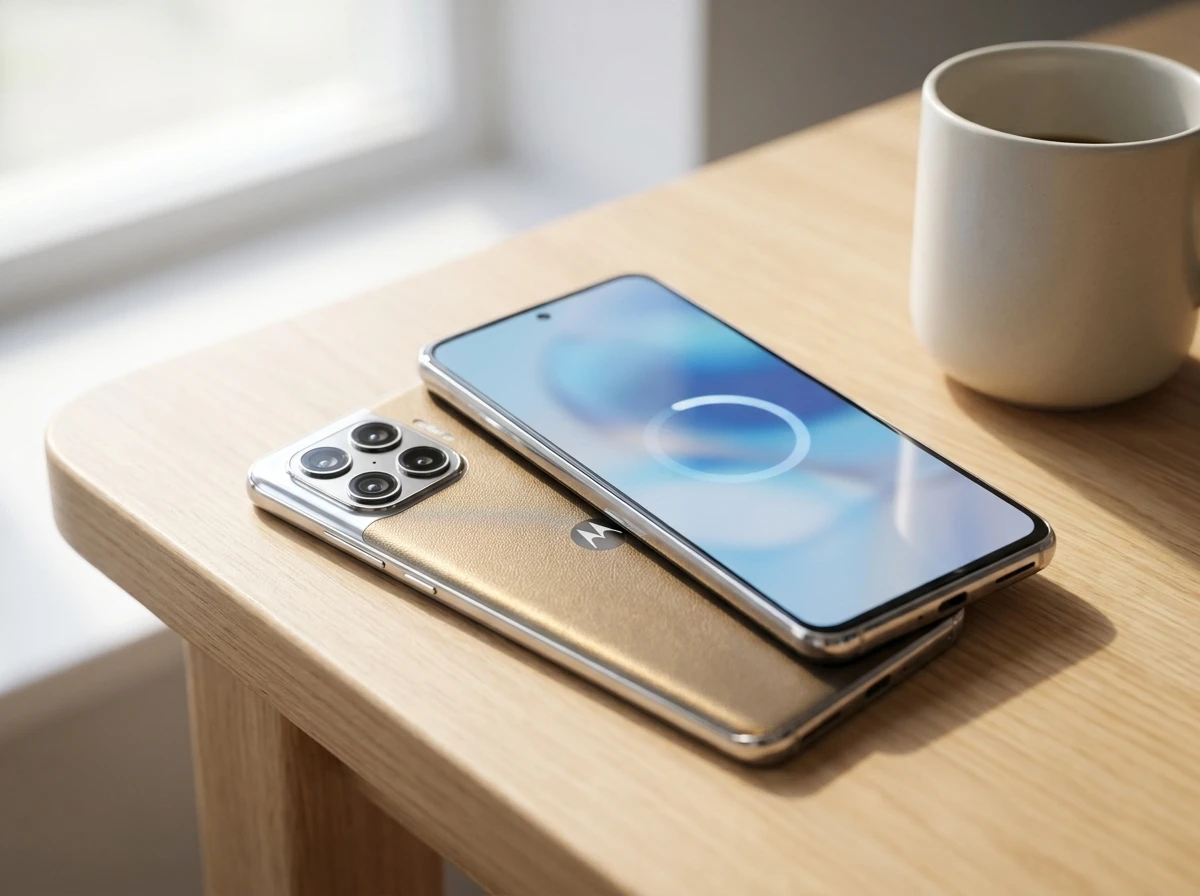
Motorola ships Android 17 under its HelloUI skin. The most visible shift moves Live Updates into a center pill around the front camera cutout, echoing Apple’s Dynamic Island while expanding support across everyday apps.
Settings now lean closer to Pixel layouts with larger buttons, refreshed icons for Wi-Fi, battery and signal, plus a new Classic Control Center. The app drawer gains background blur, a create-folder button, tinted icons and a denser 3×3 grid. Lock-screen clocks, fonts and styles multiply. Three-finger swipe down captures screenshots; swipe up opens split screen.
Additional HelloUI pieces include Landscape Stereo audio, expanded HDR brightness controls, a Battery Health monitor and the Qira AI assistant. Qira needs a dedicated NPU, so full capability stays on mid-range and flagship silicon while budget Moto G units receive a lighter set.
These sit on top of core Android 17 platform changes and new APIs that cover Live Update colour semantics, assistant volume streams and metric-style templates.
The skin does not hide the platform. It routes new Android 17 surfaces through familiar Motorola controls so owners meet the features without relearning every menu. Live Updates in the camera pill is the loudest change. The quieter ones, such as battery health and HDR brightness, matter more over months of daily use.
- Live Updates pill around the front camera cutout
- Pixel-style settings with larger buttons and refreshed status icons
- Classic Control Center and a denser 3×3 app drawer grid
- Three-finger screenshot and swipe-up split screen gestures
- Qira AI on NPU-equipped mid-range and flagship chips
Budget phones still get HelloUI, just not every AI path. That split keeps the interface consistent across the lineup while matching heavy features to the silicon that can run them.
More Than 50 Motorola Phones Are Confirmed
Lenovo’s Spanish blog published the official list of more than 50 Motorola phones eligible for the upgrade. Premium foldables and recent Edge models sit at the front of the queue.
| Series | Key Models | Notes |
|---|---|---|
| Signature | Motorola Signature | Stable first in India |
| Razr | Razr 70 Ultra/Plus/standard, Razr Ultra/+ /2026, Razr Fold 2025/2026, Razr 60 series, Razr 50 Ultra, Razr+ 2024 | Priority after Signature |
| Edge | Edge 2026, Edge 70 Pro+/Pro/Max/Neo/Plus/Fusion+/Fusion/70, Edge 2025, Edge 60 Stylus/Pro/Fusion/60, Edge 50 Ultra | Edge 2025 already live in places |
| Moto G | G Stylus/Power/Play/2026 and 2025 variants, G Max, G87, G86/Power, G77/Power, G67, G57/Power, G47, G37/Power | Later waves |
Some devices with five-year promises, including certain Neo models, do not yet appear. Motorola has not publicly closed those gaps. The confirmed roster still covers nearly every recent Razr, Edge and G handset.
Breadth is the point of the list. Foldables, slim flagships, stylus models and entry Moto G phones all appear in one roster. Owners can match a model name to a priority band without guessing from forum posts.
Gaps still matter. A five-year promise without a published slot leaves buyers reading support pages instead of the update screen. Motorola can still add names. Until it does, the Spanish blog list is the clearest public map.
Motorola Turned Its Update Record Around
Motorola once trailed badly. Early Edge phones shipped with one or two major upgrades. Public pressure and competitive pressure forced the company to climb to three, then five, and finally seven years on the Signature and select flagships.
The Android 17 beta opened only days after Google’s own Beta 1 in February. That pace continued into stable. Motorola is now the first third-party brand to finish the race. Samsung, long the speed benchmark, has slowed on recent One UI cycles while loading Galaxy AI features.
| Stage | Motorola posture | What changed |
|---|---|---|
| Early Edge era | One or two major upgrades | Trailed the field |
| Mid rebuild | Three, then five years | Public and rival pressure |
| Signature tier | Seven years OS and security | Matches only a handful of rivals |
| Android 17 stable | First non-Google brand to finish | Beta days after Google; stable ahead of major rivals |
The same shift shows in related hardware bets. The Edge 70 Max long-term update policy already advertised multi-year support as a selling point against Samsung and Google. Android 17 delivery turns that marketing into shipped code.
Being first among third parties is a narrow title. It still reframes Motorola from a brand that chased updates to one that can lead a cycle. The next cycles will show whether the pace holds when the headline device is a Moto G rather than a Signature.
Budget Moto G Owners Face the Longest Queue
Flagships and foldables move first. Historical patterns place many Moto G models in late 2026 or early 2027. That six-month gap between Signature and the last budget unit is the clearest cost of the tiered plan.
- August 2026: Signature and Edge 2025 stable begins
- August-September 2026: Razr 2025/70 priority window
- October-November 2026: broader Edge 60/50 and remaining Edge 70
- Late 2026-early 2027: most Moto G models
Owners of confirmed phones can keep checking System updates. Those missing from the list should watch support pages, because policy guarantees sometimes outrun the published roster.
The wait also highlights how software speed now separates product lines inside the same brand. A Signature buyer gets the new OS while a G57 Power owner may still be on Android 16 when the calendar turns.
Tiered rollouts protect stability. They also create two software seasons inside one brand. Shoppers who care about day-one OS access now have a reason to weigh Signature, Razr and Edge against the lower price of a G-series handset.
Quick Share Now Reaches iPhone Users
Cross-platform sharing is one of the more practical everyday wins. Quick Share expands so iOS users can scan a QR code and pull the files through a web download. Instant Hotspot simplifies tethering. Nearby Audio Streams let devices share audio with nearby receivers.
Widgets gain snap scrolling for tighter spaces. Notification summaries and better grouping cut clutter. Sensitive alerts stay more protected on the lock screen. Sharing Nudges gently suggest sending a just-captured photo to contacts.
These tools sit beside larger Android shifts such as the broader Android ambient and foldable shifts and ongoing Android verification and store changes. Motorola is folding the platform work into HelloUI rather than reinventing every surface.
None of these features needs a flagship badge to matter. A Moto G owner who finally reaches Android 17 will still gain QR-based Quick Share with iPhone users, cleaner notifications and simpler hotspot setup. The delay hurts. The feature set at the end of the queue is not empty.
What the Scam and Diagnostics Tools Add
Security and maintenance receive concrete new layers. Scam Detection flags suspicious SMS, MMS and RCS messages. Failed Authentication Lock plus tighter PIN rules raise the cost of repeated unlock failures. Device diagnostics let owners check component health and read local system information without third-party apps.
Circle to Search adds real-time translation so users can translate on-screen content without jumping apps. Accessibility sees clearer Vision Settings, Display Size and Magnification controls.
- Scam Detection across SMS, MMS and RCS
- Failed Authentication Lock with tighter PIN rules
- On-device diagnostics for component health
- Circle to Search real-time translation
- Clearer Vision Settings, Display Size and Magnification
Together the package moves Motorola from “stock-like and quiet” toward a more assertive set of daily tools while keeping the familiar clean base. The Signature wave proves the company can ship on time. The remaining test is whether the same speed and polish reach the G-series phones that make up most of its volume.
Security tools land with the OS image, not as a separate store download. That keeps scam flags and diagnostics inside the system path Narasimhan framed as fast and stable. Owners who install early become the first large sample for those protections in daily traffic.
The Seven Year Promise Meets Shipped Code
January’s Signature launch sold a long support window. Android 17 is the first major OS step that window must clear. Matching only a handful of rivals on paper is easier than delivering builds across more than 50 models on a staggered calendar.
India’s stable drop turns the promise into something owners can measure. Build A171WVH.21-16-1-3-4 either installs cleanly or it does not. Waves either widen on schedule or they stall. The seven-year claim will be judged on those outcomes, not on launch copy.
Select flagships share the long horizon. The Edge 70 Max policy already used multi-year support as a competitive wedge. Shipping Android 17 ahead of major rivals gives that wedge a fresh edge. Later Moto G waves will show whether the same discipline reaches the high-volume tier.
Promises compound. Each clean cycle makes the next claim easier to believe. Each slip reopens the old reputation Motorola spent years closing. Signature in India is a single batch. It is also the first public exam for the longer commitment.
Why India Leads and Other Regions Wait
Stable code reached Indian Signature units first. The US saw Edge 2025 stable in a similar window. Other Signature regions stay on hold until the India batch proves clean. That order is deliberate, not random.
A phased OTA limits blast radius. Carrier builds, regional radios and local app mixes differ enough that a single global push would multiply risk. India supplies a large, active sample on the headline device before the file fans out.
Owners outside the first wave still use the same check path: Settings, System, System updates. Empty screens mean the wave has not reached that unit yet, not that the phone was dropped from the plan. The confirmed list remains the eligibility guide. The timeline list remains the pacing guide.
If India stays clean, expansion is the expected path. If issues appear, later regions gain time while fixes land. Either result leaves the rest of the roster reading the same two signals: the official model list and the behavior of the first Signature builds.
Phased OTA batches will continue by region. Signature owners in India can install today if the notification has arrived. Everyone else on the confirmed list now has a clearer map of when their turn is likely to come.