Apple’s rumored first foldable iPhone, widely called the iPhone Ultra, is lining up for a fall 2026 debut that closely tracks the 2017 iPhone X rollout: September announcement, manufacturing limits that push retail sales into the fourth quarter, and a $2,300 to $2,500 price that still draws immediate sellouts.
Analyst Ming-Chi Kuo’s latest supply-chain check puts second-half assembly at roughly 7 to 8 million units, with only 500,000 to 1 million in the third quarter. That is a fraction of the 20 to 22 million iPhone 18 Pro and Pro Max units expected in the same window.
The gap between those two tracks is the entire story of a first-year foldable. Pro models ship in familiar volume. The Ultra ships as a constrained experiment that still has to look finished on day one.
A Wider Book Design Than Most Foldables
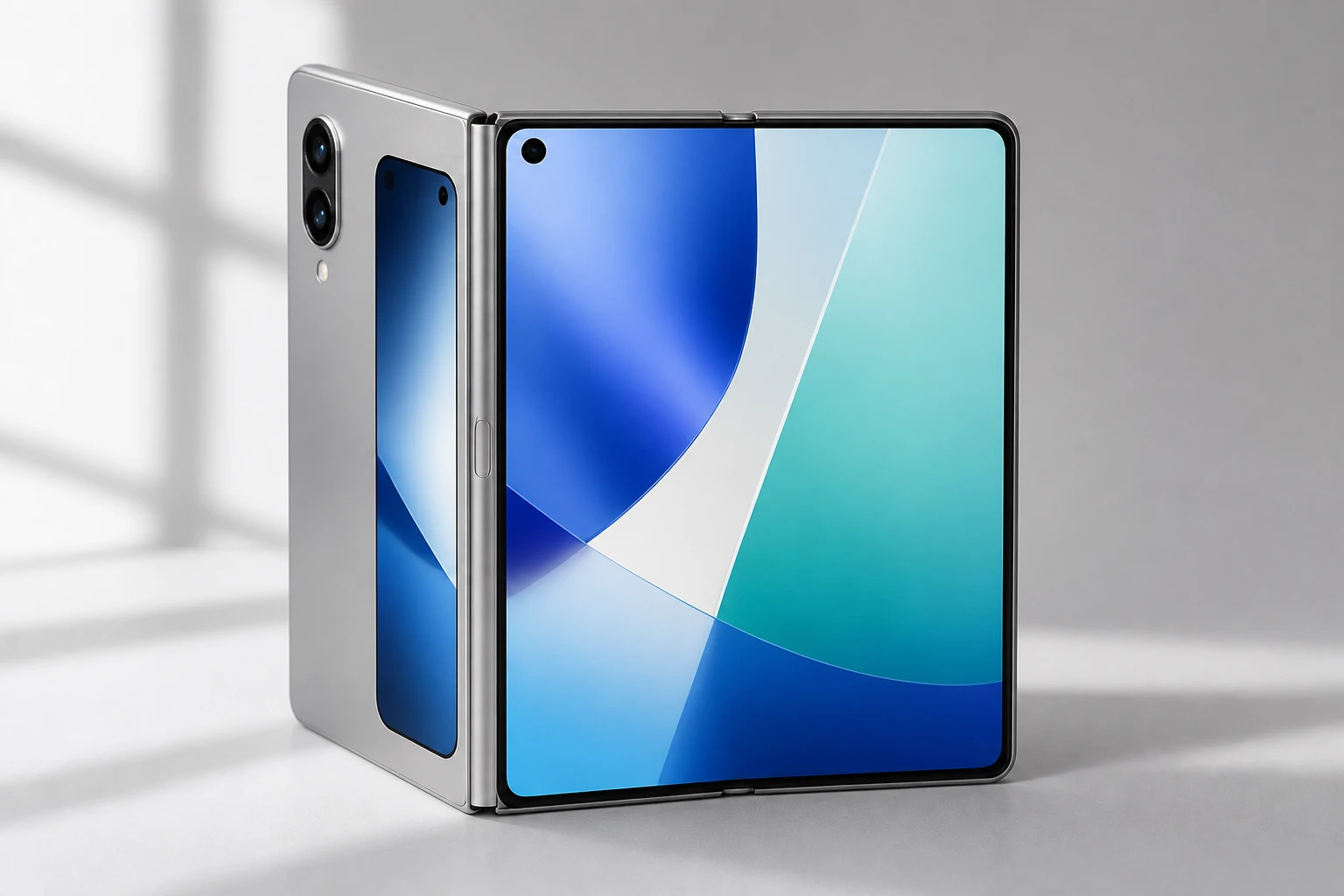
Reports describe a compact book-style foldable rather than the tall, narrow silhouette that dominated earlier Galaxy Z Folds. The closed device would carry an outer cover display of about 5.5 inches. Opened, the inner OLED stretches to roughly 7.8 inches in an approximately 4:3 aspect that feels closer to a small tablet than a stretched phone.
That wider stance gives more room for reading, photo editing, video and side-by-side apps. Samsung has already moved toward a similar wide-fold concept in 2026, confirming the form factor works in daily use. The frame is expected to be titanium. Rear cameras stay at a dual-sensor setup instead of the triple arrays on recent Pro Max models. Memory is rumored at 12 GB and the chip an A20-series part.
| Feature | Current expectation |
|---|---|
| Design | Book-style foldable |
| Inner display | Around 7.8 inches |
| Cover display | Around 5.5 inches |
| Aspect ratio | Approximately 4:3 |
| Panel | Foldable OLED from Samsung Display |
| Frame | Titanium |
| Authentication | Touch ID (side button) |
| Rear cameras | Dual-camera system |
| Processor | A20-series |
| Memory | 12 GB rumored |
| Launch window | Second half 2026 |
| Price range | $2,300 to $2,500 |
TrendForce has long pointed to the same 5.5-inch outer and 7.8-inch inner pairing for Apple’s entry later this year.
The dual-camera choice is not a step backward so much as a packaging decision. A foldable already spends thickness and internal volume on the hinge, two batteries and dual panels. Keeping the rear array to two sensors leaves margin for titanium structure and thermal hardware instead of stacking a third lens module into a shell that has to stay thin when closed.
The 4:3 inner canvas also changes how software will feel. Side-by-side apps gain usable width. Photo editing tools get a workspace closer to a small tablet. Video playback fills the open panel without the extreme letterboxing common on taller folds. That is the practical payoff of the wider book shape.
Why the Crease Fight Matters Most
Visible creases and long-term durability have been the biggest consumer complaints about foldables. Apple is treating the display stack as a materials problem more than a pure hinge problem.
Samsung Display is expected to supply the panels. Supply-chain notes describe ultra-thin glass (UTG) with variable thickness so the bend zone stays flexible while other areas keep impact strength. Newer builds add a dual-UTG sandwich that places glass both above and below the OLED layer. Optically clear adhesive (OCA) is tuned to act as a stress buffer that stays soft during slow folds yet stiffens under impact.
TrendForce frames the industry shift clearly: after years of hinge and support-plate tweaks, 2026 is the year UTG and OCA materials science shift becomes the main lever for making creases nearly imperceptible. One earlier report put Apple’s target crease depth near 0.15 mm, roughly a quarter of the Galaxy Fold 7 figure at the time.
- Phase one (2019-2022): basic fold reliability and water-drop hinges that increased bend radius.
- Phase two (2023-2025): fewer hinge parts, aerospace alloys, floating supports and better yields.
- Phase three (2026 onward): non-uniform glass thickness, chemically strengthened UTG, viscoelastic OCA and laser-drilled metal plates that spread stress instead of concentrating it.
If Apple lands a visibly flatter inner screen on day one, the marketing line writes itself.
The materials stack also explains why yields start low. Variable-thickness UTG, dual-glass sandwiches and tuned OCA are harder to run at scale than a conventional rigid OLED. Early output in the hundreds of thousands is the cost of chasing a crease near 0.15 mm rather than accepting a deeper fold line buyers already know.
iOS 27 Already Speaks Foldable
Hardware silence from Cupertino is normal. Software is less discreet. Code in the iOS 27 betas includes foldState and angleDegrees (or mechanicalAngleDegrees) parameters that let the system know whether the device is open, closed or at an intermediate angle. No shipping Apple product uses those states.
Developers also found references consistent with multiple batteries, a second display and ambient-light sensors on both halves. Separate strings point to a device that combines the Dynamic Island with Touch ID, a pairing that does not exist today. During WWDC, Apple pushed developers hard on fluid resizing and layouts that ignore fixed screen assumptions, the same quiet prep it ran before the larger iPhones and before Vision Pro.
Space inside a foldable is at a premium. Dropping the TrueDepth camera array for Face ID frees room for the hinge, two batteries, thermal hardware and wireless modules. Multiple reports now expect a side-button Touch ID sensor instead. On X, that detail has drawn the sharpest recent chatter: thinness simply leaves no clean place for the infrared Face ID hardware.
My latest industry survey indicates that assembly shipments for the foldable iPhone in 2H26 will be roughly 7-8 million units, with 3Q26 shipments at 0.5-1 million units, or about 10% of the total.
Ming-Chi Kuo wrote that on X in early July, adding the iPhone X comparison in full.
The foldState and angle APIs matter because they let apps react while the device is still moving, not only after it locks open or closed. Intermediate angles become usable states for media, multitasking and camera previews. That is the software half of the same packaging story that pushed Touch ID onto the side button.
The iPhone X Parallel Runs Deep
In 2017 Apple announced the iPhone X alongside the iPhone 8 and 8 Plus on September 12. The 8 models went on sale in late September. The X, limited by early OLED and TrueDepth yields, opened pre-orders only on October 27 and reached stores on November 3. Third-quarter X shipments sat under 1 million units. Second-half volume still climbed to roughly 30 million once the line stabilized.
- September 12, 2017: iPhone X announced with the iPhone 8 and 8 Plus.
- Late September 2017: iPhone 8 models reach retail while the X stays constrained.
- October 27, 2017: X pre-orders open after OLED and TrueDepth yields improve.
- November 3, 2017: X arrives in stores; third-quarter shipments stay under 1 million.
- Second half 2017: cumulative X volume climbs toward roughly 30 million as the line stabilizes.
Kuo sees the same pattern. Third-quarter foldable volume is too low to support a full September sales launch alongside the iPhone 18 Pro models. An event slot remains likely; retail availability is more likely to slip into October or later. That path cleared for a September event slot still leaves the hard part, ramping a brand-new hinge and dual-display assembly at volume.
Some Chinese supply-chain outlets have claimed mass production is already under way with no delay. Kuo’s numbers and the iPhone X precedent remain the more cautious and widely cited view. Either way, initial stock will be tight.
| Line | Third quarter | Second half |
|---|---|---|
| Foldable iPhone (Kuo) | 0.5 to 1 million | 7 to 8 million |
| iPhone 18 Pro and Pro Max | 20 to 22 million in the same window | |
| iPhone X (2017 precedent) | Under 1 million | Roughly 30 million |
The Ultra will not match the X’s second-half ramp in absolute units. The shape of the curve still rhymes: a thin third quarter, a September stage appearance, and the real retail fight pushed into the fourth quarter.
Who Gains When Apple Finally Ships
IDC projects the worldwide foldable market will grow 30 percent year-over-year in 2026, helped by Apple’s arrival and Samsung’s tri-fold experiments. Apple is forecast to take more than 22% unit share and 34% of market value in its first year at an average selling price near $2,400. That value share matters more than pure units because foldables already sell at three times the ASP of ordinary smartphones.
TrendForce earlier put Apple near 20 percent share and saw Samsung and Huawei each compressed toward 30 percent. Samsung has already trimmed its own 2026 foldable target to 5-6 million units across the Z Fold8, Flip8 and Wide Fold models, partly on component-cost pressure. The wide form factor Apple is chasing is the same direction Samsung’s own wide Fold split is taking, so the two companies will meet on similar ground rather than pure tall-phone versus short-tablet designs.
App developers who already support iPad multitasking and Stage Manager gain an immediate new canvas. Users who want a pocketable device that opens into a near-tablet get a first-party Apple option for the first time. The losers in the short term are the smaller Android foldable brands that have lived on Samsung’s leftovers; Apple’s brand gravity tends to expand categories and then dominate the high end.
Value share near 34 percent on unit share just above 22 percent is the clearest signal in the forecasts. Apple does not need to lead unit volume in year one. It needs the high average selling price near $2,400 to hold, and the wider book design gives it a product story that matches that price.
Limited Supply Turns Desire Into Friction
Kuo expects demand to stay strong through the end of 2026 even at $2,300 to $2,500. Pre-orders could sell out the same day they open. Delivery waits of 4 to 6 weeks or longer would be normal into December. Resale premiums of 50 to 100 percent above retail are “not out of the question” in the first weeks, he wrote.
That scarcity is both a bug and a feature. It frustrates people who want the device on launch day. It also creates the same cultural heat the iPhone X enjoyed: the phone everyone is talking about, the one scalpers chase, the one that signals you are early. True long-term demand will only become clear in late 2026 and early 2027 once launch buzz fades and yields improve. Until then the story is simple: Apple is shipping a high-priced, low-volume experiment that could still reset what buyers expect from a foldable.
Touch ID Makes Room For The Hinge
The side-button Touch ID plan is more than a biometric swap. It is how Apple recovers internal volume that a foldable cannot spare.
TrueDepth hardware for Face ID needs a tall sensor stack, infrared emitters and a clear path through the front glass. On a conventional iPhone that cost is acceptable. On a book-style foldable every millimeter fights the hinge, the dual batteries and the second display’s flex circuits. Moving authentication to a side button removes that stack from the display half and lets the closed shell stay thin.
The same space logic shows up in the dual rear cameras, the titanium frame and the multiple-battery references in iOS 27. None of those choices stands alone. Together they describe a device built around the fold first, with every other subsystem trimmed to fit.
Dynamic Island remaining in the software strings while Touch ID handles unlock is the visible compromise. Users keep the familiar status and alert surface. The infrared Face ID module does not have to claim room the hinge already owns.
How The Wide Fold Reshapes The Category
Samsung trimming its 2026 target to 5-6 million units while Apple prepares 7 to 8 million in the second half alone flips the usual volume story. The incumbent is cautious on component cost. The new entrant is still tiny next to Pro iPhone volume, yet large enough to move category share on day one.
IDC’s 30 percent market growth forecast assumes both forces at once: Apple’s arrival and Samsung’s own experiments, including tri-fold work. The converging wide designs mean the fight is less about silhouette and more about crease quality, software polish and who can fulfill pre-orders without multi-week gaps.
Developers who already built for iPad multitasking and Stage Manager sit closest to the upside. Their layouts already assume a broad canvas and flexible windowing. A 7.8-inch 4:3 panel is a smaller jump for them than for teams that only ever shipped single-column phone UI.
Smaller Android foldable brands face the harder side of the same math. When Apple expands a category it also pulls high-end attention and accessory ecosystems toward its own hardware. Living on leftovers gets harder once the mainstream premium buyer has a first-party option.
For now the public checklist stays short and consistent across analysts.
- Fall 2026 announcement likely alongside iPhone 18 Pro models
- Possible Q4 retail start if third-quarter builds stay under 1 million
- Starting price north of $2,000, most estimates $2,300-$2,500
- 5.5-inch cover and ~7.8-inch inner Samsung OLED
- Touch ID side button, dual rear cameras, titanium frame
- Initial production measured in the low millions, not tens of millions
Apple has confirmed none of it. The combination of display orders, iOS 27 fold APIs, Kuo’s shipment math and the converging wide-form designs from Samsung makes a 2026 debut the base case. Whether the Ultra becomes the next X or a niche luxury slab will be decided by how flat that crease looks and how fast the factories can fill the empty pre-order queues.
Kuo’s full note on the 7-8 million units in the second half remains the clearest single source for the production reality facing Apple this year.