Brent crude settled at $88.52 a barrel on August 14, up $1.45, locking in a roughly 5% weekly gain as fresh attacks on tankers in the Strait of Hormuz and stalled US-Iran talks overpowered a massive US inventory build. WTI finished at $82.40. If naval strikes keep pace into late August, ICE Brent sits on a clear path from the high $80s toward $100.
The irony is already visible in the numbers. Record fuel prices and choked supply chains are destroying demand at the fastest clip in years, and US commercial crude stocks just posted their largest weekly rise in three and a half years. Neither force has closed the global deficit.
Tanker Strikes and Dueling Claims Over the Strait
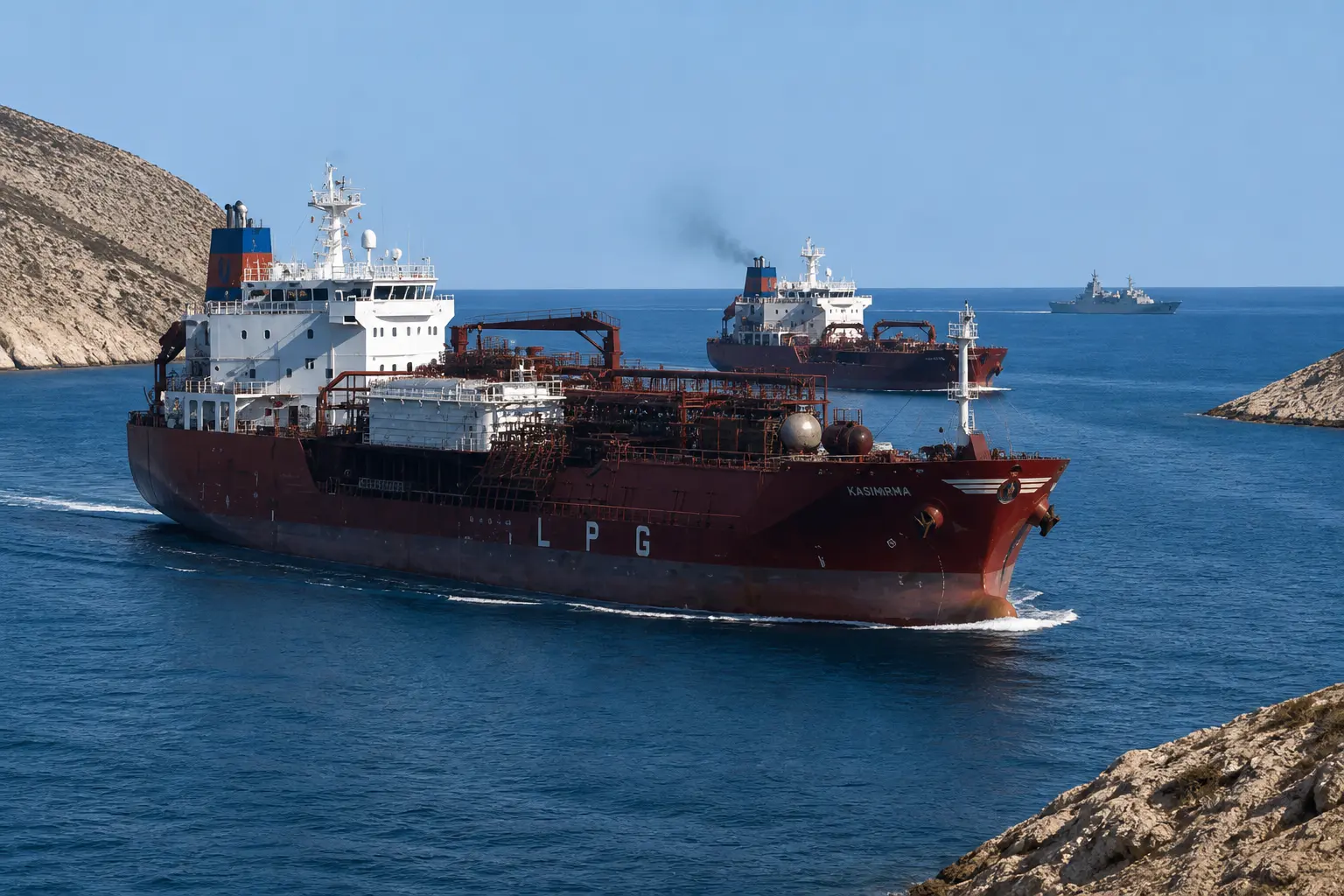
Two Abu Dhabi National Oil Company vessels were hit by UAVs while transiting the strait on Thursday, according to the UAE. No injuries were reported, but the attacks arrived as shipping traffic already ran below the monthly average. Before the late-February start of US-Israeli operations against Iran, the waterway handled about one-fifth of global oil and LNG supplies.
Washington said it can maintain a naval blockade of Iranian crude indefinitely and ratchet economic pressure higher. Treasury Secretary Scott Bessent previewed “measures like have never been seen in the history of economic isolation of a country.” Tehran insists no vessel can pass without its permission and ties any reopening to political concessions. President Trump has claimed “total control” of the waterway; Iran rejects the claim outright.
- UAE state media condemned the ADNOC vessel strikes as Iranian attacks.
- US officials signaled the blockade can run without a near-term end date.
- Iranian statements condition free transit on US political steps.
- Russian Black Sea loadings at Novorossiysk also halted after a separate drone strike the same day.
Phil Flynn of Price Futures Group put the market reaction bluntly: the tanker hits were the headline that lifted prices. Bjarne Schieldrop of SEB Research said the latest US stance implies little hope of a quick return to normal Hormuz flows.
The 17-Million-Barrel Build That Was Not a Surplus Signal
The EIA weekly petroleum status data for the week ended August 7 showed commercial crude stocks rising 17.4 million barrels to 424.4 million barrels, the largest weekly gain since January 2023 and well above the 1.4-million-barrel draw analysts had expected. Stocks hit their highest level since early June.
| Metric | Week ended Aug 7 | Context |
|---|---|---|
| US crude stocks change | +17.4 million barrels | Largest rise in 3.5 years |
| Total commercial crude | 424.4 million barrels | Highest since June 5 |
| US crude exports | 3.06 million b/d | Lowest since Nov 2025 |
| Net crude imports | +1.77 million b/d jump | Highest since June 2025 |
| Cushing stocks | +1.6 million barrels | Delivery hub build |
The build was not evidence of spare oil flooding the market. Exports slumped to their lowest point since the war began, while imports from Canada and Venezuela jumped. Matt Smith of Kpler called it the second-largest crude inventory build in history, concentrated on the Gulf Coast, driven by weak exports and a sudden import surge. Josh Young of Bison Interests labeled the print “noisy” and likely a one-off. David Russell of TradeStation said markets would look past it and stay focused on Middle East headlines. Gasoline stocks still drew 1 million barrels; distillates were essentially flat.
In short, the same Hormuz disruption that lifted prices also scrambled US trade flows for a week. That scramble produced a bearish-looking inventory number without repairing the global balance.
Supply Falls Faster Than Demand Cracks
The IEA August oil market report cut its 2026 demand outlook again. World oil demand is now forecast to decline 1.6 million b/d this year, 510,000 b/d deeper than the July estimate, as high prices and the ongoing Hormuz closure weigh on consumption. Contractions ease from 4.9 million b/d in the second quarter to 2.8 million b/d in the third before a return to growth in the fourth. Demand is projected to expand 2.4 million b/d in 2027.
Supply is falling harder. Global oil supply is projected to decline 4.3 million b/d on average in 2026 to about 102 million b/d. Gulf production recovered somewhat in July to 23.9 million b/d but remained 8.3 million b/d below pre-war levels. Regional exports, including bypass routes, fell 2.1 million b/d to 15 million b/d after the strait effectively closed again in early July. Loadings peaked near 20 million b/d early in the month then dropped toward 12 million b/d. The agency now sees a 1.8 million b/d deficit in the third quarter, more than double its prior estimate.
Observed global inventories plunged 69 million barrels in July, almost entirely from oil on water. Cumulative draws since the end of February reached 410 million barrels, or 2.7 million b/d on average. Total observed stocks slipped below 7.9 billion barrels for the first time since April 2025.
OPEC trimmed its own 2026 demand growth forecast to 580,000 b/d, the fourth straight monthly cut. The cartel still sees growth where the IEA sees contraction, yet both agencies moved in the same direction: the crisis is destroying more demand than previously assumed while supply remains severely constrained.
- IEA 2026 demand: -1.6 million b/d
- IEA 2026 supply: -4.3 million b/d
- Q3 2026 implied deficit: 1.8 million b/d
- OPEC 2026 demand growth: +580,000 b/d (cut from 780,000)
Refinery throughputs stayed nearly 5 million b/d below year-earlier levels. Product cracks and Atlantic Basin margins hit record highs as diesel, jet and gasoline markets tightened.
Producers Capture the Upside, Importers Absorb the Shock
Energy equities have repeatedly ripped higher on days when deal hopes faded. Chevron, Exxon and smaller producers posted multi-percent gains in mid-August sessions after Trump rejected Iranian compensation demands. At the same time the president publicly criticized the majors for “too much money,” noting Chevron’s second-quarter earnings jumped to $12 billion and Exxon’s more than doubled to $14.5 billion on the back of the same shortages.
US crude has become a critical swing supplier to fill Middle East gaps, yet the latest weekly data showed how fragile that role remains when tankers divert or delay. Saudi Aramco raised output more than 1 million b/d to 8.2 million b/d in July, but only about 200,000 b/d of the increase reached markets as Bab el-Mandeb disruptions forced Riyadh to push domestic inventories to multi-year highs. September Asian allocations are being negotiated ship-by-ship because owners continue to shun both Hormuz and the Red Sea.
Asia’s heavy exposure to Gulf barrels leaves refiners and governments paying the highest price. Qatar has extended force majeure on LNG to India, missing dozens of term cargoes. Indian and other Asian buyers are scrambling for Atlantic Basin and US grades, often at steep premiums. A congressional review of Hormuz flows notes that roughly 25% of world maritime crude and products and nearly a fifth of LNG normally transit the strait, making any prolonged restriction a direct tax on import-dependent economies.
Ukrainian grain shipments have already fallen 76% year-on-year in early August amid Black Sea risks, reviving separate food-supply worries. The oil shock and the food shock are traveling the same disrupted sea lanes.
Earlier Hormuz Crises Rarely Produced Lasting $100 Oil
The 1980s Tanker War offers the closest historical parallel. Iran and Iraq attacked hundreds of commercial vessels. Shipping volumes initially dropped and insurance spiked, yet the real global oil price steadily declined across the decade. Tankers proved relatively hard to sink; markets adapted; Iran even cut its official prices to offset higher freight. At peak intensity the conflict disrupted only a small fraction of Gulf sailings.
This episode is larger. The IEA has called the 2026 Hormuz disruption the biggest supply shock in the history of the modern oil market. Pre-war traffic of roughly 20 million barrels per day of petroleum liquids has been cut by multiples of the old Tanker War impact. Peak Brent this cycle already cleared $100 in March and again approached or exceeded it in July before diplomatic false starts pulled it back. An earlier price surge on Iran strikes showed how quickly the market re-prices any sign of renewed attacks.
- Late February 2026: US-Israeli operations against Iran begin; Hormuz traffic collapses.
- March: Brent surpasses $100 for the first time in years and peaks above $120 in some sessions.
- June: Fragile ceasefire hopes produce multi-day price drops.
- Early July: Hostilities and maritime attacks resume; loadings crash again.
- Mid-August: Fresh ADNOC vessel strikes and indefinite-blockade language push Brent back toward the high $80s with a clear $100 trajectory if the pace holds.
OPEC+ output moves amid the crisis have been largely overtaken by physical shut-ins and shipping risk. Spare capacity on paper means little when tankers will not sail.
What Continues If the Attacks Do Not Ease
Analysts tracking the tape say a return to normal Hormuz volumes now lacks any near-term catalyst. Schieldrop’s assessment that normal flows are “suddenly without any near-term hopes” matches the price action: each failed diplomatic window has been followed by a swift recovery in the front of the curve. Prompt differentials have returned to backwardation, a classic sign of physical tightness.
Global observed stocks have already shed 410 million barrels since late February. IEA emergency releases have slowed. Chinese crude stocks continue to draw. The buffer that absorbed earlier shocks is thinner. Product markets are even tighter than crude, with middle-distillate cracks at extremes and seaborne diesel and jet trade sharply lower year-on-year.
US producers and equity holders continue to bank the price upside while facing political pressure over retail fuel costs. Asian importers keep paying elevated differentials and scrambling for alternative barrels. Saudi inventories sit at multi-year highs because barrels cannot leave. The same price spike that is destroying 1.6 million b/d of demand is still not large enough to match the 4.3 million b/d supply loss the IEA now projects for the full year.
Brent at $88.50 with a 5% weekly gain already prices a great deal of risk. Continued attacks through the second half of August would test whether $100 is a ceiling or simply the next round number on the way higher.