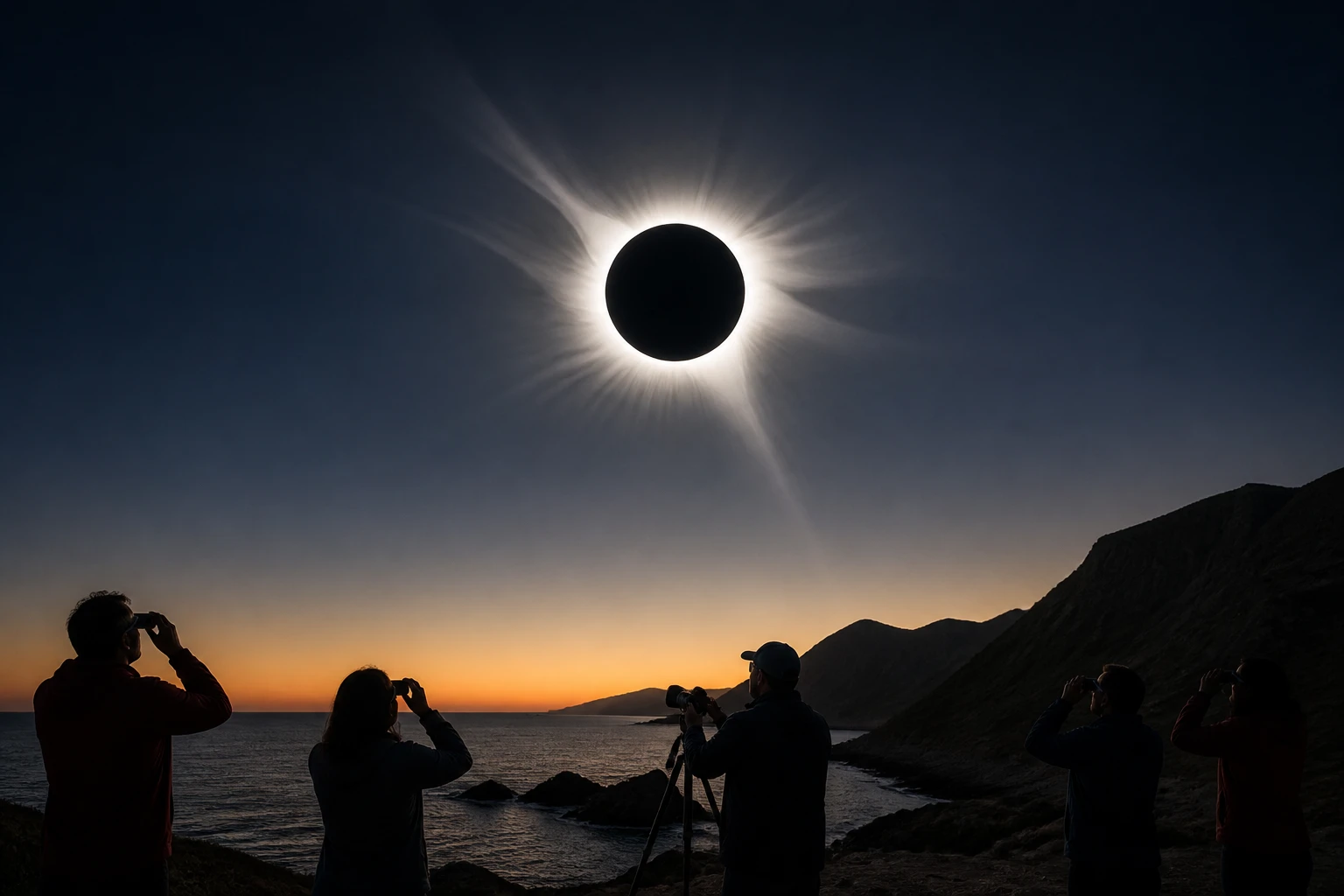
Millions across Greenland, Iceland and northern Spain watched the moon blot out the sun on Wednesday, Aug. 12, 2026, producing up to 2 minutes 18 seconds of totality. It was mainland Europe’s first total solar eclipse since 1999 and Spain’s first on the peninsula since 1905.
The shadow raced from the Arctic through western Iceland and across the Atlantic before cutting a path from Spain’s northern coast to the Balearic Islands near sunset. Partial phases reached much of Europe, North Africa and northern North America.
Where the Shadow Fell and How Long It Lasted
Greatest eclipse occurred just off Iceland’s west coast near 65.2°N 25.2°W. On the ground the longest view ran 2 minutes 18 seconds. In Spain totality arrived later in the afternoon and evening local time, shorter near the path edges.
Cities inside the path included A Coruña, Bilbao, Zaragoza, Valencia and Palma. Madrid and Barcelona sat just outside. Partial coverage exceeded 90 percent across Ireland, Britain, France and Italy.
| Location | Type | Key timing note |
|---|---|---|
| Western Iceland | Total | Totality near 17:45 UTC, up to ~2 min 13 s on coast |
| Northern Spain (e.g. León area) | Total | Evening hours, path to Mediterranean and Balearics |
| Greenland (eastern sectors) | Total | Earlier afternoon local, sparse population |
| Maximum point (off Iceland) | Total | maximum eclipse at 17:46 UTC |
A partial eclipse remained visible in northern U.S. states from Alaska to North Carolina. The next total eclipse over the contiguous United States arrives Aug. 23, 2044. A partial follows across parts of the U.S. on Aug. 2, 2027.
The 1905 Spanish Eclipse Returns at Modern Scale
On Aug. 30, 1905, a total solar eclipse with nearly four minutes of maximum duration made Spain the global focus. More than twenty international science teams set up cameras, spectrographs and polarimeters. The Madrid Observatory chose Burgos. The army handled logistics. Hot-air balloon observations were attempted.
King Alfonso XIII visited the sites. Trains filled with spectators. Festivals, theater and bullfights ran alongside a photographic competition. The 1905 path across the Iberian Peninsula closely matched the 2026 track from Atlantic coast to Mediterranean.
Earlier Spanish totals in 1860 and 1870 had already drawn pioneers such as Warren de la Rue, whose dual-site photographs proved solar prominences belong to the sun itself. A 1900 total and a short 1912 hybrid completed an early-century trio that modernized Spanish astronomy. The 2026 event opened another three-year sequence: totals again in 2027 and 2028.
- 30 August 1905, “Spanish eclipse,” nearly 4 minutes max, 20-plus foreign teams, royal visit, public festivals.
- 11 August 1999, last total over mainland Europe, Cornwall to Romania.
- 12 August 2026, first mainland Europe total since 1999, Spain mainland since 1905, max 2 min 18 s.
- 2 August 2027, next total visible in Spain, longer duration expected in the south.
Where ox-carts once hauled Grubb telescopes and Pathé cameras filmed flash spectra, 2026 brought commercial jets, cruise ships and smartphone live streams.
Hotels and Flights Captured the Windfall
Travel data turned the celestial event into a short-break economy. Amadeus recorded a 25% rise in flight bookings to path airports for arrivals 7-12 August versus 2025. Hotel occupancy across Spain and Iceland combined climbed 16 percent. Average daily rate jumped 36 percent.
Bilbao demand soared 366 percent, Asturias 292 percent, Valencia 137 percent. Short stays of one to five days rose 57 percent. Solo travel increased 48 percent. Top long-haul origins included the United States, Japan, Argentina and Canada.
- Reykjavík rooms, average around $793 (£587), nearly double the prior year according to hospitality trackers.
- A Coruña, rates up 135 percent year-on-year to roughly $451; short-term rental occupancy hit 81 percent in some samples.
- Spain expectation, finance ministry figures cited roughly 460,000 overseas visitors specifically for the eclipse; regional plans listed 660 official viewing sites.
- Iceland estimate, about 75,000 foreign tourists plus 53,000 cruise passengers, straining already busy summer capacity.
Turespaña director Miguel Sanz called the 2026-28 sequence a “Trio of Eclipses” that can lift inland and rural astronomy tourism beyond the single day. Operators who held inventory won. Late bookers and some local residents faced sticker shock and crowded roads.
Jets and Balloons Chased Two Minutes of Corona
While crowds looked up with paper glasses, NASA-funded teams treated the darkness as lab time. Kelly Korreck, eclipse program manager at NASA Headquarters, said scientists can study the corona from Earth during totality “in a way we can’t from anywhere else in the solar system.”
From our unique perspective on Earth during a total solar eclipse, scientists can study the Sun’s corona in a way we can’t from anywhere else in the solar system.
Korreck’s point framed the campaign. A NASA WB-57 jet corona cameras suite, the SCIFLI Multispectral Airborne Imager, flew at 50,000 feet. Four cameras shot at least 20 frames per second in visible and infrared wavelengths. Flying the shadow at 460 mph stretched the airborne view of the corona to nearly three minutes, longer than any ground site.
Principal investigator Amir Caspi of Southwest Research Institute noted every eclipse differs because the sun constantly changes. Teams adjusted exposures after 2024 lessons to avoid overexposing bright features. Goals included prominence formation, the corona’s million-degree heat mystery, and links to the solar wind.
Student teams under the Nationwide Eclipse Ballooning Project launched roughly 80 balloons in Iceland and six in Spain. Iceland flights spanned 18 hours before to eight hours after totality to measure the atmospheric boundary layer’s response to sudden cooling, especially under long August daylight. Spain balloons carried 360-degree cameras and ozone sensors. Earlier eclipses showed boundary-layer collapse under clear skies and ozone dips; researchers tested whether timing and season altered the pattern.
European modelers from KU Leuven issued corona forecasts beforehand so the real view could score the simulations. ESA and NASA both streamed live from sites including Spain’s Javalambre Astrophysical Observatory.
Clouds, Heat and the Fire Line
Weather split the experience. In Iceland’s Westfjords and Snæfellsnes peninsula, cloud decks hid the corona for many observers. Meteorologist Mark Skaggs still called the light collapse an 11/10. Photographer Kevin Earp at Arnastapi described mid-totality twilight against mountain backdrops even without the sun’s disk. Greenland fjords offered clearer diamond-ring moments for some chase groups.
Spain faced a different hazard. A tough fire season and temperatures near 40 °C (104 °F) put large outdoor gatherings under elevated wildfire alert. Interior Ministry civil protection officials deployed more than 35,000 officers. Smoking and spark-generating activity drew restrictions. Regional governments funneled people toward designated viewing zones and parking. Source photos captured a wildfire climbing a hill near Monte de San Pedro park in A Coruña as thousands assembled.
What we know
- Path of totality confirmed over western Iceland, northern Spain and Balearics; max duration 2 min 18 s.
- Hotel ADR and flight demand spikes documented by Amadeus and multiple trackers.
- NASA jet and balloon campaigns executed as planned; live broadcasts ran from Iceland and Spain.
What remains observational
- Final corona image catalogs and boundary-layer data papers still processing.
- Exact overnight economic total for Spain and Iceland not yet consolidated.
- Whether any ignition incidents linked directly to viewing crowds (authorities emphasized prevention).
Animal behavior and temperature drops of several degrees appeared in ground reports, classic totality signatures. Protective glasses sold out at stalls from Falmouth to Spanish beaches.
Scenes From the Path
Photographers and wire crews filled the record. At Javalambre Observatory near Teruel the corona glowed clean against the blocked disk. In Reykjavík the Hallgrímskirkja stood in premature dusk under cloud. A beachgoer at Puerto de Sagunto near València tilted special glasses skyward. Off Greenland a cruise ship Ambition caught totality at sea. In Berlin and Budapest partial crescents drew phone cameras and park crowds. A fish jumped in dimmed light along Italy’s Fregene coast. Drone shots framed glasses-wearing groups atop a British church tower.
Astrophotographers such as Javier Sanchez of the Los Taraos group set rigs in Berlanga de Duero. One NASA Astronomy Picture of the Day selection later featured the eclipsed sun above Zaragoza’s Cathedral-Basilica of Our Lady of the Pillar reflected in the Ebro. The visual haul matched the 1905 photographic competitions, only now every phone became a potential archive.
Spain’s Next Totality Already on the Calendar
The 2027 total on Aug. 2 will again favor Spain, with longer duration expected farther south, including Andalucia notes from observers who lost the corona to clouds this time. A third event follows in 2028. Tourism officials already frame the trio as a multi-year astronomy brand that can spread visitors beyond the coast.
Science teams will refine jet and balloon tactics from 2026 lessons. Hotel yield managers will keep the pricing playbooks. For everyone who stood in the shadow, whether they saw streamers or only the sudden cool twilight, the 2026 eclipse delivered the same core fact the 1905 crowds felt: daylight can vanish on schedule, and the world stops to watch.
Frequently Asked Questions
How long did totality last during the August 12 2026 solar eclipse?
Maximum totality reached 2 minutes 18 seconds near the point of greatest eclipse off western Iceland; most Spanish path locations saw shorter intervals closer to one to two minutes depending on distance from the center line.
When was the previous total solar eclipse visible from mainland Spain?
The previous total solar eclipse on Spain’s mainland occurred on 30 August 1905, with a path similar to 2026 and maximum duration approaching four minutes; a 1959 total was limited to the Canary Islands.
What science experiments did NASA run for the 2026 eclipse?
NASA flew the WB-57 aircraft with multispectral corona cameras that extended viewing to nearly three minutes and supported student balloon teams launching about 80 balloons in Iceland plus six in Spain to measure atmospheric boundary-layer and ozone responses.
When is the next total solar eclipse visible in Spain?
The next total solar eclipse visible from Spain occurs on 2 August 2027, part of a three-year sequence that also includes an event in 2028, giving the country repeated prime viewing after more than a century without a mainland total.
Was the 2026 eclipse the first for mainland Europe since which year?
It was the first total solar eclipse for mainland Europe since 11 August 1999, when the path ran from Cornwall across central Europe to Romania.