Georgian Prime Minister Irakli Kobakhidze said on 12 August 2026 that EU technical experts placed the Black Sea submarine cable on the bloc’s list of projects of mutual interest, proof that specialists see Georgia as essential to Caspian-Europe links. The high-voltage and fiber-optic line would run from Anaklia to Romania, carrying renewable power and data while bypassing Russia.
The same European institutions that froze Georgia’s accession process still elevated the project. That gap between politics and infrastructure is the story.
What the Cable Connects
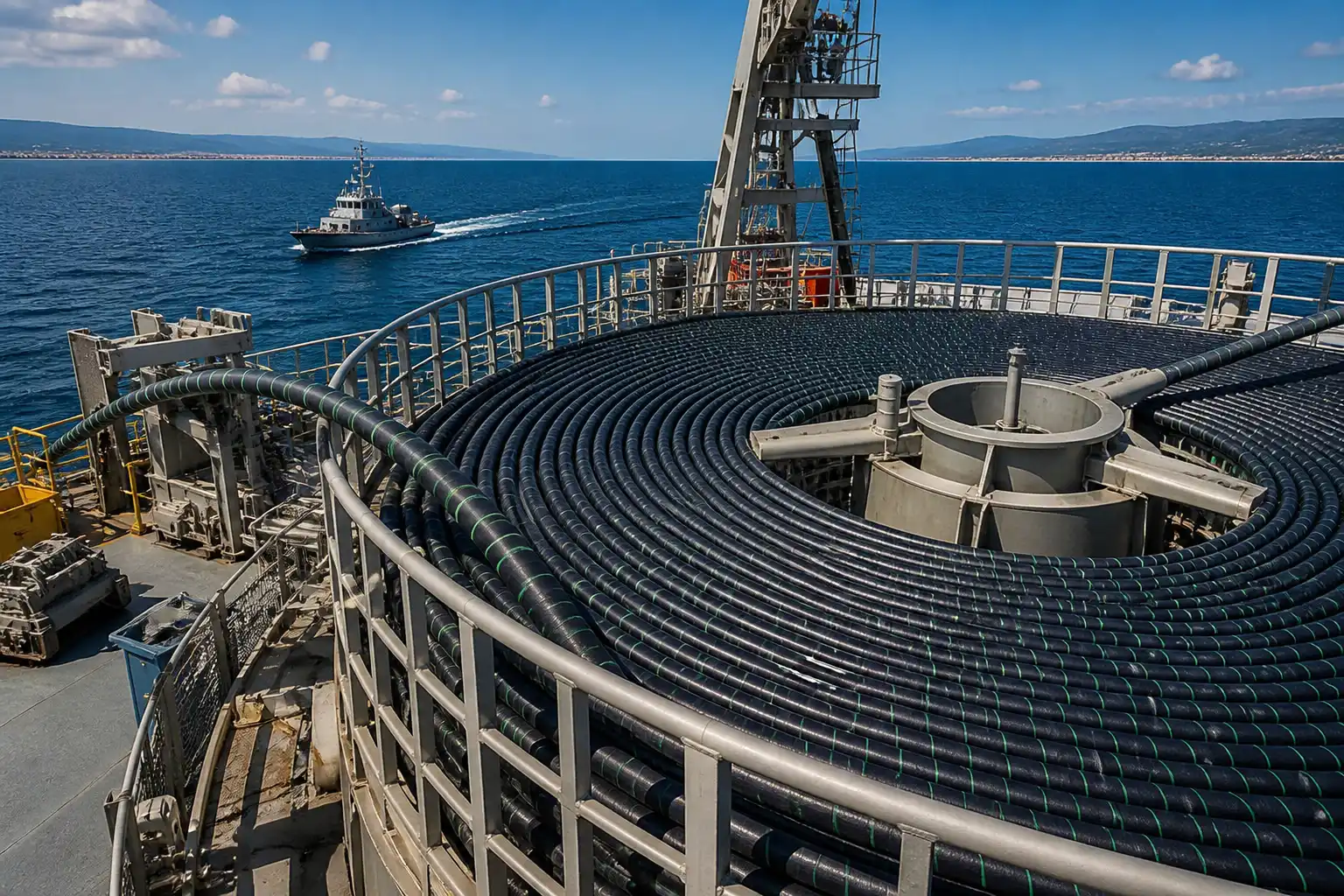
The Black Sea Submarine Cable, also called the Black Sea interconnection cable, is a planned HVDC link between Georgia and Romania. It forms the undersea spine of a green energy corridor from Azerbaijan and the wider Caspian region into the EU grid.
Electricity would flow primarily from new solar and wind plants in Azerbaijan through Georgia, cross the Black Sea, and land in Romania for onward transmission to Hungary and the rest of Europe. A parallel fiber-optic cable would ride the same route to strengthen digital connectivity.
| Attribute | First-phase target | Notes |
|---|---|---|
| Capacity | 1,000-1,500 MW (1,300 MW preferred) | HVDC ±500/525 kV |
| Length | ~1,155-1,195 km | ~1,100-1,115 km underwater |
| Landing points | Anaklia (Georgia) to Constanta/Topraisar area (Romania) | Depths exceeding 2,500 m in places |
| Cost estimate | $3.1-3.7 billion | Earlier figures around $2.3 billion; fiber optic extra $70-90 million |
| Partners | Azerbaijan, Georgia, Romania, Hungary | 2022 strategic partnership MoU |
Aspirational full build-out reaches 4-6 GW. The first phase alone could supply power for more than two million European households.
Brussels Freezes Talks and Still Needs the Route
In November 2024 Kobakhidze announced Georgia would not put EU accession talks back on the agenda until the end of 2028 and would refuse related budget grants. The decision followed EU criticism of democratic backsliding and election concerns. Relations have stayed strained.
Yet in December 2025 the European Commission included the project on the second Union list of PCIs and PMIs. The Official Journal published the delegated regulation in April 2026. Entry 2.27 under North-South electricity interconnections in Central Eastern and South Eastern Europe reads simply: Interconnection between Anaklia (GE) and Constanta Sud (RO) [currently known as “Black Sea interconnection cable”].
When the EU document was prepared from an expert perspective, experts included the Black Sea submarine cable on the list of projects of mutual interest. Wherever an expert component is involved, everyone naturally recognizes that such interconnections cannot be established or strengthened without Georgia. We must hope that pragmatic considerations will prevail.
Kobakhidze made the remarks in response to a journalist, according to AZERTAC and Georgian outlets. He tied the point to stronger Azerbaijan-Georgia-Türkiye connectivity and said Tbilisi enjoys positive momentum with both Baku and Ankara.
PMI status unlocks faster permitting and easier access to EU funding mechanisms under the TEN-E framework. It is not a membership ticket. It is recognition that the geography is fixed and the green power is needed.
How Far the Project Has Moved
The corridor began with a December 2022 memorandum among Azerbaijan, Georgia, Romania and Hungary. Feasibility work by CESI followed. The World Bank approved a $35 million World Bank preparatory loan in May 2024 under the ESPIRE program for seabed surveys, corridor identification and institutional capacity.
- December 2022, Four-country green energy MoU signed.
- 2024, CESI feasibility study completed; World Bank ESPIRE phase one approved.
- December 2025, Commission adds project to PMI list.
- February 2026, Transelectrica and Georgian State Electrosystem sign cooperation MoU covering surveys, studies and financing work.
- April 2026, European Parliament and Council approval reflected in Official Journal publication.
- July 2026, Technical workshop in Romania focuses on marine survey preparation, Romanian grid integration for 1,300 MW and updated cost/regulatory analysis.
No final investment decision has been taken. Marine surveys are the immediate next technical gate. ENTSO-E TYNDP inclusion continues.
Who Stands to Gain from the Link
- Azerbaijan gains a large export market for planned solar and wind capacity, supporting its pivot beyond oil and gas while keeping fossil revenue in the near term.
- Georgia collects transit status, potential fees, domestic grid upgrades and a concrete claim to indispensability that outlives the accession freeze.
- Romania and Hungary secure diversified clean imports and reinforce their roles as regional energy hubs inside the EU.
- The European Union reduces reliance on single suppliers, advances decarbonization targets and deepens South Caucasus ties on a practical track.
The digital fiber strand lowers internet costs and latency between the Caucasus and Europe. That layer has drawn separate interest for years.
Obstacles That Still Sit on the Seabed
The Black Sea is not a quiet construction zone. Drifting mines from the Russia-Ukraine war remain a hazard. Specialized cable ships would need secure windows. Recent sabotage concerns around other European undersea infrastructure raise the stakes for any long HVDC and fiber route.
What we know
- Project holds official PMI status and appears on the Union list entry 2.27 Black Sea interconnection cable.
- Feasibility studies exist; preparatory financing is in place; GE-RO operators have a working MoU.
- First-phase capacity and length figures are consistent across recent technical workshops.
What remains unconfirmed
- Final investment decision, full financing package and exact commercial operation date.
- Whether security arrangements can keep cable-laying and future operation safe at depth.
- How quickly Azerbaijan’s renewable build-out will match export volumes.
Cost inflation has already appeared in comparable European interconnectors. Depths beyond 2,500 meters make this one of the most technically demanding cables planned anywhere.
The Corridor Keeps Expanding Beyond Power
Kobakhidze used the cable moment to reaffirm the Azerbaijan-Georgia-Türkiye triangle. Connectivity projects of all kinds sit at the center of that relationship. Georgia has also floated a parallel green hydrogen pipeline proposal along the same Black Sea corridor concept.
On the land side, Black Sea rail upgrades already under way fit the same logic of turning geography into higher-value transit. The electricity cable is the flagship, yet it is not the only bet.
The European Commission’s own Global Gateway Black Sea electricity cable flagship description frames the project as unlocking renewable generation capacity across the South Caucasus while aligning legal frameworks with EU energy market rules. That technical track continues regardless of the political temperature in Tbilisi.
IEEE Spectrum reporting earlier detailed the scale: countries hope to finish a first phase of roughly first phase 1.3 GW by around 2030, with the longer vision at 6 GW. The engineering and security hurdles remain large. The political irony is already written into the Official Journal.
Kobakhidze is correct on one narrow point. The cable route runs through Georgian territory and waters. Europe’s green diversification plans currently have no ready substitute for that geography. Whether that fact eventually softens the broader freeze or simply sits beside it is a question for the next two years of surveys, permits and financing talks.