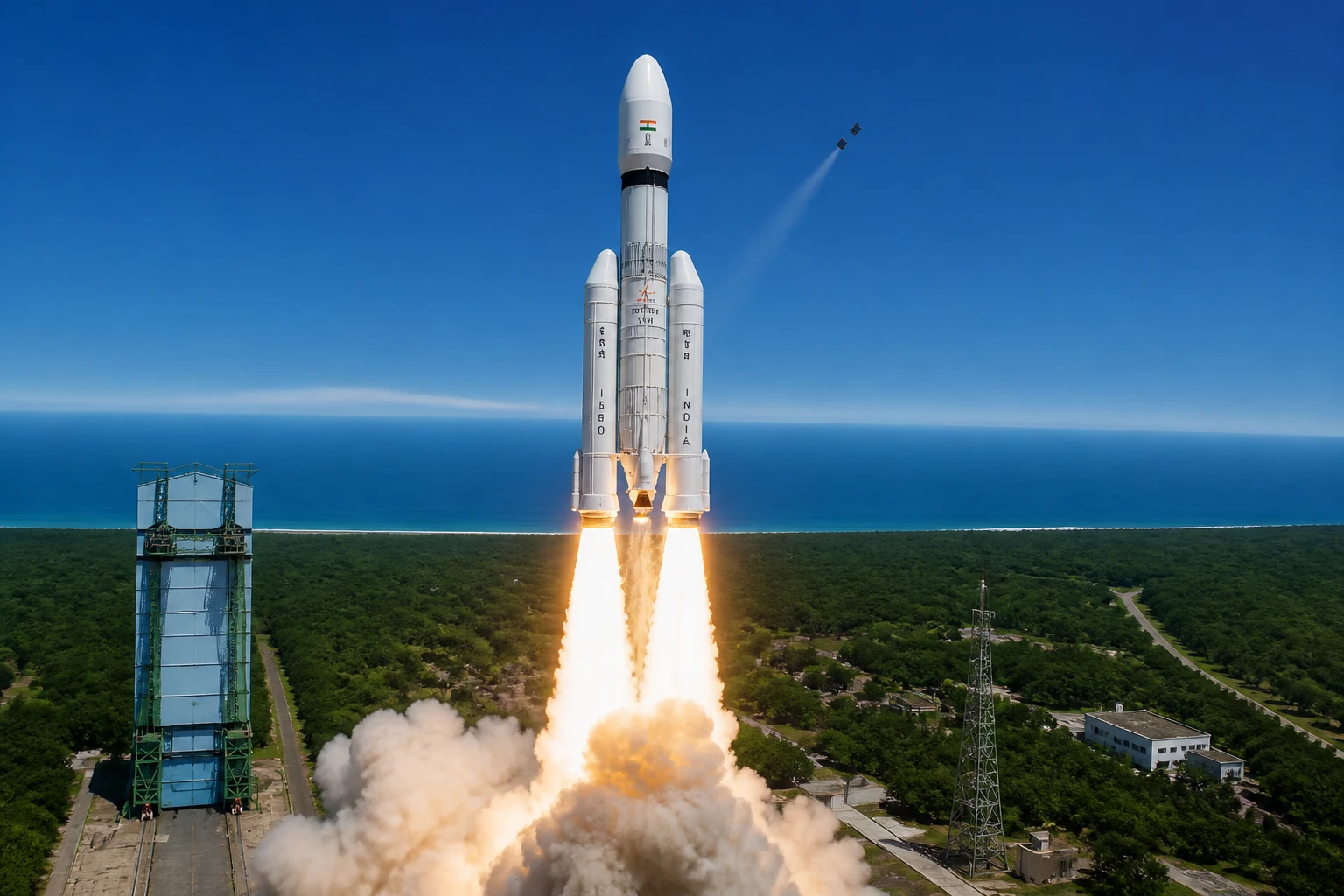
Skyroot Aerospace’s Vikram-1 reached a 450-kilometer orbit on its first flight on 18 July 2026, the first time an Indian private rocket has done so. That single success, backed by more than 400 space startups and a government target of a $44 billion domestic sector by 2033, is turning India’s long record of low-cost, application-first missions into a full package of design, launch, operations and training that other countries can buy without tying themselves to one superpower.
The second-order result is already visible. Nations that need Earth observation, navigation or communications no longer face a binary choice between American or Chinese systems. They can take an Indian stack that still carries the development DNA of Vikram Sarabhai.
The Private Rocket That Reached Orbit First Try
Mission Aagaman lifted off from Satish Dhawan Space Centre after a short delay and placed its upper stage and payloads into the planned orbit 15 minutes later. The vehicle carried two cubesats plus hosted experiments. Co-founder and CEO Pawan Kumar Chandana called it a historic moment for India and the global sector.
In the first attempt reaching orbit, I never thought it was possible, but the Skyroot team made it possible.
Chandana said that after the flight, speaking at the pad. Skyroot had raised $60 million weeks earlier to scale Vikram-1 production and begin Vikram-2. The company plans further test flights this year before commercial runs. Vikram-1 can loft up to 350 kilograms to low Earth orbit; strap-ons will push that toward 550 kilograms.
The launch sits inside a broader private surge. From a single registered space startup in 2014 the count passed 400 by February 2026. Investment topped $500 million overall, with roughly $150 million in 2025 alone. Pixxel, Agnikul Cosmos, Dhruva Space and Bellatrix Aerospace sit alongside Skyroot in the leading pack.
Global Market Math Favors New Entrants
A World Economic Forum and McKinsey study projects the global space economy to $1.8 trillion by 2035, up from about $630 billion in 2023. Commercial activity already dominates. Satellite services, Earth observation, broadband and emerging in-orbit work drive most of the growth.
| Metric | Value | Source window |
|---|---|---|
| Global space economy 2023 | ~$630 billion | WEF/McKinsey |
| Projected global 2035 | $1.8 trillion | WEF/McKinsey |
| India space economy recent | ~$8.4 billion | IN-SPACe / industry tallies |
| India share | ~2 percent | Industry estimates 2025-26 |
| India 2033 target | $44 billion | IN-SPACe decadal vision |
India’s share looks small until the growth rate is applied. Officials and industry both expect the Indian sector to expand faster than the global average, lifting its portion toward 7-8 percent if the $44 billion mark is hit. Downstream applications already make up the bulk of today’s Indian value. Upstream manufacturing and launch are the segments now accelerating with private capital.
That arithmetic creates room for mid-tier suppliers. Many countries want the services but cannot afford or politically accept sole-source dependence. Recent private space valuation swings elsewhere only heighten the search for diversified, lower-cost options.
Sarabhai’s Development Test Still Guides Every Mission
India’s program never began as a prestige race. Vikram Sarabhai framed satellites as tools for communications, weather, disaster warning, farming and education. That test still shapes decisions.
- 1970s-80s foundation, early INSAT and remote-sensing work locked the applications focus.
- 2008-2014, Chandrayaan-1 found water-molecule evidence; Mars Orbiter Mission reached orbit on the first try.
- June 2020, cabinet opened the sector to private players and created IN-SPACe.
- 2023, Indian Space Policy formalized non-government roles across the full value chain; India joined the Artemis Accords.
- August 2023, Chandrayaan-3 soft-landed near the lunar south pole.
- January 2025, SPADEX demonstrated autonomous docking, making India the fourth country to do so.
- June-July 2025, Group Captain Shubhanshu Shukla flew on Axiom-4 to the ISS and ran Indian microgravity experiments.
- July 2026, Skyroot Vikram-1 first private orbital success.
The same thread runs through Aditya-L1 solar data releases, NavIC navigation expansion and the planned Bharatiya Antariksh Station first module in 2028. Cost discipline stayed constant. Chandrayaan-3 and Mangalyaan both delivered world-class results at fractions of peer budgets.
What Full-Stack Partnerships Include
The old offer was mainly rides on PSLV or GSLV. The new pitch is wider.
- Satellite design and manufacturing support, including private platforms from firms like Pixxel for hyperspectral imaging.
- Launch services on both ISRO vehicles and emerging private rockets such as Vikram-1.
- Mission operations, ground-station access and data processing.
- Astronaut training pathways and capacity-building programs.
- Downstream applications tailored to agriculture, disaster management, maritime domain awareness and climate services.
IN-SPACe now handles authorization and promotion for non-government entities. The IN-SPACe authorization and promotion role includes seed funds, a dedicated venture vehicle and clearer FDI rules: up to 100 percent automatic in components, 74 percent in many satellite activities, 49 percent in launch systems. Public procurement still steers early contracts toward Indian firms so they can scale into export supply chains.
For a country that needs reliable weather data or coastal monitoring, the package can be sized to budget and delivered without technology lock-in clauses that create long-term leverage.
South Asia Satellite and the Artemis Choice
Concrete precedents already exist. The South Asia Satellite (GSAT-9) delivered communications, tele-education and disaster support to neighbors. ISRO has placed 434 foreign satellites launched by ISRO for more than 30 countries, universities and commercial operators. The United States remains the largest single customer by volume, yet the list also includes smaller states that treat the service as infrastructure rather than alliance signaling.
Joining the Artemis Accords in 2023 marked a deliberate step into lunar exploration norms while keeping India’s earlier Moon Agreement stance in view. Bilateral work with NASA (NISAR radar mission, astronaut training), ESA, JAXA and the Quad has deepened. The 2025 rebranding of iCET into the TRUST initiative kept space as a core pillar under the new U.S. administration. Japan and Australia partnerships add Indo-Pacific layers focused on situational awareness and commercial joint ventures.
On X and in industry roundtables the recurring observation is straightforward: roughly 100 nations need space services for security and civilian use yet cannot build full stacks themselves and prefer not to rely solely on the two largest powers. India’s combination of demonstrated reliability, lower cost and political non-alignment fills that gap. One startup founder put it as becoming the default reliable infra partner for the rest of the world.
Debris Rules Need Broader Tables
Orbital congestion, debris and resource claims are moving from specialist talk to diplomatic agenda items. India’s record of peaceful-use commitments plus its growing operational experience positions it to help write practical rules rather than simply accept them. The same development focus that once justified frugal missions now argues for equitable access: if space services matter for disaster response and food security, then governance cannot remain a closed conversation among a handful of established powers.
Faster approvals, stronger IP protection and deeper university-industry links remain unfinished work. The first uncrewed Gaganyaan flight is targeted for the fourth quarter of 2026, with crewed flight to follow. Chandrayaan-4 sample return and the Venus orbiter sit on the near-term map. Each success adds weight to the partnership offer.
The private orbital milestone of July 2026 did not invent India’s credibility. It simply made the full-stack alternative impossible to ignore. Countries shopping for capability now have a third shelf that is stocked, priced for development budgets, and run by a partner that still measures success by ground-level results rather than flags planted for their own sake.