Ukrainian drones, missiles and unmanned surface vessels struck Russia’s Black Sea port of Novorossiysk overnight on August 11-12, damaging two major grain terminals and several warships while a separate drone attack forced the Orsknefteorgsintez refinery 1,900 kilometers away to halt processing. President Volodymyr Zelensky said the port operation was unique and successful. Russia answered with ballistic and glide-bomb strikes that killed steelworkers in Zaporizhzhia and civilians elsewhere.
The week showed how far Ukraine’s long-range reach now stretches and what that reach collides with: global grain markets, Kazakh oil interests and Kyiv’s own thin stocks of high-end interceptors.
Novorossiysk Took the Heaviest Blow
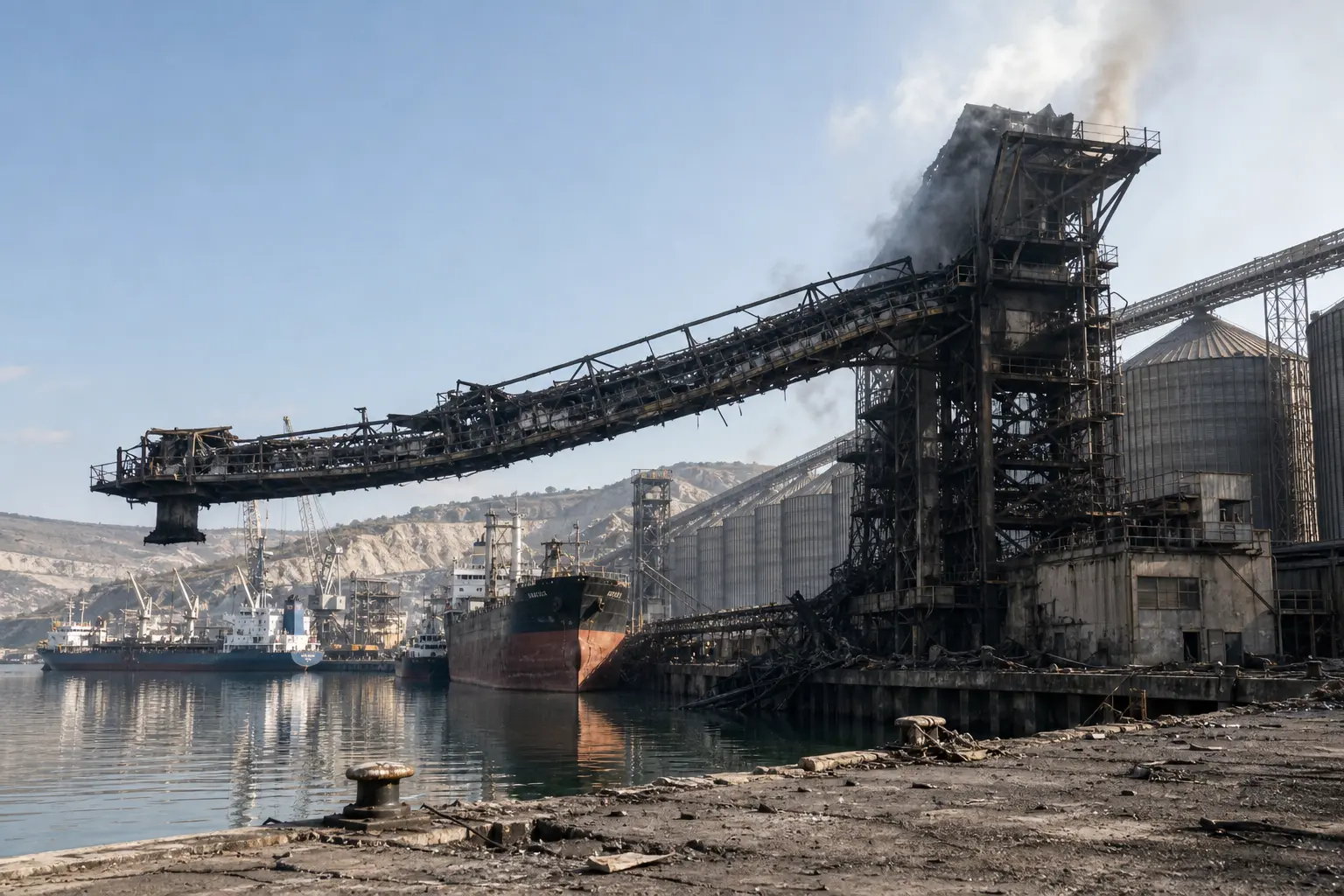
Novorossiysk has become Russia’s principal remaining Black Sea naval base after repeated earlier attacks pushed much of the fleet out of occupied Crimea. It is also a core grain and oil export hub. Industry sources told Reuters that the Novorossiysk grain terminal, with 8.5 million metric tons of annual export capacity and owned by Demetra Holding, suspended operations after damage. NKHP, another large terminal with 7.1 million metric tons capacity, also halted work.
That dual role is why the port mattered so much in a single night. Damage to piers and air-defense positions threatens the fleet that still shelters there. Damage to the grain terminals hits export volumes that Russia has used both for revenue and for diplomatic leverage over food-importing states.
Zelensky described a unique operation on the naval base more than 300 kilometers from the front line that used Palianytsia jet-powered drones, Neptune missiles and unmanned naval systems. Hits on air-defense positions, piers and seaport infrastructure were confirmed, he said. A later update listed the Admiral Essen and Admiral Makarov frigates, a large landing ship, a corvette and other vessels among the targets.
| Target | Claimed or reported effect | Capacity / note |
|---|---|---|
| Novorossiysk grain terminal (Demetra) | Damaged, operations suspended | 8.5 million metric tons export/year |
| NKHP grain terminal | Damaged, operations halted | 7.1 million metric tons export/year |
| Admiral Essen, Admiral Makarov | Hit (Ukrainian claim) | Black Sea Fleet frigates |
| Large landing ship, corvette | Hit (Ukrainian claim) | Additional vessels in bay |
Krasnodar governor Veniamin Kondratyev said the attacks killed at least two people, including an eight-year-old child, and damaged residential and commercial buildings. Russian authorities put the death toll at three. Ukraine’s grain exports in the first half of August were reported 76 percent lower than the same period a year earlier, a figure that sits against Russia’s own warnings that Black Sea disruptions threaten global food supplies.
The two halted terminals alone account for a large share of the port’s grain throughput. Even a short suspension tightens loadings and raises shipping risk premiums for bulk carriers still working the roadsteads.
Refineries Burn Far from the Front
Away from the coast, Ukraine kept pressure on Russia’s oil-refining sector. On August 11 drones struck the Orsknefteorgsintez plant in Orenburg region. Industry sources told Reuters the fire damaged refining units and the plant ceased processing. Nameplate capacity is 5.76 million metric tons per year, or roughly 115,200 barrels per day. In 2024 it processed 4.2 million tons.
- Orsknefteorgsintez: 1,900 km from Ukraine, all primary distillation units reportedly hit, full halt after August 11 fire.
- TANECO, Nizhnekamsk (Tatarstan): struck August 10; Russian authorities reported 13 dead including a child and 39 injured, residential areas also hit; Ukraine said the target supported the war effort.
- Earlier in the week: reported strikes on refineries in Syzran and Ilsky.
- Gelendzhik area: drones hit a Volna Kupol Garant electronic-warfare system and later an S-400 battery roughly 500 meters away, both near the complex known as Putin’s Palace; Unmanned Systems Forces commander Major Robert Brovdi said the S-400 fired six missiles before burning for hours.
The pattern is clear. Ukraine is trying to cut fuel for the military, logistics and a major revenue stream at the same time it chips away at the air defenses that protect deeper targets.
Distance no longer offers much shelter. Orsk lies far beyond the range once considered practical for Ukrainian systems, yet primary distillation units there were reported hit hard enough to stop the plant. Strikes on electronic-warfare and S-400 sites near Gelendzhik show the same logic applied to the sensors and launchers that guard the coast.
Southeastern Settlements Change Hands Slowly
On the ground Zelensky said Ukrainian forces had retaken 745 square kilometers since the start of the year in the Oleksandrivka operation. He listed 26 settlements recovered along a roughly 60-kilometer stretch where the Dnipropetrovsk, Donetsk and Zaporizhzhia regions meet. Air-assault troops and attached units carried the effort, he said, and the operation went “exactly as planned.”
Independent monitor DeepState confirmed control restored over 19 settlements and advances in several more areas. The lists overlap substantially. Russian forces still pressed around Kostiantynivka-Druzhkivka in Donetsk and Ukraine made limited gains near Kupiansk. Fighting has settled into small-unit infantry assaults, drones and local penetrations rather than large armored breakthroughs.
| Source | Settlements cited | Other detail |
|---|---|---|
| Zelensky (Oleksandrivka operation) | 26 recovered | 745 km² along a ~60 km stretch |
| DeepState | 19 control restored | Advances noted in several further areas |
The gap between the two tallies is ordinary in an active sector. Contested edges move daily, and confirmation lags claims. What both accounts share is the scale: dozens of small places, not a sudden rupture of the line.
That tempo matches the wider ground war. Infantry, drones and short local pushes decide who holds a treeline or a village edge. Armor massed for deep breakthroughs has largely given way to attrition measured in fields and hamlets.
Russia’s Reply Hits Workers and Hospitals
Russia kept its own long-range campaign running. On August 11 missile, drone and glide-bomb attacks killed at least 10 civilians. Seven employees of the Zaporizhstal steel plant died when a ballistic missile struck the industrial site in Zaporizhzhia; the plant suspended operations. Three more people, including a 15-year-old boy, were killed in Dnipropetrovsk region. Strikes also hit Kyiv, including grounds near a children’s hospital, and earlier attacks killed three in Kharkiv and wounded eight in Odesa. Ukrainian drones killed five in Russia’s Belgorod region.
Key civilian and industrial tolls this week:
- Zaporizhstal: 7 workers killed, 21 injured, production halted after ballistic strike.
- Nizhnekamsk: 13 dead including a child, 39 injured in the refinery-area attack.
- Novorossiysk: 3 dead including a child per Russian reports.
- Broader August 11 wave: at least 10 civilians killed across Ukrainian cities.
Pope Leo renewed an appeal for an end to the war and respect for international humanitarian law. The pattern of mutual deep strikes now regularly produces civilian casualties on both sides of the border.
Industrial sites and residential blocks are absorbing the same long-range fire. When a ballistic missile hits a steel plant, production stops and workers die in the same moment. When drones and glide bombs reach city districts, the casualty lists lengthen without changing the front line.
Food Markets and the CPC Limit
Russia accused Kyiv of threatening global food security after the grain terminals stopped. Ukraine points to repeated Russian attacks on its own Black Sea and Danube ports. The second-order effect arrived quickly: heightened shipping risk in the Black Sea and pressure on already tight grain flows.
At the same time Ukraine accepted limits. After a US request, Kyiv temporarily stopped attacks on tankers using Novorossiysk that serve the Caspian Pipeline Consortium. The CPC carries predominantly Kazakh oil and involves US majors. The Financial Times and others reported Vice President JD Vance pressed the point to avoid destabilizing markets and harming non-Russian cargo. No indication emerged that CPC facilities themselves were hit in the latest wave.
What we know
- Two Novorossiysk grain terminals halted after confirmed damage.
- Ukraine paused tanker strikes linked to CPC following the US request.
- Orsk processing stopped after unit damage.
What remains unconfirmed
- Full extent of warship damage beyond Ukrainian claims.
- Exact repair timelines for the terminals and Orsk units.
- Whether the CPC pause is temporary or open-ended.
The deep-strike campaign therefore buys military and economic pressure while running into the interests of third countries and global commodity stability.
Grain and oil move through the same port complex under different political rules. Terminals handling Ukrainian or Russian-origin grain became fair game in Kyiv’s telling. Tankers lifting CPC barrels did not, once Washington asked for restraint. That split shows how far the maritime fight now reaches into allied diplomacy.
Interceptor Stocks Stay Thin
The intensifying air war has again highlighted Ukraine’s shortage of high-end air-defense interceptors. Zelensky has urged the United States and European NATO members to accelerate Patriot missile deliveries as Russia expands ballistic use, including systems Ukraine says come from North Korea. Kyiv is also developing its own ballistic and anti-ballistic capabilities under the European FREYJA program, contributing domestically produced missiles and launchers while partners supply radars and sensors.
Earlier record Russian drone waves against Ukrainian cities already stretched those defenses. Diplomatic contacts continue with little sign the fighting is near an end. Zelensky said Kyiv submitted new proposals to US negotiators; Steve Witkoff and Jared Kushner are expected to keep talking to both sides. Prisoner exchanges remain one of the few limited channels of cooperation; Russia published a list of 224 Ukrainian prisoners it said it was ready to swap, though each side accused the other of obstruction.
Earlier earlier Black Sea bridge security incidents already showed how contested the maritime theater remains. The latest week simply raised the stakes for both fleets and for the commercial traffic that still moves through the same waters.
The Week’s Strikes Followed a Tight Sequence
The blows did not land at random. They clustered across a few days and several theaters, each shot reinforcing the next.
- Earlier in the week: reported refinery strikes at Syzran and Ilsky, plus the Gelendzhik-area hits on a Volna Kupol Garant electronic-warfare system and a nearby S-400 battery.
- August 10: drones struck TANECO at Nizhnekamsk; Russian authorities reported 13 dead, including a child, and 39 injured.
- August 11: Orsknefteorgsintez ceased processing after fire damage to refining units; Russia’s missile, drone and glide-bomb wave killed at least 10 civilians, including seven Zaporizhstal workers.
- Overnight August 11-12: the Novorossiysk package hit grain terminals, air-defense positions, piers and, according to Ukrainian claims, multiple Black Sea Fleet ships.
Read in order, the sequence pairs economic targets with military ones. Refineries and grain terminals squeeze fuel and export revenue. Air-defense and naval hits try to open space for the next wave. Civilian deaths on both sides arrived inside the same calendar window.
Long Range Packages Now Mix Many Systems
Zelensky’s own summary of the Novorossiysk package listed a long roster of Ukrainian systems working together. In a post detailing the combined long-range weapons package details he named Palianytsia, Peklo, Bars, Long Neptune, multiple drone types and Sargan and Mamai unmanned surface vessels. He framed the results as fair response and said Ukraine would keep using long-range pressure to push Russia toward peace.
The mix itself is the point. Jet-powered drones, cruise missiles and unmanned surface vessels present different flight profiles and approach routes. Air-defense crews must track low, slow and sea-skimming threats at once. Hits claimed on frigates, a landing ship and a corvette, alongside piers and radar sites, suggest the package was meant to saturate the harbor’s defenses rather than rely on a single weapon type.
That same logic appears inland. Drones that reach Orsk or Nizhnekamsk force Russia to defend depth. Systems spent against those raids are systems not guarding the coast. The FREYJA effort and the pleas for more Patriot interceptors show the mirror problem on Ukraine’s side: deep strikes and dense air defense both consume scarce high-end munitions.
The campaign has already forced the Black Sea Fleet into a narrower sanctuary and taken refining capacity offline. It has also pulled global food prices, Kazakh oil flows and American political limits into the same fight, while Russian missiles keep finding factories and apartment blocks inside Ukraine. That is the balance the next weeks will test.