Italy’s Interior Minister Matteo Piantedosi took a proposal for EU-funded migrant return hubs in safe third countries to an extraordinary council of interior ministers, naming Armenia alongside African states and others as potential sites based on Rome’s Albania model.
The plan seeks bloc financing for expulsion centres where irregular arrivals would wait while asylum and return files are examined. It arrives as the original Italian-run sites in Albania remain far below design capacity after legal setbacks.
What Rome Wants the Bloc to Build
The government’s aim is a network of centres outside the EU for managing and returning irregular migrants, built through deals with origin and transit countries. Italian premier Giorgia Meloni floated the idea at the end of June after the new EU returns regulation advanced. Rome now wants the other 26 states to adopt and fund it.
Foreign Minister Antonio Tajani said ahead of the meeting that Italy and Denmark’s social-democratic government called the session so the Pact on Migration and Asylum is implemented and returns are activated. He spoke of new Albania-model centres in various African countries and more generally in origin and transit states.
Potential candidates listed by Italian media and confirmed in reporting include Ghana, Senegal, Tunisia, Libya, Mauritania, Egypt, Uganda, Ethiopia, Uzbekistan, Armenia and Montenegro. Some accounts also named Rwanda. Uganda stands out as one of the more concrete options; Germany, Austria and the Netherlands have already shown interest in projects there. Montenegro talks remain early. Financing coverage, EU plus national, is still open.
- African focus with several North and sub-Saharan states
- Non-traditional route countries: Uzbekistan, Armenia, Montenegro
- Uganda cited as furthest advanced among options
- No host country has confirmed agreement
The hubs would handle foreign nationals who reached EU territory unlawfully. Asylum and immigration files would be examined there under the new framework that allows transfers to third countries upholding human rights, international law and non-refoulement.
Rome’s pitch treats the Albania bilateral deal as a proof of concept that the wider bloc can copy. The difference is scale and money. A single member state carried the first experiment; the new plan asks the EU budget to underwrite a dispersed network so that no one capital bears the full cost alone.
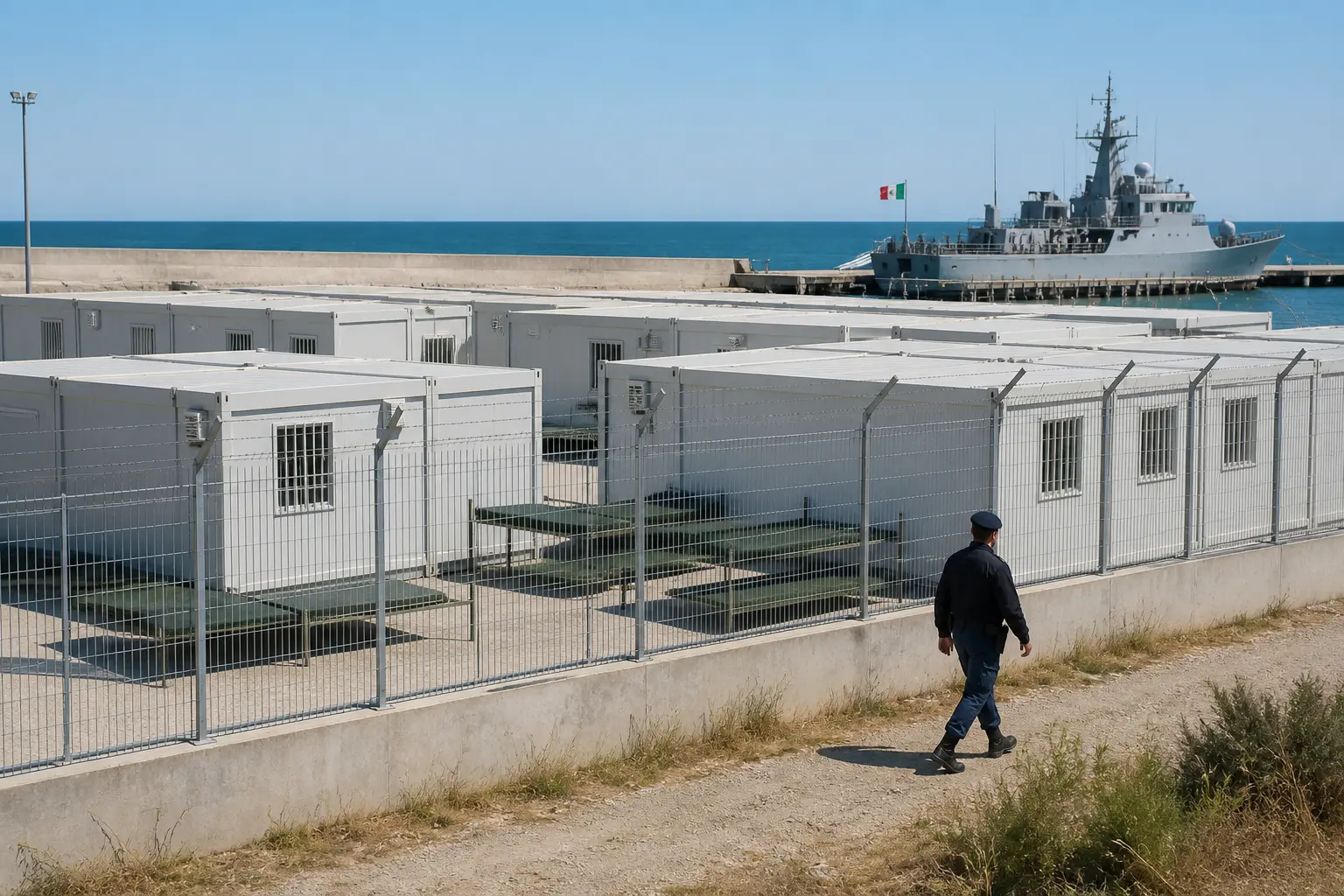
The Albania Prototype Still Runs Light
Italy’s bilateral deal with Albania produced two main facilities: an initial reception hotspot at the port of Shengjin and the larger complex at Gjader. The model treated the sites as Italian border areas under Italian jurisdiction and law, with Rome handling decisions.
Initial ambitions were high. The centres were designed for fast-track border procedures and a capacity estimated at up to 3,000 people a month, or 36,000 a year. Reality has been different.
| Facility section | Intended function | Beds |
|---|---|---|
| Gjader main | Asylum seekers | 880 |
| Gjader CPR | Repatriation holding | 144 |
| Gjader small unit | Holding for criminal proceedings | 20 |
| Shengjin | Initial hotspot reception | Port facility |
Since April 2025 the site has operated mainly as a detention centre for returns. Only a few hundred people have passed through. Detention orders have often failed judicial validation, slowing everything. EU lawmakers reported being blocked from fully inspecting the centres earlier. Piantedosi now wants the Gjader complex back at full capacity by year-end or sooner if legal proceedings clear.
Stats snapshot
- Design target: up to 36,000 migrants a year
- Actual throughput: a few hundred since repurposing
- Detention ceiling under new EU rules: up to 24 months plus possible six-month extension
- Historic EU return rate: around 29 percent of those ordered to leave
A March 2025 Italian decree expanded the Albanian sites into repatriation hubs so migrants already in Italy could be transferred there. Courts and the European Court of Justice have repeatedly constrained the safe-country lists and detention practices that underpin the scheme.
The gap between design and delivery matters for the EU pitch. If the flagship bilateral sites still run light after legal setbacks, any bloc-wide replica will face the same courts, the same inspection demands and the same need for host-country consent before beds fill.
Ceuta Pressure and a Fresh Returns Law
The extraordinary ministers’ meeting followed a sudden surge into Ceuta, the Spanish enclave on the Moroccan coast. Reports put the number of migrants forcing entry over recent days as high as 70,000. Social-media campaigns circulated instructions and videos. Spain deployed extra police and military.
That crisis sharpened an Italy-Spain clash. Tajani called Madrid’s approach ideological manipulation and said the “everyone come to Europe” line is wrong because Europe cannot take everyone. He claimed most other countries and the Commission back Italy’s rigorous stance over Spain’s. Meloni floated suspending Schengen arrangements with Spain; Finland and Denmark were said to be supportive. German Chancellor Friedrich Merz urged Morocco to take people back and Spain to regain control.
The timing also tracks the new EU returns regulation. Parliament and Council negotiators struck a provisional deal that explicitly allows removal to a third country under an agreement, including so-called return hubs. Transfers exclude unaccompanied minors. Host countries must uphold human rights and non-refoulement. Member states inform the Commission and others before agreements apply. Several provisions on return hubs apply immediately after entry into force.
- March 2025: Commission proposal for overhauled return procedures
- June 2026: provisional Parliament-Council deal on new EU rules on migrant returns
- End June 2026: Meloni first floats EU-level Albania-style hubs
- Early August 2026: Ceuta surge triggers extraordinary interior ministers meeting; Piantedosi presents the network plan
Rapporteur Malik Azmani (Renew, Netherlands) said the goal was an effective, fair and workable system after nearly two decades. The regulation still needs formal adoption.
Ceuta gave Rome a live example to put beside the legal text. A sudden mass entry on the Spanish-Moroccan frontier, followed by an extraordinary council, let Italy argue that external hubs and faster returns are operational needs rather than abstract preference.
Armenia Appears on a Preliminary List and Quickly Denies It
Armenia’s inclusion drew immediate attention because the country sits far from main Mediterranean routes and has been deepening ties with the EU. Corriere della Sera and subsequent reports placed it on the same preliminary roster as several African states, Uzbekistan and Montenegro. The list itself is not brand new; similar names circulated in April when EU countries explored return-hub partners.
Yerevan’s response was flat. Foreign Ministry spokesperson Ani Badalyan told Armenpress the country had received nothing.
We have not received such a proposal, and no such issue has been discussed with us.
Badalyan’s statement came after Euronews and Italian outlets named Armenia. Russian-language media amplified the story into claims of concrete plans or large-scale transfers, which Armenian fact-checkers and the ministry rejected. No negotiations, no approach, no agreement. The 4 August videoconference agenda focused on Ceuta, not on naming hosts.
On X and in Armenian commentary the naming alone triggered sharp pushback: fears of becoming a “migrant dump,” questions about trading dignity for Western approval, and irritation that a prelim list became domestic political fodder. The episode shows how quickly a speculative European brainstorm can land as a sovereignty issue in the Caucasus.
For EU planners the denial is a reminder that a name on a media roster is not a host. Public refusal raises the political cost for any later approach and signals that non-route countries may reject the role even before talks begin.
Italy Gains Agenda Control While Hosts Stay Speculative
Meloni’s government has turned the Albania experiment into the reference point for EU externalisation even while the pilot under-delivers. The Commission has previously praised out-of-the-box thinking. Other member states now explore similar deals. Italy positions itself as the rigorous alternative to what it calls Spanish laxity.
Spain faces the immediate Ceuta pressure and Italian criticism that its approach is too open. Potential host countries face a different calculus: EU money and political partnership on one side, domestic backlash and operational burdens on the other. Uganda appears furthest along in quiet talks. Armenia’s denial keeps it off the table for now. African states already linked to migration routes carry different political weights than Caucasus or Central Asian names.
Inside Italy the Albania project has cost hundreds of millions of euros estimates range higher than original budgets and well above domestic facilities. Rights groups and courts keep testing detention standards and safe-country designations. Expanding the model EU-wide multiplies both the ambition and the legal surface area.
Italy’s broader migration diplomacy continues in parallel. Meloni’s planned Bangladesh visit fits the same pattern of origin-country engagement. Separate domestic gestures, such as when Italy honored an Egyptian father and son who stopped an attacker in Modena, show the government mixing enforcement messaging with selective recognition.
How Third Country Transfers Would Function
The provisional returns deal supplies the legal hinge Rome wants to use. Once formally adopted, it lets a member state remove a person to a third country when an agreement exists and the host upholds human rights, international law and non-refoulement.
Unaccompanied minors stay outside that transfer path. Member states must inform the Commission and the other capitals before an agreement applies. Several hub-related provisions take effect as soon as the regulation enters into force, shortening the wait between law and practice.
Inside a hub the file work would cover both asylum and return. Detention ceilings under the new rules run up to 24 months, with a possible six-month extension. That longer holding window is meant to give administrations time to secure onward removal to origin countries, a step where the historic EU return rate of around 29 percent of those ordered to leave has long been the weak link.
| Step | What the framework requires |
|---|---|
| Agreement | Deal with a third country that meets rights and non-refoulement tests |
| Notice | Member state informs Commission and other states before use |
| Transfer scope | Foreign nationals who reached the EU unlawfully; minors excluded |
| On-site process | Asylum and return files examined at the hub |
| Onward move | Return pipelines from hub to origin country still required |
The mechanism therefore shifts location, not the final obligation. Hubs only work if origin states still take people back after the EU-side procedures finish.
Candidate Regions Carry Uneven Political Weight
The preliminary roster mixes two kinds of geography. One cluster sits on or near established Mediterranean and African routes: Ghana, Senegal, Tunisia, Libya, Mauritania, Egypt, Uganda, Ethiopia and, in some accounts, Rwanda. The other cluster lies far from those paths: Uzbekistan, Armenia and Montenegro.
That split shapes leverage and risk.
- Route-linked African states: already part of migration diplomacy; EU money and partnership may look familiar, yet domestic politics can still reject hosting.
- Uganda: furthest advanced among options, with Germany, Austria and the Netherlands already showing interest.
- Montenegro: talks remain early; proximity to the EU changes the optics of any deal.
- Armenia and Uzbekistan: non-traditional names that can read as sovereignty tests the moment they appear in European media.
No host country has confirmed agreement. Uganda’s quieter progress contrasts with Armenia’s public denial. African partners tied to existing routes may negotiate from a different baseline than Caucasus or Central Asian states asked to accept a role they never sought. The political weight of each name therefore differs even before financing or bed counts enter the discussion.
Money Levers and the Road Ahead
Rome wants the new hubs financed through the EU budget. Exact shares remain unsettled. Parallel pressure comes via trade tools. Italy will push stricter application of the Generalised Scheme of Preferences Plus (GSP+), which links tariff benefits for developing countries to cooperation on readmitting citizens who stay illegally. The updated GSP+ enters force from 1 January 2027.
Key practical hurdles sit in plain view:
- Finding third countries willing to host and able to meet human-rights conditions
- Securing multi-year EU financing without national free-riding fights
- Clearing judicial and ECJ constraints that have already slowed Albania
- Building actual return pipelines from the hubs onward to origin countries
- Managing the political optics when a named country, like Armenia, publicly refuses
Budget share fights and GSP+ conditionality are two sides of the same problem. Without predictable EU money, bilateral fatigue sets in; without trade leverage on readmission, hubs risk becoming holding sites with nowhere left to send people.
Piantedosi’s presentation puts the idea on the table. Whether any hub beyond Albania opens in 2026 or 2027 depends on deals that do not yet exist and on courts that have already trimmed the first version. The Albania sites themselves are still being coaxed back toward the capacity Italy first advertised. Scaling that record across a dozen candidate countries is the bet now being socialised in Brussels.
The proposal turns a contested bilateral experiment into an EU-wide template at the moment the original hardware is still running light and one named candidate has already said no.