Georgia’s Public Service Commission is reviewing a 100-page unsigned contract between OpenAI and Georgia Power that would deliver 3.2 gigawatts of electricity to a $20 billion data center campus in Effingham County. The power equals the needs of roughly 2 million homes and arrives in phases from 2028 to 2032.
Commissioner Peter Hubbard expects the deal to take effect around August 14 if staff raise no formal objection. The review itself is required under rules the PSC adopted last year, yet the deeper question is who covers the infrastructure bill if OpenAI exits early.
The Contract Sitting on the Table
Georgia Power filed the contract with the PSC on July 15. At 3.2 gigawatts the load is 32 times the 100-megawatt threshold that triggers mandatory review. OpenAI will pay all construction costs for the utility infrastructure needed to serve the site, according to both companies.
- 3.2 GW total contracted capacity
- Phases 2028-2032 for full delivery
- 25-year agreement term
- $20 billion project cost (over $30 billion at full build-out)
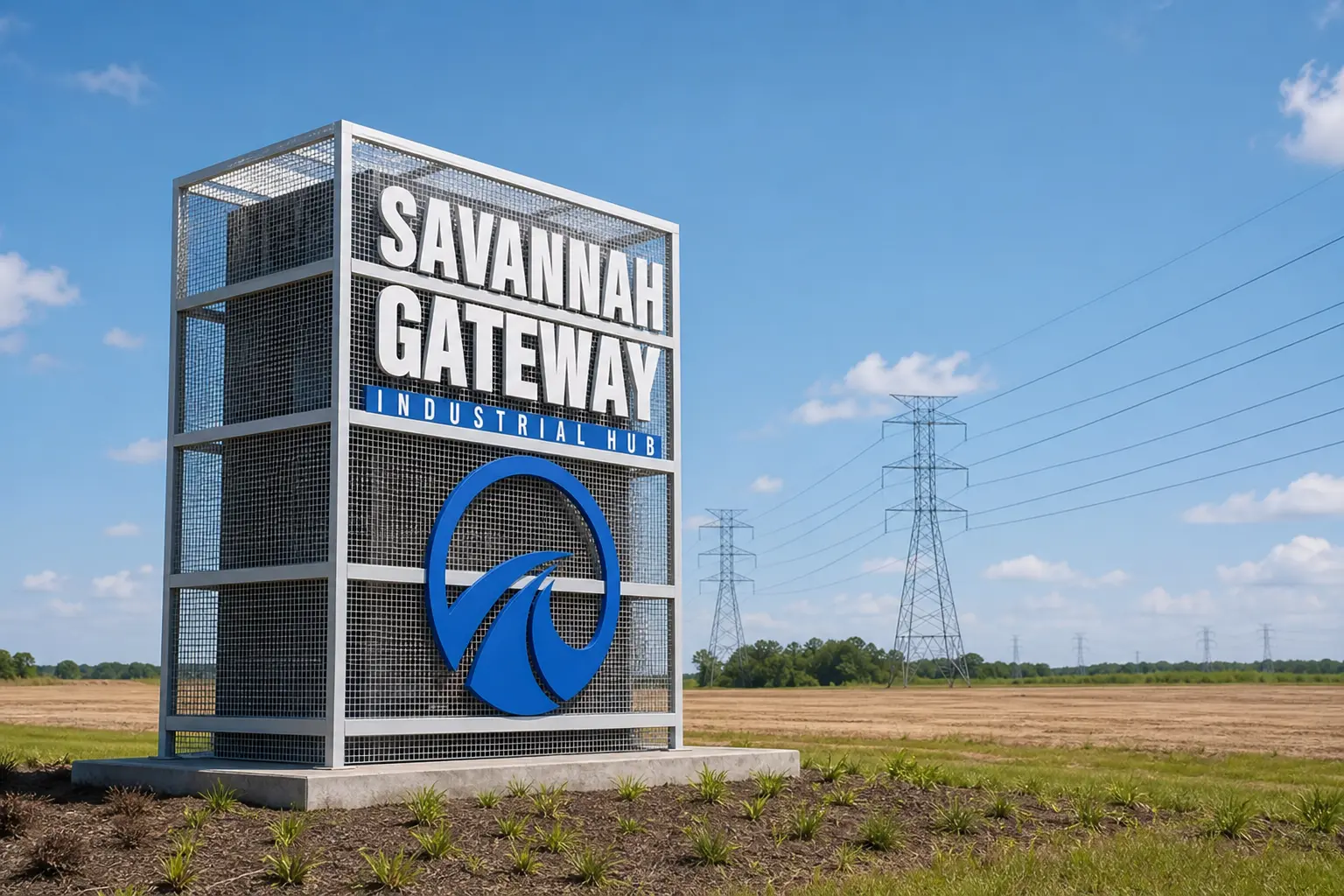
The filing follows the July 22 public announcement of Project Camellia at the Savannah Gateway Industrial Hub. Georgia Power said the arrangement includes financial assurances meant to shield existing customers from higher rates.
The sheer size of the filing explains the mandatory review. A load thirty-two times the trigger threshold leaves little room for a quiet administrative pass. Staff must examine the cost-recovery language, the collateral terms, and the exit clauses before the roughly thirty-day clock runs out.
Both companies describe the deal as customer-protected on paper. The test is whether those protections survive the first real stress, whether market, technical, or political.
How Georgia Wrote Its Large-Load Rules
Demand forecasts at Georgia Power exploded in just a few years. In 2022 the utility projected only 400 megawatts of added generation need over seven years. By late 2025 that figure had become nearly 10,000 megawatts, with data centers driving most of the growth.
- January 2025: PSC approves new rule requiring minimum billing, longer contract terms, and 30-day advance filing of data-center contracts over 100 MW.
- April 2025: Commission adjusts price structures for large-load customers.
- July 2025: Base rates frozen through 2028.
- December 19, 2025: PSC certifies 9,985 MW of new energy generation, roughly 80 percent expected to serve data centers, with Georgia Power backstopping costs through 2031.
If contracts fail to materialize, the commission retains tools to suspend projects, close plants early, end out-of-state purchase agreements, or sell excess power on the open market. The same framework produced Georgia Power’s battery storage built for surging data center loads.
The sequence shows a regulator racing to catch a forecast that multiplied roughly twenty-five times in three years. Each step tightened billing, lengthened terms, or froze rates while new generation cleared the certification process. The backstop through 2031 keeps the utility on the hook if the loads never arrive, at least on the generation side.
| Forecast Year | Added Generation Need | Main Driver |
|---|---|---|
| 2022 | 400 MW over seven years | Conventional growth |
| Late 2025 | Nearly 10,000 MW | Data centers |
| Certified Dec. 2025 | 9,985 MW | Roughly 80 percent data centers |
Hubbard Flags the Early-Exit Gap
Hubbard, a Democrat elected in the November 2025 special election amid public anger over rising bills, has repeatedly warned that the rules still contain loopholes. At a recent fundraiser he laid out the core risk in plain terms.
One is that it’s a long-dated contract, but they can get out of that contract before the end of it, and so the dollars aren’t there to go to the end of the contract. And if they do that, then someone has to pay for the infrastructure that was built. And if it’s Republicans controlling the commission, it means ratepayers pay it. If it’s Democrats on the commission, it means shareholders eat that, so we need data center accountability.
He added that the contract carries no clean-energy requirement and will draw from a grid that is half fossil or more. Hubbard is on the ballot again this year for a full six-year term against Republican Fitz Johnson, who was on the commission when the 2025 rules were written.
Johnson told The Current that Georgia’s large-load protections rank among the strongest in the country and that other states have copied them. He stressed that strong rules still require enforcement.
The political split is therefore not only about the wording of the contract. It is about who will sit on the five-member commission when an early exit, if one ever comes, forces a choice between ratepayers and shareholders. Hubbard’s special-election win already shifted the balance. The full-term race will decide whether that shift holds.
What the Demand Response Clause Delivers
OpenAI has agreed to supply up to 1,000 MW of flexible demand response. Georgia Power can curtail power to the campus during peak system stress. The utility calls it one of the largest single-facility demand-response commitments in the United States.
That flexibility lets the company build less new generation than the raw 3.2 GW load would otherwise require. Georgia Power projects the overall large-load strategy will produce at least an additional $102 in annual savings for a typical residential customer after the rate freeze ends in 2029, on top of an earlier $50 reduction.
- Full infrastructure and service costs paid by OpenAI
- Long-term contract with minimum monthly bill
- Collateral and termination payments on early exit
- Independent annual audit of community commitments
Whether those paper protections hold if the AI market cools remains the open question.
The 1,000 MW of curtailable load functions as a safety valve. During system peaks the utility can dial the campus down rather than fire every available plant or buy emergency power. That option reduces the amount of steel-in-the-ground generation the 3.2 GW headline number would otherwise force. The projected residential savings rest in part on that reduced build-out.
Phased Delivery Spreads Construction Risk
The contract does not dump the full 3.2 gigawatts onto the grid on a single day. Delivery stretches across phases from 2028 to 2032. That schedule gives Georgia Power time to match transmission upgrades, generation additions, and the campus build-out itself.
Phasing also limits how much stranded investment appears if the project stalls midway. Infrastructure built for an early phase can still serve later loads or, if necessary, be redirected. The 25-year term then locks in revenue once each phase is energized, provided the customer stays.
The same schedule, however, leaves a multi-year window in which political control of the PSC can change. Commissioners who approve the framework in 2025 may not be the ones who enforce exit terms in 2030. Hubbard’s current race and the five-member structure make that turnover concrete rather than theoretical.
OpenAI’s pledge to cover construction costs for utility infrastructure applies across those phases. The practical question is how cleanly the cost ledgers separate campus-specific work from system upgrades that also benefit other customers. The mandatory review is the first chance for staff to test that separation on paper.
Ratepayers, Shareholders and the Election Stake
The hidden stakeholder is ordinary Georgia Power customers. Their exposure depends on who sits on the five-member PSC when any future shortfall arrives. Hubbard’s election last fall already shifted the commission’s political balance after years of rate-hike backlash. His opponent argues the existing framework is sufficient if enforced.
| Scenario | If Republicans Hold PSC | If Democrats Hold PSC |
|---|---|---|
| Early contract exit leaves unpaid infrastructure | Ratepayers more likely to absorb cost | Shareholders more likely to absorb cost |
| Official company position | OpenAI pays full costs; financial assurances protect customers | |
| PSC backstop on new generation | Georgia Power covers costs through 2031 if loads fail to appear | |
Hubbard has said he simply does not trust that the AI boom will never burst. Johnson counters that the rules already force large users to post collateral and pay termination fees. The August review window will test the first layer of those claims. The November election will decide who interprets the rest.
The generation backstop through 2031 and the contract-level collateral sit on different ledgers. One protects against loads that never appear. The other tries to protect against a customer that appears, takes power, then leaves before the infrastructure is paid off. Hubbard’s critique focuses on the second gap. Johnson’s defense focuses on the strength of the written tools and the need to use them.
How Collateral and Termination Fees Function
The large-load rules require minimum monthly bills, longer contract terms, collateral, and termination payments. Together they aim to keep the utility whole if a big customer walks away. The minimum bill ensures some revenue even if the campus runs below its contracted capacity. Collateral provides a cash buffer. Termination fees are meant to cover remaining infrastructure costs.
Those tools only work if the numbers match the actual stranded cost and if the commission enforces them. A shortfall between the posted collateral and the true remaining bill is exactly the gap Hubbard describes. Who fills that gap then becomes a political decision rather than an automatic contractual one.
Johnson’s point that other states have copied Georgia’s framework underscores the stakes. If the first major test case leaves ratepayers holding unpaid assets, the model loses credibility beyond Georgia. If the protections hold, the copied rules gain a working precedent. The OpenAI contract is large enough to serve as that test.
- Minimum monthly bill keeps baseline revenue flowing
- Collateral supplies an immediate cash backstop
- Termination payments target remaining infrastructure balances
- Annual independent audit tracks community-side promises
Local Promises Meet Local Doubts
OpenAI has pledged $80 million in community benefits over the project life for schools, public safety, health care, workforce training and related priorities. It also offers up to $71 million in Codex coding credits for Georgia college and technical students. The company says it will become the county’s largest taxpayer and will use a closed-loop cooling system that recirculates water like a car radiator, keeping ongoing water use comparable to an office building of similar staff size.
Residents who packed a July community meeting remain skeptical. The project was negotiated largely out of public view before the sudden announcement. Some online reaction notes that 3.2 GW approaches 70 percent of the output of one reactor at Plant Vogtle and roughly three times Atlanta’s average consumption. Construction jobs are temporary; permanent headcount is far smaller. Transmission upgrades already raise eminent-domain fights in other parts of the state.
An independent annual audit is supposed to keep the community compact honest. Whether that report arrives before or after any early exit will matter.
The water claim rests on the closed-loop design. By recirculating coolant, the campus avoids the continuous withdrawal that once-through systems demand. Residents still weigh that technical point against the secrecy of the pre-announcement talks and the scale comparisons that place the load near a nuclear unit and well above a major city’s draw.
Community money is spread across schools, public safety, health care, and workforce training. The Codex credits add a separate education channel aimed at colleges and technical students. Both streams depend on the project lasting long enough for the dollars to flow. An audit that lands after an exit would document promises more than it would enforce them.
The unsigned contract now sits with PSC staff. If no objection is filed, it becomes effective roughly 30 days after the July 15 submission. The larger political and financial test arrives later, when the first phases energize and the next set of commissioners decides how firmly the paper protections are enforced.