The Southern Delta Aquariids reach their 2026 peak on the night of July 30 into 31 under a moon still 98 percent full, washing out most of the faint meteors that define the shower. Skywatchers who treat the calendar date as the main event will see far fewer streaks than the listed rates promise.
That timing turns the “best” night into the hardest. Brighter Alpha Capricornid fireballs peaking the same window, plus darker mornings earlier in the week, become the practical payoffs.
Peak Night Meets the Buck Moon
EarthSky places the predicted peak near 10 UTC on July 30. The International Meteor Organization lists a ZHR of 25 and 98 percent full moon for that night. The American Meteor Society marks the Southern delta Aquariids maximum on July 30 with the same velocity class around 40 km per second.
Full moon occurred at 14:36 UTC on July 29. By peak night the moon remains a bright waning gibbous that lights the sky after it rises and stays high for hours. Delta Aquariid meteors are typically faint. Moonlight erases the majority of them.
- Peak window: night of July 30-31, 2026
- Ideal ZHR: 15-25 under truly dark skies
- Moon at peak: ~98% illuminated
- Entry speed: about 41 km/s
The shower itself runs longer. Activity spans roughly July 12 to August 23, with a broad plateau rather than a sharp spike. Rates hold for several nights around the listed maximum, which means the darkest available mornings before the full moon still offered cleaner views.
A listed ZHR of 25 assumes a radiant overhead and a sky free of moonlight and haze. Neither condition holds on peak night for most observers. The gap between paper rates and what the eye can catch is the central problem of this year’s display.
Because the plateau is broad, the calendar maximum is only a label. Nights when the moon sets earlier or sits lower still carry useful activity even if they fall a day or two off the official peak.
Radiant Rises in the South
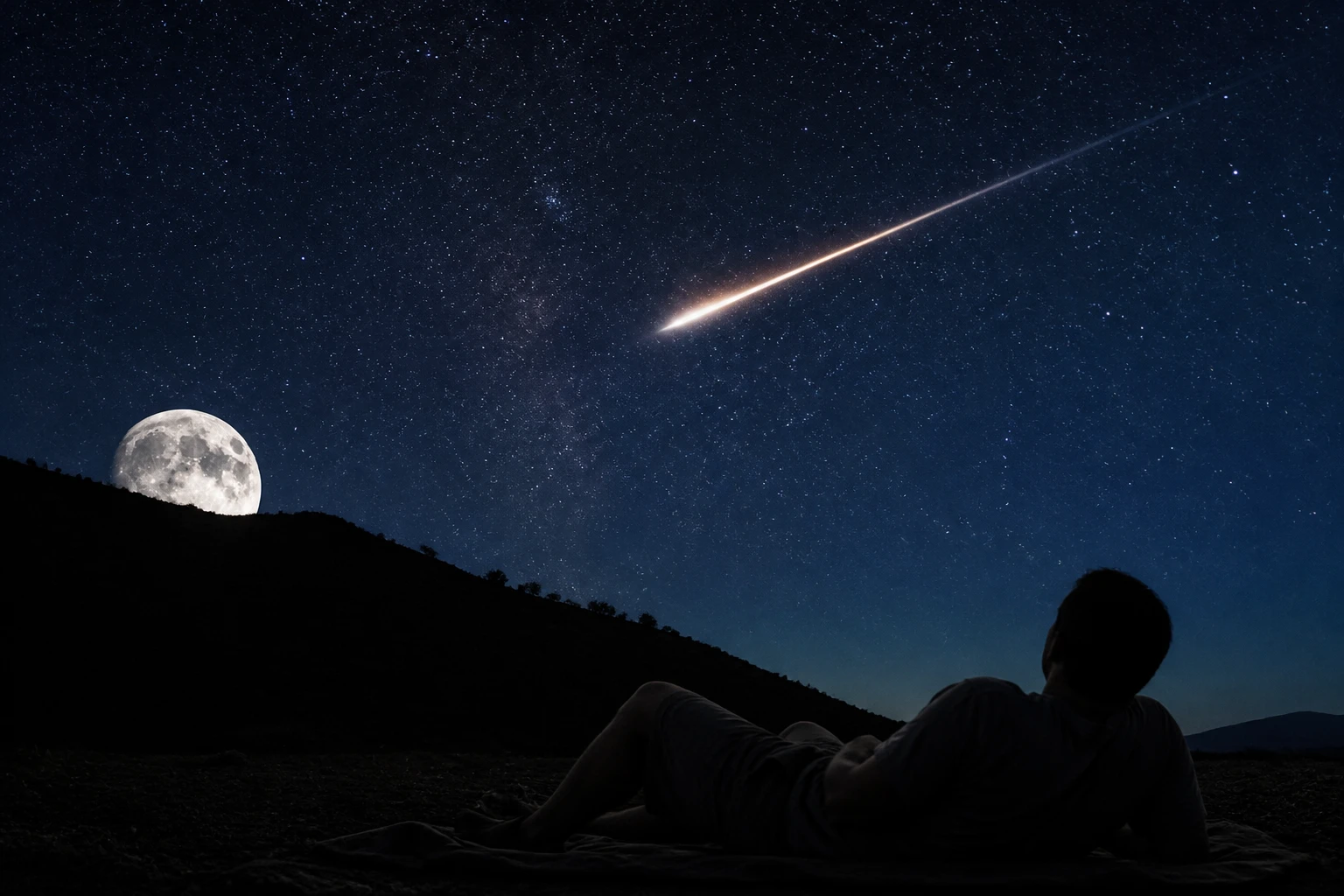
Meteors appear to stream from a point near the star Delta Aquarii, also called Skat, in Aquarius. That radiant rises in mid-evening, climbs highest around 2 a.m. local time, and sinks by dawn. From the Northern Hemisphere it stays low in the southern sky. From the Southern Hemisphere it rides higher, closer to overhead.
The bright star Fomalhaut serves as the practical landmark. Draw a line southward through the western side of the Great Square of Pegasus to find it, then look nearby for the radiant. Once located, look 40-45 degrees away from it. Meteors appear longer and more dramatic farther from the radiant point.
About 5 to 10 percent of Delta Aquariids leave short persistent trains, glowing gas trails that hang for a second or two. Those stand out even when the background is not perfectly dark.
The low northern radiant height shortens apparent paths and cuts the number of meteors that clear the horizon. Observers who wait until the radiant nears its 2 a.m. high point gain both longer trails and a better chance that a faint streak will register against residual moonlight.
Southern Skies Hold the Advantage
Geometry favors observers south of the equator and at lower northern latitudes. High northern sites see the radiant scrape the horizon, cutting rates hard. Southern tropics and mid-southern latitudes get the radiant high and the meteors more evenly distributed across the sky.
| Location type | Radiant height near 2 a.m. | Typical view quality |
|---|---|---|
| Southern Hemisphere mid-latitudes | High, near overhead | Best rates and longer paths |
| Southern U.S., low northern latitudes | Moderate in south | Solid if dark and moon blocked |
| High northern latitudes | Low on southern horizon | Sparse, short meteors |
Cities often cited for good geometry include Sydney, Auckland, Santiago, Sutherland in South Africa, and lower-latitude U.S. spots such as Miami or Flagstaff. Even there, light pollution and the moon still set the real limit. A dark site far from cities remains non-negotiable.
Latitude fixes how high the radiant climbs. Local darkness decides whether that height is worth anything. A southern mid-latitude site under heavy urban glow can still lose more meteors to light pollution than a darker northern site loses to a low radiant.
Capricornids Bring the Fireballs
The same nights also host the Alpha Capricornids. Their ZHR sits near 5, far lower than the Delta Aquariids on paper. What they lack in numbers they make up in brightness. The shower is known for occasional slow, bright fireballs that can cut through moonlight that erases fainter streaks.
Both showers peak together around July 30-31. An observer facing south after midnight can catch Delta Aquariids from the Aquarius radiant and Capricornids from a nearby point in Capricornus. Tracing a meteor backward to its radiant tells which shower produced it. In a rich hour the two streams can appear to cross paths.
Live Science and regional reports this week have stressed the dual peak and the fireball potential precisely because the moon is so bright. Gulf observers in Qatar and Oman still posted viewing notices for 20 meteors per hour under dark local skies, treating the event as visible despite the lunar glare. That optimism works better for the brighter objects than for the classic faint Delta Aquariids.
| Shower | Ideal ZHR | Character under moonlight |
|---|---|---|
| Southern Delta Aquariids | 15-25 | Mostly faint; many washed out |
| Alpha Capricornids | near 5 | Fewer but slow, bright fireballs |
The dual peak turns a washed-out single shower into a mixed display. A slow, bright streak is more likely a Capricornid. A faster, fainter one that leaves a brief train fits the Delta Aquariid profile. Sorting them by path and speed gives structure to an otherwise sparse night.
Old Dust from the Machholz Complex
The parent body is tied to comet 96P/Machholz and its wider complex. The late Don Machholz discovered the comet in 1986. The complex also feeds other showers, including the daytime Arietids and the Quadrantids. Dust particles that produce the Southern Delta Aquariids left the comet nucleus on the order of 20,000 years ago. They are old material now spread through the inner solar system.
Royal Museums Greenwich notes the likely source comet 96P/Machholz, a sungrazer roughly 6 km across that orbits every 5.3 years and passes well inside Mercury’s orbit. Earlier ideas linked the shower more tightly to the Marsden and Kracht sungrazing groups; dynamical studies still point mainly at 96P as the dominant supplier.
That long history explains the broad activity window. The Earth simply plows through a thick, long-lived stream rather than a tight fresh filament.
Old, dispersed dust does not deliver a narrow spike. It delivers steady background rates across many nights. That is why the week before full moon and the nights after peak still matter: the stream is wide enough that Earth stays inside it for weeks.
How the Calendar Window Unfolds Night by Night
The published dates already sketch a simple sequence. Arranged in order, they show why treating a single night as the whole story leaves meteors on the table.
- July 12: Southern Delta Aquariid activity begins its long rise.
- Earlier July: Earth reaches aphelion, its farthest point from the Sun.
- July 29, 14:36 UTC: Full moon arrives and begins to dominate the night sky.
- July 30 near 10 UTC: Predicted Delta Aquariid peak under a ~98 percent illuminated moon.
- July 30-31: Alpha Capricornids share the same peak window.
- After peak into mid-August: Delta Aquariid rates ease while early Perseids begin to mix in.
- August 23: Southern Delta Aquariid activity fades out.
The sequence makes the strategy plain. Darker pre-dawn hours before the July 29 full moon catch rising rates without the worst glare. Peak night itself favors the brighter Capricornid component. Later nights trade pure Delta Aquariid counts for a mixed bag that includes the first Perseids.
Orbital geometry sets both the meteor stream encounter and Earth’s distance from the Sun. The two are unrelated mechanically, yet both land in the same July stretch and both shape what reaches the ground observer.
A Playbook That Works Around the Moon
Calendar peak is not the only night worth trying. The week before full moon offered darker pre-dawn skies while rates were already rising. After peak the shower continues and early Perseids begin to mix in, giving more total meteors even if pure Delta Aquariid numbers ease.
Practical steps that still deliver under moonlight:
- Choose the darkest site you can reach and give your eyes 20-30 minutes to adapt. Keep phones and white lights off.
- Block the moon with a building, hill, or tree. Keep your back to it so glare stays out of your field of view.
- Lie flat or use a reclining chair for a wide sky view. Naked eyes beat binoculars or telescopes because meteors can appear anywhere.
- Watch from midnight through the pre-dawn hours when the radiant is highest. Rates climb as the radiant rises.
- Face generally south but scan a broad area 45 degrees from the radiant rather than staring at one spot.
Weather and local horizon still decide more than any forecast. Clear, dry air after a cold front helps. Humidity and haze scatter moonlight and kill contrast.
This July also brought Earth reached aphelion earlier this month, the farthest point in its orbit from the Sun. The two events are unrelated mechanically, yet both remind observers that orbital geometry shapes what we see from the ground.
Blocking the moon matters as much as choosing the right date. A hill or building that hides the waning gibbous can restore enough contrast for the brighter streaks and the short trains that 5 to 10 percent of Delta Aquariids leave behind. Without that shield, even a dark rural site loses most of the faint population.
When Bright Streaks Outweigh High Counts
Under a 98 percent moon the classic faint Delta Aquariid majority is largely gone. What remains is a thinner sample of the brighter members plus whatever Capricornid fireballs appear. That shift changes the goal of a session.
Observers chasing raw numbers will leave disappointed. Observers ready for a slower night that still produces an occasional vivid trail have a realistic target. The same geometry that favors southern latitudes also lengthens those surviving paths, so a bright meteor that does punch through has more sky to cross.
Gulf notices that still spoke of 20 meteors per hour under dark local skies reflect that adjusted expectation. The figure is not a promise of a classic Delta Aquariid night. It is a reminder that mixed activity and fireball potential can keep a moonlit session alive when pure rate chasing cannot.
What Remains Worth the Trip Outside
The Delta Aquariids will not produce a moonless storm this year. They still feed a multi-week stretch of southern-radiant meteors that pair with Capricornid fireballs and the rising Perseids. Observers who treat the peak date as optional and the moon as the real variable can still walk away with memorable streaks.
Find dark ground, block the glare, and stay out past midnight. The faint ones fade; the bright ones still fall.