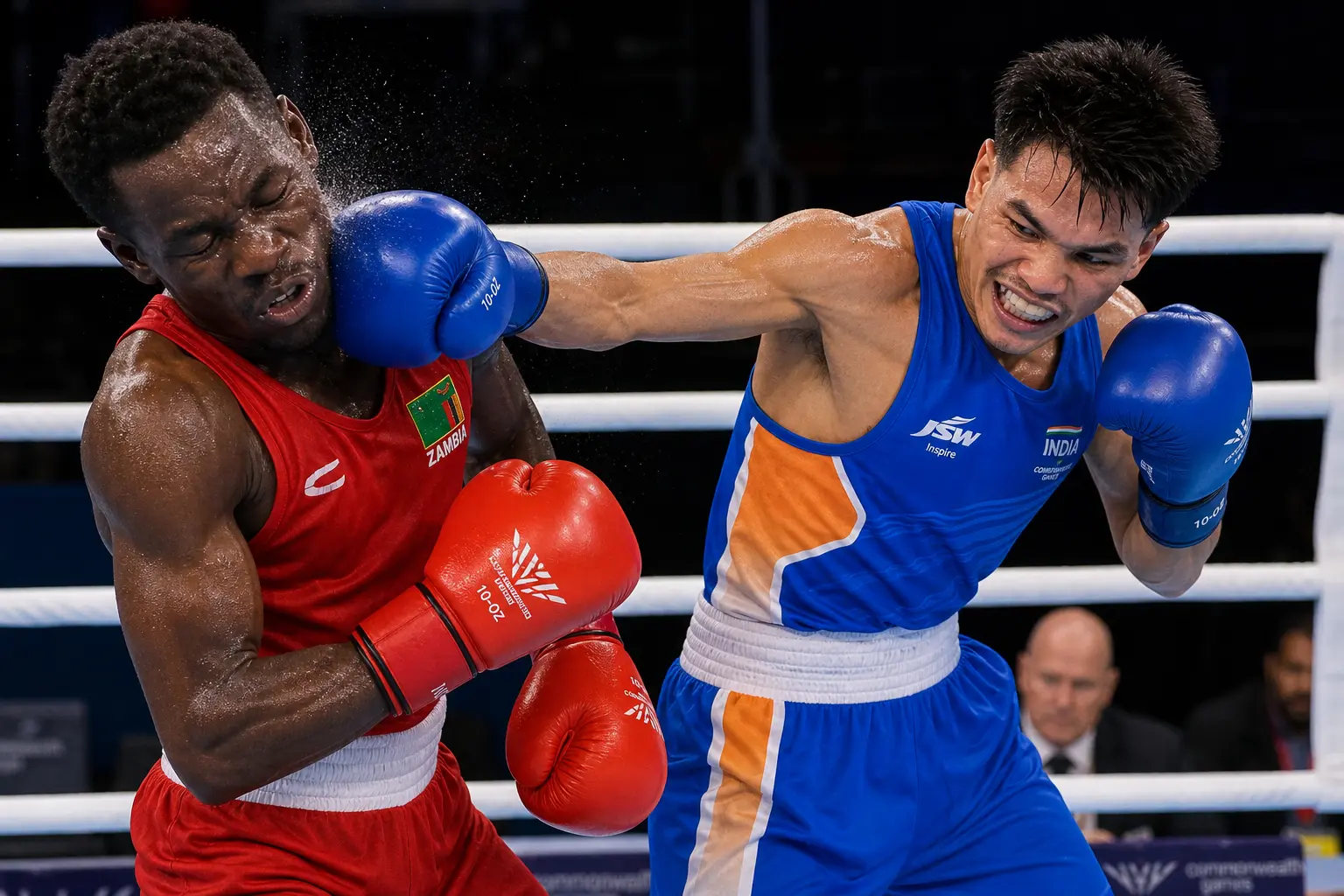
Indian boxer Jadumani Singh Mandengbam guaranteed at least a bronze medal at the 2026 Commonwealth Games with a unanimous decision over Zambia’s Mwengo Mwale in the men’s 55kg quarterfinals on Tuesday in Glasgow.
The 22-year-old Manipuri took a close first round then dominated the next two, winning on scores of 30-27 three times and 29-28 twice. The result added another podium lock for India’s boxing contingent on a busy night.
The win did more than advance one name. It confirmed that the squad’s younger tier could convert pressure rounds into hardware without waiting for a marquee final. That pattern has defined India’s recent Commonwealth boxing returns, and Glasgow is following it early.
How the Later Rounds Became One-Sided
Mwale opened aggressively with rapid combinations and forced Jadumani to work. The Indian still edged the opening round 4-1 on the cards through disciplined counters and clean shots.
From the second round the contest tilted. Jadumani set the pace with sharp footwork and accurate punching. He swept the second round unanimously and repeated the command in the third.
The shift was mechanical rather than dramatic. Once Jadumani controlled distance, Mwale’s early flurries lost their range and the Indian’s counters landed cleaner. That sequence is what the cards rewarded.
ESPN and agency reports described the final six minutes as one-sided. The full set of scorecards confirmed a clear 5-0 verdict. The 121-pound quarterfinal bout card listed the fight at SEC Hall 5 on July 28.
- Round 1: close, Jadumani 4-1 despite early pressure
- Round 2: unanimous for the Indian
- Round 3: commanding display sealed the cards
- Final tallies: three 30-27, two 29-28
Community picks on fight databases had favoured Mwale heavily beforehand. Jadumani’s technical control flipped that script.
The gap between pre-fight expectation and the final cards underlines how ring craft can override reputation in a three-round format. Judges rewarded the cleaner work once the Indian settled.
I dedicate my win to the Kargil heroes… I felt great winning against Pakistan.
That was Jadumani speaking after his earlier 5-0 Round of 16 victory over Pakistan’s Sumama Rehman, a result he tied to Kargil Vijay Diwas. The same composure showed against Mwale.
Composure across two straight unanimous decisions suggests a fighter who can reset between bouts and keep the same tactical plan under different kinds of pressure. That trait matters as the bracket tightens.
Three Indian Boxers Reach the Last Four Together
Jadumani was the third Indian boxer to book a semifinal place that day. Preeti Pawar and Priya Ghanghas also advanced and locked bronzes under Commonwealth Games rules that award medals to both losing semifinalists.
| Boxer | Category | Opponent | Score |
|---|---|---|---|
| Jadumani Singh Mandengbam | Men’s 55kg | Mwengo Mwale (ZAM) | 5-0 UD |
| Preeti Pawar | Women’s 54kg | Nicole Clyde (NIR) | 5-0 UD (multiple knockdowns) |
| Priya Ghanghas | Women’s 60kg | Niamh Mitchell (SCO) | 4-1 |
Preeti outclassed Clyde from the opening bell and scored knockdowns en route to scores including 30-25s. Priya dropped the first round in front of a home Scottish crowd then took the next two with superior ring control. Olympics.com coverage had flagged five Indian boxers in quarterfinal action that session, including Parveen Hooda and Kapil Pokhariya.
The three paths differed in texture yet converged on the same outcome.
- Preeti: early dominance and knockdowns left no doubt on the cards
- Priya: absorbed a difficult first round in a partisan hall, then seized control
- Jadumani: survived early pressure and turned the middle and late rounds into a procession
Lovlina Borgohain already held a bronze lock via a favourable draw that placed her straight into the women’s 75kg semis. India’s boxing medal floor rose quickly.
Four guaranteed boxing medals before the semifinals even begin gives the contingent room to chase gold without the fear that a single loss erases the campaign. That cushion is rare and useful.
Manipur Keeps Feeding India’s Boxing Pipeline
Jadumani arrives from Manipur, the same northeastern state that produced Mary Kom and a steady stream of national and international talent. He won silver at the World Boxing Cup Finals in the 50kg class in New Delhi in November 2025 and earlier took gold plus best-boxer honours at the Elite National Championships in 55kg.
At 22 he fits the young profile that has long powered Indian boxing. Local coaches and small training setups in Imphal have repeatedly turned out fighters ready for multi-nation stages. His Glasgow run continues that line without needing household-name status on arrival.
The route from state titles to a Commonwealth podium is familiar. National gold and a World Boxing Cup Finals silver supplied the competitive base. The Glasgow quarterfinal then tested whether that base held under Games pressure. It did.
Fans on X highlighted the state’s contribution alongside the three same-day locks. The pattern is familiar: a relatively unheralded Manipuri or northeastern boxer reaches the sharp end and converts.
That conversion rate keeps the pipeline credible. Each new name who locks a medal without prior star billing reinforces the next generation’s belief that the same path remains open.
India’s Boxing Medal Habit at the Commonwealth Games
Boxing has delivered for India across editions. The country holds India’s 44 prior Commonwealth boxing medals, including 11 golds, before Glasgow. The first gold came in 2002 when Mohammad Ali Qamar won light flyweight.
Mary Kom added a landmark women’s gold in 2018. Birmingham 2022 produced seven boxing medals. The 14-boxer squad in Glasgow, built around Olympic medallist Lovlina and a wave of newer names such as Jaismine Lamboria’s peer group, aimed to match or beat that haul.
- 2002 Manchester: Mohammad Ali Qamar takes India’s first CWG boxing gold
- 2010 Delhi: home success including Suranjoy Mayengbam flyweight gold
- 2018 Gold Coast: Mary Kom claims women’s light flyweight gold
- 2022 Birmingham: seven boxing medals overall
- 2026 Glasgow: multiple bronze locks already secured by Day 5
The depth shows in results that do not depend on a single star. Jadumani’s controlled performance fits the historical template exactly.
Eleven golds across more than two decades mean the event has rewarded consistency as much as individual brilliance. A 14-boxer squad spreads risk: if one category stalls, others can still fill the medal column. Glasgow’s early locks already illustrate that design.
The Same Day Advances Raise the Floor
Three quarterfinal wins on one night, plus Lovlina’s earlier bye into the semis, create a different kind of pressure for the remaining sessions. The medal floor is already secure in multiple categories. The remaining bouts become opportunities rather than must-wins for the overall tally.
That shift changes how coaches and athletes can approach the semifinals. A fighter who already holds a bronze can take calculated risks in search of a final place. The squad as a whole can measure success by gold-medal bouts reached rather than by simply avoiding early exits.
Community expectation had leaned toward Mwale before the Jadumani fight. The unanimous cards corrected that reading in public view. Similar corrections earlier in the day for Preeti and Priya reinforced the sense that the Indian contingent was outperforming pre-session forecasts.
Official and fan framing treated the cluster of advances as proof of depth on schedule. The practical effect is simpler: India now enters the boxing back end with a cushion built from existing results rather than from hope alone.
Glasgow Tally Rests on Weightlifting and Early Surges
By the time Jadumani won, India sat on 12 medals: two gold, six silver and three bronze according to contemporary tallies. The list featured strong weightlifting returns and para breakthroughs.
| Athlete | Event | Medal |
|---|---|---|
| Mirabai Chanu | Weightlifting | Gold |
| Sharmila Dhankar | Women’s shot put F57 | Gold |
| Rishikanta Singh | Weightlifting | Silver |
| Muthupandi Raja | Weightlifting | Silver |
| Gyaneshwari Yadav | Weightlifting | Silver |
| Sarvesh Kushare | Men’s high jump | Silver |
| Gulveer Singh | 10,000m | Silver |
| Harjinder Kaur | Weightlifting | Silver |
| Valluri Ajaya Babu | Weightlifting | Silver |
| Bindyarani Devi | Weightlifting | Bronze |
| Shilpa K. Shyla | Women’s shot put F57 | Bronze |
| Jhandu Kumar | Para powerlifting | Bronze |
Sharmila Dhankar’s gold ended a 20-year wait for an Indian para athletics Commonwealth gold and paired with Shilpa’s bronze for a double podium. Weightlifters filled most of the early silver column. The boxing locks sit on top of that base.
The spread across weightlifting, para athletics, track and field, and now boxing shows a campaign that is not relying on one sport to carry the count. Each discipline adds its own floor.
The overall campaign also reflects a smaller medal path after Victoria’s scrapped bid. Glasgow hosted a leaner programme than the original Australian plan, concentrating opportunities in the sports India traditionally contests. Separate reporting has covered scrutiny around the cancelled Victorian bid and its cost fallout.
In that leaner programme, early returns in weightlifting and para events matter more. They build the tally before combat sports and later track finals decide the final rank. Boxing’s bronze locks arrive as a second wave on that foundation.
In bowls, Dinesh Kumar and Navneet Singh opened the men’s pairs with a dramatic win over the Cook Islands, taking a tie-break 1-0 after splitting sets.
Semifinal Date Sets Up the Next Step
Jadumani’s semifinal is scheduled for 31 July at 20:15 IST. A win puts him in the gold-medal bout; a loss still yields bronze. Preeti and Priya face the same path in their categories.
Sports Authority of India updates framed the Mwale result as another medal guaranteed and urged the team to bring gold home. Official and fan posts treated the three same-day advances as evidence the squad’s depth is delivering on schedule.
Jadumani has already shown he can handle pressure rounds and hostile or partisan settings. The historical pattern of Indian boxers converting quarterfinal places into hardware gives the Glasgow contingent a clear template to follow.
The remaining task is conversion upward. Bronze is locked. The semifinal becomes a bid for a final, and the final a bid for gold. That stepwise structure keeps the pressure measurable rather than absolute.
One more clean night of boxing would push India’s medal count higher still and keep the Manipur-to-podium line intact.