Georgia’s government has sold a 239 square meter plot of land in the spa town of Tskaltubo to the Georgian Orthodox Church for exactly 1 GEL. Government Decree No. 1470 authorizes the direct sale of the parcel, a non-agricultural strip off 9 April Street in block III, and gives the Patriarchate one month after signing to hand over the money. It is a transaction Transparency International Georgia has documented dozens of times since 2002, and Tskaltubo is simply the newest address on the list.
A few kilometers away, in the same town, investors from Georgia, Egypt and Qatar have paid tens of millions of lari for the crumbling Soviet sanatoriums the state auctioned off, while hundreds of families displaced by war three decades ago are still waiting for permanent housing.
A Parcel on 9 April Street Changes Hands for 1 GEL
The decree is short and procedural. It describes a 239 square meter plot near house number 12 in Tskaltubo’s third administrative block, sold outright rather than leased, with the Georgian Apostolic Autocephalous Orthodox Church named as the sole buyer.
No auction preceded it. Georgian law lets state and municipal bodies use a mechanism called direct sale, which allows officials to hand property to one chosen recipient instead of opening it to competitive bidding, typically in exchange for a promise to develop or maintain the site. Transparency International has called the tool an easy channel for steering land toward a favored recipient without public scrutiny.
The Patriarchate now has thirty days from the date it signs the agreement to produce its 1 GEL. Nothing in the decree requires it to build anything on the site or explain what the land will be used for.
Tbilisi Has Run This Play Since 2014
Tskaltubo did not invent this. A 2017 review by Transparency International Georgia found that Tbilisi City Hall used the direct sale method 58 times over three years, and the Orthodox Church was the buyer in 28 of those cases, every single time for 1 GEL. Nearly half of all the capital’s discretionary land deals in that window went to one institution.
The pattern has only widened since. Transparency International Georgia has tracked at least 200 million lari in public funds flowing to the Patriarchate since 2002, the year a concordat with the state gave the church a constitutional status no other religious group in Georgia holds. In Kutaisi, the church recently picked up separate state property under a 99 year usufruct agreement, a different legal wrapper around the same basic gift.
| Location | Recent Mechanism | Terms |
|---|---|---|
| Tskaltubo | Direct sale, Decree No. 1470 | 239 sq. m., 1 GEL |
| Kutaisi | Usufruct agreement | 99 year term |
| Tbilisi | Direct sale, City Hall privatizations | 28 of 58 cases, 1 GEL each, 2014 to 2017 |
Investors Are Paying Millions a Few Blocks Away
Tskaltubo is not a sleepy backwater where land has no value. The government’s own New Life for Tskaltubo program put fourteen of the town’s abandoned sanatorium buildings up for auction, and officials themselves valued the batch at roughly 50 million lari, about 18 million US dollars, combined.
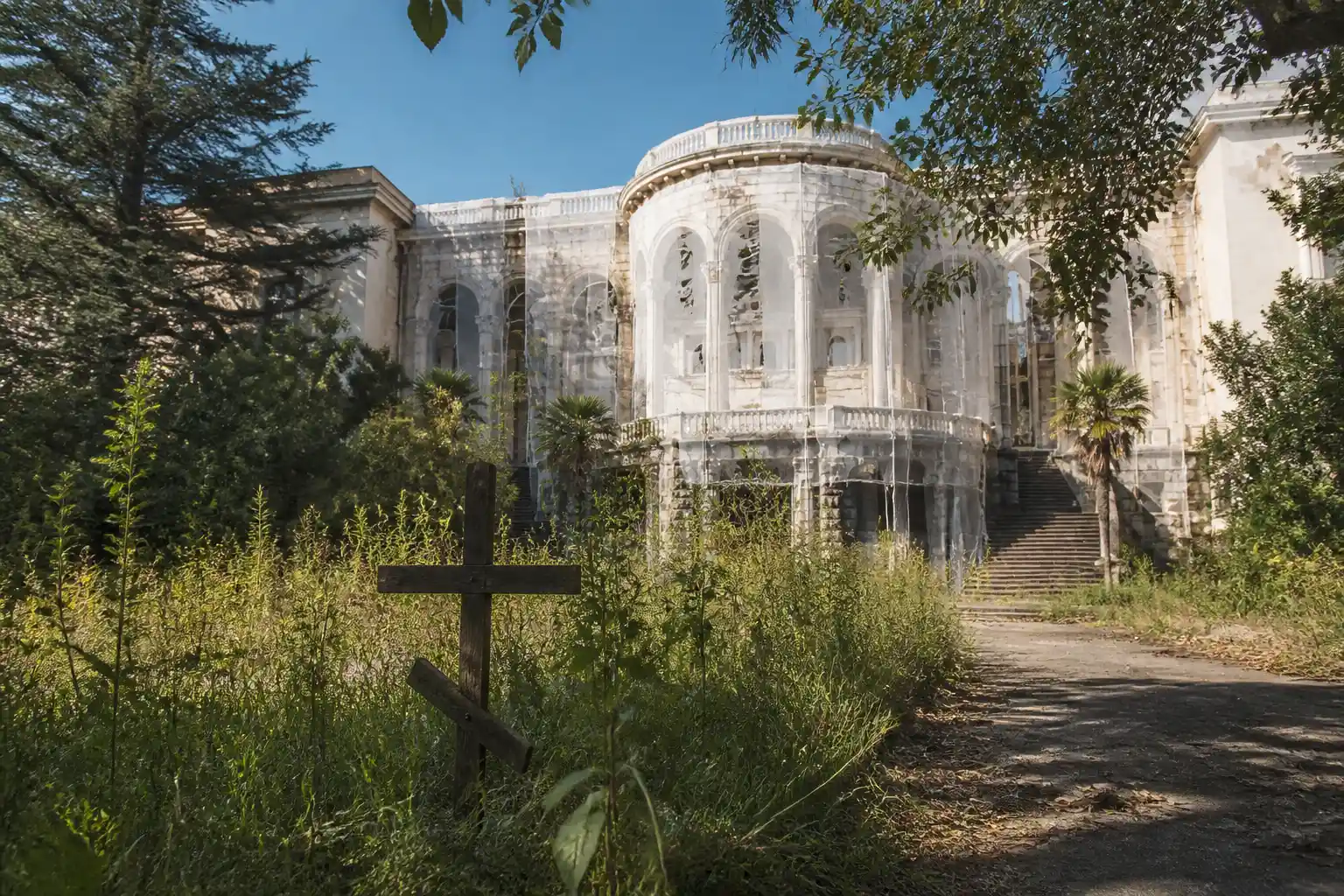
- Sanatorium Tbilisi, one of the grandest colonnaded buildings in town, is being rebuilt to reopen under the Marriott brand.
- Buyers of the other auctioned sanatoriums include Georgian consortiums alongside private investors from Egypt and Qatar.
- Officials have pitched the wider rehabilitation, backed by both state and private money, as the mechanism that turns Tskaltubo into a wellness destination again.
Against that backdrop, a 239 square meter plot changing hands for 1 GEL is not a rounding error. It is a state giving away, for free, exactly the kind of asset it is simultaneously trying to sell to the highest bidder next door.
Where Did Tskaltubo’s Displaced Families Go?
Most have been resettled. Georgia’s government has built new cottages and apartment blocks for people who fled Abkhazia during the 1992 and 1993 war, and thousands moved out of the old sanatorium wings over the past decade as part of that program. But independent reporting this year still counted hundreds of families left behind in the same buildings the state is now trying to sell.
Between 9,000 and 12,000 refugees were first given shelter in Tskaltubo’s abandoned hotels and bathhouses after the war, sharing corridors and communal bathrooms in buildings meant for spa guests, not permanent residents. The government’s own account of new cottages built for displaced families describes a resettlement effort that has moved a large share of that population into modern housing.
Eurasianet reported this year that an estimated 477 families remain in the old sanatorium suites, still waiting on the renovation and relocation timeline the state has promised for years. Some of those families live within walking distance of the very plot the church just acquired for a token fee.
Muslim Villages Are Fighting the Same Church in Court
Tskaltubo is not the only place where the Orthodox Church’s land claims have drawn pushback. OC Media has reported that Muslim villages elsewhere in Georgia have organized to resist the church’s attempts to claim land near their communities, arguing the parcels have belonged to residents for generations.
- The Patriarchate maintains that disputed sites sit on historic church ground and belong to the institution by right.
- Village residents, per OC Media’s reporting, say the land is theirs and accuse the church of pressing claims with the state’s backing.
- The US State Department has repeatedly flagged Georgia’s property registration and restitution rules as an unresolved religious freedom concern.
The State Department’s most recent religious freedom report on Georgia, which documents property disputes involving religious minorities, notes that Muslim, Catholic and Jehovah’s Witness communities have all raised complaints about unequal treatment in land and property matters compared with the Orthodox Church.
A New Patriarch Inherits an Old Alliance
The transfer lands at an unsettled moment for the church itself. Patriarch Ilia II, who led Georgia’s Orthodox Church for decades, died in March 2026. The Holy Synod enthroned his successor, Shio III, in May, at what religion reporters have described as a fraught moment for the institution’s future direction.
Georgian Dream, the ruling party, has spent recent years courting that institution’s blessing. In 2024 it floated writing Orthodox Christianity into the constitution as the state religion, an idea meant to cement the alliance. The church itself turned it down.
Declaring Orthodoxy the state religion is connected with a process of mutual subordination, which is unacceptable for the church.
An official representative of the Patriarchate said as much at the time, according to reporting on the proposal. The church has been warmer to other requests, throwing its weight behind Georgian Dream’s foreign influence law and echoing the government’s framing of Western funded groups as a threat to traditional values, a stance the Carnegie Endowment has traced through the church’s growing political role over the past two decades.
Whatever direction that alliance takes next, the paperwork on the Tskaltubo parcel is already moving. The Patriarchate has one month from signing to produce its 1 GEL, one more line in a ledger Transparency International has been keeping since 2002.
Frequently Asked Questions
How much land does the Georgian Orthodox Church own?
No public total exists, but Transparency International Georgia’s tracking of state transfers, tax breaks and low cost sales since 2002 points to the Patriarchate holding far more property than any other religious organization operating in the country.
What is a direct sale under Georgian property law?
It is a legal route that lets state or municipal authorities sell property to one chosen buyer without a competitive auction, usually justified by a promise of future investment. Transparency International Georgia has flagged the mechanism as easy to steer toward preferred recipients, with the Orthodox Church its most frequent beneficiary in Tbilisi’s records.
Who is Patriarch Shio III?
He is the Georgian Orthodox Church’s newly enthroned leader, chosen by the Holy Synod with 22 of 39 votes in May 2026 to succeed Patriarch Ilia II, who died that March after decades in the role. His enthronement came months after Patriarchate officials publicly rejected Georgian Dream’s push to make Orthodoxy the constitutional state religion.
Are religious minorities in Georgia treated the same as the Orthodox Church?
Not under the law. Georgia’s constitution singles out the Orthodox Church for its historic role, a status other registered faiths do not share, and the US State Department’s religious freedom reporting has repeatedly flagged unresolved property and registration disputes involving Muslim, Catholic and Jehovah’s Witness communities.